Archives for category: cooperation

Commodities are things produced for exchange, with a market value,
rather than for their intrinsic use or benefit.
Commodification prioritizes exchange value over use value,
meaning things are valued primarily for their potential to be sold and generate profit,
not for their inherent purpose or usefulness. 
AI Overview

US soldiers kneeling for Putin? Viral red carpet photo triggers backlash…” The Times of India

We’ll never know how many people have watched, mesmerized, the ‘breaking news’ detailing what had happened yesterday in Anchorage.

Otherwise put, we’ll never know how many people have watched exactly nothing.

On the other hand, there are some who know. How many people have already watched and how many continue to watch. The countless interpretations offered by the talking-heads regarding what had happened. Regarding the nothing which had been breaking the news all day yesterday…

What’s going on?

Until not so long ago – until Robert Murdoch has launched the first 24-hours news channel, Sky News, UK 1989 – ‘fresh information’ was provided to the general public mixed up with other ‘things’. TV channels used to air, some of them still do, a carefully choreographed mix of entertainment, sports, movies and news. And news…
TV watchers used to be treated as people. As individual human beings. With various tastes, indeed, but also with a common interest. A common interest in the well being of the place where they happened to live…
The common denominator uniting the audience was, even if never stated in plain language, the understanding that all of them cared for the important things. Country, values, tomorrow…society…

Not any longer.
Nowadays the audience is considered/treated as a herd of consumers.
How many times have you heard “welcome to the show” at the start of a news bulletin?
News bulletin which is meant to keep you riveted to the TV set for long enough so that you’ll be exposed to the commercial messages being ‘trafficked’ by the TV stations…

I argued in the previous post that democracy is a weeding out mechanism.
That in a functional democracy the informed citizen will, eventually, weed out inefficient politicians. Those who had allowed themselves to become ‘corrupted’. Not necessarily in the direct sense, as in taking bribes and all that. Political corruption takes many forms, all of them drastically diminishing the efficiency of government.

The informed citizen…
But what kind of information is currently available?
And, furthermore, who initiates the ordinary TV watcher in the fine art of watching the news?
Remember, in this context, that the ‘ordinary TV watcher’ is considered to be a ‘consumer’, no longer a ‘concerned citizen’.

And who are the people who know exactly how many viewers have watched yesterday’s news bulletins? And today’s interpretations of what had happened yesterday?
The ‘media watchers’, of course. Those who measure the audience for the sole purpose of extracting as much money from selling commercials as possible…


All of a person’s behaviors and emotions
serve the purpose of moving them closer to their goal
—which arises from the individual’s feelings of inferiority
and the desire to become perfect.

Alfred Adler

I am, first and foremost, an engineer.
‘Down to earth’ used to be my middle name.

Until I started to notice things. And to ask questions…
At first, under communist rule, I worked blue-ish collared jobs. Despite – or because?!? – holding an MSc in Mechanical Engineering. For me, ‘industry’ had a very clear meaning. And involved getting your hands dirty.
After the regime change, I also changed tack. My hands were still dirty but with a difference.
That was when I first got in contact with the ‘banking industry’.
At the time, those two words put together didn’t make much sense to me. But I was too busy making money…
Now, half a life later, things are falling into place.

‘Industry’ is the where things actually happen. Banking, hospitality, ‘heavy’, transportation, mining, garment, you name it! The point being that ‘industry’ is an actual place. A factory, an office, the open sea, a rolling meadow or a ‘dust bowl’, industry needs an actual place for the people involved to do their thing. Solving other people’s problems and meeting their needs.

Why? Why do we do it? Toil?!?
Because we cannot escape ‘economy’. A virtual space we inhabit, which conditions us to be efficient. Money-wise.

Where?
Inside ‘politics’!

– But you just said that ‘actual things take place inside industry’…

Yep. Actual things do take place inside industry and the interaction between industry and economy takes place inside ‘politics’.

You see, we’ve lived – for a very long time, at least three millennia – in a virtual world.
Vir is a latin word. Has a lot of meanings, ‘hero’ amongst them. ‘Virtual’ means ‘made, on purpose, by a hero’. By us, actually.
People who pretend to be civilized live in a world of their own doing. Knowingly and purposely.
A world carved according to those people’s wishes. Maybe not exactly but at least tentatively.

How did they pull this stunt? Built their own world? As close to their wishes as humanly possible?
Industriously, economically and driven by politics.


 “You have got to be kidding me.”
Hillary Clinton

In nature, change happens. It is produced by chance. According to rules but only when chance starts it. No one plans it, if you leave God out of the picture.
And, evolutionary wise, change ‘remains’ if it doesn’t bother too much. If the individual things/organisms affected by change are able to survive.
Please note that if ‘dramatic’ enough, change may ‘alter’ everything. A star changes constantly but at some point it will become a nova. Or even a supernova. Which event will change everything around it…

In a social setting, things are a tad more complicated.
Change, social change, is initiated. By individuals. Not necessarily according to a plan and almost always ignoring the end results. But it is always initiated by somebody.
And is allowed to stay. Or not…
By those experiencing the consequences. According to what they make of it.
Again, even in the social setting there are rules. Just as in nature. But while the natural rules are enforced by nature itself, the social rules need to be enforced. By people. By those who end up experiencing the consequences of the afore mentioned rules being enforced properly. Or not…

What am I babbling about?

You’re not comfortable with a bragging pussy-grabber signing presidential orders in the Oval Office?
How comfortable were you when Clinton got away with “I did not have sexual relations with that woman!
You’re not comfortable when ‘US national-security leaders’ establish a private group on a social network to share sensitive data?
How comfortable were you when a Secretary of State had established a private e-mail server to handle official messages? And got away with it…

Do I need to continue?

“All governments suffer a recurring problem:
Power attracts pathological personalities.
It is not that power corrupts but that it is magnetic to the corruptible.”

Frank Herbert, Chapterhouse:Dune

How can Orson Scott Card be so bigoted, but the Ender’s Game series is about empathy and acceptance of others?

– “Circle of Empathy. If you’re inside the circle, you are worthy of empathy and it applies to you. If you’re outside the circle, you are not worthy of empathy and bigotry towards you doesn’t count because you don’t count. If you’re ever baffled by how one person can be forgiving and accepting towards one group and turn around and be rabid dogs towards another group it’s because in their emotional calculus the second group literally doesn’t count as “deserving”.
Does it make sense? No. Do humans make sense? No.
“”

Card was young when he wrote Ender’s Game and for what it’s worth I think it reflected his real views on the world at the time. He’s since spent decades of his life in a high control cult that has told him constantly that gay people are moral failures.
I think there’s a chance that Card is actually closeted from remarks he’s made on the subject and fear of discovery has made him feel he has to be even more dogmatic on the matter.
I grew up queer in fundamentalist churches. I’m always going to think of people like this as partial victims, even if it would be easier to just hate them. Brainwashing is real. It’s not just something you shrug off because you’re an adult.
I love his Ender series and think it’s beautiful. It doesn’t actually matter to me what he personally believes because his work is saying something else.

Discussion found on Reddit:
https://www.reddit.com/r/books/comments/14mmmu0how_can_orson_scott_card_be_so_bigotted_but_the/?rdt=42921

Alive in a living context.

Try to imagine a single living organism.
Forget about ‘where did it came from’. Forget about ‘what does it drink/eat/breathe’.
Now, does the existence of a single living organism mean that life is present? When attempting to answer this, pretend no observer is present…

‘Life’ is ‘wide’ word. It covers a lot.
From ‘life’ as a phenomenon. That thing studied by biology.
To ‘life’ as an ‘individual experience’. That thing cared for by medicine. Human, veterinary… By the way, how do you call a person who takes care of sick plants?

Am I making any sense here?

My point being that life is both a phenomenon and an experience.
As a phenomenon, life – as we know it – needs a certain environment. And a ‘push to start’.
According to what we presently know, life may appear, on it’s own, in certain conditions. We don’t know, yet, which are those exact conditions. Nor exactly how it happened. Only that it seems possible. And that’s enough for me.
If certain conditions are met, life – as a phenomenon – is possible.

Furthermore, if life as a phenomenon has established itself in a certain environment, life as an experience becomes certain. Each individual organism living in that environment experiences its own life. Regardless of whether a particular organism is aware of its being alive or not.

Shared Awareness

Life, as a phenomenon, is a ‘process’.

Individual organisms become alive. One way or another but always as a ‘continuation’.
Each generation of individual living organisms live by the same rules as the generation before it. Each ‘child’ generation follows in the footsteps of the ‘parent’ generation. A ‘blue print’, a genetic blue-print, is passed over from generation to generation. OK, let’s pretend we haven’t yet learned about genetic variation…
Each individual organism continues to be alive for as long as:
– It remains ‘functionally whole’. A human can continue to live, at least for a while, without any limbs. But not without its head or heart. Well, you understand what I mean.
– It continues to exchange substances with the environment in which it lives. Which means that the individual organism is the entity controlling which substances get inside and which substances are ejected from its interior. OK, we need to breathe so we inhale microorganisms and pollutants ‘on top’ of the air we need to survive – and some of them make it into our blood-stream – but it’s still our lungs which absorb oxygen, eliminate carbon dioxide from the blood and leave nitrogen alone. I’m sure you get my drift.

This ability of even the most basic/primitive individual organisms to interact with the environment – along the rules inscribed in their genetic inheritance – allows us, conscient observers of the phenomenon, to consider that individual organisms, while alive, display a certain degree of awareness. They behave as if being aware of the difference between oxygen and nitrogen. As being aware of the need to breathe. As being aware of the fact that too much carbon dioxide in your blood is something to be avoided… And so on.

Fast forward from bacteria – individual organisms which are able to extract specific nutrients from a broth to, say, chimpanzee. Who are very picky about food. When there is plenty enough to choose from…
There is a certain commonality between these two very different kind of organisms being able to feed themselves, right? And if we, humans, pretend to be aware of (some of) our our actions… how do we name this ability of our fellow living organisms? Their, our?!?, ability to choose?

Together?

“The greatest consequence of the arising of self-consciousness and self-awareness in the constitution of humanness, is that to the extent that we human beings are self-conscious beings we are aware of what we do, and of the possible consequences of what we do to ourselves and to other human and not human beings. Self-awareness and self-consciousness are manners of relational living that as they are lived constitute a relational grounding for all else that is being lived. The self-conscious person lives his or her living in a manner in which a question such as, “are you aware of what you are doing?” always makes sense. The self-conscious person lives his or her being in self-consciousness as if he or she were distinguishing him or herself as an independent entity, and operates comfortably in that way. Yet, if we seriously want to explain how is it that self-consciousness happens under the circumstances that we cannot distinguish in the experience between what we call perception and illusion, and, therefore, that we cannot make any reference to an independent reality, we cannot but Þnd out that it is not possible to do so if we do not accept that languaging is not a system of symbolic communications about entities assumed to exist independently of our distinguishing them, but it is a manner of living together in a recursive flow of co-ordinations of consensual co-ordinations of doings.”
Humberto Maturana, The origin and conservation of self-consciousness, 2005

According to Maturana, self-consciousness is somebody’s ability to observe themselves ‘in the act’. To observe themselves observing. Ability developed alongside other self-conscious ‘agents’ through the use of language.
“It is not possible to understand the nature of self-consciousness without understanding the operation of human beings as living systems that exist as emotional languaging living systems: self-consciousness is a manner of living.” Op. cit.

The way I see it, consciousness – self-awareness in Maturana’s terms – is life 2.0.

Just as there are life as a phenomenon and life as an individual experience, there are also human consciousness – a shared ability – and individual conscience.
Just as there’s no way in which a single living organism might appear ex nihilo – unless some ‘outside agent’ introduces it, there’s no way in which anybody might become aware of their own self by themself.
Life – the phenomenon, once established – opens up a huge field of opportunity. Mere chemicals, entangled, ‘cooperate’ towards maintaining the life of the individual organism inside which they happen to ‘cooperate’. Evolution, the process, makes it possible for new forms of life to appear as the environment is shaped by the formerly living organisms. Or by other naturally occurring phenomena.
Consciousness, our shared ability, opens up the next level of opportunity. The opportunity for each of us, individual self-aware agents, to show/prove our ‘true nature’.

Individually as well as collectively.

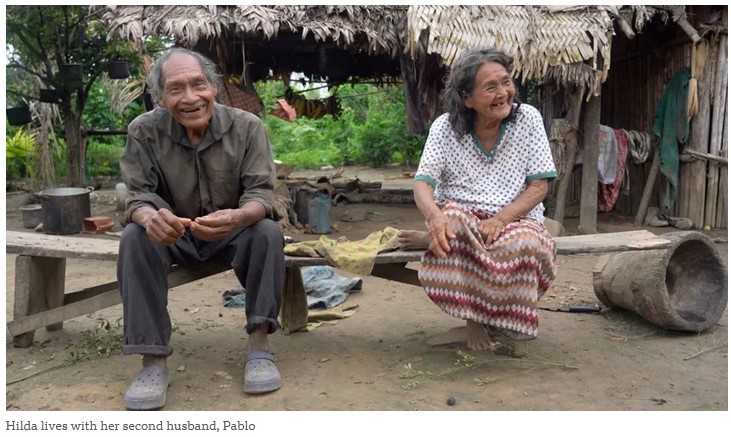
“According to their records, Hilda is 81,
but she says recently her family killed a pig to celebrate
her “100th birthday or something like that”.”
“Many Tsimanes never reach old age, though.
When the study began,
their average life expectancy was barely 45 years – now it’s risen to 50.
“But for Hilda, old age is not something to be taken too seriously.
“I’m not afraid of dying,” she tells us with a laugh,
“because they’re going to bury me and I’m going to stay there… very still.””

Big Bang 1.0 had been inconspicuous. There was nothing there to vibrate so sound could not travel. Also, there was no space so light had nowhere to travel to. On top of everything else, there was nobody there/then to notice.
What am I talking about? There even weren’t any ‘there’ nor ‘then’ at ‘that moment’…

Not for us, anyway!
Hence ‘Big Bang’ is a rather blatant misnomer.

Big Bang 2.0, the currently unfolding one, is an increasingly flashier event.
It began when we have started to talk. And developed conscience as a consequence. According to Humberto Maturana.

The first thing our ancestors had discovered was that they were heavily dependent.
On each other and on what we currently call ‘nature’.
Not having any of what we consider to be ‘scientific knowledge’ they didn’t know much about how things worked.
But they learned, slowly, to use fire.
How to make tools. And how to improve their dwellings.
All these things – fire, tools and protection from the elements – were auspicious circumstances for the first qualitative transformation of the genus. Not only our direct ancestors – Homo Sapiens – but also their cousins – Homo Neanderthalensis – had started to consider ‘the future’.

‘What is going to happen to me/us?’

This question, ‘am I going to eat this much/tasty again?’, demands three things.
A full belly, some time off and a (proto)conscience. At least some self awareness.
The fact that our ancestors, both the Sapiens and the Neanderthalensis, buried their dead and used tools to build/carve ‘jewelry’ strongly suggests that both of them did have a certain awareness/preoccupation about their own condition.

We don’t know whether they were ‘religious’ people.
What we do know is what people very close to what was going on then were doing until recently. And some continue to do. Populations which until have been ‘discovered’ were living like our ancestors used to do. They used to thank their totems for the food they hunted. And they erected ‘altars’ to celebrate the movements of the Sun.
Which strongly suggests that ‘what am I going to eat tomorrow?’ was far more important to them than ‘how much longer am I going to live?’.

The way I see it – following Maslow’s cue – people who live in rather ‘undeveloped’ communities don’t have enough ‘time’ to think about ‘death’.
They are accustomed to it – death is a lot more present in their life than it is in ours – and they still haven’t solved the ‘basic needs’. Not to the tune of reaching the ‘re-actualization’ stage.
They do think about tomorrow but they do it in far more practical terms than we do it.

They are not afraid of death as they are of dying of hunger. Painfully. Or both.

It was us, the ‘civilized’ people, who have become afraid of dying.
Concerned about ‘redemption’.
Thirsty for ‘meaning’.

Which ‘meaning’ brings me back to where this post has started.
One of the experiments which have convinced Rosenblatt et all to develop the ‘Terror Management Theory’ involved a number of municipal judges. Half were ‘primed’ by making them think about death while the others were left ‘unprimed’. The primed ones had imposed tougher bonding conditions to similar fictional suspects.
The experimenters posited that death was so important to them that thinking of it changed the conclusions they derived from the information available to them. Which is more or less correct.
Yet this experiment suggests something even more interesting. To me, at least.

Death is, besides a biological phenomenon, a cultural construct. An artifact.
And the fact that the judges had to be primed in order to be influenced by ‘death’ is a strong suggestion that they were rather influenced by the artifact than by the biological phenomenon.

We do know that we’re gonna die.
But we don’t constantly think about it. Our mere mortality isn’t a constant presence in our mind.
For it doesn’t make sense. It doesn’t help any. A waste of brain power which brings no real benefit.

What we do think – those of us who have a full belly and enough spare time, only during some of that spare time – is ‘what’s all this fuss about?’

What’s the meaning of all this?
Of all this man-made terror which is creeping on more and more of us…

Observe the abnormal.
The out of ordinary.
That’s how you might figure out the regular…

Psychology 101

We live on faith.

Without faith, one cannot even raise from their bed in the morning…
‘What’s the use?’

Animals start looking for food whenever hungry.
Human beings, for as long as they remain conscious, check whether there’s any chance of finding food before attempting to find it.

Faith in what?

Living organisms are made of matter.
Atoms and molecules stacked in a certain order and interacting according to certain rules. Rules being preserved, managed and passed over from generation to generation as ‘genes’.
Individual organisms have very little influence about the whole process, except for some ‘checks and balances’. Which checks and balances work according to some rules also contained in the genes.
Species, generations and generations of individual organisms, evolve. The genetic information passed over from generation to generation becomes slightly altered as evolution forces it to fit the changes in the environment.
According to Ernst Mayr, evolution is about the demise of the unfit. Individuals need to be able to survive in the environment where they happen to have been born. If the genetic information inherited from the parents is suitable for that environment, the individual has a fighting chance. To live and to pass over the genetic information which made survival possible.
The nature of life – the existence of successive generations and the mechanisms which pass genetic information from one generation to the next one – makes it so that genetic information may be slightly altered when copied into the new organism. The alterations appear haphazardly and ‘survive’ only if they don’t jeopardize the existence of the individual organism harboring them. If the organism survives for long enough, the alteration is passed over to the new generation. If the alteration happens to be beneficial for the organism in the context of circumstances where it needs to survive, that alteration has increased the chances of survival for the organism. And its own chances to be passed over to the next generation. Please note that no agency is involved in this process. Nobody and nothing but happenstance has anything to do with what’s going on here!

Conscious organisms are made of animals plus conscience.
You need a living organism in order to have a functional conscience.
Which conscience is nothing but a set of rules learned from the other members of the ‘species’ to which the individual belongs. In fact, conscience – individually speaking, is nothing but a set of ‘cultural’ genes.
Lumps of information passed on from generation to generation which allow us to actively interact amongst us, people, and between us and the environment where we happen to live.
Each individual conscience is like a ‘cultural’ organism riding on top of a biological one.

The difference between the cultural organism and the biological one being the fact that the cultural organism is aware of itself.
Of its mortal nature!

Being an organism, conscience has only one job. To survive for as long as it can and to pass over the information it has gathered to the next generation.
Just as a biological organism is driven by a ‘vital force’ – named ‘survival instinct’ by those trying to make sense of this whole thing – conscience is driven by hope.

Biological organisms have a symbiotic relationship with their environment. They ingest substances and excrete the consequences of their metabolism. They also notice information and react to it. Individually as well as collectively.
As a consequence, the world we currently live in is the ‘byproduct’ of 3 billion years of countless biological organisms having already lived on this planet. Without this teeming life we wouldn’t be here and the planet would be barren.

Cultural organisms have deepened and accelerated the process.
Not only they have physically transformed the planet but they have also built meaning.

As I mentioned before, consciences need hope in order to survive.
In order to have hope, you need meaning.
Things have to make sense.
Out of sheer necessity, we’ve built explanatory scenarios for what’s going on around us.

Congress shall make no law respecting an establishment of religion,
or prohibiting the free exercise thereof;
or abridging the freedom of speech, or of the press;
or the right of the people peaceably to assemble,
and to petition the Government for a redress of grievances.

Doesn’t make much sense?
Mentioning ‘God’ on money is the first step towards the establishment of an officially sanctioned religion?

Well…

In my previous post I posited that property, the concept, is the stepping stone for social order.
I’ll add to that a simple observation. Whenever too much property gets hoarded by a too small number of people, the community which had allowed that to happen is in great danger.

Same thing here.
We have religion – a social phenomenon – and religions.

We have a certain understanding of the world, shared by the members of a community – which allows the community, as a whole, to behave in a coherent manner. Not that much different from what happens when people use a common language. They can communicate. Same thing happens with people partaking in a religion. They ‘see’ things in a coherent manner. Hence can coordinate their efforts.

And we have religions…
To reach the ‘certain understanding of the world’ I mentioned before, each community had traveled a road. A particular road through the particular circumstances in which each cultural community – currently known as ‘nation’ – had had to build their culture. Their identity.
Some communities had put together certain scenarios to accompany them along this road. To help them make sense of what was happening to them.
Some communities have used more than one scenario during that journey while others use more scenarios simultaneously.

Sociologically speaking, all that matters is social coherence.
All is well as long as the community conserves its ability to function. To survive.
As long as the individuals who compose that community continue to have a common enough understanding of the world in which they live.

For the simple reason that they, we, live in the same world!
And if we, individually or in small ‘gangs’, start behaving as if the world is different for each of us…

The Founding Fathers had a common understanding of the world. They belonged to the same (functional) religion despite belonging to different ‘denominations’. For them, the First Amendment was about reigning in the powers of the Government. They had realized that a Government able to impose a certain religion – a certain scenario – upon the entire community would eventually bring destitution.
The Founding Fathers could not foresee a situation in which a few of us would deny the practical daily realities of this world. Invoking their particular scenario as an argument… As the supreme argument for refusing to see the reality.

The reality as it is.
And as it is seen by a majority of us.

I mentioned earlier that some communities have changed their scenario along their history.
They did it when they have found new meanings. They have seen new things about the reality and they have integrated those new things into their newer scenario.
By changing the scenario they have actually built a new reality.
Societies which have clung to their scenario to the bitter end… are no longer with us.
Societies which have somehow found it in their collective minds to adapt their scenarios to the reality changed by their own efforts continue to survive. To thrive, even.

“Hoarded by a too small number of people” means controlled by a handful of people.
Sometimes coordinated.
As it happens in any dictatorial regime. It doesn’t matter who formally ‘owns’ something if the use of that something is tightly controlled by somebody else.
Furthermore, a certain ideology may end up having a lot of clout without being imposed by an authority. Nevertheless, the fact that an ideology dominates, for a while, makes it so that the community which allows this to happen to experience a dictatorial regime.
For whatever reason, some people were convinced that witches were real. And burned them at the stake.
For whatever reason, a lot of people continue to believe that communism might be a good thing.
For whatever reason, some people continue to believe that they are entitled to determine whether a woman may or may not abort a fetus.

What is the difference between an ideology and a scenario?
The manner in which people relate to it.

Having been told that they were the children of the same God made it possible for the believers to stick together. To act like brothers. To respect each-other. To invent and implement capitalism and democracy. Both relying on trust. On mutual trust and on the freedom of the market. Both the market where goods and services are traded and the public forum. Where ideas are traded…

Being told that only one particular understanding of a certain text/idea/concept is correct some people remove themselves from the ‘general population’. Which ‘general population’ becomes ‘the others’.

‘The others with whom we don’t have anything in common’.

Quite an untenable situation, given the fact that the world is becoming smaller and smaller.

Each of us expects the others to behave rationally.
While each of us rationalizes their own biases.
And considers this to be normal!

Not so long ago – evolutionary speaking, things were free. As in ‘up for grabs’.
Our not so distant forefathers fed and clothed themselves by picking ‘things’ from nature.

By talking to each other they had become conscious human beings.
Then came up with the notion of property.

‘If I/we have this thing, you cannot have it too’.

Using this notion, they introduced some order unto the social stage.
Some things, albeit fewer and fewer, remained free/up for grabs while the rest – specially ‘the things of interest’ had become private.

Entertaining the notion of property means that individuals are able to link an object to its owner.
This link is a piece of information.
Discussing and remembering who owns what, our forefathers realized that information is important. Not only the information regarding the link between owners and their property but also information in general. Whatever ‘useful’ things had been learned, remembered and passed around.
Thus information became ‘a thing’.

The order created by the communities using the concept of property and by actively circulating information among the members had become the premise for those communities to thrive.

Somewhat naturally, the members of those communities had reached the conviction that:
Property is good. And that more property is better.
Old people are precious. For the simple reason that they deposit what had happened. By sharing their memories, old people make it so that the younger ones don’t need to learn again and again.

Since property and remembered information were good for the community, the communities using them developed faster and had a way better survival rate than those who didn’t. For whatever reasons.

Since in reality people rationalize rather than think rationally, they have reached the conclusion that the rich and old people were the ultimate cause for the well being of the community.
The individuals, not the modus operandi of the community.

Imagine a beach.
Where enough of the patrons pick up rocks and throw them into a pile whenever they move around.
Where enough of the patrons throw the trash into the bin instead of leaving it for the employees to do .
Would you feel any better?

You don’t work there?
No, you don’t! But would you feel better?

The world is nothing but change.
Our life is nothing but perception.

Marcus Aurelius.

Killing is the most definitive thing available to man.
To humans in general and to men in particular.

We cannot create life!
We can make love, our wives can give birth but other than that…

Yet we can kill!

You see, most animals feed on other living organisms.
We describe the process as ‘the law of the jungle’ but for them it’s only natural. That’s how they feed. That’s how they get their sustenance.
None of them gives much thought about it. When hungry, they do what they have to do. And then they stop.

We are the ones who get to choose. To kill or not to kill…
We are the ones who, once aware, have introduced thinking into all these.
We are the ones who, through our awareness, have transformed sensation into perception.
We are the ones who, in our attempt to create/maintain congruence – to keep things together, have attached meaning to sensation.

We are the ones who, once we have learned the difference between good and bad, have invented the notion of evil.

We are the ones who, once we have learned the difference between good and bad, have tried to separate them.
To separate what we have perceived as good from what we have perceived as bad. And called it evil…

And now, that we’ve reached the stage where we currently are, we’ve set our minds to determine which had come first.
The egg or the chicken…
The Good or the Bad?!?
Matter or Spirit?

When we’ll grow up, when we will have caught up with Marcus Aurelius, we’ll remember that there’s no clapping with one hand.
That while it may be natural to feed on other animals, there’s no escaping the consequences of our killings.