Archives for category: collective identity

ganditorul

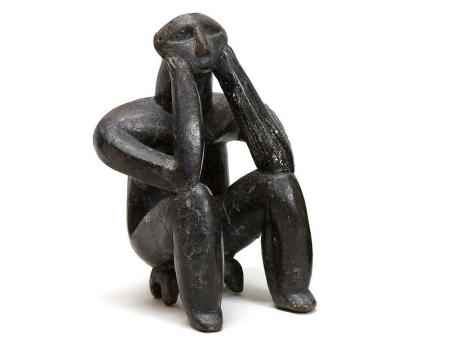
OK, this guy’s stool has four legs… nobody’s perfect…

A few days ago, while talking with a good friend of mine – Lucian Stefanescu, we convened that God has a lot in common with a chair.
Three legged, four legged… take your pick.

Let’s imagine we are part of a thought experiment.
One which allows us to travel through time.

Some ten or twenty thousand years ago, neither ‘God’ nor ‘chair’ existed at all.
The concepts, I mean.

In those times, people were just as able to sit as we are now. And they probably did it. On rocks, on logs…. which ever happened to be around when they felt the need/had the time to rest their feet….
Until somebody had the bright idea of picking up a big enough boulder, carried it to the fire and sat on it. Effectively inventing the very concept of chair.

Same thing goes for God.
I have no way in which to ascertain whether God exists outside our minds or not. Or who of our ancestors had come up with this idea. Or when.
The point being that our faith in Him has been enough for God to produce so many consequences. For our version of God to become real. To shape the very world we’ve built for ourselves.

You see, ten thousand years ago, in pitch black darkness, no one could have stumbled upon a chair while walking through the cave they called home. They could have stumbled upon rocks which happened to exist over there… but not upon any chairs.
Until some of the rocks had been used as such!
Nowadays… it’s not so unusual to trip over a chair. Even in broad daylight. Simply because we’ve build so many of them.

Same thing goes for God.
Ten thousand years ago, we didn’t have the concept yet.
Now, we have to deal with the consequences of us having already ‘killed’ Him.


SPOKEN

According to Britannica.com, language is “a system of conventional spoken, manual, or written symbols by means of which human beings, as members of a social group and participants in its culture, express themselves. The functions of language include communication, the expression of identity, play, imaginative expression, and emotional release.

Since we’re already dealing in conventions, I’m going to ask you to consider this:
How about we redefine language as ‘any manner in which information is transported across space and or time between two entities which have the possibility to interpret, act and or otherwise intervene on/influence the message, the situation described by the message or both at the same time’?

You’ll surely notice that the second definition is more inclusive that the first, of course. And you’ll also notice the differences. Which aren’t that dramatic, after-all…

– ‘Conventional’…
‘Classic’ languages – English, Chinese, French, Urdu, German,  etc., are more the result of ‘natural evolution’ than of any ‘straightforward’ convention… while Esperanto, the most conventional of the spoken languages, didn’t make it too far.
In this sense, the ‘natural’ languages – those which have evolved ‘on their own’, without any intentional intervention from those who use it, are not that far away from the ‘classic’ languages. Birds have ‘vocal’ manners of sending distress and ‘sexual’ signals; monkeys and apes also; even social insects, ants and bees, dispose of an entire array of chemicals, sounds and gestures used to convey freshly gathered information from one individual to another.

– ‘by means of which human beings, as members of a social group and participants in its culture, express themselves’.
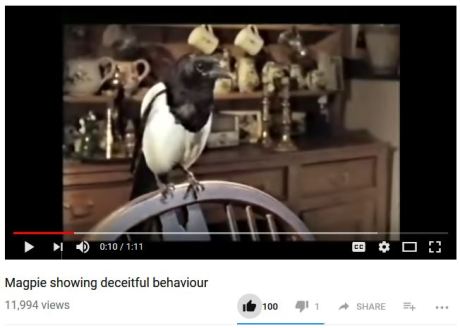
Really? What’s all this brouhaha about ‘expressing one’s self’? A call for help, ‘expressed’ in any way, shape or form, remains a call for help… regardless of the manner in which it has been expressed. Articulated language, Morse code, sign language or a simple sob. Same thing is valid for a warning call. Most of the times, the caller does it ‘instinctively’ and not to gain any ‘social points’ by ‘expressing’ their care for the rest of the ‘cultural community’ ‘conversant’ in the language used to make the call. The magpie in the video above is one of the exceptions, not the rule. Otherwise, the whole signaling ‘industry’ would have been abandoned long ago… due to the very evolutionary forces which have made language what it is today.

Don't cry wolf

– ‘The functions of language include…”
Isn’t this funny?!? ‘The functions of language include…’ How about ‘some of functions we, users of language, have been able to identify are… “.
Or even ‘some of the uses we’ve been able to put language to are …’?

Quite a lot of confusion… isn’t it?

But language was supposed to make things clearer, not muddier… right?

Tell that to those dogs… the ones sent chasing ghosts by the fake distress calls ‘jokingly’ (?!?) emitted by the magpie in the video at the top of my post…

So…

– ‘Spoken’ language.
Or should I call it ‘extemporaneous’? The way I see it, most ‘spoken’ language is uttered on the spur of the moment… or used to be, anyway.
Nowadays, spoken words can be carefully prepared long time in advance… even made to ‘faithfully’ mimic an impromptu message…

– ‘Written’ language.
While ‘spoken’ messages’ have been used, extemporaneously, for a huge amount of time – and not only by humans, as I mentioned earlier, ‘writing’ has been a late invention. Ours.
Or, at least, this is how we like to believe…
The most important characteristic of ‘written’ – as opposed to ‘spoken’, being ‘verba volant, scripta manent’. ‘Spoken words fly away, written words remain’!
The earliest scripts, both cuneiform and hieroglyphic, were used to ‘transport’ information through time. At first, to conserve data rather than what we currently call ‘complex information’. Inventory and ‘identity’ rather than information which may – or even has to, be interpreted in order to make sense. The early cuneiform clay tablets contained ‘cargo manifests’ and only later some of them had been used to ‘conserve’ the Story of Gilgamesh.

– ‘Operational’ language.
Aren’t you tired of that magpie yet?
Have you even watched the video?
Did you notice how the dogs reacted to the fake distress calls? For the umpteenth time, probably…
For the purposes of the present post, it doesn’t matter whether the magpie actively/conscientiously makes fun of the dogs or just acts out of some sort of an instinctive boredom… something akin to the bright spots we sometimes see when ‘confronted’ by a pitch-black environment. It also doesn’t matter whether the dogs are actually fooled every-time they go out to chase the invented fox or they do it because they experience the same kind of boredom like the one which ‘fuels’ the magpie.
For me, all that counts is the consistent manner in which the target reacts to the message transported through the use of this particular kind of language. It is this kind of consistency which determines the ‘operational’ nature of certain languages.

And now, let’s get to the ‘fun’ part.

The calls emitted by the magpie can be construed as being ‘spoken’, right?
They are of a ‘vocal’ nature, are fleeing by definition – unless someone records them using some artificial devices… yet they are also ‘operational’… since the dogs faithfully execute what they are ‘told’ to do…
Now, if we think of it, most natural languages are ‘operational’ indeed.
Ants and bees use them to direct ‘practical’ action, not to ‘express themselves’…
Calls used by most animals relate to avoiding danger, signaling food or ‘expressing’ sexual ‘desire’… and have little or no connection with anything else.
In this respect, the magpie is an exception, not the rule. And even here, the message is ‘formulated’ ‘operationally’. Simply because magpies don’t ‘know’ any other kinds (uses) of language.

We, humans, have bucked the trend only in the sense that we’ve developed kinds of languages lax enough to allow ‘thinking’.

I’m sure that all of you have noticed that when considering the pros and the cons to something you think using a language, right?
A language ‘lax’ enough to accommodate ‘what if’!

Something which doesn’t ‘fit’ in the ‘language’ used by most nursing babies to ask for more milk…

Basically, ‘doing business’ means obtaining sustenance by being useful to other people.
As opposed to hunting/picking/growing your own food, building your own shelter and using pelts to cover your back.

‘Doing business’ obviously implies trading. Raw materials are being transformed to fit the needs of the intended customers, transported to where they are needed and offered to those who might buy them.

For this process to take place, ‘business’ needs far more than entrepreneurs, customers raw material and workforce.

It needs a suitable environment.

It needs roads, markets – not only ‘stable’ but also safe, and – maybe the most important thing, it needs the right kind of ‘popular sentiment’.
For business to work as intended, people need to have faith in each-other.

Yep, faith!

Who would eat in a restaurant without trusting that the cook hadn’t spit in the soup?
Who would buy a car to drive their children to school without actually believing that the car had been built as it should have been?
Who would even drive on a two way road without believing that the drivers going in the opposite direction will stay on their side of the road?

And do you really think that German farmers of yore – who had enjoyed a relative safety while working their own land, living at the bosom of an extended family and being personally acquainted with all the members of the community,  would have gladly come to the ‘unknown’ city to become industrial workers  during Bismark’s ‘reign’ without the ‘safety net’ extended by the Chancellor?

Taxes are the manner in which we pay for all these.
But they are much more than this.
The willingness of the people to pay taxes means that they have faith that the money will be well spent. That they have faith that those in charge will spend the money wisely and that, in the end, those in charge will be held accountable.

Whenever any of the parties involved in this deal – or both at the same time, no longer trusts the other to do its part of the deal – or tries to use their position to access undue benefits… things go south. Way south.

Just as it happens in any other deal.

The state of being calm and not easily worried or excited.

Many human beings praise themselves for being able to ignore emotion when trying to make decisions. And the more important a decision is, the harder they try to ignore their own feelings about the matter.

People with antisocial personality disorder (ASPD) can be witty, charming, and fun to be around — but they also lie and exploit others. ASPD makes people uncaring. Someone with the disorder may act rashly, destructively, and unsafely without feeling guilty when their actions hurt other people.

Modern diagnostic systems consider ASPD to include two related but not identical conditions: A “psychopath” is someone whose hurtful actions toward others tend to reflect calculation, manipulation and cunning; they also tend not to feel emotion and mimic (rather than experience) empathy for others. They can be deceptively charismatic and charming. By contrast, “sociopaths” are somewhat more able to form attachments to others but still disregard social rules; they tend to be more impulsive, haphazard, and easily agitated than people with psychopathy. ASPD is uncommon, affecting just 0.6% of the population.

Am I the only one here baffled by how little free space is left between these two definitions? By how little leeway we have between the constant pressure to ‘act rationally’ and becoming a ASPD patient?

On a more practical level – now that I’ve noticed this, I’m even more baffled by our duplicity. As a species, I mean.
‘Concerned Citizens’ insist that ‘conflict of interests’ should be avoided at ‘all costs’ – lest it generates even higher ones, while some ‘thinkers’ consider that it is possible for humans to actually put aside their personal feelings.

Daniel Kahneman, among others, has done a brilliant job in describing many of the intricate ways of our thinking processes. Which are nothing but continuous tugs of war between emotional pulsions more or less kept in check by rational processes.
Basically, most of those concerned with human decision making have reached the conclusion that we’re not rational thinkers but rationalizing agents.

Hence my ‘nagging question’:

What keeps a cool-headed rationalizing agent from becoming a ASPD patient?
Specially given the constant social pressure towards ‘coolheadedness’…

OK, some people are better at rationalizing than others… but that would tend to help them at remaining undetected rather than not becoming affected…
Frans de Waals – again, among others, posits that, ‘statistically’,  altruism/empathy is an inbred feature of many animals, all primates included. Given this concept, ASPD would be rather simply explained as an ‘organic’ deficiency. Due to a ‘wiring error’, those affected by ASPD display less ‘phenotypically’ expressed altruism/empathy than the ‘average’ members of the society.

Bingo!

phenotype. (fē′nə-tīp′) n. The observable physical or biochemical characteristics of an organism, as determined by both genetic makeup and environmental influences. The expression of a specific trait, such as stature or blood type, based on genetic and environmental influences.

It seems that ‘what you get’ is not solely determined by the genetic information inherited from the parents but also by the specific environment in which the given genetic information gets to express itself.

For the rest of the living realm, things are relatively simple. Lady Luck is the sole ‘director’ in these matters. A really lucky organism gets to spend its life in a more suited environment than a less lucky one.

For humans… things are a tad more complicated.
Besides the fact that each of us enjoys a relative autonomy – some call it freedom of will, we also contribute enormously to the environment in which we get to live. And no, I don’t want to talk about pollution or man-made global heating.

The thing I have in mind right now is usually called ‘culture’.

Daniel Kahneman, Thinking Fast and Slow, 2013
Frans de Waal, The Bonobo and the Atheist, 2014


What do we want?

Money.

When do we want it?

Now.

How do we get it?

By being efficient.
‘Give as little as you possibly can while taking as much as you can possibly grab.’

And who’s going to get the job done?

Huh?!?

Capisci?

Huh?!?

thinking

We’re not the only ones able to use tools to solve problems.
We’re not the only ones capable of self-awareness. Otherwise said, to recognize ourselves in a mirror.
We’re not even the only ones able to use language to dampen our feelings for long enough so that the frontal cortex might take over from the amygdala.

So?

But what does it mean to be human?

What if being human means being able to do all those three things, simultaneously?

Well, I’m not so sure I’d be comfortable with that…

‘Dampen our feelings for long enough so that the frontal cortex might take over from the amygdala’.

A key difference between a psychopath and a sociopath is whether he has a conscience, the little voice inside that lets us know when we’re doing something wrong, says L. Michael Tompkins, EdD. He’s a psychologist at the Sacramento County Mental Health Treatment Center.

A psychopath doesn’t have a conscience. If he lies to you so he can steal your money, he won’t feel any moral qualms, though he may pretend to. He may observe others and then act the way they do so he’s not “found out,” Tompkins says.

A sociopath typically has a conscience, but it’s weak. He may know that taking your money is wrong, and he might feel some guilt or remorse, but that won’t stop his behavior.

Both lack empathy, the ability to stand in someone else’s shoes and understand how they feel. But a psychopath has less regard for others, says Aaron Kipnis, PhD, author of The Midas Complex. Someone with this personality type sees others as objects he can use for his own benefit.

Oops!

So one of the very things which make us human might also explain why some of us become psycho/sociopaths?

No, not only one. All three of them.

For a psycho/sociopath to become manifest, one has to behave like one. To act like one. To make the difference between their own persona and the rest – self-awareness, and then to use tools to defend/enhance what makes their own persona so special. Regardless of whatever consequences those actions might impose upon any second or third party.

Then how come we have survived for so long?
As a species?

According to Ernst Mayr – ‘evolution is not about ‘survival of the best’ but about the demise of the unfit’, whatever psycho/sociopathy has plagued us wasn’t enough to kill us.
What kept it in check?
We might have a natural propensity for doing the right thing but… bad things still happen… the mechanism which ‘tames’ us has to be a dynamic one… Does the job in an at least satisfactory manner – we’re still here, it has successfully adapted to whatever historical changes had fallen upon our head – again, we’re still here, but is not fail proof. From time to time, evil explodes into the world.

We’ve somehow coped with these ‘explosions’. For now, at least.

Basically, any future strategy for survival might imply one of the next two scenarios.

Put our faith in God. Who had created us. And who’ll lead us out of whatever predicament we might get in. Even if/when we do it to ourselves. Simply because he is our loving father.

Remember that when we had really pissed him off, he had preferred to cleanse the entire (known) world with water. And learn to reign in our own ability to do the wrong thing.

And, maybe, our distance nephews will consider that being human means being able to innovate AND to knowingly keep that ability in check.

Natural‘, ‘Artificial‘ and ‘Synthetic‘.

In my last post, I was arguing that rules are made by us, humans.
In an attempt to make some sense of the seemingly chaotic environment in and of which we’ve become aware at some point in our evolution.

So.

The ‘natural‘ rules are those which have only been ‘identified’ by us.

‘Two swords don’t fit, simultaneously, in the same scabbard’.
‘Light travels in a straight line’.
‘There’s no smoke without a fire’.
‘Magnets either attract or reject other magnets’.
‘For as long as the temperature of a gas contained in an enclosure remains constant, the product obtained by multiplying the volume of the gas by the pressure exercised by that gas on the walls of the enclosure does not change’ – Boyle’s Law.
‘Things fall down, unless…’
‘Two objects attract each-other with a force directly proportional with the added masses of the two objects and inversely proportional with the distance between the geometric centers of the same objects’. Newton.
‘The principle of mass conservation’.
‘E=M*C2’
I’ll come back later.
For the moment, I’ll just observe that ‘natural’ laws are, simply put, an enumeration of what we consider to have understood of what’s going on around us. Our take on the natural world.

Artificial‘ rules are decisions we had to make in order to improve our chances of survival. Decisions we had been forced to make at one point and which made so much sense that they had been perpetuated. Habits we’ve somehow acquired and which had proven themselves so useful that we impose them on our beloved children.
‘Drive on one side only’.
‘Wash your hands before dinner’.
‘Thou shalt not kill…’

Synthetic‘ rules are those we’ve made ‘out of the blue’.
How to play backgammon, for instance.
How to evaluate a moving picture… or an evening dress.


Things interact according to their nature.
Mass generates gravitational pull, electric charge produces electrostatic forces, a moving electric charge gives birth to a magnetic field… hydrogen is ‘infatuated’ with chlorine, white phosphorus is so keen to combine itself with oxygen that it actually behaves indecently if not ‘modestly’ hidden in water… sex is the driving force which sets the animal world in motion… while survival instinct, however powerful, is, sometimes, overcome by altruism.

Meanwhile rules are just a figment of human awareness interacting with observable interaction between things.

And no, the ‘simple’ ability to learn is not sufficient, by itself, to generate rules. The rats in Rat Park were quick to figure out how to get a ‘fix’ of morphine but that didn’t mean they had ‘discovered’ any rule…
For that to happen, the ‘ruler’ needs to be able to watch from ‘above’. From ‘outside’ the interaction.

And this is why we find it easier to study other persons. Preferably strangers. ‘The doctor who treats himself has a fool for a patient’. Simply because our ability to watch ourselves from outside – and to compartmentalize knowledge, is real but severely limited.

Yet, limited as it is, it’s powerful enough to help us generate rules.


Nature.

‘Resources’ to structures to meaning.

Man.

Opportunities to structures to comprehension.

Society.

Pre-existing conditions to structures to culture (survival)

A knife can be used for buttering toast, slicing steak and, occasionally, for slitting  throats.
A gun can be used to hunt dinner, defend a homestead or shoot a rival.
Bare hands can knot laces, caress a woman or choke the life out of an innocent.

What makes us, humans, sometimes transform tools into weapons?

We are astonished when we learn about other animals being able to make and use tools.
Which is good. ‘Astonished’ is the opposite of ‘insensitive’. A.k.a. ‘brain dead’.

How about we, humans, learning from the rest of the animals how to solve whatever issues we have amongst us without  killing each-other?
You are aware that humans and chimpanzees are the only animals who systematically murder adult members of their own species, right?

But what instance is powerful enough to transform tool into weapon?

Human consciousness?

Is this a ‘fatality’?
The simple fact that each of us is consciously aware of the differences between ‘I’ and ‘all the rest’ means that whenever ‘survival instincts’ kick in our humanity necessarily vanishes? Entirely?
And ‘love thy neighbour as thyself’ becomes ‘dog eats dog’?

We would have already been dead by now… all of us…
Our ancestors must have discovered a way to balance our propensity to ‘stick with your own kind’ with with our need to learn new things and meet new people!
Or is it that some of us continually come up with fresh reasons for ‘war’ while we, the rest, are too lazy to do anything about it? Despite everything history has ever taught us…