Archives for category: collective identity

We all know about it.
To the tune that none of us cares
anymore about what the rest of us think about it.

We’ve conditioned ourself to use a single perspective.
To measure with a single yard-stick.
To have but a single goal…


We have not yet been able to replace the founding illusion
The naturally born idol.
Our image of God…

Our hunting-gathering ancestors have become conscious, learned to speak, invented crafts. And painted numerous caves.
Life was nice in those days. A few hours spend foraging then you could do whatever you fancied. No point in gathering more food – it would have spoiled – and no point in making more tools than you could carry with you. So… lay back and enjoy.
The only problem with this was the fact that those people lived in a state of an extreme precarity. No provision could be made for tomorrow. Nobody ever knew what they were going to eat, if anything, the next day!

Hence they jumped at the first chance of agriculture. A far safer approach.

The problem with agriculture was that it had brought three things with it.

People were divided in three. Rulers, free people – men, usually and slaves.
It was far cheaper, and way more efficient, to use slaves instead of hiring free-people. They were spared for trading, fighting and other occupations which needed self esteem and a lot more personal autonomy than tilling.

Agriculture also brought about the need for protection. For an army.
Stashed produce, saved to be used during the entire year and sometimes beyond that, was liable to tempt some of the neighbors. Those who preferred to steal something rather than work for it.
The ‘protection force’ also came in handy when the slaves tried to leave their posts.

The third ‘thing’ was philosophy.
The society had enough spare resources to allow a few of its members to spend their time thinking. Instead of performing ‘menial’ tasks.

These thinkers have started to notice.
And continue to do so.
For as long as the thinkers concentrated their efforts towards the well being of the community and the community paid attention, things went well. Each generation fared better, on average and statistically speaking, than the previous ones.
Whenever things went astray – the thinkers started to ‘hallucinate’, the ‘public’ no long cared and/or both, things went the other way.

Until some 50 years ago, things were going in the right direction.
People were increasingly freer and fared increasingly better.
Since some 15 years before the communism had collapsed, things has started to sputter.

Stay tuned.

Living organisms constantly exchange information with their environment.

Then where is the difference between ‘us’ and the rest of the living creatures?
Information-wise, of course!

Language…

As far as we know, humans are the only critters currently living on Earth which are interested in how other creatures learn. Or teach…

“An individual actor A can be said to teach if it modifies its behavior only in the presence of a naive observer, B, at some cost or at least without obtaining an immediate benefit for itself. A’ behavior thereby encourages or punishes B’s behavior, or provide B with experience, or sets an example for B. As a result, B acquires knowledge or learns a skill earlier in life or more rapidly or efficiently that might otherwise do, or that it would not learn at all.” Caro and Hauser, 1992

In the 20 odd years since Caro and Hauser have set the bar for what teaching means quite a number of species have been found to do it. To fully or at least suggestively cross all the necessary t-s. From ants to primates.

Interestingly enough, all of those species have a clear ‘collective’ behavior.
All individuals belonging to a species collaborate, of sorts, towards the survival of that species. This goes without saying.
But in some species this collaboration is more intense than in others.
Ants and bees versus most other insects.
Elephants versus cheetahs. Or leopards.
Even chimpanzees versus orangutans…

OK, for some species hand to hand collaboration between generations is impossible. Most parent insects are dead when their offspring hatch. Orangutans live in forests where food is too scarce for more than 1 individual to forage.
Others have found their niches. Where the individual approach is good enough for them to survive. Cheetahs, leopards. Bears, even…

Charles Darwin taught us about evolution. Merging individual lives into the survival of the species those individuals belong to.

Life, as I see it from a “functional and mechanistic perspective“, is yet another manner in which matter is organized. Yet another ‘state of matter‘.
For life to be present, three conditions have to be met.
– Individual organisms have to be exchanging, in a controlled manner, substances with their environment. To ingest nutrients and to excrete the by-products of their metabolism.
– Individual organisms have to be exchanging information with their environment. And with their interior. Otherwise the exchange of substances would no longer be controlled by the individuals.
– Individual organisms have be passing to the next generation the pertinent information needed for the species to survive. In the kind of life we are familiar with, that would be ‘the genetic information’.

Considering the above, I dare to make a difference between what Caro and Hauser consider to be teaching and what we, humans, do.
Intent!

I doubt that any of the ‘animal teachers’ do it under their own volition.
After all, nobody has yet identified an animal con-artist who cons the members of their own species… as we do!
As far as we currently know, ‘teaching behavior’ is displayed inside species which collaborate more closely than other species. Which suggests that that kind of behavior is somehow innate to those species. A ‘habit’, not a choice. As it is with us.

What makes it possible? This difference?
Our special kind of conscience and our use of language.
The fact that we are the only species – as far as we know – capable of building a ‘virtual image’ of the surrounding reality. Capable to select certain aspects of what surrounds us and codify them using various forms of ‘notation’.
And to do this according to our own, individual, interests!
Sometimes even against the interests of the community/species to which we belong.

The words of Abraham Lincoln to honour the soldiers that sacrificed their lives in order
“that government of the people, by the people, for the people,

shall not perish from the earth”
were spoken at Gettysburg,
but these words apply as well to the countless soldiers
that died for the cause of democracy in the following 150 years.

How about people respecting each-other?

After all, government is supposed to be by the people and for the people…

Those serving in the government come from among the same people, don’t they?

 “You have got to be kidding me.”
Hillary Clinton

In nature, change happens. It is produced by chance. According to rules but only when chance starts it. No one plans it, if you leave God out of the picture.
And, evolutionary wise, change ‘remains’ if it doesn’t bother too much. If the individual things/organisms affected by change are able to survive.
Please note that if ‘dramatic’ enough, change may ‘alter’ everything. A star changes constantly but at some point it will become a nova. Or even a supernova. Which event will change everything around it…

In a social setting, things are a tad more complicated.
Change, social change, is initiated. By individuals. Not necessarily according to a plan and almost always ignoring the end results. But it is always initiated by somebody.
And is allowed to stay. Or not…
By those experiencing the consequences. According to what they make of it.
Again, even in the social setting there are rules. Just as in nature. But while the natural rules are enforced by nature itself, the social rules need to be enforced. By people. By those who end up experiencing the consequences of the afore mentioned rules being enforced properly. Or not…

What am I babbling about?

You’re not comfortable with a bragging pussy-grabber signing presidential orders in the Oval Office?
How comfortable were you when Clinton got away with “I did not have sexual relations with that woman!“
You’re not comfortable when ‘US national-security leaders’ establish a private group on a social network to share sensitive data?
How comfortable were you when a Secretary of State had established a private e-mail server to handle official messages? And got away with it…

Do I need to continue?

What would the world do if…?

Which of the worlds are we talking about here?

Recent developments have helped me to understand something.
And no, not the fact that there are more worlds out there. One happy about what’s going on, one horrified and a few rather indifferent.

Trump being elected for a second term as President of the United States hasn’t changed much in the real world. Not yet, anyway.
What it had changed, dramatically, was our image of the world. Of the US, in particular, but also of the world as a whole.

This development has helped me to understand that we don’t deal in realities.
We don’t consider things, make decisions, by examining the things themselves. No!

We consider things by examining the images we have in our minds.

We look at things and we get a ‘set of data’. A virtual image.
We recollect from our memory whatever other information we have on the subject. Another image.
We put two and two together. And we reach a conclusion.
Most of the time ignoring the fact that we’ve been dealing with images instead of the real thing.

Until we are forced to acknowledge that our image was incomplete. Inaccurate…
Or that, simply, we’ve chosen to see what was more comfortable for us!

Etiquette is a matter of social interaction.
A mannerism used to convey ‘we are in sync’. ‘We see eye to eye’ on most matters that count.

In this picture, one of the two men are dressed ‘inappropriately’. According to the ‘normal’ etiquette.

This is ‘posturing’.
That choice of attire – in flagrant breach of ‘comme il faut’ – is a constant reminder to the rest of the world that he, and his country, are not ‘normal’. Like the rest of us still are. For now…

We can accept his ‘look’. Demonstrating that we feel with him. And with his country!

Or… we can show our ‘true colour’…

And the LORD God said,
Behold, the man is become as one of Us,
to know good and evil;
and now, lest he put forth his hand,
and take also of the tree of life,
and eat, and live for ever.

“And the LORD God called unto Adam, and said unto him, Where art thou?“

Adam called back and we all what happened next.

The serpent was cursed for his role, Eve was cursed for tempting Adam and Adam was cursed for….
In the end, all those involved – including the serpent, for whatever reason – were banished from the heaven. “Lest he put forth his hand…”

What are we to understand from all this?
That God, the omniscient and all powerful Father, was ‘evil’?
He must have known what was going to happen… he was omniscient, wasn’t he?

There are people who believe the Bible to be an accurate rendering of the past.
I happen to be one of them.
Only I don’t interpret what I read in the literal sense… the narrative is true, those things did happen, only not in the ‘real’ world. The Bible is not the story of flesh but a story of mind.

It is the story of what has happened in our minds. In our collective mind!

Genesis is the story of how we’ve grown conscious!
Starting from the sensations perceived during our interaction with the ‘real’ world – read ‘serpent’ – and using the evolutionary accrued ability to speak among ourselves – we’ve learned to identify ‘information’.
We, like all other living things, were already able to make the difference between good and ‘bad’. All living things ‘know’ what’s good for them and what to avoid. Or, at least, act as if…
We, like all other primates and along many other animals, were already adept at ‘reading minds’. Were already able to figure out intentions.
As conscious ‘human beings’ we have started to attribute intent! “To know good and EVIL”!

So evil is of a conscious nature, right?

‘How about ‘God’? Is it real?’

Sorry, I don’t have a reasonable answer for this question.
All I know is that the God so many of us believe in is nothing but a representation.
A figment of our collective imagination. And since we cannot imagine things but starting from the real world, there is a strong possibility that there is something, somewhere, which fits, however loosely, our concept. Our concept of a God…

Humberto Maturana, The origin and conservation of Self…
https://constructivist.info/radical/pub/hvf/papers/maturana05selfconsciousness.html
Frans de Waal, Are we smart enough to know how smart animals are?
https://www.goodreads.com/book/show/30231743-are-we-smart-enough-to-know-how-smart-animals-are

Being able to ‘see the difference’ is what makes us able to considerate.
The result of our considerations…

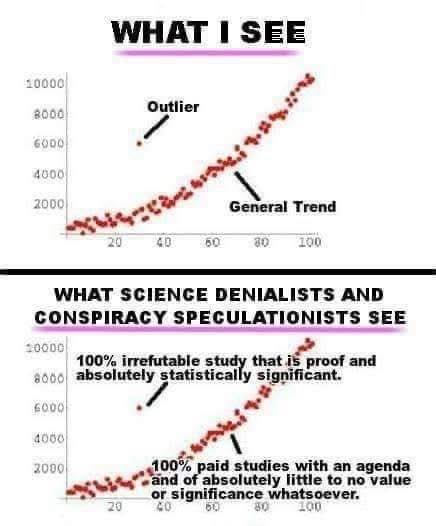
You don’t have to be a rocket scientist to spot the difference between a spot and a curve.
You don’t even need to be able to read…

Every adolescent steps out of the straight and narrow. Time and time again. And is told by his elders to toe the line. Until they learn that stepping back into the fold is easier than remaining an outlier for the rest of their natural life.
Only the fold is no longer were it used to be… It has reached its current position because those who had the guts to explore have done that for the rest of us. Experimented being outliers. So that we, all of us, did not have to experience every possibility before choosing where to go next. They, the outliers, found out what was ‘out there’ and told us.

I’ve already made a few considerations about the two pictures above. About some of the differences between the top and the bottom ones. I’ve left the main one for today’s post.

We do have a certain bias towards conformity. We do, socially and statistically speaking, tend to follow the trend. Like all other social animals.
After all, no society/herd can function – as a group, when all its members behave ‘outlierly’. So much outside the trend as to buck it.
The difference between the top and the bottom ‘graph-s’ being the attitude towards the situation.

The top one comes with the ‘normal’ bias. Each normal individual does have a certain ‘something’ against the ‘outlier’ situation and a certain affinity for the comfort of being trendy. But we have learned to respect the outliers, for as long as they don’t hurt us. For as long as they don’t rock the boat so much as to get us seasick.
The bottom graph states from the beginning that only the outlier opinion is valid. That no matter how many people continue to follow the trend, they are wrong. Even worse, they are insignificant. Hence disposable.

OK, there have been instances when the trend was leading in the wrong direction. Quite a few.
Yet people have somehow managed to survive. They stuck together, realized the outliers who kept warning them were right and followed them out of the dire situation they found themselves in.
But in each and every situation where an outlier had declared the rest of the ‘mob’ to be insignificant/disposable, and had enough traction to act upon their convictions, the situation had to become worse before people realized they had to change tack.

Before the people had realized they were following the wrong outlier!

“Thou shalt not make unto thee
any graven image, or any likeness of any thing
that is in heaven above….
“
Exodus 20:4

“God is dead. God remains dead. And we have killed him. How shall we comfort ourselves, the murderers of all murderers? What was holiest and mightiest of all that the world has yet owned has bled to death under our knives: who will wipe this blood off us? What water is there for us to clean ourselves? What festivals of atonement, what sacred games shall we have to invent? Is not the greatness of this deed too great for us? Must we ourselves not become gods simply to appear worthy of it?”

And it thus becomes obvious that Nietzsche has been falsely accused. It wasn’t he who had murdered God! He was simply the first who had the guts to write His death certificate…

My point being that what we call ‘God’ is a man made image. A concept.
It doesn’t matter, for this analysis, whether there is an actual god or not. What we call God is nothing more than our image of one.

And it had been enough. For a while.
For as long as we have followed the rules we ourselves had established to guide our own behavior – as in written them down – the God we’d imagined worked as intended. ‘Religion’ did what it was supposed to do. People had a ‘spiritual environment’ in which they behaved both coherently and cohesively.
Coherently and cohesively enough to evolve from slaves – owned and/or owners – to equal rights owning/yielding citizens.
Coherently and cohesively enough to evolve from horse driven war chariots to the M1A3 Abrams tank.
Coherently and cohesively enough to ‘be fruitful and multiply’ to the tune of 8 billion. Give or take. Not all of them following ‘the rules’ but all of them benefiting from the results of those rules having been followed for a while.

Yet, when things were unfolding so smoothly, why have we given up following those rules?

Have we outgrown the need for a shepherdly Father? For a Ghost to frighten us unto doing the right thing?
Or have we become so infatuated with our own ability to think, to reason, that we have turned it into an idol? Against all odds…
Despite having been warned about it!

Pascal’s wager is about turning the tables on ‘God’.
The image we made for ourselves about God, the ‘Holy Gost who frightened us unto staying on the straight and narrow’, convinced us to behave in a constructive manner. Benefiting the entire community.
The argument made by Pascal was made to convince us, individually, that we – each of us – should believe in God for their own sake. For their own benefit!
Effectively transforming each individual belief into an idol… ‘Graven’ by each individual, upon their own soul, in the likeness of things in heaven, for their individual use… Transforming the community creating God into an individual tool designed and believed to ‘give’ each of us ‘everything’.
Individually. As opposed to making it possible for everybody to exist.

As Nietzsche observed, by making Pascal’s wager – by transforming faith into a rational thing – we have collectively killed God. The same God which has made us possible.
Against everything we have been warned about, by our wise ancestors, we have replaced God with ourselves. So that we “gain all”. Individually. Each of those who had made the rational decision…

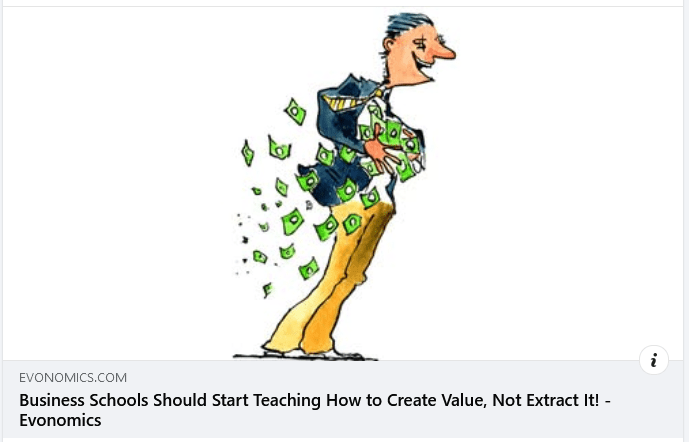
“None other than Jack Welch, former chairman and CEO of General Electric,
has called shareholder-value ideology ” the dumbest idea in the world.”
Yet business executives still pretend that maximizing shareholder value
is their primary fiduciary obligation,
which is nonsense except in few restricted cases,
such as when a company is going to be sold.“

Value… What is that?!?
Does it exist on its own?

Something must exist if anybody is to extract it, right?
If that something may be created, then it would be a no brainer to make some before attempting to extract it… if you want to be involved in a sustainable process, right?

How do you make value?
How does anybody establish that something is valuable in the first place?

– I declare this to be valuable.
– Who owns it?
– I do.
– How much do you want for it?
– xxx
– OK

That ‘this’ had became ‘valuable’ only when ‘OK’.
Before its value had been agreed upon, it being valuable was on the declarative level only.
‘Virtual’ versus ‘real’.

Only after two interested parties had negotiated about and agreed upon the value of something the value of that something has become established.

Jack Welch again:
“Shareholder value is a result, not a strategy…

your main constituencies are your employees, your customers and your products.
Managers and investors should not set share price increases as their overarching goal. …
Short-term profits should be allied with an increase in the long-term value of a company.”

As an engineer, as down to Earth as it gets, I tend to agree with Jack Welch. A company should be managed as a long term project. It needs to satisfy the natural interests of the investors – profit – in a sustainable manner. Providing something useful to both parties involved. A useful ‘thing’ to the buyers and a satisfying profit to the investors. While creating little to no damage to the ‘environment’ in order to remain acceptable to those living on the same planet…

But who am I to judge… even if I have the blessing of Jack Welch…
Who am I to tell anybody – any investor and/or any manager – how to run their business?!?

– Are they blind? Don’t they see this economic model doesn’t work?

“Inequality holds back the growth of the entire economy,
as research supported by INET has shown.
Even today’s business elites are worried about its impact:
In a 2015 poll of over 2,700 Harvard Business School alumni,
respondents said that they were more concerned about growing inequality than ever before.“

Hm…
“Share holder value is a result, not a strategy”, remember?
Same with ‘inequality’.
Let’s focus on sustainability. On the process.
And notice that the process sputters!
As a consequence of our own decisions!

We have told/allowed the investors and the managers to run the business – not their businesses, the entire business environment – in the current manner.
And we are the ones bearing the brunt. Having to deal with, among other things, the current level of inequality.
We, our decisions, have produced the current situation. Inequality is but one of the consequences.
One, among many, of the consequences engendered by our own weltanschauung.