Archives for category: Choices we make

That was how an old friend of mine – thanks Oache – was treating anyone who complained too much.
And there were plenty reasons to complain about during Ceausescu’s communist rule over Romania.

Five minutes ago I found this in my inbox:

A  young couple moves into a new  neighborhood.
The next morning while they are  eating breakfast,
The young woman sees her  neighbor hanging the wash  outside.
“That  laundry is not very clean,” she said.
“She  doesn’t know how to wash correctly.
Perhaps  she needs better laundry  soap.”
Her  husband looked on, but remained  silent.

Every time her neighbor would  hang her wash to dry,
The young woman would  make the same comments.

About one month  later, the woman was surprised to see a
Nice  clean wash on the line and said to her  husband:
“Look, she has learned how to  wash correctly.
I wonder who taught her  this.”
The husband said, “I got up early  this morning and
Cleaned our  windows.”

And so it is with life.   What we see when watching others
Depends on  the purity of the window through which we  look.
 

I’d go even further than that.
The way we perceive what’s going on around us depends heavily on the ‘filter’ each of us chooses to use when trying to make some sense of this world.
Catalin Zamfir, a Romanian sociologist with a keen interest in the decision making process, has studied how individuals try to assuage the feeling of acute/constant uncertainty experienced by each of them during the constant (social) encounters that constitute ‘daily life’. In one of his early books, unfortunately not yet translated in English, he explains that ‘ideology’ is not only a blue print for future action but also, and maybe even more important, the lens/filter through which we perceive what is going on around us. An interface that translates ‘reality’ into ideas that make sense for each of us.
The interesting thing about ‘ideology’ is that it isn’t fixed. Each of us can choose from whatever is available in his time or even ‘write’ his own.
Granted, the process of selection/rewriting incurs costs/risks. Some obvious, like adopting a contrarian stance, and others very well hidden in plain view, like the dangers that arise from indiscriminately following a herd.
And this is exactly why we should strive to keep our windows/ideological eyes as clean as possible.

‘Democracy’ comes from ‘demos’, the Greek word for ‘people’.
Basically a democratic society is  a social arrangement where the people is in charge. Through representatives, as in most cases, or even directly – the Swiss organize referendums whenever they have something really important to decide.

‘Republic’ comes from Latin. ‘Res publica’ means ‘public matters (=issues)’ so a republic can be seen as a social arrangement where everything is out in the open.

Would it make any sense for the public to know everything that is going on if they don’t have any say in the matter? Could democracy work if people are kept in the dark?

So.
In communism the state (in fact the rulers) decide everything – who does what and who gets what.
In socialism there is not much difference from the previous state. (I can vouch for both propositions, I’ve lived under both regimes)
‘Anarchy’ means no rules. If you happen to have two cows you need to defend them constantly, by your own, against anyone who covets them. Remember, anarchy means ‘no rules’ whatsoever. You cannot cherry-pick. I like this rule (property rights are fundamental for me) so this one stays in place while the the rules that I don’t like will be discarded.
As in ‘I won’t respect but the rules I like and I’ll hold everybody else to respect mine’.
That would be an absolutely one sided anarchy. If you’d be able to enforce such an arrangement it would be perceived by everybody else as the most authoritarian regime ever and Stalin would be jealous of your accomplishments.
As I said before ‘democracy’ means people having their say about how things are settled in a that particular society. If people respect each-other you have real democracy. If people band together to decide, against the will of the owner, about the fate of those fabled two cows we can no longer speak about true democracy. That would be ‘mob rule’, just another form of ‘anarchy/authoritarianism’. One ‘organized’ by a ruler who is a callous spin doctor skilled enough in his trade to make a considerable portion of the population follow him, usually against their better interests.

I was just speaking about the mutual respect that exists among the members of a truly democratic society…. I have a distinct feeling that those who promote this meme think of themselves as being ‘the true democrats’… I’m not a religious person myself, not in the classic sense of the word anyway. But I won’t ever think of a religious person as being ‘ignorant’ based solely on his creed and I’ll never refer to him using such a word, regardless of his level of education. One of the reasons being that if I ‘indulge’ in such a barbarism he’ll never listen to me again.
Why should he? To get some more abuse from me?

Now lets get this straight.
Mutual respect is absolutely essential for democracy.
There can be no such thing as mutual respect among individuals whose goals are mutually exclusive.
This meme actually doesn’t make much sense. No matter how well armed the lamb is, a determined wolf would eventually sink its fangs in the lamb’s sweet flesh so a rational lamb would do his best to shoot the wolf at the first opportunity. What kind of democracy are we speaking about here?

Most governments don’t get this. You can stretch it only that far. At some point, no matter how authoritarian the regime, people will take to the street.
This doesn’t mean that democracy will automatically be installed after a public uprising, far from it. The Arab Spring is only the latest example.
It only means that people have it in themselves to try to improve their lot. If they find a way to do this together then the sky’s the limit.
And this is a fact. Only the democratic America successfully landed a man on the Moon. The Soviet Union was the first to start this game but wasn’t able to keep up.

Yeah? And what are bragging about here?
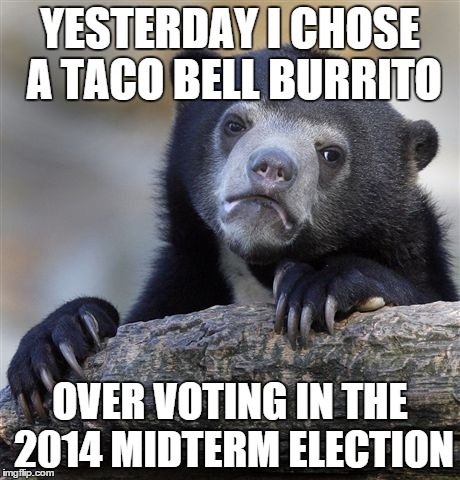
About not finding a candidate to suit your wishes AND not doing anything about this situation?
How about running yourself? Or at least going there and annulling your ballot…
If you do not vote at all the political establishment will consider that you are either content with what is going on or so despondent as to not care anymore. So why should they even consider your plight? In which direction should they change their behavior in order to suit your needs if you don’t express them when you have the chance?

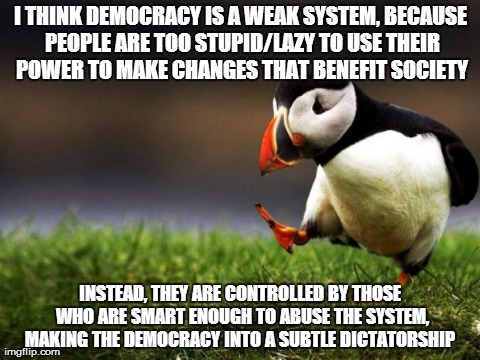
Really? Is he indeed unable to make distinction between democracy and mob rule?
‘Democracy in and of itself is not necessarily a good thing’…
I’m afraid he didn’t get the gist of it!
Real (=functional, stable over long periods of time) democracy IS good while mob rule IS bad. Period.

So, any chance for this cute fellow to have nailed it?

Close but there is space for improvement so I’ll try to rephrase this.
A democratic system invariable becomes weak/unstable if the general public becomes complacent and the power is grabbed by short-sighted but arrogant and callous spin doctors who, by eviscerating the true nature of democracy, transform the concept into an empty shell. This way the democratic process becomes a beauty pageant and an erstwhile democracy becomes a subtle dictatorship.

The strangest part of all this is that exactly those who should have known better – the professional politicians and some members of the academia – are the first to fall into the trap.


“Hope is a mistake. If you can’t fix what’s broken, you’ll go insane.” This muddled piece of dialogue grunted out by Max (Tom Hardy) is a pretty spot on summation of my thoughts on Mad Max: Furious Road. The fact that this film has somehow slipped into the consciousness of the masses, winning the heart of critics and blowing the minds of audiences, is an anomaly to me. With a staggering 98% approval rating on Rotten Tomatoes, I’m still questioning if I happened to miss something or not. I had hoped this would be the heart-thumping action film that others promised. I wanted to bawl over in joy becoming lost in a ridiculous, yet intelligent world created by director George Miller and his fellow screenwriters Brendan McCarthy and Nico Lathouris. But alas, Max was right. Hope is a mistake.” (The Cinephiliac)

OK, so is there anything to be gleaned out from here?

Firstly, hope is a mistake only if not followed through.
Yes, people might get mad if not able to fix what’s broken.
But there are alternatives.
Like next time fail better.
This way even if you don’t succeed at least you end up trying. Way better than locked up in a loony bin, specially so if the cell itself is of your own making.

Secondly, the 98% approval rate on Rotten Tomatoes bears a very clear message.
The audience is fed up. Basically with everything.

I just hope people will find a way to vent their grievances before they flare up and that the powers that be pay attention before the things go too far down the Fury Road.

Activists dismantle Ukraine’s biggest monument to Lenin at a rally in the eastern city of Kharkiv on Sept. 28, 2014. Photo: Igor Chekachkov/Associated Press

Wall Street Journal reports that Ukrainian people are somewhat baffled by  a new law banning the use of Soviet (and Nazi) symbols.

“While few outside Crimea and the rebel strongholds of eastern Ukraine want to join Russia, not all Ukrainians are ready to repudiate a joint history that remains dear to many across generations.

“I wanted to tell my child that there was ‘Uncle Lenin,’ and at one point Mama took part in a big celebration in Kiev” in honor of the first Soviet leader, said 37-year-old Svetlana Arshavina, who lives in this suburb northwest of the capital.

“Now what will I tell her? That they took Uncle Lenin and smashed him to pieces?” she asked.”

Isn’t it rather strange that the nephews of those who survived the 1921 Famine still harbor any respect for the likes of Lenin?

http://www.wsj.com/articles/ukraine-tries-adapting-to-life-without-lenin-1432324644
https://www.icrc.org/eng/resources/documents/article/other/5rfhjy.htmhttp://www.globalsecurity.org/military/world/russia/famine-1919.htm

Efficient Market Hypothesis, eh?
The proponents of this hypothesis posit that all participants to the market are perfectly rational and that they all have enough pertinent information about what is going on as to be able to reach reasonable business decisions.
Now consider this: ‘ten percent of the egg producers being wiped out results in a up to 85% hike in retail prices’.
Quite reasonably, don’t you think?
As for efficiency… maybe for the owners of the surviving ‘egg producers’…

Sometimes yes.
For instance in an economy where cash is readily available some employers might be tempted to split the compensation they give to their employees in two parts. An upfront one – which gets to be reported to the IRS – and a behind the counter one, that is settled directly between the employer and the employee. If a minimum wage is enforced the state knows for sure how much will be the taxable part.
Or in a situation when enough of the employers get together, form a cartel and start lowering the wages so much that the ordinary people end up dying of hunger.

Otherwise…

In fact there are many opinions about how this concept imposes undue constraints upon the economy. Some say it discourages job creation, others say it makes it a lot harder to start a new business and so on…

While all these opinions have their merits, just as the concept itself has its own, I think the situation is a little bit more complicated than this.

For starters I’m going to introduce the concept of ‘priming’.
“Priming refers to the incidental activation of knowledge structures, such as trait concepts and stereotypes, by the current situational context. Many studies have shown that the recent use of a trait construct or stereotype, even in an earlier or unrelated situation, carries over for a time to exert an unintended, passive influence on the interpretation of behavior.”
In other words an established mind set influences both the way we see a certain situation and the decisions we make in certain circumstances.

Minimum wages do exactly that. It both sets our minds in a certain way and establishes a certain set of circumstances.

First of all it tells us that it’s OK to compensate labor as little as possible and then settles an ‘acceptable’ minimum.

I see some of you fretting: “And what’s wrong with paying as little as possible? Are you nuts? I have a bottom line to worry about here!”

Precisely. You should take into consideration the whole picture – the bottom line – instead of short-sightedly aiming your efforts towards short term cost cutting.

Henry Ford taught us a very valuable lesson more than a hundred years ago.
By paying each of the workers more you might end up lowering your aggregate labor costs on the medium time frame.
But there’s more. What Ford did created the conditions for a mentality change. Receiving more money prompted workers to start planning ahead. On $2.25 a day Ford’s workers could afford to work for 3 days a week and spend the rest drinking. On 5 bucks a day they realized they could raise a family. Things changed dramatically. They stopped skipping work and this is how the famous American working middle class was introduced to the world.

The advent of minimum wages turned back the wheels of history. Blue collar employees were returned to the condition of working beasts whose work is no longer evaluated on an individual basis but compensated according to some opaque calculations made by government bureaucrats.
The companies no longer compete among themselves for the best available talent; they just hire anonymous ‘industrial operators’ from a pool of undistinguished semiskilled, disheartened laborers.

The entire economy suffers, from lack of solvable demand and an increasing apathy that doesn’t bode well for the future.

Also, demography doesn’t help any.
I keep hearing that individuals should improve their skills if they want to live better and that mature people who see working for McDonald’s as a life-time career cannot ever expect a ‘decent’ life style since McDonald’s jobs are for students trying to earn some pocket money.
Well… things have changed a little since people who tell this story have been in college.
In those times families had three or four children and about half the jobs were in manufacturing. That meant that the father was the bread winner, mother stayed at home and the students manned the burger joints.
Nowadays most manufacturing jobs have been exported to China, father and mother are both working, part time, in the unglamorous part of the service sector and no longer venture to have more than one or two children.
That’s why McDonald’s has become a lifetime career. For lack of eligible students, first and foremost. Thirty years ago blue collar workers could afford to send their children to college and the students went to McDonald to work for pocket money. Nowadays blue collar workers no longer afford to make many children and don’t have the money to send them to college.

Increasing minimum wage won’t change much. It would only convince the people at the bottom of the society that there is no way out and the CEO’s that there is no need to make any fundamental change in the way they manage the ‘work-force’.
Until employers will start considering their employees as partners instead of adversaries things will remain just as they are now. Or get even worse.

PS. How come so many of us constantly forget that most of the clients – after all they are the ones who keep the economy afloat – are employees?

Deflation ‘for dummies’.

That’s one way to look at it.
Sometimes it might indeed resemble a punishment but please remember the many times when common sense prevented us from making huge mistakes that might have ruined our lives.

Does he have any ‘right to exert his authority, inside the limits that have been delineated for him’?

Somebody who has real authority enjoys a certain degree of autonomy, if not outright independence. ‘Authority’ is almost never clearly delineated, there is always a gray area where the discretion of the individual in charge is the one that calls the shots.
More over if we, the ‘subjects’, consider that he has ‘the right’ to exercise that authority then it’s us who are in deep trouble.
‘Exertion of authority’ ‘smacks’ of the situation  when the ‘authority man’ had conquered his position against the wish of his subjects – like the emperors of the old. (Or like the communist dictators of not so long ago, only they pretended to exercise their authority for the benefit of the people while the emperors of the old were more straightforward and declared themselves ‘gods’)
Nowadays, at least in the democratic states, authority is, theoretically, used as a tool, towards the accomplishment of what the person in charge is supposed to achieve, not as a right enjoyed by that person.
In fact the notion of a right to exert authority inside some limits is akin to what has been described as ‘feudalism’, a social arrangement not that different from the Athenian democracy. The people were divided in two categories, just as in the previous situation – the ‘imperiums’ of the Antiquity, the difference being that in an imperium the top class was inhabited by a single individual – the emperor/dictator, while in feudalism/Athenian democracy the top class was inhabited by the free people, whose authority/freedom extended only as far as it started to encroach the authority of the equivalent individuals. I have to remark here that in many circumstances feudalism has very quickly degenerated back to imperium – for instance in absolutist France, ‘L’etat c’est moi’, or in tsarist Russia, while England successfully avoided that due to the spirit enshrined in Magna Charta.
The difference between feudalism/Athenian democracy and the modern democracy being that currently we can no longer speak of individual authority simply because nowadays no one has the “right” to own slaves – as the Athenian ‘democrats’ had, nor even enjoy extensive authority (bar the right of life and death) over other people – the serfs, as the feudal barons did not so long ago.

Nietzsche was somewhat right only he went bonkers before he was able to shed some real light on what was going on.
The point is that God didn’t die on his own. We killed him. Twice. And while the first time we were capable to fix the situation now we seem incapable to ‘make the right thing’.

Let me explain myself.

I have no way of knowing if it was God that created us or not. That’s something for others to decide.
For me it’s enough that I see no evidence to support the first hypothesis except for some ‘testimonies’ provided by people with vested interests in the matter. I find those testimonies highly biased. Nor do I find any need for a Deus ex Machina kind of explanation for anything that exists in this Universe. Modern science has done a good enough job in explaining the world to me.
On the other hand the second hypothesis is absolutely impossible to demonstrate. So, why bother?

What I do know, for sure, is that at least one kind of God does exist. The one that has been created by us, people, a social representation whose existence stems directly from our mental relationship with Him – the One who supposedly created us.
The mere existence of this ‘virtual’ God had two very important consequences. It brought us democracy and it provided us with a coherent way of understanding the world – a common Weltanschauung in German terms.

I’ll make a short break here to elaborate a little. The common lore is that ‘God made us in his image’. This means that, basically, we are equals among ourselves – we’ve been all cast in the same mould, right? – and that each of us has a spark of divinity in him. Quite a heavy responsibility – being of a Godly nature – don’t you think? Hence the ‘do not kill/judge’ commandment. Who are we to play God towards other Gods?
Also partaking in the same Weltanschauung was what offered us the possibility to act as a community, to help each other. For a while at least but it was good while it lasted. After all none of us could have done much by himself.
In fact none of us is able to survive for long by himself, let alone thrive solitarily. Not even today, with all the modern technology that we now take for granted.

We gave birth to our first generation of Gods, made exactly into our image, good and bad together, during the Antiquity. The Greek, Roman and German Gods were our look alike-s and shared our unruly behavior. Some of them even occasionally shared our beds. Then, at some point, we got cocky and abandoned them. Our philosophers thought they knew better than that and that they could come up with comprehensive solutions all by themselves. That’s how absolute authoritarianism ended up having official blessing from the Academia while the adoration of Gods was left for the unsuspecting masses.
All hell broke loose from that moment. For some 6 centuries after Plato had wrote his Republic the Mediterranean Sea had been a string of empires toppling one another.

Until we came up with a different kind of God. One that first and foremost told us to stop quarreling – for we were all brothers – and start living in communion. Until we killed him also.

Not that we haven’t been forewarned. Pascal, the French mathematician, told us that it is completely irrational to reject the existence of God. If, in reality, God doesn’t exist the believer looses nothing and the non believer gains nothing – except for the lame satisfaction to be able to brag ‘I told you so’ after death. Conversely, if God does exist, then the believers are going to inherit the world while the non believers have dealt themselves the worst hand ever. Meanwhile, by living in a world structured by the presumed existence of God both believers and non believers enjoyed the two consequences I mentioned above – equality among people, even if only in theory, and the ability of doing things in concert, a lot more efficiently.

Now, that we’ve killed God for a second time – the murder described by Nietzsche – we’ve lost it again. Only this time we didn’t lose just the hypothetical after-life, we’re gradually transforming this one – the only life we have for sure – into a bloody nightmare.

And if you don’t believe me do as Lesek Kolakowski suggests.
“Let us simply compare the godless world of Diderot, Helvétius, and Feuerbach with that of Kafka, Camus, and Sartre. The collapse of Christianity that was so joyfully awaited by the Enlightenment took place almost simultaneously with the collapse of the Enlightenment itself. The new, shining order of anthropocentrism that was built up in place of the fallen God never came. What happened? Why was the fate of atheism in such a strange way tied to that of Christianity, so that the two enemies accompanied one another in their misfortune and in their insecurity?” (God in a godless time, 2003)

Now why can’t we make the small effort to understand what Pascal told us? Why is it so hard to understand that we are spoiling the beautiful life we might have if only we kept pretending that God existed and behaved accordingly?

Why is it so hard at least to fake some respect for those who happen to share the planet with us?
Fake respect is not as good as the genuine one, of course, but is a lot better than the huge amount of scorn that is publicly traded these days.
Even more important is that if we won’t have to use so much energy in maintaining a force field to protect us from being drenched in scorn we’ll may be able to imagine a better world than the one we currently have to deal with.
And, who knows, maybe we’ll have time to discover how beautiful we really are, inside our armors.

A new (representation of) God would be born this way.

god-is-dead

Lesek Kolakowski, God in a godless time, 2003, http://www.firstthings.com/article/2003/06/visions-of-eternity-7