Archives for category: Choices we make
armed citizens
Terrorism needs three things in order to produce victims.
Some disgruntled/deranged individuals to perpetrate the actual crimes.
Some callous individuals who for various reasons organize/support the disgruntled/deranged.
A large enough section of the community which is too tired/despondent/discouraged to care about what’s going on in its close vicinity – that’s where the terrorists (hit men and the support network) hide while preparing a hit and where the support network will try to sink itself afterwards.
Since it is practically impossible to corral all the deranged and to smoke out all the schemers beforehand the only really viable strategy  remains to make it so that the general public no longer assists catatonically to whatever is happening in its close vicinity. Until it’s so late that even drawing a gun is no longer very helpful.

I don’t even think that arms are such a must.
They might come handy in certain occasions but what we really need is a much more active attitude. A calm and considerate one but firm enough to impose respect.


forgiveness

Some say that God created the world, a long time ago, and that’s why he is the only one who can forgive.
Some others remember how the elders taught them that keeping a grudge is far worse than having an ulcer. It will eat you alive, like a cancer.

I, personally, don’t know anything about God creating the world. I wasn’t there at that time so…
What I do know is that playing God is extremely dangerous. Not only for the impersonator but mostly for those around him. Exactly those who were amused at first by his performance – enough so that they encouraged him to continue, only to find out later how annoying the show will soon become AND that the exit door had been paddled shut behind their back, while they were happily clapping after the first gigs.
At the very end, after the impersonator had left the scene – by his own will or simply carried out, he will end up shouldering the whole blame – as he should, of course.
But I can’t stop wondering how much suffering could have been avoided if the crowd were just a tad more circumspect?

Not making very much sense, do I?

OK, first take a look at this:

No mercy

Then watch this:

go hard

Do you really think this is funny? Well… more than 38 000 of the almost two and a half million who watched this say they enjoyed it and only two and a half thousand became worried enough to express their feelings.

Most of you have not experienced how it is to live under dictatorship so I’ll use another metaphor.

You are probably quite familiar with this guy:

dirty harry

He was lionized during the ’70’s and the ’80’s for impersonating a no-nonsense cop who cut through the red tape and got things done.

Mostly by shooting the bad guys.

Don’t get me wrong.

They didn’t get anything else than they actually deserved.

What I find really troublesome about Dirty Harry is the casualness with which he killed people. And his over-reliance on guns. On brute force, that is. “Go ahead, make my day.”

It is true that at that time people were exasperated with the daily occurrence of violent crime and were desperate for a way out of that situation. I’m not going to offer you statistics or stuff, you can look them up yourself. I’ll just tell you that the Romanian television was having an almost daily news bulletin presenting the latest violent acts committed Stateside. It was all part of the propaganda, of course, but the facts were real. And plenty enough to make me wonder, I was a teenager at that time, what on Earth is going on there?

That wave of violence has subsided, as we all know. Some say it happened because of ‘broken windows policing’, some ‘freakin’ others ‘blame’ ‘Roe vs Wade’ for it while I suspect that all of the above had something to do with it but that the main ‘culprit’ was the economic upsurge that followed the ‘stagflation’ period.

Nowadays we find ourselves in another economic and psychological down-turn. With a twist though.
The recent economic troubles were brewed at home while then it started with the Oil Crisis. Much of the violence no longer starts as a robbery but has a psychological motivation – disgruntled and socially disconnected young people commit multiple acts of homicide, either by indiscriminately shooting their victims or by blowing themselves up, along with a huge amount of explosives, in densely populated areas.

And how do we respond to this fresh wave of violence?
By turning a blind eye to heavy policing? By digging fresh trenches that further divide our already highly polarized society? By another wave of over reliance on guns?

“I said it was only me and, hands still raised, slowly descended the stairs, focused on one officer’s eyes and on his pistol. I had never looked down the barrel of a gun or at the face of a man with a loaded weapon pointed at me. In his eyes, I saw fear and anger. I had no idea what was happening, but I saw how it would end: I would be dead in the stairwell outside my apartment, because something about me — a 5-foot-7, 125-pound black woman — frightened this man with a gun. I sat down, trying to look even less threatening, trying to de-escalate. I again asked what was going on.”

Go ahead, click on that quote and read the entire article. My post won’t go anywhere.

What’s the connection between what happened to Kyle Monk, the Dirty Harry movies and Putin?

For starters all those involved were …human individuals.
Kyle’s neighbor who called the police and who, when asked by Kyle ‘why did you do it’, chose to end up the conversation with “I’m an attorney, so you can go f— yourself.”
All of the nineteen policemen who played a role in this drama – and who treated a 125 pound, scantily clad, woman as if she were an armed and dangerous criminal were also human individuals.
The heads of the public administration, those who adopt and enforce policing policies are also human individuals.
The financial wizards who engineered the recent crisis belong to the same species as we do.

We, the guys who admired Dirty Harry for his toughness, are the parents of the hapless generation who blows itself up or mindlessly shoot their colleagues in campuses.

We are also the guys who are amused when bored magazine writers attribute to Putin such silly quotes as ‘it’s my job to send them to Him’.

And it’s us who applaud the Putins of this world. Only to find out, on our own skin but too late to be able to do anything about it, that the ‘hug of the bear’ is not that comfortable as it seemed from a distance.
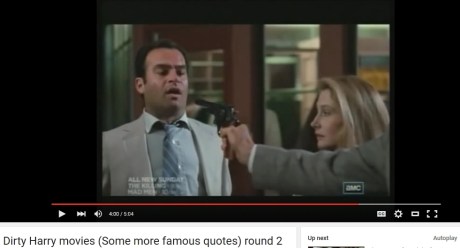
you're Callahan


I happened to stumble upon this image on somebody’s FB wall.
gore2bvidal

And then it hit me.

Waging war is simple.
Even winning one is relatively simple if one has enough resources.
Winning the peace afterwards is the real challenge.
America did very good jobs at winning the peace after WWII and the Korean War but very poor ones afterwards.
Here’s Gore Vidal elaborating on the subject:
gore vidal

Let me elaborate on some concepts first.

We have religion and we also have religions.

Regardless of whether religion comes from the Latin ‘religare’ or not it is obvious for the concerned observer that inside what is commonly known as ‘culture’ there is a tightly knit set of traditions which constitutes the common ground where all members of the community that share those convictions come to meet and ‘find the time of the day’.
Emile Durkheim, one of the founding fathers of sociology, has written a whole book on this subject – The Elementary Forms of Religious Lifeand John Faithful Hamer, one of his disciples, has summed up brilliantly the whole idea: “Religion is largely a function of sociology, not theology.”

Only each community has evolved in its own distinct environment. Hence, even if for each community ‘religion’ plays the same role, there are no two religions that are similar. Simply because each of them consists, as I’ve said before, of a certain set of traditions whose main goal is to help the community make the most of the environment into which it has to make do. And since each environment is different from the next one…

And now we have arrived at the second role played by religion. To offer a certain degree of solace and certitude to the individual believer. Just as nobody can make it out by himself – regardless of whatever the anarchist libertarians might think/preach – all of us need some assurance about the world having some kind of congruence. Some of us find it in science, some others in stories which involve a God or a team of Gods and yet others in a godless narrative about how to behave in order to find, eventually, a way out of this Earthly ‘Valley of Tears’.
In order to offer that solace each individual religion has developed a certain ritual. Just as rigorous performance of calisthenics provides a certain physical well being by performing a religious ritual individuals forge a strong connection with the same minded people belonging to the same flock. That’s why some people believe that ‘religion’ comes from ‘religare’ – the Latin word for ‘binding’.

Let me now put two and two together.

We have religion as a set of guiding traditions and we also have religion as a ritual which is performed in order to bind people together so that they no longer feel alone and helpless.
Putting things this way it’s easy to observe that there are some people who are firm believers in those guiding traditions but who, for various reasons, do not feel the need to constantly reenact the ritual; others who are more or less skeptic about the traditions but who are convinced that their world would come apart if the ritual would no longer be performed and still others who are both firm believers in ‘their’ traditions and staunch performers of the ritual attached to those traditions.

From a more practical point of view the non ritualistic ‘firm believers’ will live and let live even if they are convinced the others will rot in hell while those who attach great importance to the proper performance of the ritual will try to impose it as widely as they (even im)possibly can.
So, if we need to reduce their militancy it would be easier to reduce their perceived insecurity/helplessness than to try to change their ‘religious’ convictions. Maslow taught us that it’s relatively easy to lift an individual from the base of his famous pyramid to a more comfortable level while history has taught us that it takes a lot of time to change a time-honored tradition.
Also, by helping them to overcome their perceived helplessness we’ll also help them notice the fact that each religion offers a great degree of autonomy to its followers.
BTW, that’s why many would be dictators insist on religious-like values (nationalism is also a religion), on the corresponding rituals being faithfully respected AND simultaneously do their worst in order to reduce their followers – the ordinary members of the community they intend to dominate – to a state of abject dependency. The most poignant example being Pol Pot’s Cambodia but this has happened, to various degrees, in all communist states. But not exclusively.

girls chose ISIS

mothers of ISIS

coruptia ucide

Every 25 years or so Romania startles the rest of the world.

In 1989 we had to pass through the bloodiest Revolution in the Eastern Block in order to get rid of the most unreasonable communist dictator in Europe, bar Stalin of course.
In 2015 we had to be awaken by a disastrous fire in a night club to oust a prime minister who is currently under investigation for alleged corruption.

What’s going on here?

Some history first.

For the last 2000 years the Carpathian mountains have been the first obstacle that had to be negotiated by the migratory peoples that came to Europe from the depth of Asia.
Since for the first 1000 years on the plains where now lie Northern Poland and Northern Germany there was nothing to be plundered while the Northern shores of the Sea of Marmara were harboring a very rich city – Byzantium – most of those tribes transformed the area between the Carpathians and the Black Sea into a sort of highway. That’s why whatever forms of political structures the local population – the proto-Romanians – were trying to set had very short lives. They usually were fleeting fiefdoms run by chieftains from the migratory tribes whose authority survived only till the next, and more powerful, tribe arrived in the region.
After the huge Russian plains have been somewhat stabilized by the establishment of the Crimean Khanate the situation became even more complicated. The area was a battle ground for Bulgarians, Turks, Tartars, Hungarians and later Austrians and Russians. Besides the constant political instability this situation included the fact that very seldom the people who were in charge with running the place had a strong connection with the people they were leading. If any at all.
This had very insidious consequences, the most important being a huge distrust of authority. The present days libertarians would argue that this is a good thing… Well, think again.

If the people do not, not at all that is, trust those who happen to be in power and those in power do not care at all about those under their patronage you have the ‘perfect’ set of circumstances for the onset of an all pervasive corruption.

During the last five centuries the Western Europe has slowly evolved from Feudalism – the rule of he who happened to be powerful enough, tamed by some traditions inspired by religion, to what is now known as ‘The Rule of Law’. Meanwhile, in the European provinces occupied by the Ottoman Empire people lived in an almost schizophrenic manner. They passionately hated their rulers – and did their best to cheat them when ever they could, while developing a very strong respect for traditions, the only thing that kept the people together.
By the way, this is also the explanation for what has happened in the former Yugoslavia, where strong ethnic and religious allegiances were played upon by callous political adventurers.

This constant distrust/disdain between the rulers/administration and the general public has only deepened during the Soviet imposed communist rule and produced a real chasm between these two social strata. And it’s exactly this divide that is the reason for which all dictatorial regimes fail abysmally, sooner or later.
A convincing explanation for this was provided, long ago, by Pareto: ‘whenever the circulation of the elites (social mobility) is hindered, the society where this is happening is in great danger’.
Another way of explaining the unfailing demise of any dictatorship is corruption. When ever the rulers do not care about anything else but their very short term interests and the ruled do their best to cheat the system the corruption becomes so pervasive as to clog the entire social mechanism.

If left to itself this cancer can lead to implosion. The Roman Empire, for instance, didn’t fell because it was mortally wounded by the barbarous migrant tribes. It had became so weak because of wide spread corruption as to allow the barbarians to provide him with the fatal blow… Just consider what Caligula used to do for fun… The Soviet Empire did almost the same thing.
Now that I’ve reached this point I’ll have to remind you that corruption does not always have to be about money but covers all instances when people misuse, intentionally, their power.

You see, people make mistakes.
There is no way of avoiding this.
And the main difference between a corrupt society and one which is more or less ‘normal’ is that in a normal society he who notices a mistake has at his disposal enough means to report that mistake to the relevant authorities while having a decent chance to survive the attempts of the ‘perpetrator’ to ‘cover his tracks’.

The fire that started the current uprising in Romania was nothing but the final straw that broke the camel’s back. People have witnessed, individually, so many instances of corruption that had become fed up with it. But each of them wasn’t quite sure about what the guy next door was going to say/do about it. Meanwhile the authorities were more a part of the problem than providing a solution.

When this tragedy struck a lot of people have finally understood that this has to stop. And took their grief to the street.

These wrinkly, hairless creatures may help scientists understand more about preventing cancer (Credit: Frans Lanting Studio/Alamy)

Just finished reading an extremelly interesting article in BBC Earth.
I learned that humans, dogs, cats and mice – among many others – do get a lot of cancers while elephants and the rodents depicted above are fairly immune to this disease.

Now, if we remember that humans and mice are the most versatile species on this Earth – we are able to live practically everywhere on the planet, something nobody else can – and that dogs and cats have been bred into a cornucopia of variations could we consider cancer as a cost for our ability to adapt to an extremelly variable environment?

“One day a blonde woman entered an auto body shop claiming that she’d suffered extensive damage to her new car. The mechanic thought he’d have some fun with her so he told her that she didn’t need him to fixed all the dents. He said she could fix them herself by blowing into the tailpipe as hard as she could and they’d all pop out. The woman went home and proceeded to get down on her hands and knees in the driveway. She was blowing into the pipe as hard as she could and her face was turning purple when another blonde woman walked by and asked what she was doing. After hearing the whole story the second blonde pauses for a moment then responds, “Hello! The windows are down”.

What am I to laugh about here? A jerk who misleads a dimwit into believing that blowing up a tailpipe will fix ‘all the dents’? A woman who rightly observes that blowing into a space which is not airtight will accomplish absolutelly nothing?

Or this one:

“A woman yells to a blonde walking along a river, “How do I get on the other side!?” The blonde says, “You are on the other side!”

inner nigger

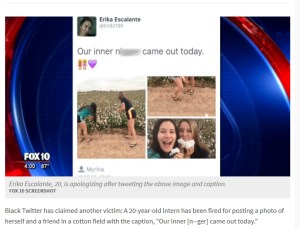
A twenty year old intern was “fired for posting a photo of herself and a friend in a cotton field with the caption, “Our inner [n–ger] came out today.” She later apologized invoking a “lack of my better judgment.”

Looking from the other side of the Atlantic this is rather exaggerate.
OK, I understand why calling someone a ‘nigger’ could be seen as an insult. But if you refer to yourself as such?

In fact, all what she said was that the two of them were doing work which not so long ago was done by ‘niggers’. While they seemed to be enjoying performing their duties.
I don’t think she erred there. She just doesn’t seem to understand (anymore?) the world as people our age do. Could this be a sign for us to let the old ghosts find some peace?

‘Politically correctness’ hits again, and some of us are not even aware of what’s going on.

I know, it’s easy for me to speak like this. I don’t live there. But what if my emotional detachment from this issue allows me to look deeper into the matter?
And no, we should not simply forget what had happened. Just learn the lesson – so that we’ll never have to repeat it – and move on. If we keep pestering that wound in an inappropriate way (nigger is just a word, we give it its meaning) it will stay open. For as long as we encourage it to fester. Do we really want this?

PS Politically correctness “involves changing or avoiding language that might offend anyone“. If we keep sliding down this slope we’ll soon end up unable to open our mouths. It’s damn hard not to offend ‘anyone’, sooner or later.

Basically, “anarchy” is about everybody for himself. And damn everybody else – even though most forget about this part.

While “secession” is mostly about someone trying to carve a ‘piece of the action’ for himself – and some people (naively?) following him. Maybe hoping that the new ruler would prove to be better than the old one?


globalnews.ca Storms flood roads, cause train derailment in Texas, which awaits remnants of Patricia

Some people maintain that we are in a middle of a ‘Global Warming’ and that, at least partially, we have brought this on our own heads.
Some others say that this is nothing but bullshit while a third group says that yes, it might be possible that the Earth is slowly heating up but that there is no way to demonstrate that ‘we did it’.

When it comes to what to do about it people are divided among totally different lines.
Some say we need to go on burning fossil fuel because it’s the most cost efficient way of producing energy, some-others that ‘we are sorry but we really need to close the economic gap there is between us and the developed nations’ and a few try to convince the rest that the Earth is the only home we’ve got and that we should do everything in our power to keep it as close to habitable as we can.

Where do I stand on this matter?
I’m not going to enter the dispute that tries to convince us that weather and climate are two different things.
I’m not going to pretend that ‘we did all of it’. Not even the most rabid treehuggers go that far.

All I’m going to do is ask this: Are you aware of the fact that burning things produces CO2 and that is a very effective green-house gas?
Do you know that “Currently, humans are emitting around 29 billion tonnes of carbon dioxide into the atmosphere per year.”? OK, some of it, about half according to some, is absorbed by the so called ‘carbon sinks’. But the rest? And how long before those sinks become saturated?
Furthermore, determining how much CO2 has been added to the atmosphere – or if any at all – is a rather murky business. Simply because of the seasonality of the plant life, volcanic eruptions and a lot of other variables.

That’s why I’m going to take another tack.
During billions of years in Earth’s history plants and animals have transformed atmospheric CO2 into coal, oil, natural gas and limestone. During this period, climate – and the Earth itself – have suffered huge transformations. Do we really think we can undo, even in part, this process – at a very rapid pace – without bearing at least some consequences?

Even some of those who, until very recently, kept saying that they need to close the development gap are having second thoughts and look for alternative methods.

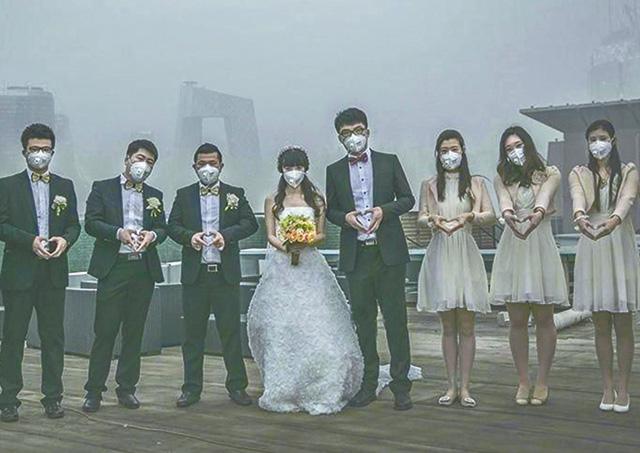
www.chinatoday.com, A wedding ceremony held during heavy pollution in Beijing (20141021)