Archives for category: awareness

Nothing which is impossible may ever happen.’
Until it does…

Life happens. Because it is, after all, possible.
In certain conditions, true.

Life, individually speaking, is limited. Individual organisms live for a while. Then go away.
Species adapt themselves. Or disappear…
Evolution! That’s how we, conscious observers, call this process.
Life itself, the entire phenomenon, may happen – as I’ve already mentioned, I know – only ‘inside’ a certain ‘environmental bracket’. The kind of life we’re familiar with, anyway.

The ‘impossible’ I’ve started with is a very interesting thing.
First of all, it’s – again – us who have come up with the notion. Until we’ve started to observe, things happened. Or not… But there was nobody to tell whether something was possible. Or impossible…
Things which could happen, did – if the conditions were right for long enough, while things which could not – at least not in the then present circumstances – simply didn’t happen. Without anybody noticing any of those things.
Now, that we’ve started to observe – in a conscious, as in ‘what’s in it for us’, manner – we’ve become very much interested in whether something may happen or not. Whether something good might be ‘enticed’ to happen and whether something bad might be prevented from happening.

I need to go back to ‘life’ for a moment.
I’ve already mentioned that individual life is temporary. Finite. I’ve also mentioned that species have to adapt to changes in order to survive. And that life itself, as we know it, can happen only inside a certain environmental bracket.
The point being that individual organisms which happen to be less than perfect – less than perfectly attuned to their environment – may still survive. At least for a while.
Life, as a phenomenon and strictly inside that environmental bracket, has somehow stretched the very notion of possible/impossible. The limits of ‘impossible’ are no longer clear cut. Somehow hazy. As in ‘possible’ but not for very long…
‘In constant balance’.

And we’ve arrived to the next level.
Society. Conscious people in congress.
Just as life has stretched the limits of ‘possible/impossible’, society – us, individual people working in concert – has stretched those limits even further.

The most blatant example which crosses my mind being the academic who had decreed that ‘heavier than air flying machines are impossible’. Lord Kelvin, 1895.
So. What had happened in the short 8 years passed between Kelvin uttering his now infamous words and the Wright brothers taking off? Had physics changed? Had our understanding of physics changed?
None of the above. We, as in ‘we humans’, made it possible. Found ways.
Just as life found a way to transform inanimate matter into living organisms – on a temporary basis – people working in concert have found ways to accomplish feats which seemed impossible. To their contemporaries. And, sometimes, even to those who live in the distant future of those achievements. We still have not figured out, in detail, how the Egyptian pyramids had been built…

I’ve been speaking of ‘individual’ achievements.
Flying machines as well as pyramids are, in a sense, ‘individual’. Somebody had an idea and, based on previous human achievements and with the help of others, have put their ideas into practice.
‘Individual’ not strictly in the sense that they have been achieved by an individual but in the sense that they have been the result of a deliberately targeted effort.

Other achievements had been ‘natural’. Or social?
In the sense that they had come around without anybody coordinating the effort. As in the case of the individual ones.
Learning to speak. To write. Yes, we do know that Cyril and Methodius were the guys responsible for the Russian alphabet. And that Mesrop Mashtots had created the Armenian Script. Only these efforts had been based on previous knowledge. Humankind had already been writing for at least 3000 years. Using different manners of notation but the principle was already there. And the achievement was ‘folkloric’ in nature. No identifiable author. The feat belonged to the entire community.

Another social/natural achievement is morals. Our habit of doing ‘the right thing’.
Which is different from what is being known as ‘justice’. Formal law being upheld by the government. Which is, basically, a collection of individual achievements.
So, why do we – statistically speaking – behave in a moral manner?

Evolutionary speaking, simply because moral communities fare better than amoral ones. And even better than immoral ones.
Don’t believe me? You’re not convinced that immoral communities will, sooner rather than later, either change their ways or crumble under the weight of their undoings? You are still under the impression that immorality is here to stay? Based on what you witness on a daily basis?
Do you remember that “individual organisms which happen to be less than perfect – less than perfectly attuned to their environment – may still survive. At least for a while”? Same thing goes for communities/societies. Communism, amoral by definition and profoundly immoral in practice, did survive for quite a while.

Then why do we stray from the ‘straight and narrow’?
Why do so many of us succumb to temptation?
I’m going to save that for the next post. But I’ll add this here.
Each digression is individual in nature. The consequence of ‘a deliberately targeted effort’. An individual human being comes up with a new idea. Good or bad. Is followed, if at all, by a group. Which group will survive – and add the ‘new’ idea to what is called ‘tradition’ if, and only if, that ‘new’ idea is beneficial for its survival. If that new idea works in the particular set of circumstances where that group of people live. Only after that had happened, after the group had survived for long enough and the new idea had become traditional, that particular, individual, achievement becomes a social one. The original author of the idea is forgotten and the engendered habit becomes natural.

Communism failed. Like all other totalitarian regimes.
Some people, most living in countries where it has never been experimented, consider communism to be an interesting idea. They also believe that what took place in the communist lager was not the real deal. Not what Marx had in mind!

First things first.
According to Marx’s Communist Manifesto, communism – as in the communist regime – was going to be instated by “the most advanced elements of the working class”. The communist activists… And the regime was going to be imposed by revolutionary means.
For a very simple reason…

The whole rationale of communism was that everything bad came from private property.
Abolish private property and everything will be just fine.
Yeah but… who in their right minds would accept that? Those who have only their chains to lose, right, but what about the rest? Hence the need for revolution! Which revolution was to install the dictatorship of the proletariat…

Forget about the proletariat and focus on the idea of dictatorship. Top down decision making, at its worse.
Remember the ‘who in their right minds would accept anything like that’ part…

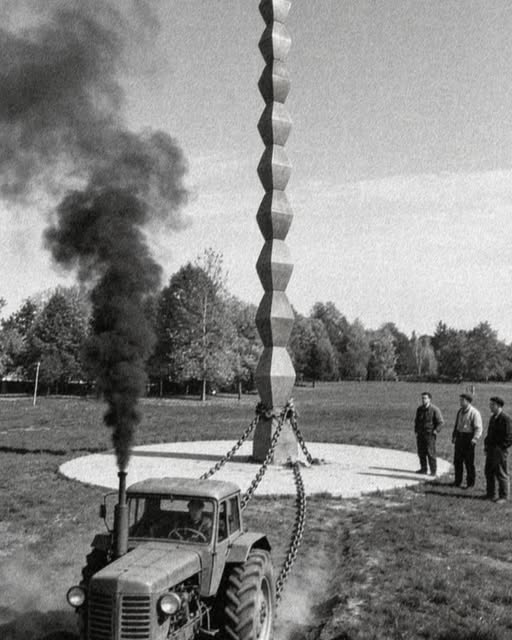
You might have already recognized Brancusi’s Endless Column. World famous sculpture built in Targu Jiu, Romania. Considered to be ‘decadent’ by a local communist activist in the 1950’s. So, being ‘decadent’, it had to be removed. The recovered iron was going to be melt and used in the industry.

Fortunately, the activist running the show was an idiot.
A smarter guy would have attached those chains higher. Far higher. The results may had been different.
The rig pictured above didn’t accomplish anything. The chains broke and the column didn’t budge.

The whole thing is a perfect example.
For what happens when an ignorant nincompoop tries to remodel the reality.
Nothing if the reality is lucky.
Nothing good in all other instances…


Neo-liberalism – a ‘folly’, to be polite – was, and continues to be, a reaction to an all-encompassing left wing etatism. A reaction to the overbearing attitude of the government. Of too many of the governments around the world.
The fact that neo-liberalism has ‘gone too far’, way too far ‘in the right direction’, doesn’t excuse etatism. One folly doesn’t justify another.
Since Milei’s Argentina is a particularly poignant example of neo-liberalism, I may very well point out that ‘it takes two to tango’…
As for the root of all our problems… that’s ideology itself. Left, right… each and everyone of them. Each of every pre-scripted attitudes we tend to adopt when trying to cope with the excesses we need to survive on a daily basis.
We no longer examine the factual reality whenever we need to figure something out. To solve a problem. To cope with a situation.

We check what ‘our’ ideology has to say about the subject…

I argued in my previous post that corruption is akin to decay.
Going forward, evolutionary speaking, we need to figure out what’s driving it. It’s ‘raison d’etre’.

Decay, also known as decomposition, re-allocates resources. Frees resources. Resources previously used in an currently ‘dead process’. Building blocks currently stuck in a corpse. Waiting to be freed, in order to participate in the next living process.
Corruption does more or less the same thing. Only less naturally. Way less naturally, sometimes bordering malignancy…

I mentioned corruption taking place in two environments. In a closed, abandoned, fridge – in an authoritarian environment, or in an open forest. A free society. In the fridge, corruption begets ‘hairy’, aberrant, ‘things’ while in an open society corruption plays a more nuanced role.

‘Intensity’ wise, at the individual level, there is ‘grass-roots’ corruption – like tipping your restaurant server or your hairdresser – and white-collar corruption. Which culminates in ‘pork-barrel’ politics.

‘Consequence’ wise, at the social level, grass-roots corruption sets the stage for the white-collar variety. ‘Educates’ people. Accustoms individuals exposed to it with the phenomenon. White-collar corruption weakens the entire society. Prepares it for take-over. Softens it for ‘revolution’. Not very different from an insidious rot weakening a seemingly strong tree before it is knocked over by wind.

Historically speaking – as in looking back in time – it’s easy to notice that corruption weakens both kind of societies. Open as well as the authoritarian ones.
The difference being that it works in opposite ways!

Corruption frees, eventually, those living in authoritarian societies.
The same process weakens the open, democratic, societies which allow it to grow malignantly.

Let’s remember.
Hitler’s Germany was defeated not only by the valor of those resisting its aggression but also by its inability to adapt. By its absolute corruption.
USSR collapsed, under it’s own weight, like all other empires. The British one included.
No authoritarian regime had ever survived for the long run. Each change of dynasty was, in reality, the advent of a new authoritarian regime. People had no alternative in those times.
On the other hand, no democratic regime had ever collapsed as long as it had managed to preserve its democratic character. What had happened in Eastern Europe after communism had caved in is ample proof for my thesis.

Corruption kills.
Sometimes literally.

Some ten years ago – 2015, October 30 – a fire broke out in a Bucharest night-club.
64 people died on the spot, including 4 members of the band. “The day we give is the day we die” was one of the tunes Goodbye to Gravity played that night.

The inquiry had determined that corruption was the main cause for what had happened. Safety certificates issued outside any norms, dysfunctional health care, unresponsive authorities… Massive popular protest forced the prime-minister to resign.
Things are better now, in Romania, but only slightly. Too slightly…

The point being that we’ve been warned.
Lord Acton: “Power tends to corrupt and absolute power corrupts absolutely.
Frank Herbert: “It is not that power corrupts but that it is magnetic to the corruptible.

Both were right.
Power both corrupts and is a magnet for the corruptible!
Hence we need to keep it in check…

Nothing moves without power. We need it. To make things happen.
We also need to survive. To remain alive after things will have happened!

In order to do that, we need to understand something.
About the thing which may derail the whole thing.
About corruption!

Current events – Andriy Yermak resigning his post in Ukraine and Federica Mogherini being detained – are hailed as being ‘flaws’. As highlighting the weakness of Ukraine and the EU, respectively. Their ‘unworthiness’.

I forcefully disagree.
Corruption, like decay, is a natural thing.

Let me put it in a different perspective.
Decay may happen in an abandoned fridge. A closed space in which all kind of ‘unnatural things’ will happen if left unattended.
Decay naturally takes place in a forest. Where ‘no longer living’ organisms ‘turn back to dust’.

A fridge – which is a dead thing, specially when abandoned – is incapable of managing anything. Including a process of decaying.
A forest – which is a meta-living organism, if you’ll allow this expression – thrives as long as natural processes can take place. Decaying being one of the most important ones.

Same thing goes for societies.
Open societies – the ones known as democracies – are no more and no less ‘corrupt’ than the closed ones. The ones usually known as autocracies. In the sense that those in powerful positions are equally tempted by corruption. Equally tempted to misuse their power…
The difference being that the open societies deal with corruption in an open manner. Above the board. In public. In a court of law.
While autocracies deal with the corrupt people only when the autocrat allows it. Only when the autocrat feels that a particular act of corruption is detrimental for his own well being…

So.
Every time an open society exposes an act of corruption, that society becomes stronger.
While autocratic regimes are corrupt from top to bottom. By definition. Very much similar to an abandoned fridge brimming with ‘hairy’ things.

Winning the war is not enough.


At the end of WWI, the vanquished was left to her own devices. After having been saddled with huge war reparations. The US – whose President, Woodrow Wilson, had been the brain behind the League of Nations – went back into its ‘splendid isolation’.
Adolf Hitler rose to power. Conquered the western part of Europe and then attacked the Soviet Union, convinced that the US would not intervene into the conflict. Convinced that ‘Western Civilization’ had become weak. That the good life enjoyed by those living there had ‘mellowed’ the people. Read ‘castrated’.
Japan was convinced that attacking the US was a good idea. For more or less the same reasons used by Hitler to convince himself that America wasn’t going to fight back.

America had to fight on two fronts. For otherwise all her partners would have been conquered. For otherwise America would have been left alone…

Any resemblance with the current situation, when America seems to be extracting herself from the European front and when Russia has been left to her own devices after loosing the Cold War, is purely coincidental. And since there’s no such thing as a coincidence…

Doing business is not enough.
America and Nazi Germany did a lot of business.
Nazi Germany and the Soviet Union did a lot of business.
The EU and the US did a lot of business with Russia.

WWII is ample proof.
Winning a war is useless unless followed by a workable peace. Which comprises the integration between the victor and the vanquished.

Yet winning the war comes first.
Any attempt to integrate an unrepentant aggressor is doomed to fail.
1938 Munich Agreement and 2014 Crimea should be enough.

Things – every’thing’, actually – are/is relative.
Relative to the agent evaluating each of those things
.
Accordin’ to Einstein, that is.
He was the one who taught us to use whatever reference frame suits our needs.

Do you reckon anybody wasted any time or energy thinking about freedom before the advent of slavery?
Me neither.
Forget about the fact that, in those times, people didn’t have much time left for abstract thinking. Finding food and enjoying it with friends kind of drains your energy when you have to do it yourself… The point being that, in those times, everybody was free. Hence ‘had’ nothing to compare freedom with… No lack of freedom, no reason to speak/think about it.
No reason to notice the thing and no reason to coin the concept…

Hunter-gatherers have no use for ‘property’. Personal objects are just that and everything else either belongs to Mother Nature or to the entire group. And this goes without saying. Or thinking about it. People share everything as a matter of fact and common sense discourages the others to use anybody’s personal objects unless in an emergency.
Agriculture – either herding animals or growing crops – changed everything. Property, both as a concept and as an everyday manner of dealing with ‘things’, was invented and introduced in daily use. Productivity increased dramatically. Which made it possible for people to have ‘spare time’. For thinking.
And for planning…

‘The neighbors have better crops. Let’s go take some for us. And while we’re at it, let’s take some of their women too’.
The first slave was probably the first person to long for freedom…

‘Cheap’ slave work coupled with the increased social productivity induced by a markedly improved technology for obtaining food meant that some individuals could afford the luxury of thinking.
The Ancient Athenians had both slaves and philosophers. The slaves did whatever was needed to be done while some of the ‘beneficiaries’ had enough time, and energy, to let their minds ‘free’. To roam free in search for meaning.
To coin the concept and to explore freedom…

Relative “To whom”? To us!
We’re responsible for freedom and freedom is relative to us.
We have invented it. We’re the ones using it. In the sense that we’re the ones who need to notice that freer communities fare a lot better than the less free.

So freedom is relative both to those thinking about it and to each particular community.
To each particular community which puts freedom into practice!

The answer you get depends on the question you try to answer…

“To see Steve Lazarides, Banksy’s former manager, tag his creative genius by staging an unsanctioned exhibit, complete with a souvenir shop, is the greed Banksy graffitied against,” Chapman responded by email. “I can only await his response – and I envision a large mural featuring a rat with a human face.”

‘Art’s uneasy alliance with capitalism’…
‘the greed Bansky graffitied against’!

I gather from Chapman’s words that Bansky has a grudge with greed, not necessarily with capitalism itself.
And I wonder how ‘art’ and ‘capitalism’ may ever enter into an alliance. However uneasy…

Both art and capitalism are, first and foremost, concepts.
On a more practical level, both can be construed as ‘places’.
Art is the place where people so inclined ‘do their thing’.
Capitalism is a social arrangement. The current manner in which most social organisms – nations, in modern parlance – run their economies. Organize the constant exchange between them, nations, and their environment. As well as the economic relations which exist between the individual members of each society.

OK, artists do need to eat… to wear clothes, to use a shelter… Artists are involved in the economic life of the society at large. So artists do have capitalist ties with the rest of the world. Organic ties, not agentic ones. The artists’ need to eat does not depend on their will. Only their greed, in as much as they allow that sentiment to manifest itself.

Which brings us back to Bansky…
I understand from Chapman’s words that Bansky has a grudge against greed!
Which is fine by me…

Some other people, quite a few, have developed a grudge against capitalism itself.
Google ‘anti capitalist art’.
Click ‘images’.
Most of the ideas present there are valid. Many of those yielding a lot of power, a lot of ‘capitalist power’, do behave badly. Are too greedy. Disrespectful. Towards other people and towards the environment.
But should we toss the baby out with the dirty bath water?

Consequences.
We are the consequences of the decisions we take.
Of the choices we make.

As biological organisms, our fate, both individually and as a species, depends on whether circumstances remain habitable. Whether we can continue to live.

As rational humans, our individual destinies depend on luck, genes and on our ability to make good decisions.

‘Good’ decisions!
The tricky part being that nobody knows in advance the consequences of our decisions… whether a decision we consider to be good – when we take it – will remain so after its consequences will have been evaluated. After enough time will have passed for the full gamut of consequences to unfold…

To make things easier, humanity has developed ‘culture’.
Layered information which has morphed into ‘Weltanshauung’. Experience distilled into knowledge and accrued in time. Advice we no longer need to ask, only to remember.
When in a hurry, we do as we always used to. Back to the tried and tested.

But there’s a small problem here.
The cultural norms might have been ‘tried and tested’, hence ‘right’, but are we applying the appropriate norm in the given circumstances? Have we interpreted whatever information we have in the right way?

Ukraine is at war. Resisting aggression against all odds. Despite some of those in power attempting to access ‘undeserved rewards’. Unfortunately, war profiteering and corruption are as old as civilization…

Earlier this week, NABU (National Anti-Corruption Bureau of Ukraine) and SAPO (Specialized Anti-Corruption Prosecutor’s Office) said top company officials demanded illicit commissions of 10-15% from contractors.
The corruption allegations center on contracts linked to Energoatom, which provides most of Ukraine’s electricity.
According to investigators, an organized criminal group laundered the funds through an office in central Kyiv linked to the family of former lawmaker and suspected traitor Andriy Derkach. Among those named in the case was then-Energy Minister and later Justice Minister Herman Halushchenko.

https://www.kyivpost.com/post/64185

How do we choose to evaluate the current development?

As yet another step in the right direction? A country at war cleaning up its act?

Or…

Further more, what will we choose to DO?… after we will have chosen an interpretation to fit our ‘general disposition’… ’cause, unfortunately again, this is how we tend to evaluate things! Specially when we’re not diligent enough. Allow our ‘general disposition’ to take over and permit our reason to cowardly back off …

Help Ukraine to defend itself? And the rest of Europe? Freedom in general!
Or give up? On Ukraine, on cultural norms which seemed set in stone until not so long ago…

And the Truth shall set you free.

Heidegger, the philosopher, has an interesting take on this ‘truth’ thing.
Nobody does, and never will, know everything about anything. Lest of all about ‘everything’. Hence nobody has access to a ‘true’ piece of knowledge.
Furthermore, ‘truth’ is about communication. About a message. An expressed piece of knowledge. And since there is no language precise enough to allow a communicator to cram into a message all they want to express… nor precise enough to allow a ‘reader’ to figure out everything the communicator had attempted to express…
Which drives Heidegger to posit that truth depends on intent. On a communicator sharing honestly everything they know about a subject. On a communicator allowing the receiver of the message to reach their own conclusion.

I ended my previous post by mentioning the ‘fairy tales’ our ancestors have spun in order to ease their ‘passage into the great unknown’. Thus making their lives bearable. Enjoyable, even.
In those times, ‘the truth’ – the unconcealed truth, in Heidegger’s terms – was that nothing made sense. That life itself was a meaningless joke. As a Romanian saying goes, ‘life resembles a hair from the private parts of the body. Short and full of shit…’
I’m not going to make a historical inventory of the various fairy tales the humankind has used to lullaby itself into accepting life as it used to be. Enough to say that they, the fairy tales, did the trick. Helped us reach the present stage.

I’m going to make a break here.
And notice that any, or even all, of those fairy tales might, eventually, be proven as being true. No matter how improbable this might be. I’m not an atheist. I just don’t know whether a god, or more, do exist.
What I do know is that, by their own admission, all of those stories have been spun by people.
Each of those stories is about what the original ‘spinner’ saw fit to communicate on the subject.
And the better stories, those who made more sense in the particular circumstances where they had survived, made it up to the present.
Helped the respective believers to survive. Helped some of them to thrive, even.

Now, today, we need to make up our minds.
Accept that our consciences are works in progress.
That consciousness is a space caught up in an accelerating evolution. A cauldron of sorts.
That each of those ‘fairy tales’ was useful in its own time. That the need to mitigate our cognitive dissonances continues to exist.
That we’re responsible for our future. Nothing new here.
And that there’s no one to save us. Not now. Or after we will have fucked up everything.


The ‘Truth’ being that ‘Give me Liberty or give me Death’ was a very effective call at arms.
On the face of it, on the ‘logical front’, it doesn’t make much sense.
‘Death’ was, and continues to be, inexorable. Why, for the sake of ‘liberty’, jeopardize the few precious moments left to be experienced as a living creature? Specially when, according to the lore considered valid when Patrick Henry had uttered the words, a second life was going to open just ‘after’…
‘The Devil is in the details’!
The belief in the ‘after-world’ works both ways. It encourages the freedom-fighters to take risks – believing they will get their reward ‘afterwards’ – and encourages the prudent to endure. Believing that they will get also get their reward ‘afterwards’.

Now, that I’ve ‘spilled it out’, I must confess that I’ve successfully convinced myself.
I’ve rationalized, according to my standards, my belief that it’s our responsibility.
To understand and accept that we’re responsible for the consequences we’re leaving for those coming after us.
I don’t know what we should do. I’m no prophet.
But I do know what we shouldn’t.
You do too!