Archives for category: arrogance

Bill Clinton, that is.

“It depends on what the meaning of the word ‘is’ is. If the–if he–if ‘is’ means is and never has been, that is not–that is one thing. If it means there is none, that was a completely true statement….Now, if someone had asked me on that day, are you having any kind of sexual relations with Ms. Lewinsky, that is, asked me a question in the present tense, I would have said no. And it would have been completely true.”

Trump: “Yeah that’s her with the gold. I better use some Tic Tacs just in case I start kissing her. You know I’m automatically attracted to beautiful… I just start kissing them. It’s like a magnet. Just kiss. I don’t even wait. And when you’re a star they let you do it. You can do anything.”

Bush: “Whatever you want.”

Trump: “Grab them by the pussy. You can do anything.” “

PS

Listening to Trump describing his unbridled urges I couldn’t repress the memories of how we,  rambunctious teenagers gathered in the local park, drinking  under-aged beers and smoking unfiltered cigarettes, were bragging among ourselves about completely imaginary sexual exploits and how the older ones, those who had already experienced ‘the bliss’, were smiling when overhearing our pretenses…

It was only later in life that I learned the real difference between not being able to ‘keep it in your pants’ and not being able to keep your mouth shut about ‘it’.

“There are known knowns. These are things we know that we know. There are known unknowns. That is to say, there are things that we know we don’t know. But there are also unknown unknowns. There are things we don’t know we don’t know.”

Donald Rumsfeld (b.1932)

“Of all things the measure is man, of the things that are, that [or “how”] they are, and of things that are not, that [or “how”] they are not.”

Protagoras of Abdera (c.485 – 415 BCE)

“Making (political) decisions requires judgement and skill. It should, Plato urges, be left to the experts.”

Plato (c.425 – 348/347 BCE, ‘translated’ by Johnatan Wolff in
An Introduction to Political Philosophy, 2006)

“The Prime Mover causes the movement of other things, not as an efficient cause, but as a final cause. In other words, it does not start off the movement by giving it some kind of push, but it is the purpose, or end, or the teleology, of the movement. This is important for Aristotle, because he thought that an effective cause, giving a push, would be affected itself by the act of pushing. Aristotle believed the prime mover causes things to move by attraction in much the same way that a saucer of milk attracts a cat. The milk attracts the cat but cannot be said to be changed in the process! “

Aristotle (384 – 322 BCE)

“Give me a place to stand and I’ll move the Earth”

Archimedes (c.287 – 212 BCE)

“For every action there is an equal and opposite re-action”

Sir Isaac Newton (1642 – 1727)

“As many more individuals of each species are born than can possibly survive; and as, consequently, there is a frequently recurring struggle for existence, it follows that any being, if it vary however slightly in any manner profitable to itself, under the complex and sometimes varying conditions of life, will have a better chance of surviving, and thus be naturally selected. From the strong principle of inheritance, any selected variety will tend to propagate its new and modified form”

Charles Darwin (1809 – 1882)

“The Communists, therefore, are on the one hand, practically, the most advanced and resolute section of the working-class parties of every country, that section which pushes forward all others; on the other hand, theoretically, they have over the great mass of the proletariat the advantage of clearly understanding the line of march, the conditions, and the ultimate general results of the proletarian movement.

The theoretical conclusions of the Communists are in no way based on ideas or principles that have been invented, or discovered, by this or that would-be universal reformer.
They merely express, in general terms, actual relations springing from an existing class struggle, from a historical movement going on under our very eyes.”
Karl Marx (1818 – 1883)

“Einstein deduced that there is no fixed frame of reference in the universe. Everything is moving relative to everything else….
… space has three dimensions, and the fourth dimension is time.
Space-time can be thought as a grid or fabric. The presence of mass distorts space-time.”

Albert Einstein (1879 – 1955)

“”Heidegger’s analysis of Plato attempts to show that a transformation occurs in the nature of truth in Plato’s philosophy, as a consequence of which Being is subordinated to the correct perception of beings. This subordination, Heidegger maintains, characterizes the history of Western philosophy as metaphysics.
The allegory of the cave is, for Heidegger, an illustration of the nature and process of paideia. At each level of ascent — within the cave to the light, and out of the cave to the sun — the individual experiences a painful blinding. Each stage requires an adjustment and transformation in vision. This transformation in vision expresses the turning of the soul from what is disclosed in one region to what is disclosed within another. This is paideia, according to Heidegger. The relationship of paideia, in this new sense, to alétheia is not apparent because, as Heidegger sees it, we have not only misunderstood the nature of education but, more importantly, have misconceived the nature of alétheia by conceiving it as “truth.” If paideia is a transition from one abode to another, affected by the soul’s receptivity to what is disclosed within each region, then alétheia is disclosure itself: “At first truth meant what was wrested from a concealment. Truth, then, is just such a perpetual wresting-away in this manner of uncovering.
Heidegger indicates that what “truth” means is not so much a correspondence as it is a disclosure.”

Martin Heidegger (1889-1976)

The depth of the uncertainty principle is realized when we ask the question; is our knowledge of reality unlimited? The answer is no, because the uncertainty principle states that there is a built-in uncertainty, indeterminacy, unpredictability to Nature.

Werner Heisenberg (1901 – 1976)

“Contrary to the tenets of classical economics, Simon maintained that individuals do not seek to maximise their benefit from a particular course of action (since they cannot assimilate and digest all the information that would be needed to do such a thing). Not only can they not get access to all the information required, but even if they could, their minds would be unable to process it properly. The human mind necessarily restricts itself. It is, as Simon put it, bounded by “cognitive limits”.

Herbert Simon (1916-2001)

‘Evolution is not as much about the survival of the fittest as it is about the demise of the unfit’

Ernst Mayr, (1904 – 2005, What Evolution Is)

“We human beings can reflect on ourselves, on what we do as well as on what we do not do, on what we imagine and on what we do not imagine, that is, we are self-conscious beings. Yet, how do we do this has been, and still is a mystery for many philosophers, scientists, and mystics that reflect on the matter. So, the search for an explanation continues, with some people hoping to Þnd some unique entity, different from what we connote or intend to connote as we speak of our self, that by itself may provide us (that which we are without it?) with this ability. Others look for some property of the operation of our brain that realises in us the ability that we call our self-consciousness. The old dilemma entailed in these and other different attitudes can be stated as follows: Is our operation as self-conscious beings a property of our brain, the gift of some external agent, or does it consist in some particular manner of our operation as organisms in our interactions?”

Humberto Maturana (b. 1928)

” “Consider a turkey that is fed every day,” Taleb writes. “Every single feeding will firm up the bird’s belief that it is the general rule of life to be fed every day by friendly members of the human race ‘looking out for its best interests,’ as a politician would say.

“On the afternoon of the Wednesday before Thanksgiving, something unexpected will happen to the turkey. It will incur a revision of belief.” “

Nassim Nicholas Taleb (b. 1960)

It seems rather obvious that humankind has ‘consistently’ oscillated between two opposing views on things.

Some of us are convinced that the (whole) truth can be achieved (and that ‘they’ had already done that) while others have reasons to believe that while ‘individual efforts’ are indeed the source of everything that exists, the final results of those efforts are always being shaped/conditioned/reacted to by the medium where they are exerted and by those who bear the consequences.

Coming back to Rumsfeld’s words it seems that the most important (dangerous?) category is, contrary to our first impression, the (presumptive) ‘known – known’.
We cannot do anything about the unknown-unknowns, except for preparing ourselves in a ‘general manner’, and we can always ‘dig up’ something fresh about the known-unknowns but it seems that nothing can convince us that what we consider to be the known-known is but a thin layer of ice floating on a very deep lake.

So the real question that awaits our response is ‘What are we going to do, now that so many have told us what’s been going on?’

Abraham Maslow, the initiator of ‘humanistic psychology’, has been described as being “concerned with questions such as, “Why don’t more people self-actualize if their basic needs are met?” and basically why don’t people try to reach their full potential.”

“To over simplify the matter somewhat it is as if Freud supplied to us the sick half of psychology and we must now fill it out with the healthy half. Perhaps this health psychology will give us more possibility for controlling and improving our lives and for making ourselves better people. Perhaps this will be more fruitful than asking “how to get unsick”. (A. Maslow, Toward a Psychology of Being,)

In a sense Maslow follows in the footsteps of J.J. Rousseau.

“Although, in this state [civil society], he deprives himself of some advantages which he got from nature, he gains in return others so great, his faculties are so stimulated and developed, his ideas so extended, his feelings so ennobled, and his whole soul so uplifted, that, did not the abuses of this new condition often degrade him below that which he left, he would be bound to bless continually the happy moment which took him from it for ever, and, instead of a stupid and unimaginative animal, made him an intelligent being and a man” (J.J. Rousseau, The Social Contract)

In more than one sense.

Both consider that society presents its members with almost endless opportunities for self em-betterment, both wonder how come so few make good use of those opportunities and both have been accused of things they have never done.

Rousseau has been falsely accused of being the father of the ‘Noble Sauvage’ – and the quote above proves his complete innocence, ‘stupid and unimaginative animals’ can be mistaken for ‘noble savages’ only by those ‘abused’ by their ‘new condition’ – while Maslow’s detractors – who have failed to scientifically validate all aspects of ‘the hierarchy of needs’ – are questioning the scientific nature of Maslow’s ideas instead of reconsidering their own positions. (The truth being that Maslow had stated upfront that “I yield to the temptation to present it (his notion of a ‘Psychology of Health’, which includes the concept of ‘self-actualization’) publicly even before it is checked and confirmed, and before it can be called reliable scientific knowledge“)

Unfortunately it is rather obvious that while Maslow has successfully detailed what it takes for an individual to ‘ripen’ into the situation of being able to ‘reconsider its own self’, he failed to reach as far as Rousseau was able to. While the latter deplored the fact that ‘the abuses of his new condition often degrade him below that which he left’ the first blindly entertained the notion that self-actualization is necessarily a positive process.

I’ll use only two examples to illustrate my theory, even if by doing so I’m presenting myself as a target for the ‘science-nazi’.
First take a glance at those who founded/were involved in running LTCM. All of them had very respectable careers behind them at that moment. Why did they feel the need to get involved in such a risky business? For those of you unfamiliar with the financial world LTCM was a hedge fund which had to be bailed out in 1998 after losing $4.6 billion, a huge amount of money for those times.
Then tell me what drove Bernard Madoff, an already very successful ‘operator’ in the financial market  to transform the wealth management branch of his company into a huge Ponzi scheme that eventually lost some $18 billion of actual money ($65  billion if the fabricated gains are added to the total)? Not to mention the fact that he involved his family into the daily operation of his company, leading to his brother being sentenced to 10 years in prison and one of his sons committing suicide… – the other one died of lymphoma a few years after Madoff had been incarcerated.

Could it be that this ‘self-actualization’ business depends on two things, the character of the individual involved and the kind of interaction that exists between him and the community of which he is a member? Meaning that if the ties are weak the character of the individual becomes the dominant factor?

And since nobody’s perfect…

“It is not power that corrupts but fear. Fear of losing power corrupts those who wield it and fear of the scourge of power corrupts those who are subject to it.” (Aung San Suu Kyi, Freedom from Fear)

But also

All governments suffer a recurring problem: Power attracts pathological personalities. It is not that power corrupts but that it is magnetic to the corruptible.” Frank Herbert, Chapterhouse: Dune

I’ll end up saying that it’s not the governments that have a ‘recurring problem’ but the peoples themselves. By definition governments come and go, it’s the peoples that stay behind and must suffer the consequences of ‘self-actualizations’ went wrong.


quote-we-learn-from-history-that-we-learn-nothing-from-history-george-bernard-shaw-52-49-23

Funny, isn’t it?

Or yet another reminder that constantly cracking jokes about everything and everybody is not exactly the best thing to do… Let’s compare the relative importance of the British Empire during Shaw’s coming of age – the period when he developed his habit of cracking jokes about everything, no matter how serious the subject, with the fact that Scotland is seriously planning a second independence referendum.

Or let me remind you of another Brit who enjoys cracking annoying jokes:

3727584669

Not funny anymore?

OK, let me try another tack.

What if

caaf122f196e61ec72335fd6ee6b0981

Could it be that the problem resides with us?

That this is basically a matter of what we do with whatever (history) has been passed to us by our forefathers? That what has been passed to us does have its own importance but that we can’t do very much about it?
History can only be rewritten but never changed…
We, on the other hand, can and should learn to deal with the dynamics of this world.


learning_from_history

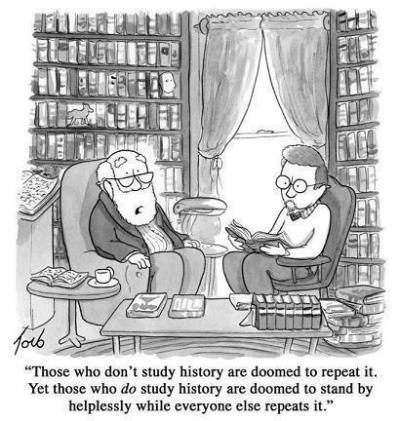
How come ‘those who do study history are doomed to stand by helplessly while everyone else repeats it’?

Could it be that some of the ‘students of history’ are doing something wrong?
Misunderstand the very lessons they try to impose on the others?

Cracking annoying jokes about the matters at hand instead of honestly helping others to reach intellectual autonomy and then respectfully allowing them to develop their own interpretations of things?


The scientists act on the assumption that their efforts to un-peel the  ‘onion’ will eventually bear fruit and that ‘the truth’ will eventually be found crouching behind the proverbial ‘last skin’.

The artists keep torturing their souls hoping that theirs will be the one blessed with enough sensitivity to feel the ‘ultimate’ experience and with enough talent to be able to communicate it to the rest of us.

The mystics keep entertaining the proverbially faithful ‘grain of hope’ that their soul will be blessed by their Maker with some ‘insider’ knowledge and with enough stamina to make the revelation known to the rest of the flock.

Meanwhile the rest of us, the ‘regulars’, keep altering the ‘onion’ – otherwise known as ‘The Reality’, sometimes beyond recognition.

Let me elaborate.

As of now it seems that there are a hard core reality – the one feverishly pursued by all those mentioned at the start of my post, a multitude of partial images of what that reality looks to each of us – the ones made up by each of us when trying to make sense of our perceptions about the (hard core) reality, usually without being aware that what we look at is a window dressing composed of the numerous patches pinned by by each of us on the original while acting according to what each if us perceived to be (the image of) the ‘reality’.

And it’s exactly this overgrowth that constantly changes the object of perception at which each each of us stares continuously and tries not only to understand it but alto to adapt to it. Constantly forgetting that our efforts not only adapt us to the (perceived) reality but also alter the reality itself, not only the image we perceive of it.

But hold on. I haven’t mentioned the really interesting part yet.
All of the above constitute the ‘innocent’ side of the whole thing. The natural process that would take place if all of us would act ‘up-front’.

In reality some of us have ‘ulterior’ motives.
Some of us consider that their understanding of the world is not only better than that of everybody else but also that they are entitled to act based on that understanding. Without asking permission from and sometimes even against the wishes of those who will bear the brunt of the consequences brought forth by those actions.

That’s why the ‘patches’ pinned by these callous people fit a lot less to the real reality than those attached by the honest ones among us.

And that’s the catch.
The ‘distance’ between the reality of a fact and our perception/action about it produces a certain ‘energy’. If the distance is small the energy corresponding to it is manageable. People can adjust to it and absorb its consequences.
But sometimes the distance is larger than what can be comfortably absorbed and this leads to the formation of social scars. And if successive ‘distanced’ patches are applied without enough healing time in between, then, eventually, wide ‘gaps’ will have to be dealt with.

And since ‘wide’ produces a lot of ‘energy’ and ‘a lot of energy’ leads to massive upheavals…

trumped up plagiarism

I’m not naive enough to argue that the most powerful man on Earth must also be a very honest one and that not even the slightest shadow must be allowed to tarnish his public image.

After all even his followers portray him as an effective leader who gets things done, not as a virgin knight riding a white horse. Otherwise the ’eminent domain’ incident and all subsequent ones would have already scuttled his political career.

Recent developments show that at least some Americans have started to figure out the real danger posed by his ‘management style’:

It’s an embarrassing screw up; clearly the passages were lifted, and a half-assed attempt was made to vary them by changing a word or two. Sad thing is, Melania actually did a good job in the delivery. This didn’t have to happen.

It just offers more evidence that Trump can’t/won’t hire competent people. He’s ultimately responsible here. With him as President, we’d probably be subject to these kind of embarrassments on a daily basis. Seems he either hires people who are in way over their head, or hires smart people and then refuses to listen to them. What kind of cabinet would he pick as President? It really doesn’t matter; he probably wouldn’t heed their advice anyway

Unfortunately they also prove that there are some people who don’t give up on him so easily:

Michelle Obama did not write “her” speech. A team of paid political speechwriters did. THAT is Trump’s point with having his wife repeat those words.

PS.
Just read about another possible interpretation of what had happened.

The sentences were probably planted there to make Melania’s speech go viral and drive the left wing crazy.

Very plausible hypothesis, given Trump’s modus operandi, and suggesting that Trump may entertain an even more disparaging opinion on his followers than the one he has already expressed:

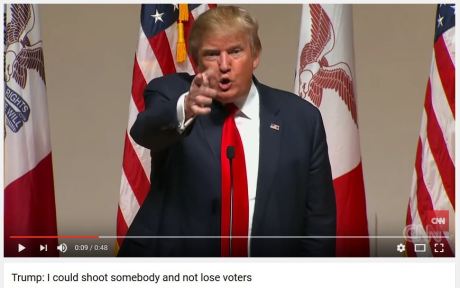
““I could stand in the middle of Fifth Avenue and shoot somebody and I wouldn’t lose any voters,” he said.”

‘I can make my wife do some dirty work for me and still not loose any voters’.

shooting trump

tainted vote

“It was a fair vote. They may not like the outcome but nobody’s saying that the vote was tainted. Maybe by the misinformation ahead of it … but the actual voting process…”

If there is something to be learned from the current debacle is that democracy is about way more than honestly counting the votes.

In fact, if we resume ourselves to that, we’ll end up tied down in a cage known as ‘mob rule’. Who ever succeeds to stir up more efficiently the public sentiment will rule the day and ‘apres nous, le deluge‘.

In order for the democratic process to be efficient – actually democratic, that is – the electorate must have at its disposal all the pertinent information that is available at that moment. If the electorate doesn’t really care and doesn’t mind that information… that’s it. But the information has to be readily available.

And there’s the catch.

If those ‘in charge’ use the media to spur up public sentiment instead of honestly informing the people about the  situation at hand then we’ll have a beauty pageant instead of a democratic election. Or referendum.

What we really need to remember, fast, is that for a democracy to maintain its function – weed up the really bad leaders/ideas proposed in the public square – we need to add two things to ‘honestly counting the votes’.

‘Mutual respect’ among all members of a given society and a keen enough interest of a majority of the members of that society in the well being of their community.

‘Democracy’ won’t work properly unless the voters respect each-others, and the government they had, themselves, elected. Simultaneously  the government has to treat ‘the people’ with utmost respect, not as if they were hapless children in dire need of close guidance.

At the same time no democracy ever successfully maintained its character unless the ‘leaders’ were constantly remembered of their ‘mortal’ status.

And the Lord God said, “The man has now become like one of us, knowing good and evil. He must not be allowed to reach out his hand and take also from the tree of life and eat, and live forever.”” Genesis, 3:22

The point being that those who think they can make the difference between good and evil need their feet constantly brought back to the Earth.

In Heaven it was God who did that. Here on Earth God works through the hands of Man. Hence we have to take good care of our own fate.
We won’t be able to do that efficiently unless we start respecting each-others, and each-others’ opinions – because none of us will ever be able to know the entire truth so we’ll be better off collectively if we share our knowledge.
For the very same reason – no one can master all the information that floats around us – all those who try to grab too much power must be treated with ‘extreme caution’. Again, this can be done more efficiently in a collaborative, and respectful, manner.

That’s why I’m convinced that the EU needs to be remodeled, not bulldozed.

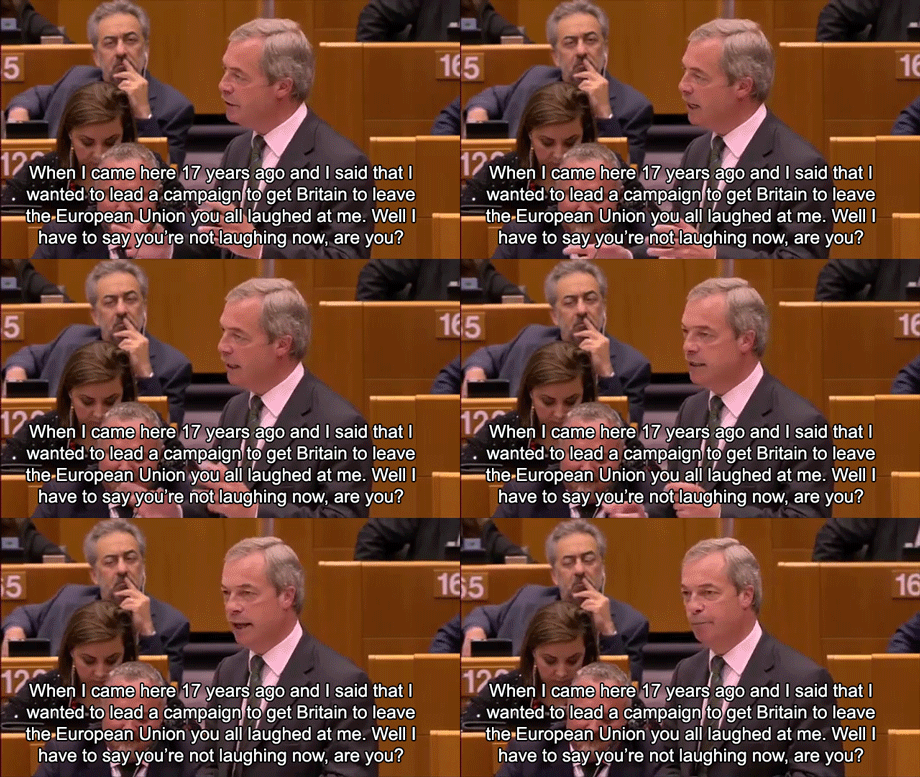
the brexit hero

“Isn’t it funny?
You know, when I came here 17 years ago and I said that I want to lead the campaign to get Britain to leave the EU, you all laughed at me.
Well, I have to say, you are not laughing now, are you?”


Now let me get something straight.

This guy has been going to work, as an elected official, with one goal in mind. And one goal only.

To undermine the very institution he was working for.

Not to improve it in any way but to simply dismantle it.

I’m not going to discuss here whether he is right about the shortcomings of the EU or not. (He is)

But I am going to question his modus operandi.

OK, he did point out, very astutely, which are the weak points of the European Union.
And then, instead of proposing ways to mend those problems, he did his ‘best’ to make matters even worse.

That was all that he could do in those circumstances. That’s it. Nobody’s perfect.

But why elect a guy like this, time and time again, into a position where he gets to be paid, handsomely, for making trouble?

And no, he wasn’t a ‘whistle-blower’. He never came forth with anything new.
He just kept milling around a few otherwise well known ideas – most of which are absolutely correct – and then turned them on their head, effectively morphing them into ‘seeds of doom’.

And yes, he was the guy “who has repeatedly criticised wasteful EU spending” and then used 58 000 pounds of EU money to cover a security bill “for just five events held in modest venues such as a darts arena in Essex where there was not a single demonstrator.

Now go figure.
There are people out there who consider him to be “The Hero of Brexit”….

they keep telling us.

As if it would always be obvious where ‘up’ and ‘down’ are…

In his efforts to figure up how society works Max Weber has introduced the concept of “ideal type”:

Ideal type, a common mental construct in the social sciences derived from observable reality although not conforming to it in detail because of deliberate simplification and exaggeration. It is not ideal in the sense that it is excellent, nor is it an average; it is, rather, a constructed ideal used to approximate reality by selecting and accentuating certain elements.”

In other words, Weber proposed that in order to better understand social interactions we should first divest everything we consider unimportant from whatever we are studying and then concentrate our attention on what, in our opinion,  ‘makes the world go round’.

Key words here, in my opinion, being “our opinion”.

Common lore, somewhat older than organized ‘science’, used to speak about ‘put yourself in his shoes’.

To me this way of putting it shows two different things.
Commoners are more humble than scientists – none of them pretends to know which are the aspects that have to be taken into account and which are those that should be discarded –  and, maybe even more important, a lot more ‘democratically minded’ – ‘put yourself in his shoes’ plainly states that both opinions, ‘his’ and ‘yours’, have equal value.

In this sense ‘look from above’ seems a rather ‘scientific’ attitude, don’t you think?
By telling somebody that he should search a vantage point and then examine the situation from there actually suggests him to construct one of Weber’s ideal types.

Now, please, don’t get me wrong.
Of course this is exactly how human minds work.
Whenever we look at something – no matter how open minded we believe ourselves to be about it – we do it from a personal point of view. There’s no way that we can reasonably pretend otherwise.

The real problem is what we do next.

When ever we try to put ourselves in somebody else’s shoes we have to make a choice.

We can either try to understand/feel what we would have understood/felt if those things would have happened to us or we can try to imagine what the original owner of the shoes understood/felt then, when things were actually happening to him, in ‘real time’.

I’m sure you all see the difference.

This is why, whenever I’m asked ‘please look at this situation from above and tell me your conclusion’, I always start with ‘all I can do is offer my opinion on this, accompanied by a stern warning: My opinion is just that, an opinion. It can happen to be more accurate than yours but it can also be wrong. If you still want it I’ll gladly put it on the table and let us all discuss it.’

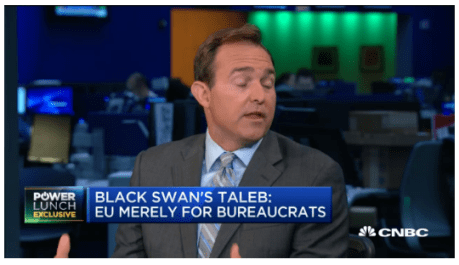
On the practical level Nicholas Nassim Taleb proposes that we should shift our focus from trying to determine which is the best option in a given situation to doing our best to avoid choosing the obviously wrong ones.

‘Obvious’ to those who do not allow themselves to become mesmerized by the illusion that ‘best’ can be identified, o course.

Shortly after becoming aware of his own awareness Man figured out that, from then on, his real job will be to attach meaning to everything that was, is and will be happening around him.

The very same moment He freaked out – because of the enormous responsibility that had just fallen upon his head – and invented god to help Him.

There is, of course, no way of knowing for certain whether a real God had interfered, in any way, shape or form, in our evolution.
The fact that so many of us think the world can be explained ‘through itself’ – that there is enough information available to construct a plausible narrative about what went on since the Big Bang – is the real proof of nothing more but the huge cockiness harbored by our inflated egos.
OK, nothing more but a long held tradition suggests that God exists for real only this is no factual demonstration about the nonexistence of God.

On the contrary. The very fact that the tradition held for so long means that God had a real contribution to our life.

It doesn’t really matter whether that God was real or contrived by us.

And the fact that so many of us use their respective gods as pretexts to commit heinous acts sends no other message than that those who commit such crimes have no real understanding about what God really means.