Archives for category: alternative ways of acquring knowledge

And the LORD God said,
Behold, the man is become as one of Us,
to know good and evil.

Genesis, 3:22

The point of this post is simple.
The difference between ‘bad’ and ‘evil’.

‘Good’ is straightforward.
It doesn’t matter – evolution wise – whether the ‘good’ has happened ‘naturally’ or ‘intentionally’.
But it makes all the difference in the world whether the ‘bad’ only happened or it was the consequence of somebody planning it to happen.

Even if that difference is visible only to us.
Conscious humans beings who use language to communicate and to consider.

Visible as well as ‘accessible’.
How many among you consider that anybody else but us, human people, is capable of ‘evil’?

And what about the perpetrators?
How many of them consider themselves to be ‘evil’? To have become evil, as they had intentionally hurt somebody?

And how come this simple ability was enough to elevate us to “one of Us” status?

On the other hand… letting go, emotionally speaking, may not be as beneficial as advertised.
We might lose some bitterness but we might become more liable to ‘repeat the experience’

As in …

Forgive but don’t forget is a lot easier to be said than done, you know…

Which brings us to:

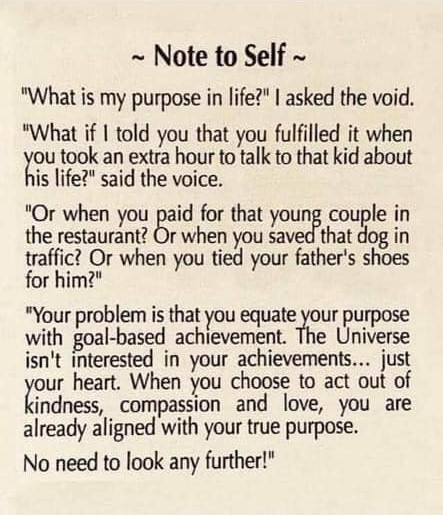
Do we really need ‘a purpose’?
As in ‘an ideologically determined goal’?
Remember Marx’s “The philosophers have hitherto only interpreted the world in various ways. The point, however, is to change it.”. Then the consequences produced by those who had followed Marx’s teachings…
But not only Marx’s!

All set goals which go ‘against the grain’ incur costly consequences.
Which are detrimental to survival! Of the leading trespasser, of those in the following or of those hapless enough to be too close to that particular goal being pursued.
Remember Marx? Nothing unpleasant had happened to him. Not as a consequence of his attempts to change the world! But to others…
Which is equally valid for all other ‘world changers’. Along with all ‘world preservers’ who run along ideologically drawn paths.

Then what should we strive for?
Simply ‘follow the heart’ to achieve ‘peace of mind’?!?
Would that be enough?

Enough for what?!?

https://www.goodreads.com/book/show/56083.In_Dubious_Battle

An inhabited planet where some of the people have finally figured out the inherently limited nature of their world.
Global warming, pollution, soil erosion, loss of biological diversity, dwindling and unevenly distributed natural resources…

Two hot wars. And a huge trilateral economic contest involving a third of the population which leaves the other two thirds in relative misery.

Most of the conflict – hot and cold alike – can be pinned down to old people doing their best (worst, more likely) to conserve their status. Wealth, power, influence…

As things happen, currently there is one collective agent which yields enough power to decisively influence the outcome of the two hot wars. And to negotiate the economic contest.
The attention of the people constituting that particular collective agent has been hijacked by an insurrectionist ex-president attempting to regain that position.
The ex-president has curried the favor of significant political party by making it possible for the party-activists to succeed in their attempt to limit women’s access to abortion.
The ex-president and soon to be presidential candidate is currently involved in a penal process. The trial attempts to determine whether the hush money he had used to silence a porn actress regarding a ‘close encounter of the third kind’ had been spent legally.

What? When? Where?
Opportunity Evolving in Time.

‘OK, I can accept the concept of opportunity evolving in time.
After all, the whole thing is nothing but a truism.
Opportunity is fluid by definition. Evolution is its natural destiny. And time is the natural consequence of evolving opportunity.
But where does this whole process take place?!?’

In our heads, where else….

Opportunity, evolution, time and, yes, ‘space’ are concepts.
Ideas coined by us, conscious human beings acting as thinking agents who use contextualized observation to further our understanding of what’s going on around us.

‘Huh?!?’

Consciousness is a state of mind.
A mind is like an AI machine. Something more than a live brain but not yet a wake, conscious, entity.
The closest thing to a ‘mind’ is a sleeping human conscience. Sleeping – hence not doing its ‘thing’ – but able to be awaken. Able to do what it’s capable of doing.
A brain is nothing but hardware. A mind is like a computer. Hardware and software put together. The only difference between a mind and a computer is that a mind is an expression of natural evolution while a computer is an expression of human ingenuity. Another thing minds and computers have in common is that both need a will to start them. To point their attention towards a goal.
This being where consciousness takes over. A mind which is aware of its own ‘wokeness’ is a conscious mind. It can pay attention, do things and generate meaning.

‘Hardware, software, natural evolution… aren’t you throwing too much ‘content’ into a single post?’

I’ll try to keep it simple.

We, humans, are the pinnacles of ‘natural evolution’. According to our interpretation of the information we have gathered until now.
As you already know, a pinnacle is a small thing perched on top of something way bigger. And for pinnacles is far easier to notice other pinnacles than to perceive what lies under them.
Our bodies – including our brains – depend on what’s going on ‘beneath’ us. In fact, ‘our’ whole world – the world we depend on, the one we live in – is working ‘in the back ground’.
Yet most of the time we’re interested only in what the other ‘pinnacles’ are doing… ‘Cause they are the ones which grab our attention!

Well, the ‘cool’ fact is that this is only ‘natural’.
In the sense that this is how we’ve become human in the first place. That’s how our minds got their ‘software’.
We’ve learned self-awareness by interacting with other human beings. We’ve built our culture by remembering the lessons learned by our ancestors. And we’ve built our civilization in concert with our brethren.
Individually, we may know little. But together we can move mountains. As we did.

And got cocky.
Our success has narrowed our attention span.

Somewhere inside the book which metaphorically recounts how we’ve learned self-awareness – the Bible – Mark, one of the evangelists, quotes Jesus:
Because of your unbelief; for verily I say unto you, if ye have faith as a grain of mustard seed, ye shall say unto this mountain, ‘Remove hence to yonder place,’ and it shall remove. And nothing shall be impossible unto you.
I’m not a psychologist. But I find this idea as being very explicit regarding the manner in which our minds work.
We cannot start anything, in a voluntary manner, before ‘believing’ in the outcome. We need to have ‘faith’ in that action. No matter how simple.

How do we get that faith?
We don’t get it, it’s being built into our conscience during the process. Continuously.
There are two factors which build our faith. Experience and reason. Past interactions we had with the wider world and the meaning we’ve derived from them. Putting it bluntly and oversimplifying things, based on previous experienced we convince ourselves, involuntarily, that it was us who were entitled to claim the merit for what had happened. Either we’ve done something right, ‘believed’ in the right things/gods or both at the same time.

Up to not so long ago, we have evolved in a religious manner.
In the sense that faith was shared amongst us. We used to share a ‘core faith’. That things not only work in a certain manner but also that things should go in a certain direction.

Success has changed that.
We’ve become so confident in our ability to generate meaning that we have emptied what’s left of the core faith.
We, the pinnacles, have reached such heights that we’re no longer aware of our link with the rest of the mountain. We’re racing ourselves for the top forgetting that we need fuel and spare parts. That our very racing completely changes the ‘racetrack’. For better or for worse…

And everything described here takes place inside our heads!
Happens inside our heads and changes, through our actions, the very world which keeps us alive.

About which individual are we talking about here?
About me? The ONE above all?
About us? The only ones who ‘belong’?
About all individuals? Regardless of age, gender, ethnicity …

“Plato suggests, and all later collectivists followed him in this point, that if you cannot sacrifice your self-interest for the sake of the whole, then you are a selfish person, and morally depraved.
But this is not so, as glance at our little table may show. Collectivism is not opposed to egoism, nor is it identical with altruism or unselfishness. A collectivist can be a group-egoist. He can selfishly defend the interest of his own group, in contradistinction to all other groups. Collective egoism or group egoism (e.g. national egoism or class egoism) is a very common thing. That such a thing exists shows clearly enough that collectivism as such is not opposed to selfishness.
On the other hand, the individualist or anti-collectivist can at the same time be an altruist. He can be ready to make sacrifices in order to help other individuals. (….) To be an individualist means to see in every human individual an end in itself, and not merely a means to further other interests, for example, those of the state. It does not mean to take one’s own individuality particularly seriously, or to lay more stress (or even as much) on one’s own interests than on the interests of others.”
Karl Popper, ‘After The Open Society’, Chapter 7.”

“On the other hand, the individualist or anti-collectivist can at the same time be an altruist…”

Sir Karl Raimund Popper had died in 1994.
Long after all of the so called collectivist regimes of the XX-th century had shown their true colors.
Long after all the self styled collectivist regimes had unveiled their murderous nature.

And murder, by definition, is the most individualistic attitude available to a human being.

Let me be absolutely clear.
I’m talking about murder here.
That thing perpetrated by an individual, alone or in cahoots with others, against other individual or individuals.
Self defense – the minimal action meant to save one’s own life, which stops as soon as its goal has been fulfilled – has nothing to do with murder. Criminals can, indeed, try to camouflage murder as self defense but their actions are obvious for all level-headed observers.

My point being that individualism cannot be defined as being anti-collectivist.
And what’s bothering me is the fact that Popper himself had fallen into this trap.

If I get this right, Popper’s main contribution to our understanding of the world is the notion of ‘falsifiability’. The idea that human knowledge – science – grows in fits and starts.
That individuals notice things, formulate their observations as theories and put them forward for public examination.
And that even the theories which hold water, for a while, will, by definition, be proven false – or at least incomplete – at some point in the future.
The way I understand this process – I’m an engineer converted to sociology – is as a continuous dialogue between individuals and the community which nurtures them.

Just as you can’t have a working engine – I’m a mechanical engineer – without all the pieces fitted in the right places and without a tank full of fuel, you can’t have a ‘healthy’ collective without ‘established’ individuals.
Symmetrically, no individual can survive – let alone thrive – alone. A baby needs to be fed and taught to walk/speak/think in order to become an individual. A conscious human being.

Collectives, currently known as nations, fare according to the opportunities enjoyed by the individuals comprising those collectives/nations. AND according to how each of the individuals understand to enjoy each of those opportunities.
The members of the North Atlantic Treaty Organization – who treated their citizens far better than how the Soviet citizens used to be treated by their self styled collectivist leaders – have fared a lot better than the defunct Soviet Union. Democratic and free-market capitalist countries fare a lot better than those run in a more or less centrally planned manner by authoritarian regimes.

And the explanation is simple. Democracy and free market capitalism mean that many more individuals have many more opportunities to contribute to the well being and the ultimate survival of their community than what’s going on inside authoritarian regimes. Where the decision making is concentrated in a very few hands. Where most opportunity has been confiscated by a handful of self chosen few individuals.
In fact, the democratic and free market capitalist countries are far more collectivist minded than the self-styled collectivist authoritarian regimes. Where only the high ranking officials count as individuals!

And no, Plato wasn’t exactly right either. His ideas haven’t reached us in their intended form… or it is us who can’t read them in an appropriate manner…
“Plato suggests… that if you can’t sacrifice your self-interest for the sake of the whole, then you are a selfish person, and morally depraved.”
‘Suggests’ already comprises a healthy dose of individual latitude. A healthy dose of individual lee-way when it comes to interpreting each individual situation. Furthermore, this is rather a matter of how a collective deals with each individual situation than an individual being selfish or morally deprived.

All situations which determine the fate of a collective are experienced, interpreted and dealt with by individuals. No collective exists as a ‘unit’. Nor reacts as one, regardless of whatever efforts have been made, under whatever disguises, by ultimately individual dictators to implement such ‘unity’. Around the ‘individuality’ of the dictator….
And whenever the individual called to solve a particular situation considers his individuality as being superior to the fate of the collective… then that individual actually lights a fuse. Which might or might not detonate a charge. Which charge might or might not destroy much… but…
The main problem here residing in the fact that many individuals haven’t figured out yet that their own individual fates are inexorably linked to that of the collective.

That if it’s not peer-reviewed, it’s not science!
That being a bona fide individualist “does not mean (that the concerned individual is entitled) to take one’s own individuality particularly seriously, or to lay more stress (or even as much) on one’s own interests than on the interests of others.”

The Dunning-Kruger effect occurs
when a person’s lack of knowledge and skill in a certain area
causes them to overestimate their own competence.

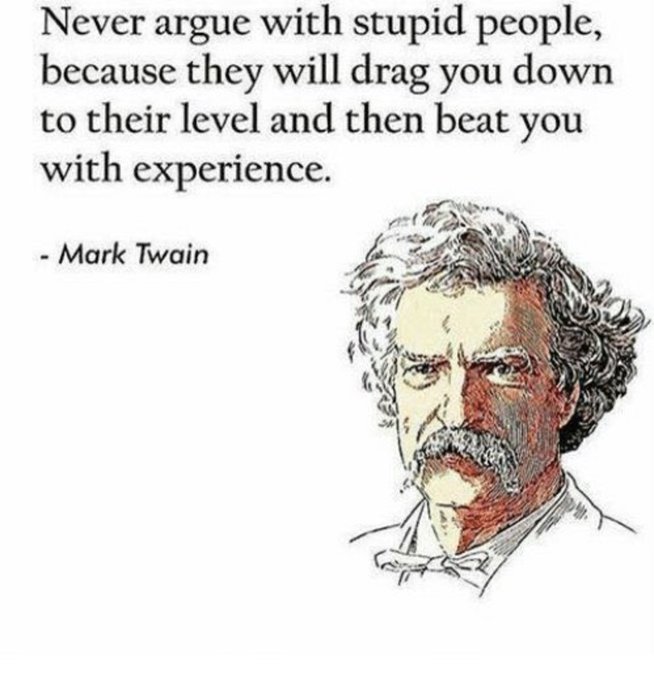
‘Experience’… as in “drag you down to their level and beat you with experience”…

But is this even possible?
For a really stupid individual to survive for so long?!? For long enough to become ‘old and experienced’…

Maybe we need to reconsider the whole thing!

My own experience – ‘Trust me, I’m an engineer!’ and I’m not kidding – strongly suggests that ‘bona fide’ stupidity is far less abundant than currently advertised.
The hard reality we have to deal with is the one described by the Dunning-Kruger effect.

Whenever we don’t understand other people’s actions, or motives, we tend to consider them as being stupid. Actions, motives and even the people themselves.
Specially when we experience the slightest discomfort as a consequence of such actions.

Furthermore, much of what is currently considered to be a consequence of stupidity is rather the result of accrued ‘misguided smartness’.

The law of unintended consequences
was first mentioned by British philosopher John Locke
when writing to parliament about the unintended effects of interest rate rises.
However, it was popularized in 1936 by
American sociologist Robert K. Merton who looked at
unexpected, unanticipated, and unintended consequences
and their impact on society.

On the other hand, never underestimate what mere happenstance can accomplish!

I hated all the things I had toiled for under the sun,
because I must leave them to the one who comes after me.

Ecclesiastes 2:18

Our hunting/gathering ancestors had been very successful. So successful that hunting/gathering has survived to this day. Not only that most hunter/gatherers continue this lifestyle even when offered an alternative but a few ‘civilized’ persons have also decided to embrace this manner of ‘making ends meet’.
According to many sociologists, it was during this stage of development that humankind had ‘invented’ spirits and totems in their quest to make sense of the world.

Agriculture – the ability to grow/raise a far more predictable amount of food than that available to the hunter/gatherers – had been the first game-changer.
Specialization is natural. Individuals are different hence each of them is better at doing diverse things.
And this was valid from the very beginning. Some of the hunter/gatherers were better at knapping others at curing hides. But because food had to be gathered constantly, by essentially every member of the clan, the specialists didn’t have many opportunities to advance their craft.
Agriculture had changed all of that.

Work specialization had given birth to social division.
Tools had been transformed into weapons and used to defend stashed crops. This process had engendered ‘landlords’ and had transformed some of the peasants into soldiers. Temporarily at first and professionally later.
Meanwhile, the specialists could stop gathering/growing food and offer the results of their toil in exchange for whatever they needed.
Trade had appeared naturally and the notion of property had to be invented in order for things to remain orderly.
A new narrative was needed to provide meaning and social cohesion.
Productivity had shot up and societies had started to produce more than they needed for day to day life
‘Left over’ resources had started to be accumulated and then used to ‘make things’.

Among other things, accumulated ‘left over’ resources had allowed local ‘rulers’ to hire more soldiers and to enlarge their fiefdom.
To put more and more (social) distance between them and the ‘common people’. And to ‘hire’ ‘thinkers’ whose job was to make sense of what was going on.
Hence organized religion and, simultaneously, ‘science’.

At some point, technology – the practical side of science – had become sophisticated enough to have a huge impact on trade.
When people have enough ‘spare time’ in which to think about ‘meaning’ they also have enough time to look for and design easier methods for doing things. For achieving practical goals. To fabricate things, to transport them, to preserve food… That was how a new profession had been invented. The trader!

Who needed a specialized tool! Money.

Trading, more and more intense and reaching farther and farther away, had furthermore increased social productivity.
Having more diverse resources at their disposal meant that people had to learn more crafts. The longer and longer distances which had to be covered induced a new technological leap in this realm.
More and more things which had to be learned, understood and made sense of enticed the birth of ‘real’ science

Science, what we call ‘science’, has again played havoc with the established order of the world.
Not only that the innumerable new technological breakthroughs have vastly increased productivity, modern science has also proposed new meaning. A new narrative for making sense of the world.
An impersonal one. Devoid of any almighty and fully responsible agent.
Abruptly, people were left without any ‘origin’ on which to peg their understanding.

‘Man as a measure for all things’ had acquired a totally new meaning.
For those who could ‘afford’ it.

The Supreme Court on Monday ruled that states cannot disqualify former President Donald Trump from the ballot for his role in the Jan. 6, 2021, attacks on the U.S. Capitol.

The Supreme Court on Friday eliminated the constitutional right to obtain an abortion, casting aside 49 years of precedent that began with Roe v. Wade.
the decision permits states to implement far more restrictive abortion laws

I’m not going to discuss any of these ‘calls’.
In a normal world, it doesn’t matter who makes a decision. At which level.

In the present world, which is far from normal, something jumps at any open minded observer.

‘States are good enough when it comes to setting rules about when a woman might have – or rather not – an abortion but they shouldn’t be allowed to decide, individually, whether a would-be president has been involved in insurrection.’

I agree with the legal minded among my readers that there are sound arguments, legal-wise, for each of those decisions. Unfortunately, most people are ‘legal-blind’. Instead of delving into the obscure paragraphs which shed light into the nook and crannies of any judicial sentence they prefer to decide based on what they see at the first glance.
And what’s staring at us is the fact that the President of the USA is elected state-side. Each state sends a number of people to Washington with a clear mandate about who should be the next POTUS. Which means that candidates need to ‘win’ more delegates, not necessarily more individual votes from the general public. States play a critical role in this process.
Equally staring at us is the fact that ‘individual rights’ are defined and upheld at the federal level. States no longer have anything to say about an individual right as soon as a particular ‘something’ is assumed – at the federal level – to pertain to the realm of the ‘individual human rights’.

Is it possible to see a new colour?
David Hume, 1739

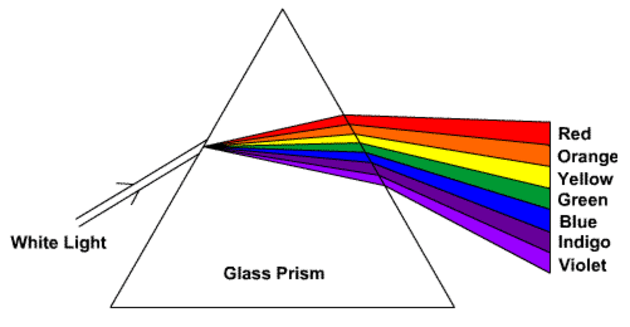
According to Newton, there’s no new colour to be seen.
The spectrum he had ‘split’ from what was called white light was continuous. And still is.
So, in order for us to see a new colour we should rename one of the already existing ones.

That’s according to the ‘light splitters’….

According to people who study vision – how humans see – “People can be made to see reddish green and yellowish blue—colors forbidden by theories of color perception.”

Oops!

There’s more to light than meets the eye… at the first glance, at least.
The way our brain works has something to do even with what we see of this world!
The good thing being the fact that once we understand how our brain works, we are capable of by-passing at least some of these limitations.

But what has any of these to do with ‘dimensions’?!?

I’ve argued in my previous post that having evolved as ‘runners’ we basically live in a 2.5 dimensional world. That we are biased against a proper perception of depth. And that we loath to go back and reconsider already entrenched convictions.

In this post I’ll go further and say that dimensions are tools.
Gimmicks we have invented to help us make sense of the world. And not only invented but fine tuned to fit our purposes.

We have invented length and breadth when we needed a way to impose taxes on arable land.
We have invented weight and volume when trading cereals and wine.
We have invented time when needing to pin point our position on a map while sailing around the world.
We have radically altered geometry when the old one was no longer useful.
We have even learned to adjust dimensions when speed had became fast enough to demand it.

Now, time is ripe for us to reconsider them altogether.
Opportunity, space and time.
We can make do with only three basic dimensions.

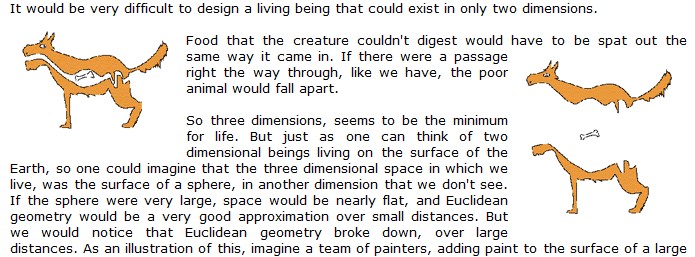
Life needs ‘thickness’.
As suggested in the drawing above, if animals had only two dimensions they would have had to make do without any digestive systems.

Hence we live in a 3 dimensional environment.
But we, the only fully conscious beings on Earth, live ‘on a surface’.
We’ve learned to fly rather late in our evolution. Most of us behave as if able to fully process only two and a half dimensions. We make good use of height and length, the things we ‘face’, but depth is rather tricky for most of us.
OK, we’ve climbed up and down trees and mountains since only ‘god’ knows when but we’re basically runners. And runners run on a surface. Runners run along a mostly linear trajectory which happens mostly on a surface. This whole thing takes place in a three dimensional environment, true, but our ‘running’ nature has left some influences on the way we think.

The most obvious one being the discursive nature of our reasoning. We start from ‘premises’, go along a logical path and end up with conclusions. We very much like the things which fit into a narrative. And we hate going back to reconsider our ways.

Since Einstein has noticed that things were ‘relative’ – to the manner in which we measured them – we have started to add dimensions. To the previously 3 dimensional environment into which we used to live.
The first dimension which had been added was time.
Nowadays, many scientists believe that ‘the universe operates with 10 dimensions but 6 of them are very tiny‘.

I’m not going to contradict them. For the very simple reason that I don’t know – and don’t care – about the other 6. Dimensions. I’m sure that they are out there, somewhere, and that those who have discovered those dimensions knew what they were doing.

What I’m going to do is to propose a new manner of counting. ‘Dimensions’.
Redefine them, first, and only then (re)count.

What do you think about mass? Is is a dimension?
How about energy? ‘White’ (aka ‘visible’), ‘dark‘ … whatever…

Since the ‘jury is still out’…

I’m going to pause the narrative here to make a point.

‘The jury is still out’ means two things.
The obvious and the one which stops us from sleeping at night.
The fact that the jury – us – hasn’t (yet) been able to fulfill the task.

Back to our main thread.

How about we return to our good old 3 dimensional Universe?

Where space is what separates ‘things’, time is what separates ‘events’ and opportunity is what sets the stage for ‘things’ to evolve into ‘events’?

Easier said than done?
In the sense that it’s very easy to put it into words but there’s no mathematics available to describe in ‘absolute’ terms what I’ve just narrated?
They key word hasn’t been mentioned in the phrase above.
There’s no mathematics available yet…
The mathematics used by Einstein to demonstrate his theories wasn’t available to Newton…
Mathematics – a form of artificial language – is invented by those capable to do that as soon as the opportunity arises.
As soon as there’s a need for new ways to express new perceptions of reality.

And no, don’t expect me to come up with new mathematical expressions of anything.
I’m no artist. I have enough trouble expressing my using with mere words.

Since this post is about dimensions, not about my limitations, I’ll end up remembering the three (meta?) dimensions. In a more ‘natural’ order.

Opportunity.

Anything which makes things possible.
Mass – visible and/or dark, energy – visible and/or dark – and anything else which ‘works’ in this sense.
I’m going to make a second – and a lot shorter – ‘transgression’ here and remind you how ‘relative’ things are. How right Einstein was. We speak about visible matter being “normal” and about “dark” (invisible to us) energy/matter having to exist in order for us to be able to make sense of the Universe as we are able to perceive.

Space

Whatever it is that separates, and also harbours, ‘islands of concentrated opportunity’. Mainly ‘mass’ but who knows (yet) what else might be ‘separated/harboured’ by space. Energy – as we know it, is somewhat distributed ‘along’ space rather than ‘separated’ by space.

Time

Whatever it is that separates, and also sequences, events. Happenings.
‘Notable’ ‘intersections’ between matter and energy.
Here, again, we have a difference between matter and energy. While matter seems to ‘survive’ better ‘in time’, energy seems to be more ‘vulnerable’ to the passage of time. Entropy….