Image

Stirea asta face turul internetului de vreo doua zile insa abia astazi mi-am dat seama cu adevarat de semnificatia gestului facut de Inalt Preafericitul.

Toata tarasenia este profund ‘anticonstitutionala’, adica nesocoteste/batjocoreste niste obiceiuri adanc inradacinate in ritual.

Toti stim ca in mod “normal” agheasma este imprastiata asupra celor ce urmeaza a fi sfintite cu ajutorul unei legaturi de busuioc.
Fiecare dintre noi are cate o explicatie pentru acest lucru:
-Credinciosul autentic invoca traditia.
-Cei cu oarecari cunostinte in domeniul plantelor medicinale stiu ca busuiocul este un puternic dezinfectant.
-Paganilor le place pentru ca miroase frumos.

Eu unul inteleg de ce a folosit Daniel un trafalet, ca doar nu era sa se apuce sa stropeasca haotic cu apa, oricat de sfântă, intr-un studio TV  plin de aparatura electronica extrem de scumpa.
Problema este ca actiunea sa deschide larg poarta indoielii:

Oare ce alte traditii mai este dispus sa incalce intai statatorul bisericii autocefale romane?

Incotro isi conduce turma, catre mântuire sau către mântuială?

De ceva timp imi tot propun sa trec la lucruri mai serioase si sa nu ma mai ‘agat’ de tot felul de exagerari sau de articole scrise doar de dragul de a mai face niste audienta.
Si iar dau de cate o chestie ‘groasa’…

Cea de astazi a aparut in Money.ro, o publicatie on line de actualitate economica, destul de interesanta de altfel. Si tocmai caracterul ei ‘specializat’ ma face a ma mir de ‘naivitatea’ celui care a scris acest articol, chiar crede ca poate ‘prosti’/impresiona pe cineva cu logica sa scolareasca?

http://www.money.ro/prc-c8prc-9aara-bogaprc-c8prc-9bilor-din-europa-depinde-aproape-total-de-gazul-rusesc_1258957.html

Pentru inceput aflam ca Luxemburgul are cel mai ridicat nivel de trai din Europa – cred ca stiam toti asta, in orice caz toti cei care stim cam pe unde vine pe harta. Apoi ni se spune ca Luxemburgul este statul european care depinde cel mai mult de importurile de gaz, 99.7% din consum provenind din afara granitelor sale. Aha, prima noutate, nu stiam ca Luxemburg are si surse interne de aprovizionare cu gaz – chiar si cele 0.3% trebuie sa provina de undeva, nu?

Si acum urmeaza bomba. Cica 97% din importurile europene de gaze provin din Rusia iar de aici rezulta ca daca cumva Rusii opresc robinetul Luxemburghezii vor ingheta de frig, in ciuda bogatiei lor – pai doar ei depind in proportie de 99.7 de importuri. De unde rezulta, pentru autorul articolului, ca daca Rusii nu mai vand gaze atunci Luxemburg nu va mai avea nici macar cu ce sa-si fiarba un ceai.

Pe bune?!?

gas in europe

Astia de la BP spun ca Europa importa cam la fel de mult gaz metan din Norvegia pe cat vine din Rusia precum si o cantitate cam la fel de mare de gaz lichefiat (LNG – care intr-adevar nu este gaz metan ca cel rusesc ci un amestec de propan cu butan adica gaz de bricheta sau de butelie). A…, cred ca am inteles ce vrea sa spuna autorul articolului… el se refera exclusiv la importurile de gaz Metan facute de Europa in intregul ei (adica inclusiv toate statele scandinave, ca si ele sunt in Europa)…iar in cazul asta chiar are dreptate. Dupa cum se vede si in infograma de mai sus in Europa, luata in intregime, intra gaz Metan doar din Rusia si din Libia. Aha!

Si totusi autorul a mai uitat ceva. Oare in ce proportie isi acopera Europa consumul din productia interna? Chiar daca acceptam idea ca 97% din importuri ar proveni din Rusia asta nu ne spune nimic despre cat importa Europa din consumul anual, nu? Ni s-a spus intr-adevar ca Luxemburg consuma exclusiv gaze din import (sa ne facem ca uitam de aia 0.3%) dar asta nu ne spune in ce masura depinde intreaga Europa de importuri, corect?

“On the gas supply side, indigenous production registered a slight decrease of 1% to 1690 TWh (156bcm), in comparison with 2012. EU production nevertheless still remained the largest source of gas for EU28 customers, making up 33% of the total net supplies. The main external sources of supply were Russia at 27%, Norway at 23% and Algeria with 8%.”

Aha! Adica cel mai mare furnizor al Europei (ma rog, al Uniunii Europene) este chiar Europa (cu 33% sau aplicand idea ‘continentala’ in intregul ei chiar 56%) iar Rusia vine abia pe locul doi cu un important, intr-adevar, 27%. Important, important dar totusi abia un pic mai mult de un sfert…

Si pana la urma cum ramane cu dependenta bogatilor Luxemburghezi de gazul rusesc? 99.7% din 27% inseamna, grosso modo, cam tot 27%. Cu alte cuvinte cam un sfert din gazul ars in Luxemburg provine din Rusia, evident in conditiile in care importurile s-ar distribui uniform. Nu mai pare chiar asa de ingrijoratoare dependenta asta, nu? Iar daca ne gandim ca la banii lor Luxemburghezii ar putea sa ne plateasca pe noi, de exemplu, sa dardaim un pic si sa le vindem lor o parte din ‘cota’ noastra (noi consumam cam 12.9 miliarde de metri cubi pe an, ei 1.3 miliarde) s-ar putea ca acesta dependenta (perceputa de autorul articolului) sa dispara cu totul…

‘Mai lasati-o bai jos ca a-nceput sa macane…’

Alternative natural gas supplies Europe in 2013 received natural gas from Russia (27%), Norway (23%), North Africa (8%), as liquefied natural gas (LNG) from other suppliers (9%) and domestic production (33%). Increasing pipeline imports from Norway (102 bcm in 2013) is possible up to about 120-130 bcm. There is certainly spare capacity for importing more in the summer months to fill the European gas storages. Increasing natural gas imports from North Africa by at least 5 bcm also seems feasible. The cost of this gas might be slightly higher than Russian gas (US$350/tcm). | Read more at Bruegel http://www.bruegel.org/nc/blog/detail/article/1283-can-europe-survive-without-russian-gas/

“The wiser of the two equally matched opponents will give up first.”
This is a Romanian proverb oftentimes interpreted as a justification/rationalization for cowardly behavior.

It’s anything but!

In a protracted conflict, where none of the opponents has a clear advantage or when the price of wining would be so huge that no one is willing to underwrite it, it is essential that at least one of the interested parties comes up with something new that might defuse the situation. Otherwise the whole thing drags on, people get bitter and calloused and what might have started as a misadventure or as a badly calculated move eventually becomes a festering wound that changes, for the worse, the life of many generations to come.

Think of what happens when two families become embroiled in a ‘vendetta’.
Or about the outcome of the WWI when the people of Germany were punished for the ‘mishaps’ perpetrated by Kaiser Wilhelm.

After WWII the victors have built on previous experience and didn’t fell anymore in the same trap. Instead of inflicting further pain on the already tormented German population they came up with the Marshal Plan. Now, 70 years after the allies landed in Normandy, it would be inconceivable that war might start again between France and Germany. The victors of the Cold War weren’t as wise as their predecessors.

What is happening right now in Ukraine is completely unacceptable. Occupying, in full or in part, the territory of another country, under any pretext, puts the aggressor outside the realm of the civilized world.
But who is the aggressor in this case?

Not so long ago (historically speaking) Louis the XIV-th used to say “L’Etat c’est Moi”. In those times political decisions, including those that had to do with the neighboring states, were made by the rulers while the general population could do nothing but endure their effects. Up to a point of course.
Meanwhile, in a large number of states the political system has evolved considerable. Elections are held periodically so that political leaders and general policies become sanctioned by the electorate. Because of this most of the time there is a certain compact, however fragile and contested, between the political class and the general population.
Unfortunately there still are a number of states where the political situation is ‘ambiguous’ and where the link between the powerful figures of the day and the general public relies more on deceit than on mutual respect and informed consent.
Whenever a country like this is involved in a less than savory encounter on the international scene a very fine line has to be toed when communicating displeasure with its actions. While firm and unambiguous, each message must be very carefully calibrated/formulated lest the general population of the less than democratic country involved will feel besieged. And will naturally coalesce around whoever is in power at that moment. Exactly what that person would wish for and exactly what those who are displeased by the actions perpetrated by that person should try to avoid at any cost.

PS.
In modern terms this whole concept is called re-framing.
And yes, it involves ‘giving up’ in the sense that the ‘wiser’ makes the gambit of renouncing rigidness and maybe even some ‘face’ in exchange for a workable solution.
Any incurred costs are temporary while the benefits tend to stretch far out into the future.
I repeat, just look at what role Germany is currently playing in the European concert.

Răzvan Constantinescu's avatar

Institutul de Gastroenterologie şi Hepatologie din Iaşi a fost ani de-a rândul spitalul cu cei mai buni indicatori de performanţă din România şi a reprezentat mândria medicală a Iaşului. Decizia aberantă a Guvernului Emil Boc de desfiinţare prin „comasare” (HG 85/02.02.2011) a IGH – concomitent cu înfiinţarea unui institut cu profil similar în alt oraş – face ca această unitate sanitară de elită să devină un simbol întru nostalgică şi furioasă amintire a valorilor distruse de incompetenţa proletcultistă cu sprijinul nepăsării noastre. Condiţiile de spitalizare şi tratament, pe care abia acum le apreciem (din păcate retrospectiv) la adevărata lor valoare, performanţele şi indicatorii financiari nu au contat pentru un ministru (Attila Cseke) care anterior se ocupase cu activitatea de comercializare a hranei pentru pisici; un proiect în plină dezvoltare şi care-şi arătase eficienţa încă de la început a fost distrus prin decizia „din pix” a unui om care…

View original post 993 more words

the right to bear arms

Somehow I don’t think the 2nd Amendment is that much about guns as it is about trust.
That your neighbor can be entrusted with such powerful tools.
That more individuals being powerful enough to defend themselves will bring about safety for all while power becoming concentrated in the hands of the few will eventually lead to tyranny.

hering roe

This is all my nonplussed 15 years old son could mutter when confronted with my last culinary creation.

Actually this is nothing fancy, just my version of a taramosalata. Use purple potatoes instead of regular spuds, replace ‘winter’ onions with a mixture of spring onions and chopped fennel and add a couple of garlic cloves and some grated ginger. As to what fish roe?… herring is my favorite. Spread it on a rice wafer.

Here is the Greek recipe: http://www.olivetomato.com/taramosalata-or-taramasalata-heres-how-to-make-it-the-traditional-way-or-the-easy-way-and-find-out-why-its-healthy/


Industrial Age

I found this picture on Bob Colgan’s FB page accompanied by the following caption:

THE LONGER You stare at this…….the more you realize how wrong the Industrial Age has been

I don’t want to sound apologetic but isn’t it that the ‘Industrial Age’ is nothing but a set of circumstances that lays at our discretion the technical/social means for us to complain about the shortcomings of the very ‘Industrial Age’ itself?

What if it is US that are responsible for the way WE (mis)use the means at OUR disposal?


Supposedly humans are autonomous and sometimes rational individuals. Overwhelming them with huge quantities of information while restricting the scope of that information – with the declared goal of keeping them focused – will shortly reduce those individuals to the status of highly biased and eventually completely programmed hu(man)-bots.

Whole article appeared in Bizcloud, http://bizcloudnetwork.com/salesforce-wear/

three wishes

So time has come to get down to the serious business…

Better late than never!

panem et circensis 1

And yet:
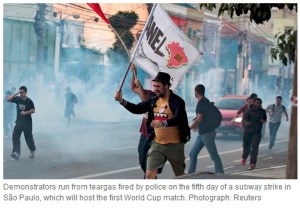
“Less than four days before it hosts the opening game of the World Cup, São Paulo became the scene of protests, street fires and teargas on Monday as striking subway workers brought chaos to the city.
The strike – which disrupted half the metro stations and worsened traffic in South America’s most populous city – was the latest headache for organisers as national teams from the United States, Spain and Argentina flew in for the start of the tournament on Thursday.”

panem et circenses 2

“Brazil’s government already faces the threat of street protests by Brazilians opposed to the high cost of hosting the tournament. Massive demonstrations broke out last year during a warm-up for the World Cup and have continued on a smaller scale, sometimes with violence.”

Might it be that ordinary people are not that dumb as some of us think them to be?
In fact this lesson has been taught to us time and again so I only hope this instance we’ll figure it out less painfully that the French did in 1789.

Football is deeply ingrained in Brazilian culture to the extent that much of world sees the nation through the lens of the Brazilian National Football Team. Since football was brought to this South American – See more at: http://sites.duke.edu/wcwp/research-projects/politics-and-sport-in-latin-america/brazil/#s
Football is deeply ingrained in Brazilian culture to the extent that much of world sees the nation through the lens of the Brazilian National Football Team. Since football was brought to this South American – See more at: http://sites.duke.edu/wcwp/research-projects/politics-and-sport-in-latin-america/brazil/#sthash.1rNrsCQ9.dpu