
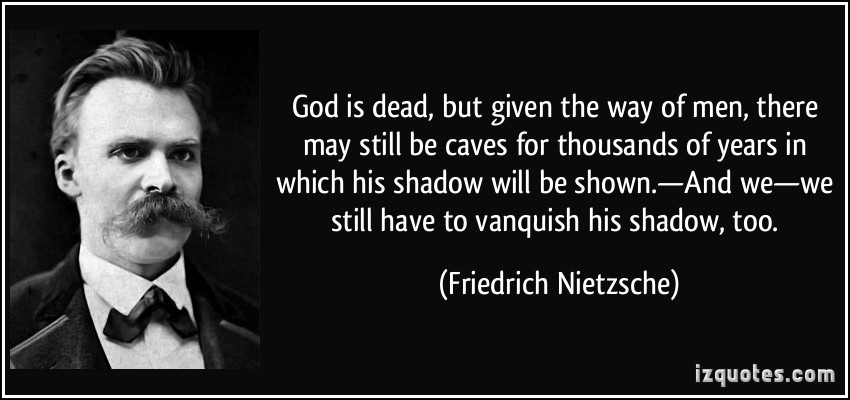
Nietzsche was somewhat right only he went bonkers before he was able to shed some real light on what was going on.
The point is that God didn’t die on his own. We killed him. Twice. And while the first time we were capable to fix the situation now we seem incapable to ‘make the right thing’.
Let me explain myself.
I have no way of knowing if it was God that created us or not. That’s something for others to decide.
For me it’s enough that I see no evidence to support the first hypothesis except for some ‘testimonies’ provided by people with vested interests in the matter. I find those testimonies highly biased. Nor do I find any need for a Deus ex Machina kind of explanation for anything that exists in this Universe. Modern science has done a good enough job in explaining the world to me.
On the other hand the second hypothesis is absolutely impossible to demonstrate. So, why bother?
What I do know, for sure, is that at least one kind of God does exist. The one that has been created by us, people, a social representation whose existence stems directly from our mental relationship with Him – the One who supposedly created us.
The mere existence of this ‘virtual’ God had two very important consequences. It brought us democracy and it provided us with a coherent way of understanding the world – a common Weltanschauung in German terms.
I’ll make a short break here to elaborate a little. The common lore is that ‘God made us in his image’. This means that, basically, we are equals among ourselves – we’ve been all cast in the same mould, right? – and that each of us has a spark of divinity in him. Quite a heavy responsibility – being of a Godly nature – don’t you think? Hence the ‘do not kill/judge’ commandment. Who are we to play God towards other Gods?
Also partaking in the same Weltanschauung was what offered us the possibility to act as a community, to help each other. For a while at least but it was good while it lasted. After all none of us could have done much by himself.
In fact none of us is able to survive for long by himself, let alone thrive solitarily. Not even today, with all the modern technology that we now take for granted.
We gave birth to our first generation of Gods, made exactly into our image, good and bad together, during the Antiquity. The Greek, Roman and German Gods were our look alike-s and shared our unruly behavior. Some of them even occasionally shared our beds. Then, at some point, we got cocky and abandoned them. Our philosophers thought they knew better than that and that they could come up with comprehensive solutions all by themselves. That’s how absolute authoritarianism ended up having official blessing from the Academia while the adoration of Gods was left for the unsuspecting masses.
All hell broke loose from that moment. For some 6 centuries after Plato had wrote his Republic the Mediterranean Sea had been a string of empires toppling one another.
Until we came up with a different kind of God. One that first and foremost told us to stop quarreling – for we were all brothers – and start living in communion. Until we killed him also.
Not that we haven’t been forewarned. Pascal, the French mathematician, told us that it is completely irrational to reject the existence of God. If, in reality, God doesn’t exist the believer looses nothing and the non believer gains nothing – except for the lame satisfaction to be able to brag ‘I told you so’ after death. Conversely, if God does exist, then the believers are going to inherit the world while the non believers have dealt themselves the worst hand ever. Meanwhile, by living in a world structured by the presumed existence of God both believers and non believers enjoyed the two consequences I mentioned above – equality among people, even if only in theory, and the ability of doing things in concert, a lot more efficiently.
Now, that we’ve killed God for a second time – the murder described by Nietzsche – we’ve lost it again. Only this time we didn’t lose just the hypothetical after-life, we’re gradually transforming this one – the only life we have for sure – into a bloody nightmare.
And if you don’t believe me do as Lesek Kolakowski suggests.
“Let us simply compare the godless world of Diderot, Helvétius, and Feuerbach with that of Kafka, Camus, and Sartre. The collapse of Christianity that was so joyfully awaited by the Enlightenment took place almost simultaneously with the collapse of the Enlightenment itself. The new, shining order of anthropocentrism that was built up in place of the fallen God never came. What happened? Why was the fate of atheism in such a strange way tied to that of Christianity, so that the two enemies accompanied one another in their misfortune and in their insecurity?” (God in a godless time, 2003)
Now why can’t we make the small effort to understand what Pascal told us? Why is it so hard to understand that we are spoiling the beautiful life we might have if only we kept pretending that God existed and behaved accordingly?
Why is it so hard at least to fake some respect for those who happen to share the planet with us?
Fake respect is not as good as the genuine one, of course, but is a lot better than the huge amount of scorn that is publicly traded these days.
Even more important is that if we won’t have to use so much energy in maintaining a force field to protect us from being drenched in scorn we’ll may be able to imagine a better world than the one we currently have to deal with.
And, who knows, maybe we’ll have time to discover how beautiful we really are, inside our armors.
A new (representation of) God would be born this way.
Lesek Kolakowski, God in a godless time, 2003, http://www.firstthings.com/article/2003/06/visions-of-eternity-7


 nicichiarasa