
“The resistance that had been everywhere at first faded as the years went on.
The spectacles were exciting. Being amid the crowds was exciting.
The certainty, the unity—the pleasure in being superior to the scorned minority,
as well as the Dostoevskyan pleasure in overthrowing everything
—was exactly what had been missed.
Politicians, business leaders and others who should have known better
—and some who later deeply regretted it—drifted to his side, quietly,
often one by one, drawn by the thrill of power, plus the useful patronage it could give.
There also was the pleasure, relief, in not being targeted themselves.“
David Bodanis, The Art of Fairness: The Power of Decency in a World Turned Mean (2021)
Life, in general, is about species evolving in a given set of circumstances. If the circumstances allow it, live will appear. And survive for as long as the circumstances remain livable. We must keep in mind that life changes the environment in which it evolves.
Social life, the human kind in particular, is about cultural species evolving in given sets of circumstances. For as long as the circumstances remain livable, cultural species will continue to evolve. To put their culture to work and to build civilizations. Each set of circumstances influencing both the culture which inhabits the circumstances and the civilization being built there.
Currently, there are three main categories of cultures. Imperial, democratic and incomplete.
I will start by noting that those cultures which are ‘incomplete’ have remained so because they didn’t have enough time to make ‘full use’ of the limited resources they had at their disposal.
The difference between the imperial and the democratic cultures being the fact that the imperial ones stagnate as soon as they reach a certain level of development while the democratic ones continue to evolve for as long as they manage to remain democratic. To retain their ability to change as soon and as far as they need in order to survive. To maintain their democratic character.
Need proof?
Are you familiar with any empire which had lasted for long?
The Egyptian? 33 dynasties covering 3 millennia? Is that long enough for you?
Well, not so fast. ’33 dynasties’ actually means 33 different empires. It was very seldom that a dynasty ended when/because there was no available successor… Most dynasties were removed from power rather than petered out. And, nevertheless, who cares about why a certain dynasty was replaced by the next one?!? The simple fact that it was replaced is enough for me. The replaced dynasty was no longer able to cope! Hence it had to make place for the next one. Another set of decision makers, naturally following a (however slightly) different mantra.
Don’t believe me? Consider any other empire. Evaluate the duration for which each dynasty had managed to hold the helm. And compare it with the fact that the Roman Republic had survived, as a functional democracy, for almost 5 centuries.
And no, Europe isn’t the only place where democratic forms of self-rule had happened during human history. Kurultai, Loya-Jirga… The mere existence of the concepts is proof enough for the budding democracies which might have developed in those places, given enough time and resources.
Then, if democracy is so much ‘better’ – as in more helpful towards the survival of a certain set of mores/culture – then why is it so ‘scarce’?
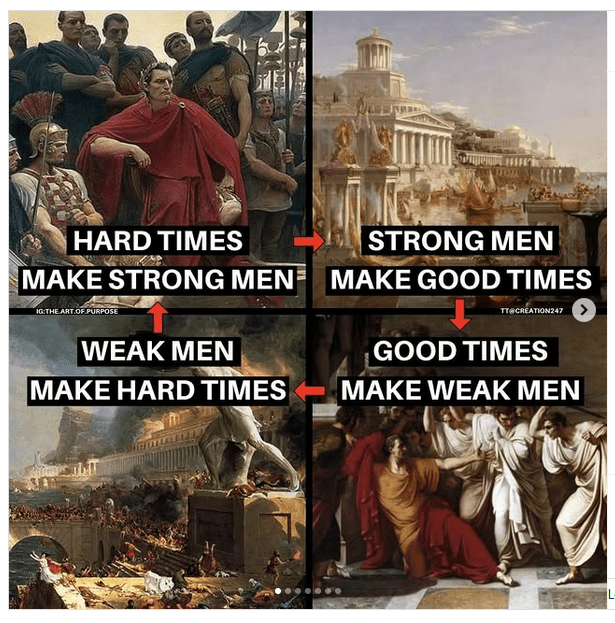
Well, for democracy to remain functional, at least some wise men need to remain both strong and focused on the job at hand. Otherwise, the helm will be confiscated by the would be strong but not so wise….
And why is it that good times tend to make weak people?
First of all, good times tend to weaken ‘the people’. Not as much to weaken the individuals living a good life as to make them careless. To take the good times for granted. To convince them that ‘times’ will continue to remain good regardless…..
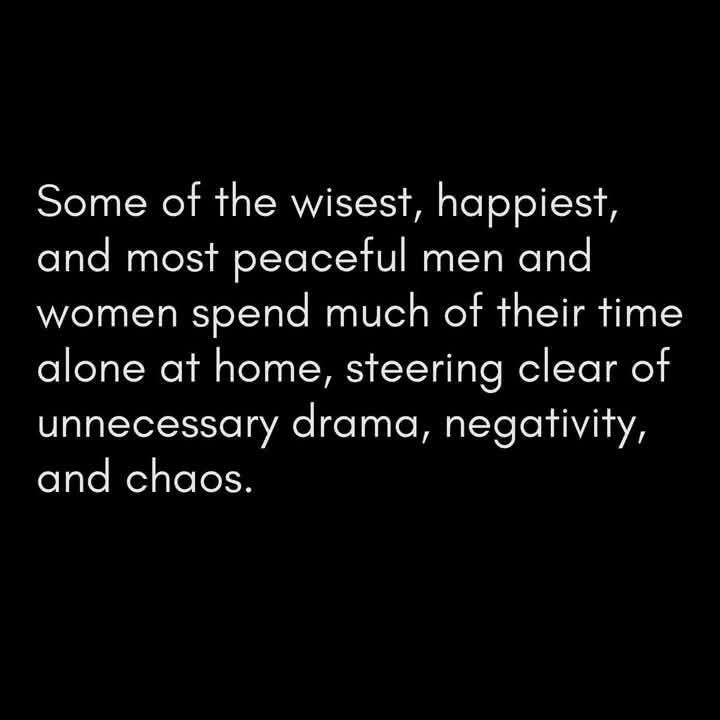
Not having to struggle for their day to day existence tends to make ‘some of the wisest, happiest, and most peaceful men and women to spend much of their time alone at home, steering clear of UNNECESSARY drama, negativity and chaos’.
This being how successful democracies sometimes succumb to tyranny and how empires eventually crumble under their own weight.

 nicichiarasa