
Things are relatively simple.
Vaccines work for whole populations, not necessarily for individuals. In order to make them acceptable those who market them try (or at least should try) to make them as good as possible.
For a rational (but callous) individual the best thing to do is to make sure that he is the only one not vaccinated: he cannot catch the disease since nobody can have it yet suffers no possible side effects from being inoculated.
If enough people opt out then the whole effort would have been in vain. The immunity obtained by vaccination isn’t as strong as the one one gets after surviving the disease so if enough people get the disease because they haven’t been vaccinated at all then older people, those who have been vaccinated first, start to fall ill.
From this point on nobody would vaccinate anymore their children – because it’s useless, right? – while the right thing to do would be to get a second vaccine, a rappel.
What’s getting on my nerves is the fact that sometimes we trust ‘scientists’/’technicians’ with our lives (for instance when we get aboard airplanes) yet other times we develop all kind of wild theories (about vaccines, for instance).
Of course we need to be extremely careful, both when choosing an airline or a pharmaceutical company, but to refuse altogether to fly or to vaccinate your children…
Vaccines
The sole characteristic that makes us what we are, human beings, is our ability to ‘get out of our selves’ and to make decisions as if their outcome didn’t matter to us. In other terms we are able of cold blooded reasoning.
I don’t say this is easy – it involves quieting down our emotions – nor that everybody is able to do it. In fact almost nobody is able to do it consistently yet here we are, all the better just because of this particular ability of ours.
I find it extremely strange that some of us, in fact too many of us, are willing to give up this special ability, for different reasons.
Some try to introduce self driving cars, in the name of safety and to increase the capacity of existing highways. http://www.businessweek.com/articles/2014-04-03/the-problem-with-self-driving-cars-they-dont-cry
Some others came up with software to grade students essays. http://www.informationweek.com/mobile/mobile-devices/automated-essay-grading-software-stirs-debate/d/d-id/1111035?
Not even the stock market is immune to these developments. “High-frequency trading practices” – robots, that is – have become widespread enough as to create concern. http://www.aboutschwab.com/press/issues/
As you’ll notice if you read those articles there is no clear majority as yet, for or against this phenomenon. Pros are carefully weighted against the identified cons and then advice is given by the authors. Unfortunately none of them distances himself far enough from the brouhaha to notice the somber fact that by allowing so many automatons to take over our lives we not only basically give up our individual autonomy but also we give up more and more of the opportunities we have to exercise our capacity to decide for ourselves.
It is indeed increasingly safer and more profitable, in the short term at least.
But is it really good for us? For our ability to cope in unforeseen/unforeseeable circumstances?
Amandoi, atat clientul cat si ‘restauratorul’ sunt vinovati de ‘lacomie’. Uita ca ‘banul’ si mancarea sunt doar unelte. Primul masoara cat de eficienta este activitatea noastra iar a doua ne tine in viata.
Din pacate le-am transformat pe amandoua in ‘obiective strategice’.
Si iar imi aduc aminte de bunica-mea care ma intreba “ce crezi tu, noi oamenii mancam ca sa traim sau traim ca sa mancam?”
Iar daca uitam ca scopul primordial al activitatii noastre (actul de a manca este inclus aici) este in realitate “supravietuirea” (atat cea fizica, individuala, cat si cea ‘sociala’ – adica a mediului social si economic care ne face posibila existenta fizica) vom sfarsi prin a da faliment/muri de foame sau din cauza obezitatii. Ca sa nu mai vorbim despre faptul ca asta se va intampla in mijlocul unei gropi de gunoi.
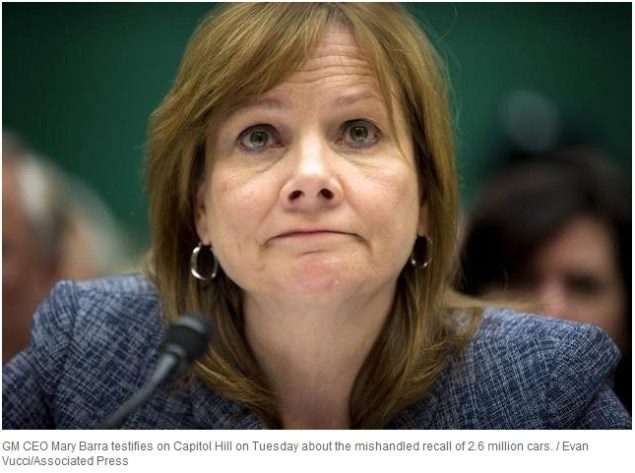
We all know were the ‘cost culture’ has taken the ‘old’ GM: into the ground.
I’ll be blunt on this one. In fact it is not about minimizing the costs. That is not only rational but also natural. The real problems arise from ‘maximizing profits’, sometimes at “all costs”. Non financial costs that is. I.e. lives. Human lives in this case.
And this will keep on happening until we’ll finally understand that profits are good – inexorable even – but only as long they are an indicator for being on the right track towards long time survival (sustainable growth if you want to call it that way).
Allowing for the customers to get killed just for the sake of some pennies shaved from the costs is an extreme but compelling symptom of the present confusion. Short time profits, made at the expense of the customers, can be extremely dangerous.
Eventually they’ll kill the business itself, not just the customers.
PS Click on the highlighted quote, or here, and read the entire Bloomberg article. It’s worth it.
Some believe innocence is lost when becoming sexually active.
Some others understand, mostly the hard way, that being innocent means not being able to discern crooks from trustworthy people and that sometimes this condition cannot be cured.
Little Akio
The teacher said “Let’s begin by reviewing some history. Who said: ‘Give me Liberty, or give me Death’?” She saw a sea of blank faces, except for Little Akio, a bright foreign exchange student from Japan, who had his hand up: “Patrick Henry, 1775 ” he said. “Very good!”
“Who said: ‘Government of the People, by the People, for the People, shall not perish from the Earth’?” Again, no response except from Little Akio: “Abraham Lincoln, 1863”. “Excellent!” said the teacher continuing.
“Let’s try one a bit more difficult. Who said, ‘Ask not what your country can do for you, but what you can do for your country’?” Once again, Akio’s was the only hand in the air and he said: “John F. Kennedy, 1961”.
The teacher snapped at the class “Class, you should be ashamed of yourselves. Little Akio isn’t from this country and he knows more about our history than you do”.
She heard a loud whisper: “Fuck the Japs”. “WHO SAID THAT? I want to know right now!” she angrily demanded. Little Akio put his hand up “General MacArthur, 1945”.
At that point, a student in the back said “I’m gonna puke”. The teacher glares around and asks “All right! Now who said that?” Again, Little Akio says “George Bush to the Japanese Prime Minister, 1991”.
Now furious, another student yells “Oh yeah? Suck this!” Little Akio jumps out of his chair waving his hand and shouts to the teacher “Bill Clinton, to Monica Lewinsky, 1997!”
Now with almost mob hysteria someone said “You little shit! If you say anything else, I’ll kill you!” Little Akio frantically yells at the top of his voice “Michael Jackson to the children testifying against him, 2004”.
The teacher fainted.
As the class gathered around the teacher on the floor, someone said “Oh shit, we’re screwed!” Little Akio said quietly:
– “Albertans, if Justin Trudeau gets elected PM”.
– “The people of Pakistan, when Zardari became President, 2008.”
– “The City of Toronto, if Rob Ford gets re-elected as mayor.”
– “The Egyptian people, 4 month after Moursi was elected.”
– “The Australian people, when Gillard was elected, August 2010.”
– ‘The Bermudian people, November 9, 1998.’ …
.
“What’s the meaning of all this?”, you probably ask yourself right now!
Well…how about globalization going on so well that we all share the same problem?
Not only that it has been replaced by the omnipotent ‘procedure’ but we have already been conditioned to accept this as being OK.

OK, we are all humans and mistakes happen all the time. But as individuals we have an obligation to ourselves to act humanely and not like soulless automata. Not one of the two guys who signed the check was curious enough to find out why the government was sending 1 (one) cent to somebody… I wonder if any of them had actually understood what was going on or they signed it just because somebody told them ‘the whole matter was being dealt with in full compliance with the relevant regulations’?
“School forces half-naked, sopping wet student to stand outside, frostbite results”

Can you figure out how things could get this far?
“A Minnesota public high school was so committed to obeying its fire drill policy to the exact letter of the law that it forced a female student–dressed only in a swimsuit, and sopping wet–to stand outside in the freezing cold for ten minutes. As a result, she suffered frostbite.
…
It was 5 degrees below zero in St. Paul that day. With the windchill, it was 25 degrees below zero.
Hagen-Tietz asked to wait inside an employee’s car, or at the elementary school across the street. But administrators believed that this would violate official policy, and could get the school in trouble, so they opted to simply let the girl freeze.
Her fellow classmates, at least, huddled around her to try to keep her warm. And one teacher did eventually lend her a coat.”
But wait to see her mother’s reaction:
“Eva Tietz told National Review that the school was wrong to put a wet, unclothed kid out in the cold.
“Immediately, when they had seen that, they should have had some kind of protocol,” she said in a statement.
Tietz also noted that she would have been arrested for doing such a thing to her child.
“If I had a fire and brought my children out in that condition, you know, I’m sure I would be charged in some way or another if I didn’t instantly bring them into a neighbor’s house or someplace else,” she said, according to WCCO”
She even proposed a remedy:
“Tietz wants the school to issue an apology and reexamine its fire policies.”
And the school district promptly “issued a statement saying only that it routinely reviews such policies.”
Please notice that what had started as an article about a child being forced to stay outside practically naked in freezing temperatures by a bunch of inept teachers has ended as a dispute about ‘protocols’ and ‘policies’.
What happened to common sense? Do we need ‘protocols’ for absolutely everything now?
What happened to the rest of the people present there, beside the ‘stickler’ who was ‘in charge’ and who needed 10 (ten) full minutes to grasp the situation?
What could have happened to a mother whose child has been left out to freeze to make her ask for ‘better policies’ instead of her yelling at the top of her lungs: ‘Act sensibly, for God’s sake!’
Stirea zilei din domeniul economic in Romania este ca platim cele mai mari contributii sociale din aceasta parte a Europei si ca rata mare a taxelor are un efect negativ asupra veniturilor colectate.
Aha, a descoperit si Banca Mondiala ca pe lumea asta exista apa calda. Mai are un pic si observa ca unii practica mersul pe jos…
Dar hai sa vedem partea plina a paharului. Daca ii incurajam poate inteleg si ce se intampla in jumatatea cealalta … care e adevarata problema a taxelor mari.
Cu cat acestea sunt mai mari SI consensul social cu privire la plata lor este mai slab cu atat existenta acestor taxe distorsioneaza extrem de grav intreaga viata sociala a unei tari.
Da, ati citit bine. Intreaga viata sociala este afectata, nu doar cea economica. Totul. Economia, politica, viata de zi cu zi a fiecaruia dintre cei care traiesc in acea societate.
E adevarat ca exista tari in care taxele sunt mari si unde oamenii sunt in general multumiti. Scandinavia, Germania, chiar si Franta pana nu de mult…
Chestia e ca in tarile alea cetateanul contribuie foarte mult la ‘bugetul tarii’ numai ca acolo primeste inapoi sub forma de servicii sociale aproape tot ce a platit ca taxe. Drumurile sunt ca in palma, politia functioneaza, invatamantul si sanatatea ofera servicii de calitate iar politicienii nu (prea) fura si in orice caz atunci cand sunt prinsi o incurca rau de tot. In conditiile astea cei mai multi dintre contribuabili isi platesc taxele relativ de buna voie iar cei care incearca sa insele sunt prinsi destul de repede. Aproape nimeni nu este avantajat in mod nejustificat.
In tarile in care serviciile sociale nu sunt de calitate dar unde taxele sunt mari – la noi de pilda – apare un cerc vicios. Contribuabilul de rand, care nu se simte aparat/ajutat de stat, are un dispret suveran fata de ideea de a plati ceva catre stat: ‘de ce, sa se ingrase aia?’. In conditiile astea fentarea fiscului devine un sport national si nimeni nu mai sesizeaza adevaratul pericol: cei care reusesc sa nu plateasca taxele si sa nu fie prinsi au un mare avantaj competitiv fata de ceilalti. Daca TVA-ul este de 24% si reusesti sa nu-l platesti atunci tu poti sa mergi cu o marja negativa de 14% si la sfarsitul anului sa ramai totusi cu un profit de 10% din cifra de afaceri…(bine, calculul nu este foarte exact dar ati priceput ce vreau sa spun) Nu e rau de loc, nu?
Si daca tot nu platesc TVA-ul ce rost mai are sa angajez muncitorii ‘cu carte de munca’? Ar insemna ca sunt tampit, nu? Daca n-am TVA de platit inseamna ca n-am produs nimic si atunci de ce as avea nevoie de muncitori?
In conditiile astea cum sa concureze cu mine cei care isi platesc toate taxele? Poate doar daca or fi de doua-trei ori mai eficienti decat mine… precum si un pic naivi… Iar eu o sa ma descurc daca vin niste controale… ca am de unde…iar angajatii de la stat au niste salarii de mizerie… de unde bani la buget pentru lefuri daca nu-si plateste nimeni taxele?
Aveti impresia ca asta mai este economie de piata libera?
Ce nu inteleg eu e cat mai dureaza pana intelegem ca in conditiile astea absolut toti avem numai de pierdut. Inclusiv cei care, doar aparent, profita acum si isi umplu buzunarele de bani. Copii lor tot in scolile astea proaste invata, isi rup masinile in aceleasi gropi ca si ‘fraierii’ iar daca au nevoie de o operatie ceva trebuie sa se duca tocmai pana la Viena…
 nicichiarasa