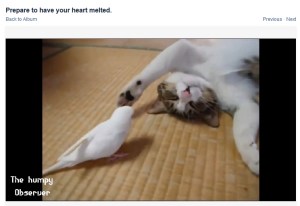
A FB friend of mine shared this post:

melted heart

(You know the drill, click on the picture if you want to watch)

The video is accompanied by this rather touchy caption:

Because they bring us joy.
Because they are at our mercy.
Because they teach us kindness.
And compassion.
And understanding.
Because they are voiceless.
Because they wish us no harm.
Because they are our companions.
And because we are all animals.
We will never stop being a voice, for them.

Help us create a kinder world for animals: www.bit.ly/vo2Aco

Video via TheHumpyObserver
Music: The Time To Run (Finale) by Dexter Britain”

Really?!?

“Help us create a kinder world for animals”? Wow…
Now why on Earth should we ‘create’ a ‘kinder’ world for them?!?
How about not destroying the one they already have and which has served them a lot better than whatever we might come up with?

“Although hospitals are prohibited from denying treatment to patients seeking emergency care, it should be expected that they will charge for services provided. Emergency charges are usually covered in full by most insurance programs. Uninsured patients will be responsible for costs following treatment.”

And that is because in the US health care is seen more as an industry providing services for individuals than anything else.

In a sense this situation is perfectly understandable. Yersinia Pestis is endemic in the Western US but America has never seen a major outbreak of plague. Why? Simple. American cities are far apart and were built way after humankind learned that washing yourself is good for you. This is why America, as a nation, has never experienced a major pandemic except for the Spanish flu in 1918 when 20 to 40% of worldwide population fell ill and 670 000 Americans died.
Only this was children’s play compared to the European experience. While for most of the Americans ‘plague’ is some biblical punishment that zealots keep threatening us with for Europeans the word brings back memories of the Great Death that has visited  the continent from 1347 up to 1600. OK, most of us weren’t present at that time but an epidemic that kills one third of the population – as it happened in 1347-1398 – leaves more than a scar on the collective memory of the population. It alters the way society works.
I won’t enter into details now but experiences like that prompted ‘political’ rulers to ponder upon the need to take care of the ailing/sick portion of the population. Both to prevent such diseases from spreading so violently and to mitigate their effects once they had befallen on their subjects. And no, they weren’t soft-hearted lefties but hard core pragmatists: every major epidemic left behind not only a deficit of workforce but also it drastically reduced the number of ‘conscriptable’ males, something very dangerous for a kingdom in an era of constant ‘international’ aggression.

Here is what britannica.com has to say about this: “Stirred by the Black Death, public officials created a system of sanitary control to combat contagious diseases, using observation stations, isolation hospitals, and disinfection procedures. Major efforts to improve sanitation included the development of pure water supplies, garbage and sewage disposal, and food inspection. These efforts were especially important in the cities, where people lived in crowded conditions in a rural manner with many animals around their homes.”

In fact this is how the European style Public Health System came into being. If you’d compare a community with an organism it would be the social equivalent to the immune system, a section of the whole thing that (automatically) fights infection without individual cells having to bother with anything.

“But we are not MINDLESS CELLS, we are FREE human beings!” I hear some some of my conservative friends shouting at me.
“If they want protection they should get insurance!”

Fair enough, only:

We humans are not at all independent but, at most, autonomous. Try living by yourself, isolated somewhere if you don’t believe me.

I’m not talking about individuals here but about whole communities. The Black Death didn’t bring any benefits to any of the peoples of Europe, it didn’t just cull the misfits leaving more breathing space for the powerful to develop their potential. The disappearance of one third of the population teared apart the entire social fabric and I don’t think there where many, if any, people glad of what had happened in those times.

Insurers and service providers work for profit, not as a public service. As such any insurance is limited, one way or another, and each service provided bears an individual cost that is accrued to the total bill. Even Lloyds, the only place in the world where somebody could buy unlimited liability insurance has drastically curtailed the practice.
So, in the present conditions, who is going to pick up the tab if a real pandemic will happen in the US?

Not to mention the ‘technical’ and regulatory hurdles that appear due to the in-existence of a ‘national health care system’:
“U.S. hospitals may be unprepared to safely dispose of the infectious waste generated by any Ebola virus disease patient to arrive unannounced in the country, potentially putting the wider community at risk, biosafety experts said.
Waste management companies are refusing to haul away the soiled sheets and virus-spattered protective gear associated with treating the disease, citing federal guidelines that require Ebola-related waste to be handled in special packaging by people with hazardous materials training, infectious disease and biosafety experts told Reuters.”
“CDC advises hospitals to place Ebola-infected items in leak-proof containers and discard them as they would other biohazards that fall into the category of “regulated medical waste.” According to DOT guidelines, items in this category can’t be in a form that can cause human harm. The DOT classifies Ebola as a Category A agent, or one that is potentially life-threatening.
DOT regulations say transporting Category A items requires special packaging and hazmat training.
CDC spokesman Tom Skinner said the agency isn’t aware of any packaging that is approved for handling Ebola waste.
As a result, conventional waste management contractors believe they can’t legally haul Ebola waste, said Thomas Metzger, communication director for the National Waste & Recycling Association trade group.”

As of now individual solutions have been worked out. Americans are inventive and resourceful people but so far they had to deal only with isolated incidents. I hope things will peter out before anything more intense will take place but I also hope that those with vision will use this opportunity to educate the wider public about the necessity of a nation wide system capable to deal with medical problems of this magnitude.


“Middle Class doesn’t understand wealth”:

“Few people in the middle class really understand the mindset of the richest people.

After all, if they did, they would be among the top earners as well.

“Among the many money issues misperceived by the general public is the notion that acquiring great wealth is more about showing off than creating choices. While money certainly brings status, it’s acquired mostly for the purpose of attaining personal liberty.It’s impossible to be truly free without wealth. The middle class is controlled by employment, government, and other entities with superior resources that dictate what they can and can’t do. It’s tough to make a moral stand for freedom when you’re worried about making your next mortgage payment.Rich people can afford to stand up and fight oppression. They can afford to buy their way out of unhealthy work environments, bad bosses, and other unpleasant situations. They have the means to enlist the best doctors when they get sick, and they are able to make themselves as comfortable as possible when they can’t get well. When they want to raise money for business, politics, or charity, a few phone calls to their rich friends is all it takes. If they need more money, they throw a party or host an auction and charge $1,000 a ticket. The examples of how much money buys freedom are endless.Start thinking about the freedoms you’ll gain when you are wealthy!

“It’s impossible to be truly free without wealth. The middle class is controlled by employment, government, and other entities with superior resources that dictate what they can and can’t do. It’s tough to make a moral stand for freedom when you’re worried about making your next mortgage payment.

Rich people can afford to stand up and fight oppression. They can afford to buy their way out of unhealthy work environments, bad bosses, and other unpleasant situations. They have the means to enlist the best doctors when they get sick, and they are able to make themselves as comfortable as possible when they can’t get well. When they want to raise money for business, politics, or charity, a few phone calls to their rich friends is all it takes. If they need more money, they throw a party or host an auction and charge $1,000 a ticket. The examples of how much money buys freedom are endless.

“The rich really are different”

“This one-room house was about a mile away from any road. It had no floor, no latrine, no electricity, no running water, no windows. Twelve people lived in it, all under the age of 25, and every one of them were born in that house.
  Several of the kids were showing signs of malnutrition. Their only source of water was a fetid stream that was polluted with cholera.

 There were a lot of houses like this, but this one was the worst.

  When I tell my friends in the States about this place their responses are always “Wow. That’s sad.” or something like that.
   What my friends don’t do is ask questions like, “How do they do such-and-such?” The questions never occur to my working class friends because this level of poverty is foreign to them.

  Sure, people in America understand the fear of not being able to find work, or losing their homes, or having their kids go to bed hungry.
   But that isn’t 3rd world poverty. So while working class Americans empathize, they can’t understand it in a day-to-day way.

  As for the super wealthy, who have never experienced the fear of losing a home, or missing a meal, they simply have no associated experience.
  They say to themselves, “I work hard. Why can’t you?”
And one thing you can’t hold against the super wealthy on Wall Street and elsewhere is that a lot of them do work hard and put in long hours.
   What they don’t understand is simply not having opportunity. Something their lives are filled with. They don’t have empathy because everyone they have ever met has succeeded if that person worked hard.”


See what I mean? Both articles amply demonstrate one thing and one thing only. ‘Having it’ or ‘not having it’ dramatically changes one’s perspective on almost all things.

Why did I bother with such ‘common knowledge’?

Because this is NOT AT ALL ‘common knowledge’. Had it been common it would have created mutual understanding, as it is it creates a wider and wider chasm.

People knowing that something exists doesn’t mean ‘common knowledge’. It becomes so only after enough of those people have an at least partially overlapping view of that something.

cerebral palsy, painting

Computers can be used for painting or for distributing child pornography.
We, the users, are the ones who make the difference.

As in mob rule?

A British historian that went by the name of Lord Acton observed more than a hundred years ago that
“All power tends to corrupt; absolute power corrupts absolutely.”

Judging by what historians keep writing and the politicians keep ignoring this observation tends to be pertinent.
Click on the highlighted quote to see some of his arguments in Ben Morrell’s interpretation.

Somewhat unhappy with this vision, a sci fi writer, Frank Herbert, contradicted the historian:
“Power attracts pathological personalities. It is not that power corrupts but that it is magnetic to the corruptible. Such people have a tendency to become drunk on violence, a condition to which they are quickly addicted.”

In fact it’s more like a completion than a contradiction but I’ll have to leave it at that because both are dead now and way past such mundane preoccupations.

Recently, things having not been properly set yet, a team of Swiss scientists lead by John Antonakis decided to sink their teeth in the matter. They gathered a group of people, ‘measured’ all sides of their personalities – including their honesty – and then involved them in a game of ‘lets play dictator’.
“The findings showed that those who measured as less honest exhibited more corrupt behaviour, at least initially; however, over time, even those who initially scored high on honesty were not shielded from the corruptive effects of power.”

OK, so Acton was right altogether, ‘power’ does corrupt. The problem is that Antonakis never tried to verify Herbert’s hypothesis. If he was right then the honest people stand no chance at becoming powerful enough to become corrupted because the already corruptible are fighting dirty to get on top, something the more honest would not do, at least not from the very beginning. Seen this way the very competition for power selects the people who get on top based on how corruptible they are.

Luckily things are not that simple. Really smart guys, no matter how corruptible, figure it out – sooner rather than later, that by ‘stealing’ too much/misbehaving really bad  they destroy the entire structure upon which their very existence, let alone power, depends.

So how come really bad dictators do come into existence?
From Lenin to Hitler, from Ceausescu to Pol Pot and nowadays from Putin to al-Baghdadi.

Here Antonakis’ findings fit in perfectly.
Participants “were given complete control over deciding pay-outs to themselves and their followers. The leaders had the choice of making prosocial or antisocial decisions, the latter of which resulted in reduced total pay-outs to the group but increased the leader’s own earnings.”

The key concept here is ‘complete control’. In fact this ‘dictator game’ is no game at all. It’s nothing but a solitaire. It has rules, certainly, but it’s up to the ‘player’ himself to decide whether to respect them or not. If the rest of the people concerned – those who suffer the consequences of the ‘game’, have no say in what is going on then they don’t count. And are not able to help, either. The final outcome will depend exclusively on the honesty of the ‘player’. And we haven’t, as yet, made any mention about skills…

Besides the very important insight Antonakis also offers us a valuable piece of advice:
” “We think that strong governance mechanisms and strong institutions are the key to keeping leaders in check,” concludes Antonakis. “Organisations should limit how much leaders can drink from the seductive chalice of power.” “

It’s a very good starting point. Add to it a renewed insistence on initial honesty – it helps, just as the study showed, coupled with intense surveillance and continuous feed back from the stakeholders and things might improve dramatically.

After all ‘governance mechanisms’, ‘strong institutions’ and ‘organizations’ are nothing but words. Powerful and meaningful words indeed but ‘words’ cannot do anything by themselves. They have first to be pronounced by pertinent persons and then diligently put into practice.

And this would mean that ‘power’ won’t belong to anyone in particular, not even to ‘the people’.

Keep tuned for the difference between real democracy and ‘mob rule’.

7 Fiecare isi alege ce vrea.

Click the link below to see the entire album.

7 Fiecare isi alege ce vrea.

For some time I’ve been ‘wriggling’ my brain continuously yet I failed, as of now, to find the difference between those who ‘paint Islam using a big brush’:

and those who use a more subtle one to poke fun at Jews:

I only hope that people like Reza Aslan will go on explaining to us that ‘Islam is just a religion and like every other religion in the world it depends on what you bring into it”.:

and that those who ‘spread bullshit about religion’ will finally understand that they are not helping anybody. OK, they do increase their audience but at what price? Is it really worth it to pitch one community against another just in order to make ratings?

https://nicichiarasa.wordpress.com/2014/10/01/george-carlin-spreading-bullshit-about-religion/


NakulArora's avatarJust A Crazy Dreamer

Will there be any Good if there isn’t any Evil?

Will there be any Evil if there isn’t any Good?

For aren’t good or evil simply relative degrees of each other?

Doesn’t each exists only as a relative comparison of other, simply depending on the viewpoint?

So, then Is a stage of all good(fully white) even possible and should it be aspired to?

What difference then does it make to walk down either path, be it good or evil?

Why be Good then?

Why not be Evil then?

View original post

This video is funny as hell and more than half true.

Unfortunately Carlin belongs to that group of people (religious as well as un and anti religious) that confuse ‘religion’ with those who ‘administer’ (use) religious passions of the people in order to reach their personal goals.

‘Religion’, per se, is nothing but a set of convictions held in common by the members of a community, convictions that have been accumulated in time and represent the affective memory of the community that partakes in those convictions.
‘People’, on the other hand, are individual members of the community who have been influenced all their lives by the afore mentioned convictions – regardless if a particular individual currently holds  those convictions or not – and who lead their lives negotiating continuously inside their minds, consciously or unconsciously,  about how to apply those convictions in their daily lives.

In this respect every ‘bullshit’ – perpetrated in the name of religion, against it or having nothing directly to do with it – is the ‘work’ of ‘people’ – who have ‘free will’ (= personal autonomy) – not the direct result of ‘religion’.

Christian teachers tell us that god works through man, never directly. Same thing applies to religion.
That’s why blaming ‘religion’ for anything is logically equivalent to blaming god for everything.

Not a very ‘atheist’ attitude, is it?

‘Selective focus’ is a technique used by skillful photographers to grab the attention of the viewer by opening the lens at its widest and focusing it on the most interesting part of the picture. This way everything else is left ‘out of focus’ and more or less blurry so the viewer concentrates his attention on the clear part it. Nowadays, when most pictures are taken using smartphones or pocket cameras this is no longer possible because the lenses in those cameras are too short for this technique to work. There are computer that can mimic this but it’s not the same thing.

The point is that if we are not really careful our attention can be grabbed by glitzy but insignificant aspects of the reality while the more mundane but infinitely more important ones remain hidden in full view.

Here for instance.

Selective focus

Frankly I don’t care about how they live, that doesn’t concern me. Not in the least.
The problem is that by being so few they induce a lot of fragility in society.
Empires and other totalitarian regimes fail inevitably because they are run by very few people while more democratic countries survive/thrive for longer periods of time because they make better use of whatever human potential they have.
By allowing more people to have their say democracies have a way bigger pool of potential solutions for the problems they have to face while totalitarian regimes have to make do with only the very few solutions envisaged by those who happen to be at the top when a particular problem has to be dealt with.