
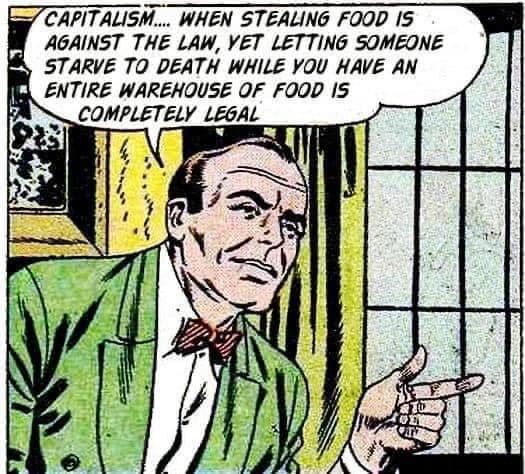
“Doubt everything” instead of ‘trust the scientist until proven wrong’.
‘Illiberal democracy’, whatever that might mean…
“Abolish capitalism”. As if there was any viable alternative!
What’s going on here?!?
“Doubt everything” instead of ‘trust the scientist until proven wrong’.
‘Illiberal democracy’, whatever that might mean…
“Abolish capitalism”. As if there was any viable alternative!
What’s going on here?!?
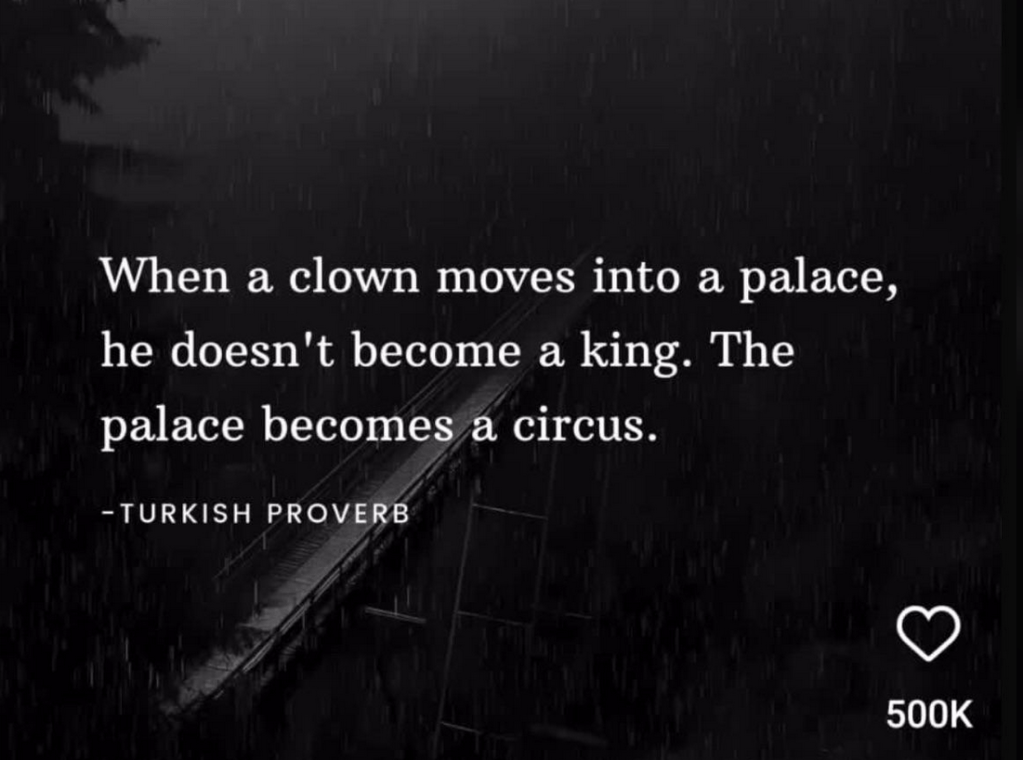
Indeed, but only a clown has enough gumption to tell the king that ‘he’s got no clothes on’!
Furthermore, every respectable palace has both a king and a jester.
The jester overpowering the king doesn’t change the palace into a circus. Only refocuses the attention of those paying attention…
If it did,
it probably had to happen!
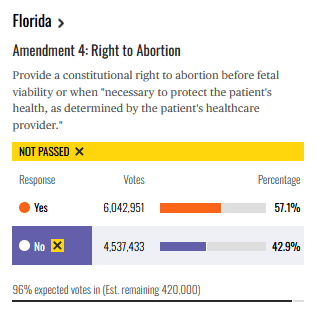
“Trump, a Florida resident, has said he would vote against the ballot measure, after initially appearing to suggest he would vote in favor.” Reuters, 2024-11-06


Abstract:
While there has been a plethora of analysis on diverse subjects within Holocaust studies,
there remains some reluctance to engage with women’s unique experiences,
which were largely subsumed under those of men in the decades following World War II.
This article examines how women’s specific experiences, both biological and social, are often denied
or suppressed in research and literature on the Holocaust, even in survivors’ own testimonies,
despite the fact that these are often clearly gendered experiences.
By revisiting key themes from the testimonies of female survivors,
such gendered analyses contribute to a fuller picture of the unprecedented
and relentless killing that the Final Solution’s anti-Semitism entailed.
Nicole Ephgrave
Journal of Women’s History Johns Hopkins University Press
Volume 28, Number 2, Summer 2016 pp. 12-32
10.1353/jowh.2016.0014
Those who had ordered what had happened at Auschwitz and many of those who had actually perpetrated the crimes considered themselves to be free. They did it on their own will.
Their freedom was intact!
And they had chosen, freely, not only to diminish the liberty of other people but to actually defile them…
Individual freedom is something which depends, largely, on each of us. On how each of us ‘digests’ their previous experiences and chooses to operationalize what they have learned.
Social freedom, on the other hand, depends on how we, as a group/community, aggregate our individual choices.
In this sense, the latter one, freedom becomes a space.
A place – THE place, actually – where each of us can put in practice our own individually free choices.
Now, places have rules.
Each place being defined by the rules governing that place. Some of those rules are specific for each space while others come from the ‘previous’ spaces.
For example, we – humans – are both animals and something ‘higher’. As such, we ‘obey’ both the rules governing the biological realm and the laws of each of the countries we happen to live in.
One of the most fundamental rules evident to man is “no good deed goes unpunished”. Otherwise known as the law of the consequence. “Do not be deceived… A man reaps as he sows” Gal 6:7
Everything we do leaves a trace. Influences the future. Creates karma.
How we, each of us, chooses to exert their freedom creates the circumstances in which we, and our children, will have to exercise theirs. Their freedom!
The manner in which the ‘free nazi’ had chosen to exert their freedom – to kill other people – has shaped the future of Europe. And of much of that of the world!
The manner in which we choose to ‘digest’, to interpret, what had happened shapes our future.
Which brings us back to ‘dehumanization’.
Many of us consider that the victims have been dehumanized. Made less human.
Had their humanness obliterated!
By the abusers. By those who had abused both their freedom and their power!
By those who had transformed other humans into victims….
I beg you to reconsider this:
Who had undergone the process of dehumanization?
The victims or the bullies?!?
We, as free thinkers, have the ability to poke fun at whatever happens to us.
To relativize our experiences.
Hence ‘no good deed goes unpunished’. When the utmost importance of the subject begged for a way more formal wording…
Poking fun at things we cannot control is a survival gimmick. By doing this we can, individually, survive in dire circumstances. Specially in situations where our inner values are questioned. When we have to quell what psychologists call ‘cognitive dissonance’. When we are forced – by ‘external factors’ – to do something we would not have done in ‘normal’ circumstances.
In this sense we can better understand the process of dehumanization.
The defiler actually needs to dehumanize the victim. To consider the victim something else but a human being. Otherwise, the defiler would no longer be able to defile the victim.
But what happens when a human being does not recognize (some of) their fellow humans as being their peers?
Who ceases to be human?

Until not so long ago, all people were busy surviving.
‘Waking alive to see another day’ wasn’t taken for granted.
Food was scarce, illness was plenty and war was a constant presence. And these were shared by all. From kings to their last subject. “Although (Queen) Anne (of Great Britain and Ireland, 1702-1714) was pregnant 18 times between 1683 and 1700, only five children were born alive, and, of these, only one, a son, survived infancy.”
And this need to survive didn’t stop at death.
Since most people were convinced that, one way or another, there was life after death, they were also concerned about redemption. It doesn’t matter what you believe in, if your belief includes any kind of an after life … you need to prepare yourself for it. Either to avoid reincarnation or to ascend to heaven/escape going to hell.
This commonality insured that all people had something to share. A common ground.
Which made it possible for them to see eye to eye regarding at least something.
Which common understanding of one thing made it possible for them to live in a (sort of) community. Together!
Nowadays…
Too many of us continue to have a hard time foraging for the essentials. Continue to survive.
While others have it differently.
Haven’t experienced hunger. Nor need. And their most dangerous experience is speeding on the highway. Dangerous in the sense that they may pay a fine if caught ….
Surviving has been replaced by searching for a better quality of life!
Which is fine!
One should make the most of the opportunities present, right?
But do we really know what we’re doing?
The consequences of our actions?
Specially since surviving was a team effort while ‘quality of life’ is a solitary quest… With nobody in attendance – except for the occasional life coach – to warn us when we ‘jump the shark’.
“And the Lord God commanded the man,
“You are free to eat from any tree in the garden;
but you must not eat from the tree of the knowledge of good and evil,
for when you eat from it you will certainly die.””
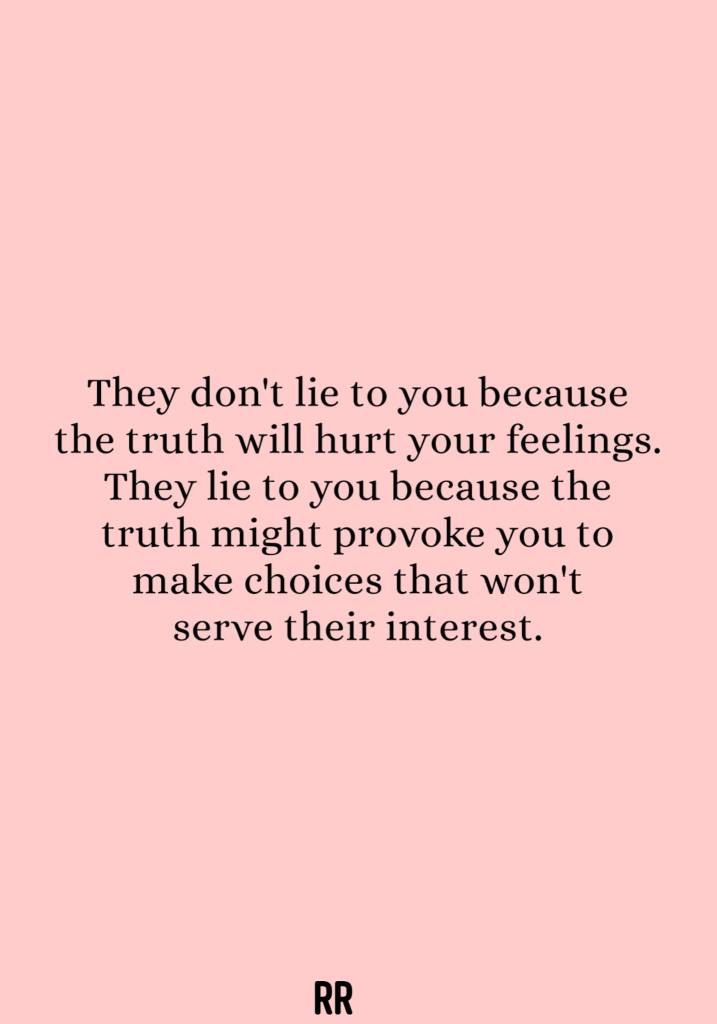
As you might already know, I grew up under communist rule.
The regime described itself as being democratic and promoting freedom. Freedom for all!
The day to day practice, the life we had to endure, proved those words were blatant lies.
Nobody but the dictator was free and the communist democracy was a sham. As soon as anyone opened their mouth – nobody was crazy enough to open their mind! – however slightly, their words were met with extreme caution!
This way I became accustomed with ‘double talk’ before even knowing the book existed!
In a sense, being aware of the fact that words are able to ‘transport’ anything – from abject lies to sublime – is a step further. For the individual. For a society…
When each individual member of a society doubts everything heard or read, that society does have a problem! Disseminated disbelief precedes dissolution.
When individuals no longer trust each-other, things go south fast. Society wise!
Freedom has three dimensions.
‘Phusical’, personal and institutional.
Phusis is the ancient Greek term for ‘growing’ and ‘becoming’. My point being that some things are free in a naturally occurring manner. Also, the phusical freedom is naturally limited. Birds are free to fly only inside the lower strata of the atmosphere.
Personal freedom resides inside our individual minds. Is learned by each individual as a result of social interaction. Is limited by what each individual internalizes during their ‘potty training’.
Institutional freedom is the cultural product of social interaction in a given historical context. I’ll leave aside the fact that history is heavily influenced by geography.
Back in my communist experience, freedom was ‘make believe/belief’. We pretended to be free – otherwise we would have gone nuts – to the tune of convincing ourselves that life was worth living. Otherwise we would have died trying to escape. Furthermore, we convinced the ‘others’ – the ever present ‘political surveyors’ – that we were at least content with what was going on. With how our lives were unfolding.
Our pretenses were the opportunity on which ‘the party’ – the communist party – had built its edifice.
The opportunity grabbed and put in practice by the dictator. Which dictator was the only one enjoying actual freedom. Institutional, personal and, certainly, a lot more phusical freedom than the rest of us.
Another crass example of double talk is how the Americans use the term ‘liberal’. For the Conservative Americans ‘liberal’ is a cuss-word while the Liberals are proud to be called in this manner but the word does have the same meaning for both of them. It includes everything on the left side of the political spectrum, communists included.
The problem with this whole thing being the fact that the communists – the ones inspired by Marx, anyway – are amongst the most conservative political operators ever. No communist has ever changed anything in Marx’s Communist Manifesto. Or doubted anything written by Lenin. No communist has ever accepted that institutional communism, the one that failed, was far more than a crime. A huge error!
Anything familiar?
And what has any of this to do with the First Lie?
With the first lie, perpetrated by the Founding Father at the very beginning of the most important Book?
Which Book is supposed to be read literally by certain individuals having a certain political orientation?
I really can’t wrap this thing up before noting that the First Lie didn’t hold.
The serpent convinced the woman to eat, she passed the fruit along to her man and thus we’ve all became able to ‘tell good from evil’. To a degree, of course.
And nobody died! Not immediately, as a consequence of them eating that darn fruit.
“And the Lord God said,
“The man has now become like one of us, knowing good and evil.
He must not be allowed to reach out his hand and take also from the tree of life and eat,
and live forever.”
So the Lord God banished him from the Garden of Eden
to work the ground from which he had been taken“.
“And what’s in it for us, ordinary people?”
My 90 years old father, commenting the news just running on TV

Nothing but what we can make of it.
The Earth was circling the Sun since the very beginning. Way before Bruno ‘discovered’ the phenomenon. Again…
The egg was sending ‘chemical signals’ since … who knows when. We, all of us, have been born without any knowledge on this matter.
Giordano Bruno was burnt at the stake.
He wasn’t the only one to face the consequences of his discovery. The lives of everybody else have been changed by his discovery. And the way we understand the world!
Sooner or later, somebody will find a way to use the information about ‘how the egg works’. To make some money out of it, to help people… or even to make an ‘ideological point’. “Yet another male dominated fantasy about the creation of life…”
So, Giordano Bruno was burnt at the stake as a consequence of his discovery?!?
Nope!
Bruno was burnt at the stake as a consequence of what we, the people, have made of his work.
Well, not exactly us but our ancestors. And not exactly we, the ordinary people, as the ‘bright minds of the day’. They had to be bright since ‘they’ were the ones running the show, right?!?

OK, so ‘those who know how to weave a story are those who order around those who know the facts’.
According to Yuval Noah Harari.
And, again, what’s in it for us?
Nothing but what we can make of it.
For as long as we’ll continue to chase power, ‘political power’, things will continue as they were.
As we’ve conditioned ourselves to expect them to be.
But, hopefully, when the next Giordano Bruno will tell us things can be spun the other way around, we’ll know better than to burn him at the stake. Alive. Again!
Power can be exercised in many ways!
The more sustainable of which being in favor of the general public.
‘For the long term benefit of the self aware social organism’ instead of ‘for how the public has been led to believe by the spin doctors’.
When will we be able to figure this out?
When those who know how things work will spill the beans out-front instead of choosing whose arse to lick.
After all, the egg encourages the most suitable sperm, not the most enchanting one…
Survival of the fittest?!?
No, only the demise of the unfit!
Ernst Mayr, What Evolution Is?
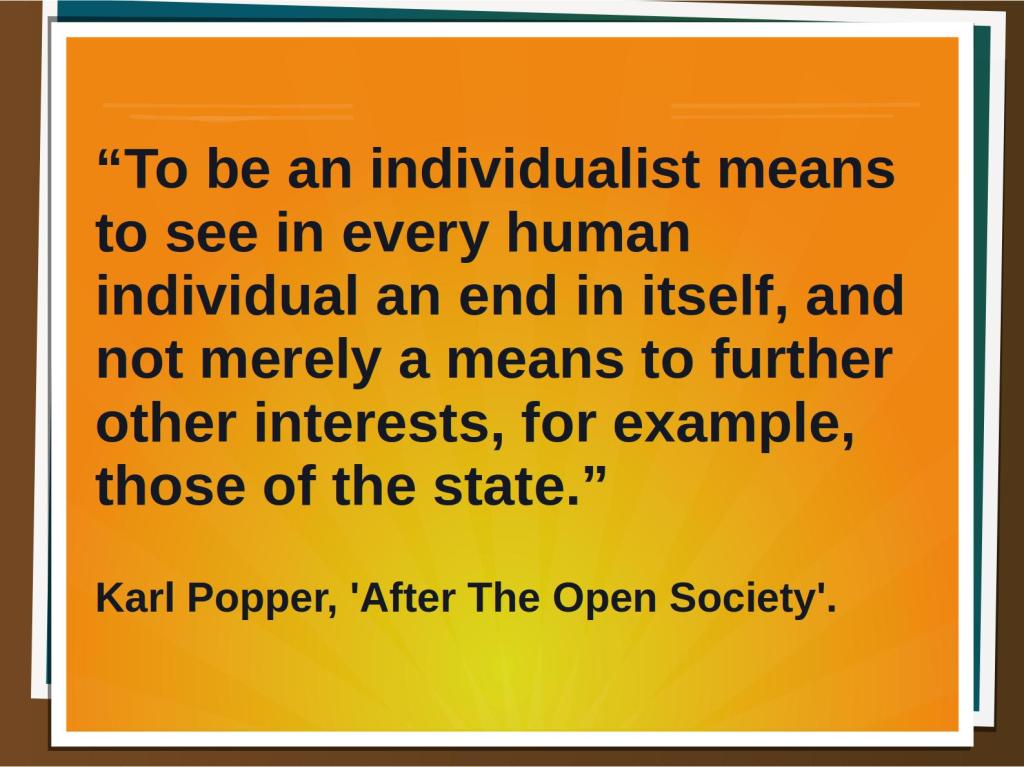
An end in itself…
For whom? For the concerned individual?
For the philosopher pondering the concept?
For the ideologue promoting the idea?
And who determines ‘the interests of the state’?!?
“Plato suggests, and all later collectivists followed him in this point, that if you cannot sacrifice your self-interest for the sake of the whole, then you are a selfish person, and morally depraved.”
Since there’s no better judge for ‘sustainability’ than mere history, let’s ‘look back’.
Whenever the powerful of the day considered that everything belonged to them, and that the collective wasn’t worth any consideration, that ‘arrangement’ soon ended in chaos. From Alexander the Great to Saddam Hussein. Hitler, Stalin, Ceausescu…
Whenever the meek had accepted everything which came from ‘above’, very soon the ‘arrangement’ also ended in chaos. The Khmer Rouge experiment, the Chinese Cultural Revolution, communism being instated in the Eastern Europe by the Soviets…
As a rule of thumb, individuals can exist only as members of a collective.
None of us can birth itself (?!?)
None of us can educate itself ON ITS OWN. OK, one might teach itself to read. And then devour a whole library. But for that to happen, somebody else must have invented the letters first!
None of us can develop into a conscious human being without living with other human beings.
Furthermore, the same rule of thumb states that collectives which value their individuals, all of them, fare a lot better than the highly ‘hierarchical’ ones.
In this sense, Popper was right. ‘Individualistic’ societies – the collectives which ‘see individuals as ends to themselves’ – fare better than the collectives which allow, for a while, their temporal leaders to lure them into obedience.
Our children have to make do
with the consequences of what we’ve cooked up.
The happier amongst us live in states run as liberal democracies.
Most countries on this planet define themselves, constitutionally speaking, as being democratic.
And except for a very few, all the others behave in an apparently capitalistic manner. Some under a free(ish) market and the rest under a ‘mixed’ regime.
Since we’re speaking about the ‘current’ socioeconomic arrangement, which is in flux, we still don’t have a name for it.
We do have a name, though, for the previous one. Feudalism.
And for the one before that. Slavery.
Or, to use a modern term, all the previous regimes might be bundled together as ‘authoritarian-isms’. Regimes where authority flows from top to bottom and where feed back comes only in the form of revolution. Coup d’etat. Dynastic change… and other euphemisms.
History suggests, and those wise enough to notice implement this lesson where ever possible, that all authoritarian regimes crumble under their own weight.
While liberal democracies tend to survive for as long as they maintain their liberal nature. Their freedom!
What’s the difference between liberal and ‘illiberal’ democracies?
“It’s not who votes that counts
but who counts the votes”
Josef Stalin
Now, speaking seriously – as Stalin style ‘popular democracies’ have crumbled more than 30 years ago, following all other ’empires’ which no longer exist, there is a difference between liberal, a.k.a. functional, and make-belief democracy.
People maintaining a liberally democratic regime take their job seriously.
They speak up their minds. Hence the problems become known.
They listen what the others have to say. Hence the people are not only aware of problems as they arise but people also have the opportunity to understand the nature of those problems.
They respect each-other. Hence they treat all problems, affecting all the people, in a fair manner. Thus maintaining the natural stability of the social arrangement.
It goes without saying that in a liberal democracy everybody can vote and each vote is counted…
An illiberal democracy, on the other hand, is where things are more complicated.
The most illiberal situation is that where it doesn’t matter whether people vote or not. The results have been counted beforehand. The latest example being Venezuela 2024.
A more ‘subtle’ picture is offered by, for example, Hungary. As a matter of fact, it was Viktor Orban, the Hungarian “dictator“, the one who had coined the very notion of “illiberal democracy“. A revamped Constitutional Court, some Constitutional Amends, “emaciated checks and balances“, tight controls imposed over the media…
What about the ‘capitalist’ part of the current arrangement?
I’m afraid we waddle in confusion here.
We no longer make any distinction between ‘capitalism’ seen as ‘hoarding money as a sport’, and ‘using accumulated fiscal deposits as resources for building something new’. New and useful, of course…
‘Fiscal deposits’ – hoarded fiduciary money – have been around since coins have been minted. And IOU notes have been written. But capitalism, as Adam Smith understood it, wasn’t born yet at that time.
Under authoritarian regimes, having a lot of money does offer some leverage. But no immunity!
Consider what had happened to the Templar Monks when France’s Philip the IV-th coveted their money. Or the fate of the richest Chinese, after he had been perceived as being too cocky by the communist regime…
Whenever ‘capitalism’ takes place in liberally democratic settings, the market can be described as being ‘free’. Each economic agent – buyer or seller – decides in an autonomous manner. Takes their own advice and has to obey nobody’s orders. Has to obey the law but doesn’t have to abide to any whims.
Putting two and two together, for a society to remain functional in the longer run, the most importing thing is the ‘free market’.
The key word here being ‘free’. The meaning attached to the word and the understanding people have about the concept.
There is ‘free’ as in ‘free for all’ and free as in ‘freedom under the law’.
‘Free for all’, also known as ‘the law of the jungle’, inevitably ends up as a ‘dog eat dog’ situation while freedom under the law remains functional for as long as The People bring the law up to speed whenever needed.
The ‘market’ part is a lot simpler.
A ‘place’, an ‘open’ space, where both ideas and wares are exposed and exchanged. Amongst those who come to the market, to the agora, to solve their problems. To fulfill their needs.
As long as that ‘space’ remains free – as in ‘open’ for all – most people are able to make ends meet. The situation remains stable. For everybody to enjoy.
As soon as one ‘operator’ starts to ‘corner the market’ – using any of the already known ‘technologies’, the most popular being the old fashioned lie – the situation becomes potentially dangerous.
Whenever ‘The People’ have a sound understanding of what freedom really means, the bullies are ejected from the system. The ‘antitrust’ legislation is put to work and the budding ‘monopolies’ are dismantled before real harm was done.
If not… If von Papen hadn’t helped Hitler to rise into power and if Chamberlain hadn’t led the free world into submission…
Had we not threaded so lightly when Putin snatched Crimea back in 2014….
https://carnegieendowment.org/posts/2017/03/revisiting-the-2014-annexation-of-crimea?lang=en
The point I’m trying to make here being that what candidates say matters.
That we really need to see through their words.
Whether they are interested in solving issues – and which of them – or they simply want to accede to power.
Doesn’t matter? As long as they keep their promises?
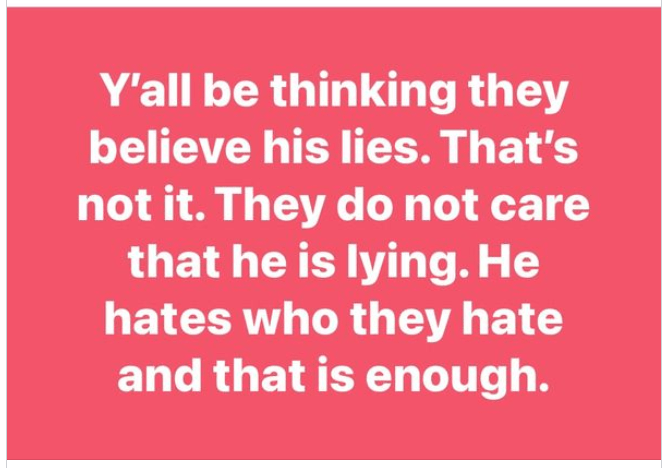
Do you really expect a lying bully to keep up with their words? To fulfill their promises?
Are you comfortable with ‘hiring’ a lying bully to mind the future of your children?
Do you really care about where your car was built?
No, but I am interested in how it works.
I need that in order to use it properly!

‘Ordinary matter’ is ‘lifeless’. Inanimate.
The rules which ‘shape’ the interactions between pieces/portions of the lifeless matter are the same ‘all over the place’. As far as we know, anyway.
The pieces/portions consisting of ordinary matter are more or less similar. There’s nothing to tell apart one proton from another. One rock from another one. One drop/bucket of water from the rest of the pond.
And there’s life.
‘Technically’, the living organisms are made from inanimate matter.
And, anyway, while ‘ordinariness’ is forever, life is temporary. Individual organisms have a limited lifespan, species evolve and life itself has appeared some time after the ordinary matter.
The rules which shape the interaction between the living organisms and their environment are species specific. Further more, individual sets of data set apart each individual belonging to each species. Which means that each species interacts in a specific manner with their environment while each individual organism does have its own particular ‘manner of doing things’. ‘Inside’ the species specific behavior but nevertheless particular.
Then there’s conscience.
Which conscience is nothing but a concept. Like everything else here.
Which concept, like all other concepts, has been coined by us. By us, conscient human beings.
The point being that we, conscient human beings, attempt to understand conscience by thinking about it.
Somewhat similar to looking inside an eye when attempting to understand sight. Or listening attempting to understand hearing.
Freud came up with the notion that studying what’s wrong, out of the ordinary, might help us to understand ‘normal’. But Freud was a psychologist…
Engineers prefer to ‘look from above’. To extricate themselves from the problem in order to see it ‘whole’. And I’m an engineer…
So, what is conscience?
An individual ability and a space/place.
There is life and there are individual living organisms.
Life goes on regardless of a number of individual organisms passing away. As long as one individual living organism continues to be alive, life itself will continue to exist.
Further more, regardless of how life might have appeared, presently it seems impossible to have life, the kind we have learned to appreciate, with only one species being alive. Let alone with only one living organism…
Same thing with conscience.
Humans become conscient through human interaction. Our ancestors had become conscient way before anybody was thinking about conscience. People who, in various circumstances, have had a limited interaction with other people struggle to develop a functional conscience. A full fledged one…
But humans are not exactly alone when it comes to being conscient.
Not exactly aware of their own selves, but still functionally ‘conscient’.
Being alive, individually speaking, means being able to:
Maintain the ‘structural identity of the organism’. As in keeping the inside in and the outside out.
Manage to breathe, eat, drink and excrete.
Life, as larger process, means successive generations of individual organisms transmitting the pertinent species specific genetic information to the next cohorts.
Maintaining the inside in, the outside out and managing to breathe, drink, eat and excrete means behaving in a conscious manner, albeit in a very limited sense.
This behavior being specific to ‘life’ and life being dependent on species specific information being passed from one generation to another means that human conscience – acceded by individual humans imbibing culturally specific information – is nothing but a particular example, maybe the most evolved one to date, of an otherwise widespread phenomenon. As a matter of fact, people who – for various reasons – are not ‘conscious’ – as in aware of themselves – continue to ‘breathe, eat, drink and excrete’. ‘Incompletely’ and only for a short while, if left unattended, but that’s another matter.
Furthermore, there is a ‘continuum of conscience’ starting from plants and culminating with the human awareness.
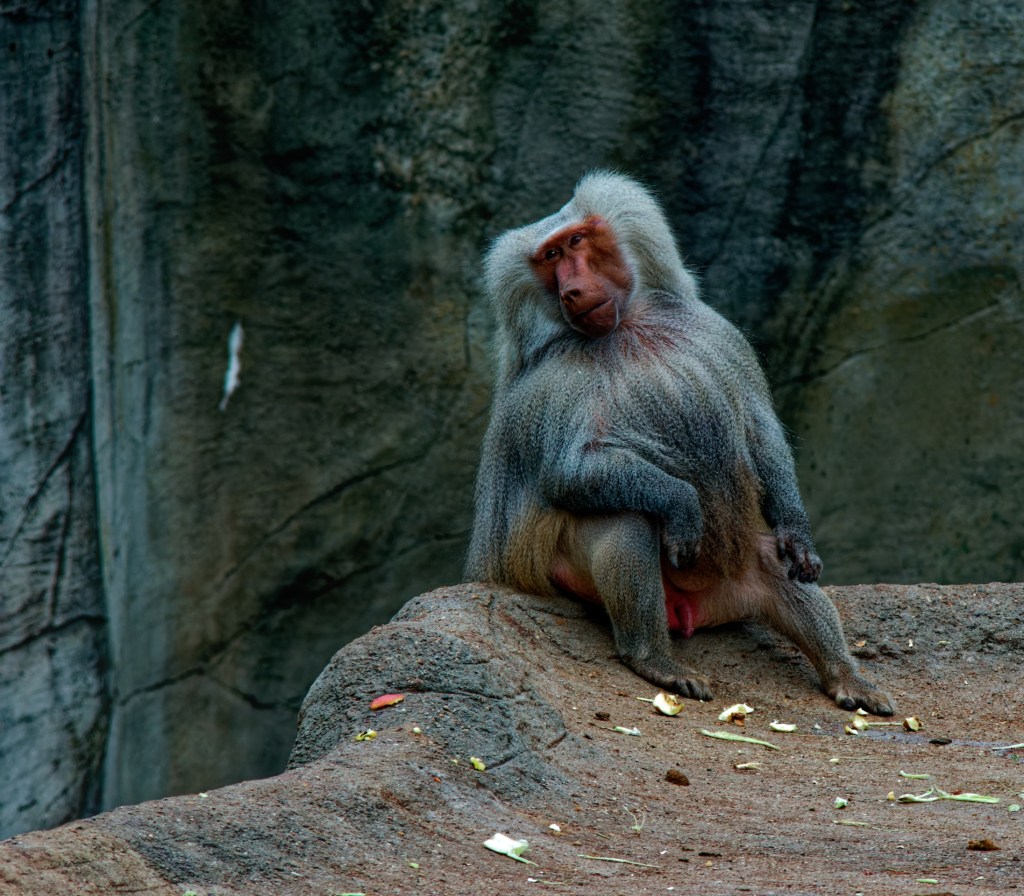
While plants and fungi manage to stay alive, animals display a widely nuanced repertoire of behavior. From the learning slime to our cousins, the apes.
 nicichiarasa