Archives for category: freedom

scalia1

It is very rarely that I agree in full with something that I happen to stumble upon over the Internet.

And it’s no wonder that Scalia was absolutely right on the subject.
He had lived for so long in the shadow of the Constitution that at some point it must have downed on him.
The constitution, just as any other legal document, is nothing more, and nothing less, than what we make of it.

After all it was us, citizens, who wrote it in the first place.
Then amended it as we saw fit.
And are now interpreting it. To fit our own purposes, of course.

We don’t seem to agree much, lately, about those very purposes?
So we came up with diverging interpretations of what’s written in the Constitution?

Then the problem is with us, not with the Constitution.

Using it as a weapon, or adjusting it to fit the short term goals of whomever happens to be in power momentarily, won’t solve anything. Actually it will only make things worse.

Just finished reading, again, another excellent post written by John Faithful Hamer on Committingsociology.com

I remember now that something was nagging me after reading it for the first time. I also remember the pangs of helplessness felt almost a year ago, when I couldn’t identify what was nagging me.

Well, this time I nailed it.

“Getting angry isn’t really like releasing the built-up pressure in a steam engine; it’s far more like exercising a muscle group. Every time you give in to the desire to lose it, you strengthen your “anger muscles”; every time you resist the urge, you weaken them.”….
“So perhaps it’s time to stop preaching the gospel of expression, and revisit the much-maligned virtues of repression.”

“Anger” and “getting angry” are not the same thing.
Anger is just a feeling – and, hence, a source of ‘energy’ – while ‘getting angry’ is the manner in which we allow it, consciously or unconsciously, to take us over.
I fully agree that ‘getting angry’ only worsens the situation only I’m afraid that ‘resisting the urge’ isn’t any better. In fact that would be no different from tightening your arse because you don’t want to fart in public.
The problem is not solved, not at all, only postponed. You still need to relieve yourself.
By widening Freud’s concept of repression to encompass more feelings than the simple embarrassment we might find a reason to continue to look for a manner in which to ‘release that built up pressure’.
Only now we are faced with a new problem, since we’ve already agreed that ‘getting angry’ is not the best thing to do.
Freud, again, to the rescue.
How about widening another one of his concepts, sublimation?
How about learning to express, this time consciously, our intense negative feelings in a socially acceptable, and hence a lot more effective, manner?

section 211-1

section 211-2

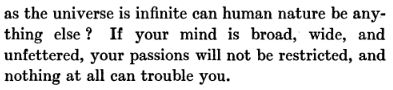
Yoshida Kenko, Tsure-Zure Gusa

As you can very easily infer from the title, I define myself as being an agnostic.
I’m reasonably satisfied with the scientific explanation about how the world came to be but I cannot rule out any intervention from an out-side agent during the process.

Hence my unwillingness to commit myself to any of the extreme positions.

And hence my conundrum.

A significant portion of the theist believers are convinced that God, their God, is behind everything that takes place on the surface of the Earth. And beyond.

All scientific materialists are convinced that everything takes place according to some immutable and implacable ‘natural laws’.

Then how come any of them has enough gumption to contradict any of the others?

How come a religious believer can say to another ‘your God is false’ if he is convinced that nothing in this World can happen without the knowledge and approval of his own one? Isn’t this a form of censorship towards his own God?
How come a religious believer can say to an atheist ‘you are going to rot in Hell’?
Last time I checked all Gods were very jealous, all religious teachings I know are clear about this: ‘You do your job and let Me do the judging.’ Then how come so many zealots feel free to usurp the place of their Gods and pass judgement on their peers?

How come so many of the atheists feel free to poke fun at the believers?
According to their own creed, religion is a natural thing. It does exist, isn’t it?
And by its mere existence it necessarily observes the very natural laws the atheists so staunchly defend. As if any of them needs any defense, let alone to be imposed upon the others…

When are we going to accept that religion, any of them, is nothing but an environment, not a yoke?
Just a place with some rules, not some kind of a prison?
That the final responsibility for our acts belongs to us, regardless of any God watching or not over our fates?

Here on Earth, anyway.

661211-_uy447_ss447_


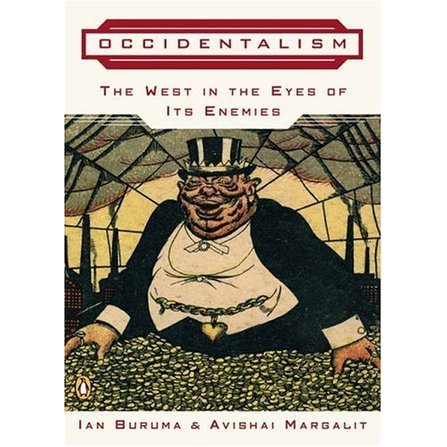
Just finished reading about the West as an object of hate.

Next in line is a book about the Orient as an object of study.

51k6n6ma-nl

Bearing in mind the fact that the Occident is still very much hated by a significant number of people residing in the Eastern part of the World it seems that we, the Westerners, have  been rather poor students of the Orient.

Or that some of us don’t give a damn about the long term consequences of their actions?

“To understand is not to excuse, just as to forgive is not to forget, but without understanding those who hate the West, we cannot hope to stop them from destroying humanity.”

I’d say these are very wise words which constitute an excellent starting point.
Towards the end of their book Ian Buruma and Avishai Margalit argue that “despite Christian fundamentalists speaking of a crusade, the West is not at war with Islam. In fact the fiercest battles will be fought inside the Islamic World.” (translation belongs to me, I have a Romanian version of the book)
How about us, in the West, helping the ‘right’ side in an innovative way?
By giving them an example.
By mending our own ways, before telling others to mend theirs!

I’m not a huge fan of the EU but I have a mostly positive opinion about it.

This morning my stance on this matter was about to change, dramatically.

I had found in my email a link towards a newspaper article, in Romanian, which said ‘the European Court for Human Rights in Strasbourg had ordered that starting with March 1 2016 people in Europe are no longer allowed to baptize their under-aged children‘.

Hard to believe something like that, isn’t it?

Are you really sure about that?

Now try to read articles like this – which are reasonably ‘well’ written, using the right lingo and having enough details thrown in to make them sound credible – through the eyes of a guy already worried by the so much hipped ‘migrant invasion’. Who was already pissed off by the various rules and regulations handed over from Brussels and acquiesced by the local, and supposedly sovereign, governments without any fuss.

Most people do not have the exercise of doubting everything they read, specially if the message comes from somebody they trust – a friend, for instance, or if the site where they read it seems legit.
OK, a certain proportion of them – not all, will exert some discretion if money is involved. That’s why phishing has a limited, yet certain, impact.
But when a particular piece of information apparently confirms an already entrenched stereotype – the bossiness of the EU, for instance – quite a large number of readers will fall for it.

Yesterday evening I was reading a comment added by Nassim Nicholas Taleb on his own Facebook wall: What social media finally did: destroy the press. It is more organic to get information from word-of-mouth, which it accelerated.
Corroborate that comment with a quote from an excellent article published by the same guy on Wired.com: “I am not saying here that there is no information in big data. There is plenty of information. The problem — the central issue — is that the needle comes in an increasingly larger haystack.” (Nassim N. Taleb, Beware the Big Errors of ‘Big Data’, Wired.com, 08.02.2013) and things start to gain some perspective.

What we’re dealing here is the famous lack of symmetry that currently bothers the strategic planners who presumably shape the future of the humankind.

In the ‘good ole’ days’ – when we had writers, publishing houses (newspapers, magazines, you name it) and ‘specialized’ readers, things were a lot simpler.
The writers had a certain notoriety and most of them didn’t want to jeopardize it by publishing bullshit.
Publishing houses didn’t dare to publish bullshit – except for those that did it on purpose, because most of their readers would no longer have bought their papers.
The specialized readers – those who usually bought a certain kind of magazines or books – were able to recognize most bullshit when they saw it, simply because they had some experience in the fields that used to elicit their interest.

Bullshit was being pushed in those days too, for sure. But it was a specialized job, that had to be done carefully.
And in that era, for bullshit to be effective, you had to have very ‘favorable’ circumstances.
Communism didn’t take hold but in very poor countries and fascism only in war torn Italy, Germany and Spain.

Nowadays, “…any simpleminded partisan with a political ax to grind can find an online community of like-minded whack-jobs who’ll be happy to provide him with plenty of ideological ammunition (e.g., bogus stats, pre-fab arguments, etc.). Before long, what was once a more-or-less harmless, single-issue troll has morphed into something far more monstrous and formidable: a veritable Swiss-army knife of bullshit, a perfect storm of bad ideas, a walking Wikipedia of stupid.” (John Faithful Hamer, From Here (2016) )

And since it’s very hard to police the Internet – even harder if we are determined to preserve the ‘freedom of expression’, we are in a very delicate position.

Is there anything to be done about this? Considering that there will never be a real shortage of ‘simpleminded partisans with political axes to grind’?

I think there is.

I started this post by mentioning three related concepts.

Freedom, responsibility and discretion.

We should not tamper with Freedom. Basically this is everything we’ve got, our most precious achievement.

So, we are left with ‘responsibility’ and ‘discretion’.

How is it that most sites manage to stay on line?

They are either sponsored by somebody or they sell advertising space, right?
Who provides that money? Who buys those advertised products? Who spreads around the news about those sites?

Who reads those bullshit laden articles and swallow them hook, line and sinker, simply because some of the (seemingly legit) arguments presented there happen to be consistent with our previously held convictions?

So, if you wish that your kids will be able to live in a better world, stop distributing bullshit through social media, stop buying things advertised on bullshit peddling sites – or, even better, stop going there altogether, and, above all, learn your kids to think with their own heads.

Even if that means they’ll end up contradicting us. As long as they’ll do it in a respectful enough manner – the second most important thing we’ll have to teach them about, all will be OK.


Update. A friend of mine, thanks Lucian, has done some digging over the Internet and found out where all this has started from:

baptising

Read the comments to any article that deals with the European Community and you’ll certainly find something to this tune:
“This is the end of the EU”

That might happen anytime, of course, but I’d still like very much to know why so many contemplate this possibility with so much glee? And I’m not talking here about those who think they have something to gain from a weaker Europe. Putin, for instance. Or Erdogan.

Why so many ordinary Europeans are so angry towards the very idea of a closely knit European Union?

How about reading the entire history of this continent as a long story of individuals striving hard to become more and more autonomous?

Some would say that Europe was about individuals becoming free, and I can agree with that. Only that freedom had strings attached.

“My freedom stops where your freedom begins”.

Meaning that none of us is really free unless each of us respects the liberty of all the others. That our individual liberties depend on each-other. Well, that’s the definition of autonomy, not that of ‘absolute freedom’ but let’s not be bogged down by words.

In fact what helped Europe become what it is today is an unique combination of ever growing individual freedom made possible by an ever stricter respect for the rule of law.

This was not at all a smooth process.

From time to time some individuals garnered a lot of liberty for themselves precisely by depriving all other of theirs and sometime even succeeded in writing this into law. For instance, until 1848 it was still lawful to own slaves in France.

Another type of ‘garnered’ freedom is what happens in a dictatorship. The dictator and his henchmen are freer than the rest of the people, but none of them as free as the people living in a truly free country. And Europe had witnessed a considerable number of dictatorships.

Which all eventually failed.

But something lingered in the collective memory of the Europeans. Their disdain for being told what to do. Their mistrust for rules imposed from above, for regulations that did not have the opportunity to become evident, through the passage of enough time, for those called to follow them.

This is why the ‘enthusiasm’ with which “l’aquis communautaire” was peddled by the Brussels bureaucrats to the new entrants has been met with such reticence.
This is why the measures being practically imposed by the more powerful members of the Union to the rest of the gathering are met with such scorn.

Very little real consideration is being given to the manner in which these measures are adopted and then communicated ‘from above’  and, simultaneously, very little attention is paid, by those called to put them in practice, to what their real effect would be – if they’d be applied in earnest.

And, unfortunately, there is no real shortage of callous political mavericks who eagerly try, and sometimes succeed, to capitalize on these misgivings.

As if we didn’t know any better.