Archives for category: democracy

5eg5cq4_llox-4hqq6q6r-cwzhlmn9igl6ermaorfgy

For the last 3500 years humankind has been busy writing Laws.

Which can be grouped in two main categories.
Natural laws and man made (normative) laws.
According to this classification while all laws have been written by Man those belonging to the first category are active regardless of Man being aware of their existence and those who belong to the latter come to life only as long as Man chooses to enforce them.

Another classification could be ‘phusical’ laws – ‘phusis’ being an ancient Greek term for ‘grown naturally’, all things that came to be in a ‘natural’ manner – ‘statistical’ laws and, again, ‘normative’ laws.

Both these classifications depend on how much influence Man has over how the laws work, besides the obvious fact that the wording, in all cases, belong to Him. To Man, of course.

The difference between them being that while the first sees Man as an individual making decisions by himself the second takes into consideration the fact that Man cannot function properly outside of a community.

Before going back to discuss some more about both classifications I have to note that laws are important mainly because they define areas of opportunity.
People are, from a functionalist point of view, self aware decision makers. But since none of them has an infinite amount of knowledge at his disposal nor an infinite capacity to process what ever information he has on a subject, people find it very useful to have the reality around them partitioned into ‘safe’ and ‘enter at your own risk’ areas.
In this respect it doesn’t matter whether the law itself belongs to either of the 5 categories. The consequences of the law are the same. Those who are aware of its existence have a lot easier job at discerning the safe from the potentially dangerous places than the ignorant ones. What each of them does after finding that out is another matter.

Coming back to the first classification, ‘natural’ versus ‘normative’ laws, let me elaborate a little about what ‘natural’ means in this situation.
It is obvious that the law of gravity, the one formulated by Isaac Newton, belongs here.
It started to produce consequences as soon as ‘mass’ came into existence – regardless of who, if anyone, made the necessary ‘arrangements’ and regardless of anyone being aware of its very existence or not.
But how about the law against killing another human being?
Animals belonging to the same species occasionally do kill each-other so this doesn’t seem to be an all encompassing natural law.

On the other hand history has compellingly taught us that communities where individuals are treated fairly by their peers fare a lot better than communities where some of the members kill (some of) the others. In a Darwinian sense the communities who do protect the lives of their members have an evolutionary advantage over those who don’t.
In this sense the ‘do not kill’ law becomes ‘phusical’. It is both ‘man made’, hence ‘normative’, and acts regardless of people being aware of its existence.

And no, this is not the same thing as ‘ignorance of the law offers no excuse‘.
As I said before, the first classification, ‘natural’ versus ‘normative’ considers Man mainly as an individual – who cannot hide himself under the cloak of ignorance and who has to bear the consequences of his acts, if apprehended – while the second classification, ‘phusical’, ‘statistical’ and ‘normative’, considers Man as an individual member who both depends heavily on his community and contributes decisively to the well being of the place where he lives.

In this respect ‘do not kill’ becomes a ‘statistical’ law. If enough individuals refrain from killing other people and if the community successfully puts in place and operates a protection mechanism  to guard the lives of its members, without otherwise stifling the ingenuity of its people, that community will fare better than those who either fail to protect their members or protect them so jealously that transform them into hapless puppets unable to fend for themselves. Those who are interested to find out more about the equilibrium between protection and freedom of expression might want to check Crime and Deviance, Functionalist Perspective.

By now you must have noticed that ‘statistical’ laws are both ‘objective’ – in the sense that they will produce consequences even if people are not aware of/do not care about their existence, and ‘normative’ – in the sense that those consequences do depend, heavily, on how people act.

So. Does this make me a staunch defender of ‘normative’ laws?

Not at all. Just as Durkheim noticed long ago telling people what to do will only stifle their ability to adapt. To cope with change.

That’s why I strongly feel that ‘normative’ laws, the few that are really necessary, must be written in a ‘negative’ way. Do not kill, do not rape, do not discriminate, do not steal are quite different from ‘all of us have to be maintained alive’, ‘we must assign an armed guard to every nubile woman’, ‘we must write millions of pages of rules to cover every possible act of discrimination’, ‘we must arm ourselves to the teeth in order be able to defend our property against all odds’.
 

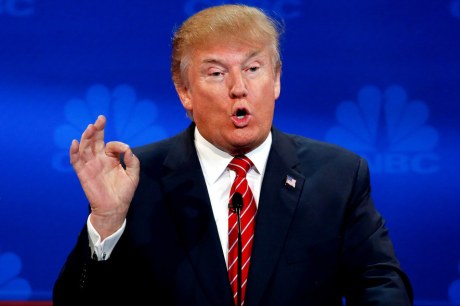
I recently read an excellent article about how the ever-growing lack of trust in public institutions, governments and experts included, is generating aberrations like Donald Trump becoming the darling of a sizable proportion of the American Republicans.

collapse of trust in institutions

I’m afraid that all of us have contributed to this.

People who get elected to power use it to fulfill  their own goals yet continue to get elected despite the fact that many of those goals do not add anything to – and too many times even subtract from – the general well being.
People who, for various reasons, vote for those mentioned above.
Media pundits who fill the airtime with their versions of the reality, purposefully crafted to fit their own goals instead of honestly trying to present to the public what they have seen/understood of what had happened.

What’s bothering me most is that all of them are behaving in an absolutely ‘rational’ manner.
In the sense that all of them are convinced they are following the current mantra.
“Make the best of the opportunities at hand”

Given the current ethos – that only the pussies do not grab everything within their reach – each of those in places where they might be given things would act foolishly not to accept those ‘gifts’. If they might find a ‘legal’ way to do it.
And the Supreme Court of the US concurs.

In a unanimous decision, the U.S. Supreme Court threw out the corruption conviction of former Virginia Gov. Bob McDonnell.

“There is no doubt that this case is distasteful; it may be worse than that,” Chief Justice John Roberts wrote for the court. “But our concern is not with tawdry tales of Ferraris, Rolexes, and ball gowns. It is instead with the broader legal implications of the Government’s boundless interpretation of the federal bribery statute.””

What happened was that former Gov. Bob Mc Donnell had accepted various gifts from a certain business man called Williams and then (because of them?) ‘set up meetings, hosted parties and called Virginia officials to discuss  a series of meetings to discuss aspects   related to William’s businesses.

Now, is this an example of corrupt behavior or not?

According to the Government and to the lower courts that have sat on this matter, it is.
According to the Supreme Court, it is ‘distasteful and even possibly more than that’ but not yet corruption. Or, at least, not in the way the Government has presented its case.

“But conscientious public officials arrange meetings for constituents, contact other officials on their behalf, and include them in events all the time. The basic compact underlying representative government assumes that public officials will hear from their constituents and act appropriately on their concerns — whether it is the union official worried about a plant closing or the homeowners who wonder why it took five days to restore power to their neighborhood after a storm. The Government’s position could cast a pall of potential prosecution over these relationships if the union had given a campaign contribution in the past or the homeowners invited the official to join them on their annual outing to the ballgame. Officials might wonder whether they could respond to even the most commonplace requests for assistance, and citizens with legitimate concerns might shrink from participating in democratic discourse.” Chief Justice John Roberts writing on behalf of the court.

The way I see it this is nothing but ‘hiding behind technicalities’.
From a formal point of view the Supreme Court’s decision is absolutely correct.
On the other hand almost everybody speaks out, some very vehemently, against ‘pork barrel politics’.

Yet nobody does anything when occasion arises. Forgetting that this is exactly what we, humans, are supposed to do. Make decisions and assume responsibility for them. Otherwise, if we only look out for pretexts to do nothing when those around us keep making ‘good’ use of whatever opportunities they identify, the whole world will soon become, again, encased in the kind of straight jacket Hitler and Stalin were trying to put on us.

Here’s another example.

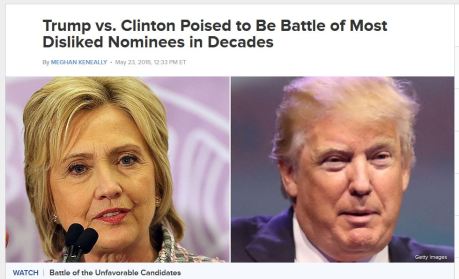
Less than a fortnight from now the Republican and the Democratic conventions will likely nominate Trump and Clinton as their respective presidential candidates. Each passionately defended by their followers and viciously attacked by their adversaries.
Yet both almost equally disdained by the general public.

“More time on the campaign trail isn’t improving the image of either major-party presidential candidate, Hillary Clinton or Donald Trump, a new Wall Street Journal/NBC News poll finds.
Some 60% of registered voters held a negative view of Mr. Trump, the presumptive GOP nominee, compared with 58% in May. Some 29% viewed Mr. Trump positively this month.
Mrs. Clinton, the former secretary of state and presumed Democratic nominee, fared somewhat better, with 55% viewing her in a negative light, compared with 54% in May. One-third of registered voters held a positive view of her.” (Peter Nicholas in Wall Street Journal, June 27 2016)

What’s going on here?
Why has any of them been picked up as candidate in the first place?

And why none of their detractors mentions the trait of character that both of them have in common?

The complete disrespect both of them have for ‘comme il faut’.
You see, ‘properly’ doesn’t necessarily mean ‘being a stickler for the word of the law’ but certainly means following the ‘spirit of the law’.
You’d expect as much from the two contenders for the Oval Office, don’t you?

Yet Donald Trump has a history of trying to use the law in order to drive an old woman out of her house so that he could have build a parking lot for one of his casinos while Clinton is being currently investigated for the highly irregular manner in which she used to manage  her e-mails when she served as Secretary of State.

To me this is a pertinent enough explanation for why a majority of the people do not trust that any of them would have ‘the better interests of the country’ in mind if and when any of them will be elected to office.

Making a step further people might soon develop a distrust for the whole concept of democracy – simply because the system was unable to deliver better candidates/alternatives. Not only in America.

And since the idea of democracy starts with trusting your fellow citizen to be able to make pertinent decisions – even if they happen to be contrary to your own ideas on the matter – it is highly likely that we’ll soon live in a very untruthful world.

the brexit hero

“Isn’t it funny?
You know, when I came here 17 years ago and I said that I want to lead the campaign to get Britain to leave the EU, you all laughed at me.
Well, I have to say, you are not laughing now, are you?”


Now let me get something straight.

This guy has been going to work, as an elected official, with one goal in mind. And one goal only.

To undermine the very institution he was working for.

Not to improve it in any way but to simply dismantle it.

I’m not going to discuss here whether he is right about the shortcomings of the EU or not. (He is)

But I am going to question his modus operandi.

OK, he did point out, very astutely, which are the weak points of the European Union.
And then, instead of proposing ways to mend those problems, he did his ‘best’ to make matters even worse.

That was all that he could do in those circumstances. That’s it. Nobody’s perfect.

But why elect a guy like this, time and time again, into a position where he gets to be paid, handsomely, for making trouble?

And no, he wasn’t a ‘whistle-blower’. He never came forth with anything new.
He just kept milling around a few otherwise well known ideas – most of which are absolutely correct – and then turned them on their head, effectively morphing them into ‘seeds of doom’.

And yes, he was the guy “who has repeatedly criticised wasteful EU spending” and then used 58 000 pounds of EU money to cover a security bill “for just five events held in modest venues such as a darts arena in Essex where there was not a single demonstrator.

Now go figure.
There are people out there who consider him to be “The Hero of Brexit”….

donald-trump-short-fingered-vulgarian-fingers-bruce-handy-ss13
When trying to understand a rather complicated phenomenon one has two options.
Amass as much pertinent information as possible and then try to put it together or watch out for questions posed and opinions offered by others on the same subject. And, then again, put them together in your own way, of course.
A friend of mine posted this on FB:
“Trump’s trick is that he has never run on substance, yet his opponents and detractors attempt to attack the substance of how he is wrong. Because there is no substance, they cannot help but miss.”
See what I mean? Why strain your own head when there are people who already have the answer to your question?
All that is left for me to do is elaborate a little.
Well, as the man said, it is hard to be a ‘Trump detractor’ since there is nothing there to detract in the first place!
As for the ‘Trump’s opponents’… here again it’s a matter of understanding the mechanics of human interaction.
This whole thing started when Trump, the ‘perfect opportunist’, noticed that the ‘anti-Establishment’ sentiment was strong enough to present a ‘workable opportunity’.
Which he gleefully grabbed. And started to position himself as the ‘quintessential anti-Establishment candidate’.
As a matter of fact this is also the explanation for why he joined the Republican camp… after lavishing so much money on Clinton, for instance.

Among the Republicans the anti-Establishment feeling is stronger than among the Democrats – Sanders doesn’t seem able to uproot Clinton.
Now I have to remind you what most Trump supporters were saying a year ago:
‘I don’t like him, as a person, but by supporting him I’m sending a strong message to the Establishment’.
What happened during the last 10 months or so – that so many people have started to ‘like him as a person’ – is very simple to understand. Trump was skillful enough to position himself effectively while those who disliked him started to ‘oppose’ him. And, by doing so, gave him ‘substance’.
You see, engaging a conversation – no matter how ‘heated’ – with somebody means acknowledging his presence. Speaking to somebody means lending him some of your own legitimacy.
The second mistake made by Trump’s opponents was ‘calling names’ to those who spoke in his favor. And, just by doing so, transformed those who at first only wanted to vent their frustration into full-fledged supporters.
What we have now is a perfect example of a man made ‘perfect storm’.
A ‘loose cannon’ candidate whose supporters are experiencing a double layered frustration. A basic one fueled by the bleak economic perspectives faced by the entire middle class which is exacerbated by the disdain so oftenly felt by Trump’s supporters whenever they express their political opinion.
Hopefully Trump will eventually loose. But the ‘perfect storm’ will remain and it will have to be treated with utmost care.
The point being that we should not forget who brought us here.
The Establishment.
Reason tells us that in its own interest the Establishment – who has the most to loose – would be the first to look for a solution.
As we’ve just seen, the Republican half has failed miserably and the Democratic one is following in their footsteps. Judging by the quality of the candidates, of course.
Could this be the reason behind Kim’s endorsement for Trump?
trump, far sighted politician

North Korea supports Trump over “Dull” Hillary

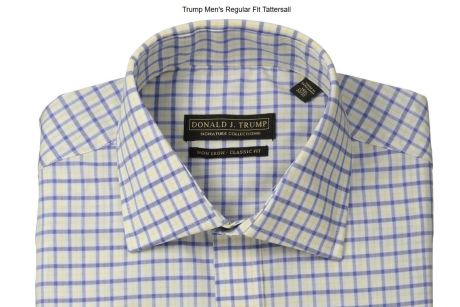
Trump's shirts


Did you know that Trump was selling shirts over the Internet?

Yes, Trump, the guy that so many Americans are going to vote for simply because they are convinced he will completely change the way America works.

Why?
Because he says so.
He presented himself as the quintessential anti-establishment candidate and they bought it.

OK, something has to be changed so I fully understand their exasperation with the current state of the Union.
But is he “the” guy?

And since deeds are, or should be, more convincing than words, lets see if he is as anti-system as he pretends to be.

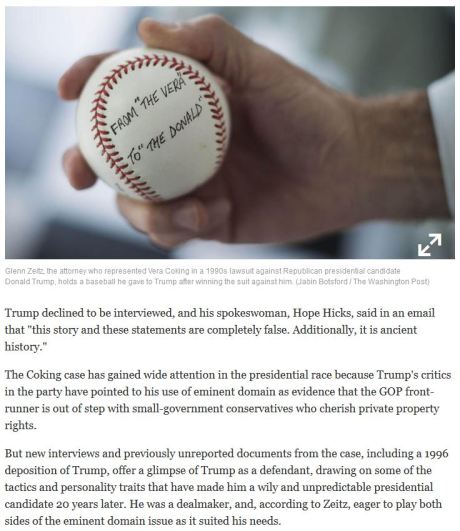
Well… at some point he did try to use the power of the government in order to con an old lady out of her house, didn’t he?
from the vera to the Donald

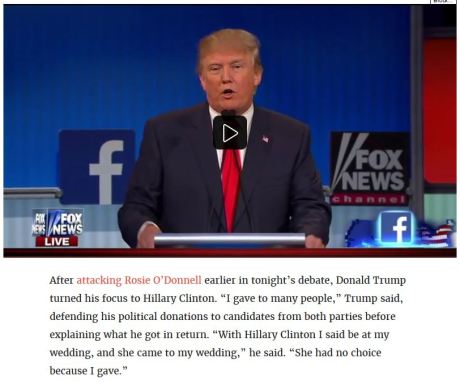
And he did ‘bribe’ Senator Clinton to come to his wedding. Simply because he had the money…

clinton came because I gave


And now this.
The way I see it the real problem is not the fact that he makes his shirts in Bangladesh in spite of being vocal about the need to preserve American manufacturing jobs. After all it’s his job to conduct his business as he sees fit. And if he is comfortable with doing one thing while saying the complete opposite…. that’s his job too.

But how come so many people take his words for real, without at least perfunctorily checking the facts?
How come so many are they so convinced he is ‘the right guy’ when he sells himself so cheap?

Oh, you didn’t know you could buy a “Donald J Trump Signature Collection” shirt for as little as $12.56!
Why is he doing this? Because he is so anti-Establishment that he doesn’t care about money?
You’re already laughing, right?

Or he simply does it because he can get away with it!
Because we don’t really care. Not anymore…

As one of my friends said about Hillary Clinton, Trump’s ‘Democratic’ counterpart:
” Hard to fathom how someone so openly, unapologetically corrupt can be the front runner. I think that says a lot about what we really expect from our politicians.”

I’m afraid she’s absolutely right.
We are the real culprits here.
‘They’ are simply doing what they are good at, grabbing gleefully whatever opportunities are within their reach, but we are the ones providing those opportunities.

Not only in America.

Clinton, trump, unpopular

Not so long ago I was asking myself “What’s going on there?“.

Now, that my nightmare is very close to becoming reality – both major American parties are about to nominate unpopular candidates for the 2016 presidential elections, I’m wondering about the current meaning attached to the very concept of ‘politics’.

For an impersonal and very theoretically minded observer ‘politics’ would seem to describe the job of those who make it possible for the rest of us to lead our lives in an orderly fashion.

I believe you are familiar with what a ‘super’ does. ‘Super’ as in ‘superintendent’ for a residential building.
“The super must be conversant with every mechanical and technical system in the building, work diplomatically to solve problems in the building, be responsive to residents and be able to work as a team member with the board and the managing agent.”
Not exactly ‘rocket science’ but a very important role. So important that when poorly played the whole thing might very quickly deteriorate beyond repair.

After all, ‘the government’ should do nothing more, and nothing else, but act as a nationwide ‘superintended’ while ‘politics’ should be nothing more, and nothing less, than what we, all the inhabitants of a country, do in order to make sure that the government, our government, does its job. Properly.
Especially when living in one of the so called ‘democratic countries’.

Then how come I’ve got a growing feeling that ‘politics’ have become just another set of means towards specific goals? Goals that are more often than not detrimental to the society, as a whole?

PS.
This is for those of you who are not familiar with how this site works.
By clicking on the pictures, or the highlighted text, you are automatically linked to the sources of the quoted material. Sometimes they might be interesting, to some of you.

This is probably the biggest bone of contention between the conventional sides of the political spectrum.

The conventional right claims that we’d be a lot happier with a considerably smaller government while the conventional left would, if left to its own devices, transform the government into a huge, and ‘smothering’, nanny.

Is there any reasonable way of determining the right size of the government or we should just try to reach a compromise between the warring factions?

I don’t think I’m smart enough to determine how big a government should be.
I also dislike the very concept of compromise – if I have to settle something I prefer to negotiate instead of compromising.
And that’s is why I’d rather approach this problem from another angle.

What KIND of government!

Let me take you on a short, and very condensed, historical ride.

Basically humankind has used, somewhat alternatively, two systems of running things.

Authoritarianism and democracy.

Specifics do not matter much. If decision making was centralized it was authoritarianism, if decisions were made by those directly affected by the results of those decisions being put in practice it was democracy.

What’s really important here is the fact that those two different manners of decision making generated different forms of government.

Authoritarian regimes employed ‘administrative’ (meaning ‘directorial’) forms of government while democracies were served by ‘referential’ forms of government.
And it was only natural that things happened this way.
Authoritarian regimes need nothing more than a ‘transmission belt’ to convey orders from the very top to the base of the social pyramid while democracies need a team of referees to keep the playing field level and nothing more than that.

Of course that I’m presenting a very simple sketch here. Things are more complicated than that.

And there are at least two main complications. ‘Human greed’ and ‘international relations’.

It doesn’t really matter if that greed is for money of for power. Whenever greedy individuals are allowed to enter the government and to cater for their ‘special needs’ things are headed south. And the only difference between this situation occurring in a democracy or under an authoritarian regime is that the latter has no natural defense against this kind of ‘mishaps’.

‘International relations’ play a less obvious role. The main job a government has to fulfill is to keep the state together. If a hypothetical state would exist in a vacuum – and have no neighbors, things would be a lot simpler. Since in the real world states do have neighbors the governments have to organize armies, secret services, engage in arms races…
Also in the real world states are very different. In size, for instance.

For all these reasons it’s very hard to ‘calculate’ the ‘proper’ size of a government.

Specially so without defining clearly what’s expected from that government.
An authoritarian regime would ask the government to preserve the privileges of those at the helm of the regime while a truly democratic minded people would expect their government to safeguard, using legitimate means, the independence of their country on the international level while simultaneously making sure that the individual members of that people enjoy enough personal autonomy so that their political regime remains democratic.

After those expectations are clearly formulated, the size of the government will simply be a consequence…


scalia1

It is very rarely that I agree in full with something that I happen to stumble upon over the Internet.

And it’s no wonder that Scalia was absolutely right on the subject.
He had lived for so long in the shadow of the Constitution that at some point it must have downed on him.
The constitution, just as any other legal document, is nothing more, and nothing less, than what we make of it.

After all it was us, citizens, who wrote it in the first place.
Then amended it as we saw fit.
And are now interpreting it. To fit our own purposes, of course.

We don’t seem to agree much, lately, about those very purposes?
So we came up with diverging interpretations of what’s written in the Constitution?

Then the problem is with us, not with the Constitution.

Using it as a weapon, or adjusting it to fit the short term goals of whomever happens to be in power momentarily, won’t solve anything. Actually it will only make things worse.

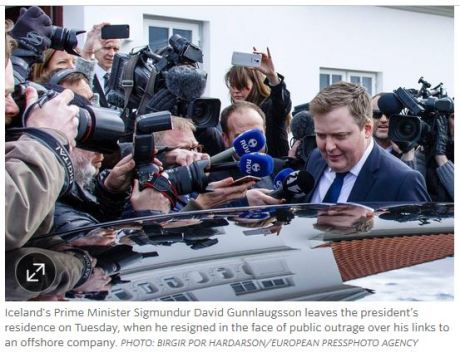
The ‘Panama Papers’ rekindled the public interest in the subject of ‘what legitimate goal could anyone have in setting up a company in a fiscal paradise?’.

Taxes, stupid!

Actually it’s quite simple.

Let’s pretend you are an alien from the outer space who has a business idea backed up by enough capital and you want to put it in practice somewhere on Earth. Aren’t you going to shop around for the best environment you might find? So that your business would have optimal conditions to grow? And when the business ripens wouldn’t you want to be able to cash on it – and end up with as much money as possible?

Rather conflicting demands, isn’t it?

First you want an ‘operational base’ with relatively low costs but secure and full of whatever amenities your business might need in order to thrive. Next you’ll need fast access to a market where to sell your wares. Last but not least it would be important for you to incorporate your business in such a way/place that you’ll end up pay the least amount of tax, both while operating the business and after the cash out moment.

While all these are legitimate demands there are a right and a wrong way to meet them.

I’ll refrain myself to discussing exclusively about the tax part, the rest being relatively easy to balance.

In this respect you can choose to incorporate the business in the same place you have selected for your operational base and pay whatever taxes are due in that place, under the rationale that those taxes cover the cost of doing business there and are nothing but a compensation for benefiting from the conditions present there at the time. After all, when you have chosen a particular place as the home of your business you have entered into an informal arrangement with that place. It lets you make good use of whatever is there to be used – exactly the things that convinced you to select that particular place, and expects you to fulfill your side of the bargain. Provide enough compensation so that that place can continue to be a good place to conduct business and, if possible, improve itself. Pay the local taxes.

Or, equally legitimate, use two different places for each thing. Organize your operational base where it would work best and incorporate your business in a place where you’ll be able to pay as little tax as possible.

And here’s the catch. No matter where you incorporate your business you’ll still have to pay some taxes in the place you have chosen as your operational base.

Then why bother?!? you might legitimately ask.
Since this is not an accounting dissertation I’ll just tell you that there might be serious financial advantages in making this choice, not the least of them having to do with the cash out moment.

And this is the very point where some people get greedy. They try to avoid altogether the taxes tied to the ‘operational base’ – by employing various semi, or even completely i-legal stratagems, and by doing so completely transform the very nature of the entire operation.

From one of fiscal optimization to one of money laundering.

There are a lot of rationalizations for this course of action. From ‘the state is a thief that uses force in order to part me from the fruit of my efforts!’ to ‘why give it to the state since the money will be squandered by the inefficient government?’.

Now let’s please remember where we started from.
OK, you are not an ‘alien from the outer space’ but what’s stopping you from conducting your business where ever you want on the face of this Earth? (My bad, this question is not valid for exactly everybody, there still are countries that don’t allow for people, or capital, to exit freely, but I’m sure you get my drift)
Oh, you like it where you are but you hate paying taxes and/or you’re disgusted by the way the government handles its finances!

Then let me remind you of two things.

First, you probably live in a democracy. Speak up. Make your concerns known. Loudly. Make sure you are listened to. Vote wisely.

Secondly, you are probably fed up not only by the fact that in your country taxes are really high but also by how little you get back in return.
Well… that’s because there are so many people who do not pay their fair share and that your government has to take more from those who do pay in order to make the ends meet.

Savvy?

iceland prime minister resigns over Panama papers

Us electoral sinopsis, re-edited

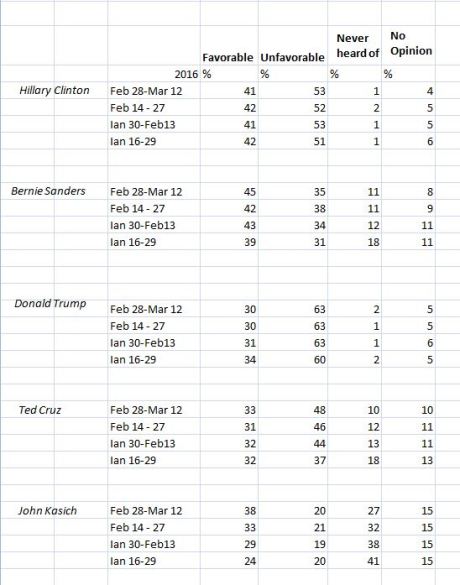
Favorability: People in the News, Gallup, April 2, 2016

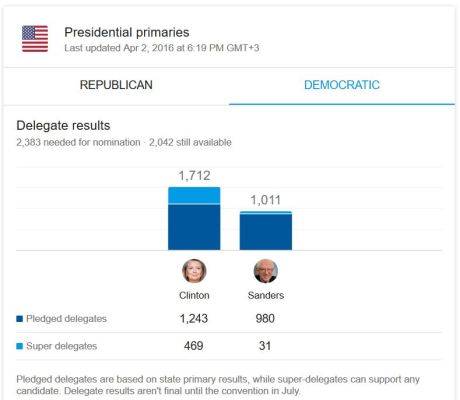
Clinton vs Sanders, April 2, 2016

Source: AP

So, it looks like that the concerned Democrats – those who bothered to show up for the preliminaries, and specially the ‘super delegates’, are going to send Hilary Clinton to compete on the national stage, despite her constant ‘negative favorability’ and despite the fact that Sanders is constantly improving his chances – both favorability and ‘never heard of’ scores are slightly better now than they were at the start of the year. Furthermore, Sanders is the one who can ‘grow naturally’ – simply by making himself known – while Clinton needs to convince the voters that their erstwhile opinion about her was mistaken. An almost impossible feat, given the length of her public career…

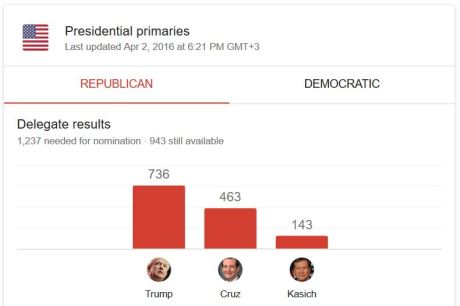
republican pack, April 2, 2016

Source: AP

On the Republican side things are even stranger.
Trump gathers more and more delegates while his ‘negative favorability score’ becomes slightly even ‘more negative’, Cruz gets a second lease on life despite his ‘unfavorable’ score increasing dramatically while Kasich, the least favored by the hard core Republicans, climbs nationally from +4% to + 18% in 4 short months. And if you look closely almost all new opinions on him, those that have been developed during the last 4 months, have been in his favor.

One of my Republican friends said “I can’t speak for the other candidates, but people support Cruz because they believe in what he believes, and feel that sometimes it’s more important to stand up for what’s right, rather than what’s popular.“.
OK, I can understand that. The despondent and/or exasperated use Trump as a banner for their state of mind while the hard core, value toting, Republicans hope that by backing Cruz they will somehow bolster those values.

But let’s see what some ‘significant Republicans’ have to say about the matter.

Scott Walker, Governor for Wisconsin and ex candidate, being interviewed on WTMJ’s Charlie Sykes Show:
““If you’re someone who is uneasy with the frontrunner, right now there’s really only one candidate—I think if you’re just looking at the numbers objectively, Ted Cruz, Sen. Cruz, is the only one who’s got a chance other than Donald Trump to win the nomination,” Walker said in the Wednesday interview on WTMJ’s Charlie Sykes Show. “Statistically, my friend Gov. Kasich can not.””

Then there is Lindsay Graham, Republican Senator for South Carolina and ex candidate who endorsed Jeb Bush when dropping from the race:
“Graham said there are other candidates he likes better, but he doesn’t think they can win. “I prefer John Kasich; Cruz is not my first pick by any choice,” the South Carolina senator explained. “But I don’t see how John Kasich can mount the opposition that Ted Cruz can to stop Donald Trump from getting 1,237” (the number of delegates needed to secure the nomination).
Graham has made it abundantly clear that he really doesn’t like Cruz at all. In January, he said Cruz has “exhibited behavior in his time in the Senate that make it impossible for me to believe that he could bring this country together,” adding that choosing between him and Trump is “like being shot or poisoned — what does it really matter?” Last month, he joked about Cruz’s general unpopularity among his colleagues, saying, “If you killed Ted Cruz on the floor of the Senate, and the trial was in the Senate, nobody would convict you.””

The way I see it, these guys, the Republican ‘apparatchiks’, are more concerned about derailing Trump than with promoting the more suited candidate among the trio. Suited for Presidency, that is.

sansele candidatilor

source: Huffpost Pollster

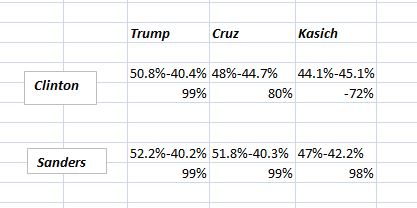
So, according to the polls compiled by Huffington Post, Sanders would lick the entire Republican field – if allowed to compete, while the Republican candidates are stacked, at least for now, according to the ‘who has the least chances on the national front’ criterion.

?!?

Does any of this make any sense? Any at all?

Here’s my Republican friend again: “In the case of Clinton, despite her unfavorability in the polls, there’s a sense in the Democratic Party that it’s her “turn.”
Some others think she is ‘in cahoots’ with the ‘big business’… “Family charities collected donations from companies she promoted as secretary of state“… Coming from Wall Street Journal this is a powerful allegation indeed…

But at least in this camp things are unfolding, lets say, ‘naturally’. The guys with vested interests (the super delegates, for example) are acting according to those interests while the rank and file Democrats are slowly (too slowly, maybe?) finding out what’s going on.

What really baffles me is what’s happening on the Republican side.

Some of the rank and file have adopted ‘the Donald’ as their mascot despite the obvious fact that he doesn’t belong, at all, in politics. He might have been a successful business man – read chock full of money, but the way he made that money disqualifies him from holding office. Does ‘eminent domain‘ ring any bells with you? Not to mention his antics on the public stage: “Excuse me”, ‘I’m the best thing that could happen to America!’
Are all these people delusional or are they so fed up with what’s currently going on in America that they can’t see the trees because of the forest (is on fire)?

Some others have gone ‘back to basics’ and try to revive what they consider to be the ‘sound Republican values’ – I’m speaking now about those who support Ted Cruz, if you didn’t figure that out by yourselves.
But what are these ‘hard core Republican values’?
How come some of Cruz’s followers are blaming Lincoln for being the first ‘statist’ in American history – not for abolishing slavery but for imposing that measure by force to the unwilling Southern States.
And how come those values have come to be embodied in someone so ‘popular’ among his Senatorial colleagues that “If you killed Ted Cruz on the floor of the Senate, and the trial was in the Senate, nobody would convict you.” ?

And isn’t it strange that so many Republicans are so mesmerized that they are willing to give up almost any chance of electing a Republican President?
OK, I can understand that way of thinking being used by ‘lay people’. But what is the real meaning of ‘pundits’ rallying behind the ‘value laden’ Cruz when it is obvious that Kasich is in a way better position on the national front?

Could it be that these pundits are more concerned about their own careers than with the fate of the Republican party? And even about the Republican values?
Farfetched?
Are you sure? Don’t you see that by energizing their constituencies into a frenzy they are simply building Republican (local) fortresses for their own use, leaving the rest of the (national) Republicans out to dry?

more stuff

Well, I was under the impression that Conservatism was about maintaining a common way of life, not about conserving privileges.

I still believe that.