Archives for category: Culture

Finally someone who got it right!

Children are born to us, their parents, and government is populated with regular people, just like you and me. Even more so, in a democracy they are supposed to do as we, the voters/tax payers, tell them to.

Just as parents bear the ultimate responsibility for the upbringing their children receive so we, the people, bear the ultimate responsibility for the way we are treated by our governments.

And just as responsible parents teach their children how to drink, how to drive and how to keep these two things wide apart, it is our responsibility to constantly teach our politicians how to behave.

People glimpse fragments from the surrounding reality and then use their newly found understanding to gradually change it.
They do this in three, successive, steps.
The first has a lot to do with happenstance – the right man at the right place, the second involves a lot of ‘due diligence’ and the third depends very much on how those who end up in command of the new understating relate to the rest of the people.
Sometimes some of the people who ‘happen’ to ‘stumble’ on new information/experience something really new feel the urge to communicate to others what has happened to them.
Usually the information gleaned/sentiments experienced during this first step are so new that there are no socially sanctioned symbols that can represent them faithfully so the individual trying to communicate the entire experience has to find a novel way to make it understandable for those around him. This is art.
The second step has less to do with actual discovery and is more about systematization of information already at our disposal. Something like charting a newly discovered territory. Even if we have to adapt our existing tools to the new task – some of them had been discovered during the first step but that means they are already here when we start the second one, here the job to be done is more about reason than inspiration. This is science.
And now, that new information is available – even before it was widely disseminated – people start to use it. Some of it is used straight away/as it is/honestly while some other is used to keep ‘the others’ in the dark or to alter their perceptions in order to fit the goals of the ‘user’/’entrepreneur’/spin doctor.
Usually this last way of using newly found understanding has perverse consequences. The ‘user’ becomes arrogant and starts to believe he has somehow become a (demi)God while the people kept in the dark/unwittingly exploited sooner or later become aware of what is going on – and sometimes express that in artistic ways.
At some point the equilibrium is regained, either through  a  a series of oscillations that ’embrace’ it – a revolution – or through small steps in the right direction – evolution.
(Usually, as the distance between a given state of facts and the perceived point of equilibrium becomes wider then people gradually loose hope in evolution and start to consider more revolutionary methods.)

A fact is just that, a mere fact.
An acknowledged fact asks for an interpretation, otherwise the human mind finds it hard to accept its very existence.

An interpretation that seems to make sense becomes an understanding and regardless of that understanding being right or wrong it generates a belief.
Until that understanding is proven wrong and even then… eventually a new understanding is generated and, in its turn, it leads to a new belief.

That’s why we should indeed reserve the right Patton Oswalt speaks about and then use it sparingly, only when other believers tries to forcefully impose their beliefs on us.

In fact Oswalt is right. We don’t have to respect other people’s beliefs, only their right to have their own beliefs.

American political doctrine – rather voluntaristic if you ask me, despite it being already more that 200 years old – maintains that ‘separation of powers’ means that the three powers that need to be kept in balance – by carefully coding in the Constitution the role each of them has to perform – are the Executive, the Legislative and the Judiciary.

This arrangement proved to be resilient enough, otherwise it wouldn’t have survived for so long, despite it depending heavily on each of the teams involved performing their jobs with due diligence.

Watching a documentary about the coronation of Queen Elizabeth II – I just realized she’s been around for so long that the steamship that was christened in her honor, QE II, is already retired from service – I started to think that maybe things are a little different.

Farewell to the Forth

Sometimes after the ‘Recognition’, more precisely when she briefly curtsied in front of her subjects, it dawned on me that maybe those powers that need to balance themselves in order for the society as a whole to operate smoothly are the ever changing reality, tradition and will to change. Represented, of course, by the People, the Church and the Monarch.

We need to let our hearts acknowledge beauty wherever and whenever we encounter it before telling to ourselves ‘I cannot understand (accept) what is going on there’.
If we’ll do that, ‘not understanding’ will no longer stand in the path of our acceptance of something different than we were accustomed to.

If humans have been created equal why some cannot express themselves just as freely as all the others?

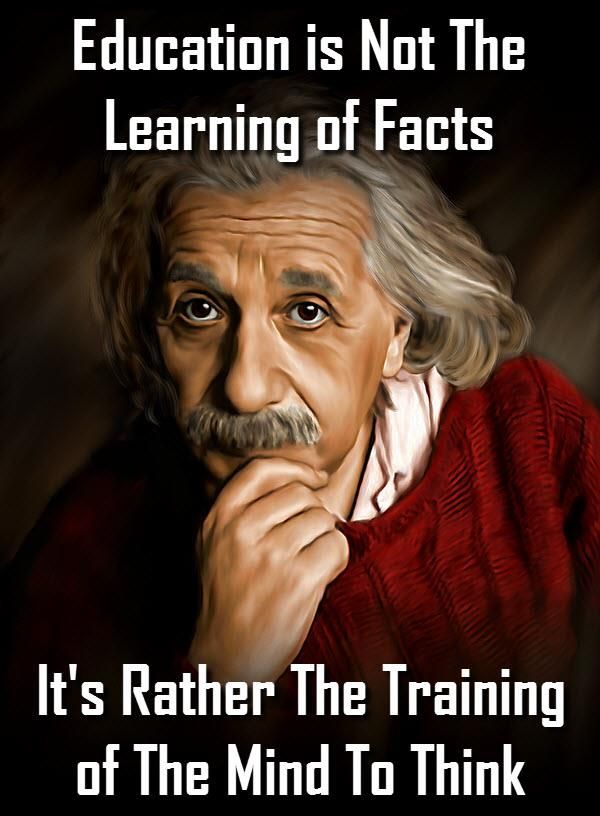
quotes-about-education-16

but also

So?

The way I see it ‘education’ is a blanket term that covers many things:

– Mental conditioning into obeying the prevailing rules of the moment/place
– Accumulation of information that is deemed useful by the educators.
– ‘Training of the mind to think’ – only this cannot be done without first supplying the student with some information on which to hone his mind.
– “Training of the mind to think” according to the rules of the moment/place – the term currently used for this kind of attitude towards thinking is ‘science’. If those rules are not obeyed then not only that the results of the thinking process won’t be recognized as valid by the community but the thinker won’t even be able to share them with those around him because those results won’t resemble anything known/familiar/acceptable to most of the members belonging to that community.

– Training of the mind to think outside of the box. To be able to do that a student needs first to learn what a box is so he must graduate through the first four stages AND to overcome some of the conditioning he was subjected to during the first stage.

Only after he “awakens” a student might start to discover for himself the rest of the world. And only if he uses his newly found awareness in a sensible way he will be able to share the results of his thinking with those around him and thus contribute to the long time survival of the society (family, community) that has nurtured him through his ‘coming of age’.

And only if that society (family, community) takes good care of its young it will have any chances to survive.
‘Taking good care of its young’ meaning encouraging them to open their wings in search of their full potential, not shackling them down to the nest in search for absolute safety.


Some of you might know that ‘ratio’ comes from Latin, where it’s original meaning was linked with the mental operation of dividing.
Yep, the first ‘rational’ thing made by man was resource allocation: how much food each member of the clan will get, according to a huge, and variable, set of criteria. I won’t get into details now.

My point is that we shouldn’t be bragging about how rational we are. At most we are ‘rationalize-rs’.

You see, for a decision to be perfectly rational it has to fulfill three criteria. The decision maker must:
– Have at his disposal all pertinent information regarding the entire situation under consideration,
– Be able to act in a completely unemotional way,
– Be in possession, and willing to use it to the maximum, of a brain not only in perfect working order but also able to process that huge amount of information in such a short time that nothing significant changes while the decision is being made.

So, which of you still thinks we are actual able of reaching actually rational decisions?

In reality we function in a completely different way.

From time to time an IDEA flashes in our heads. Again I won’t enter into details about how this outcome is influenced by our needs, emotions and previous experiences, for now I’ll just deal with what happens after that idea has already ‘sparked’.

Depending on a plethora of individual characteristics people differently when something like this happens to them.

Some shun it as if displaying any degree of originality was a mortal sin.
Some honestly and straightforwardly set to examine it as thoroughly as they can. They take into account as many information as they can muster about the subject and not only carefully balance costs against possible benefits but also try to determine as many stakeholders as possible and determine, to the best of their knowledge, whatever consequences might befall upon them if that idea is put into practice. And they proceed only after this entire process has been followed step by step.
Some take a different route after the cost analysis. If they reach the conclusion that the whole thing might prove to be profitable enough for them they start identifying who might object, for what ever reasons – no matter if valid or not – and thoroughly plan how to stifle the opposition.Some don’t even care about the costs. If they become, by any means considered to be proper by themselves, convinced that that particular idea has to be implemented then they will stop at nothing. They will employ all means at their disposal in order to put that idea into practice, no matter what those around them might feel, think or even suffer.

Please observe that the last three are all using their rational brain to the utmost. Yet only the second one might be described as reasonable, right?
Most of us are culturally conditioned to think about the third that he is a callous manipulator and about the fourth that he is an aggressive bastard. Right again, ain’t I?

Well, not so fast.
According to Plato the fourth is doing the right thing. ‘He who sees the light has not only the right but also the obligation to take the others with him towards that light’. (Plato’s Republic). One might think that this is a very dictatorial attitude that doesn’t, in any way, resemble Socrates’ manner of dealing with things – after all he was convicted exactly for teaching the young how to make their own decisions – but this is another discussion. Coming back to the manner advocated by Plato it is indeed extremely authoritarian – all dictators have followed it to the letter – but it is not altogether without merit. What should a doctor do when you are brought to his ER with a mangled leg? Wait for a couple of days for you to come about and decide if you’ll accept the amputation – while the already dead tissue poisons you beyond any therapeutic possibilities – or proceed with cutting away your limb and thus saving your life but assuming the risk that you’ll sue him for his last dollar?
According to the modern business practices the third guy is acting in a quite conventional way. Most of us agree that planned obsolescence is good thing – it provides a lot of jobs – doesn’t it? Well, I don’t, not on the scale we are using it anyway, but that again is another subject.
And now that we have reached the presumably respectable and the only reasonable ‘second decision maker’ I’ll just add some of George Bernard Show’s words on this matter:
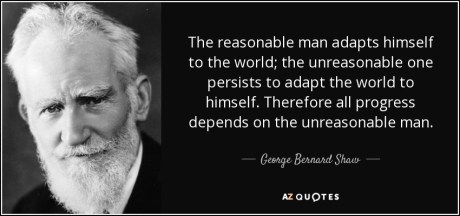
the-reasonable-man-gbs

So it seems that there isn’t such a thing as an always valid manner of thinking, right? Things depend a lot more on our individual judgement than a lot of people feel comfortable with. Rational thinking isn’t at all that panacea some people believe it to be and in reality reason is nothing but a mental tool and the manner in which we use falls squarely in  our individual responsibility
That’s why Plato thought he was doing a service to his fellow citizens when he wrote: “I said, the intention of the legislator, who did not aim at making any one class in the State happy above the rest; the happiness was to be in the whole State, and he held the citizens together by persuasion and necessity, making them benefactors of the State, and therefore benefactors of one another; to this end he created them, not to please themselves, but to be his instruments in binding up the State.” Let me remind you that Plato was contemporary with the Golden Age of the ancient Greek civilization and with the last days of the Athenian democracy. I’m not going to pretend now that the demise of the Greek democracy  or the relative rapid decay of the Greek civilization after Pericles and its replacement by the Roman and Persian ones were influenced by Plato’s writings. No. In fact it’s all the way around. Plato had only witnessed and put in writing the attitudinal changes that affected the Athenian/Greek society and which eventually caused those developments.

And now that we have reached the subject of democracy here is why maintaining a democratic attitude is extremely important for the long time survival of a society. Real democracy means that a considerable part of the people pay active attention to what is happening to their lives and have the ‘constitutional’ possibility to intervene peacefully if they don’t like where their leaders take them. We have seen that we cannot depend, as Plato urges us to, on the wise guidance of a ‘specialist leader’ since there is no such thing as ‘perfectly rationality’ being attained by a man. A widely disseminated attitude of the general population is the only way in which individual mistakes made by the leaders are eventually acknowledged and fixed. Any other ‘political arrangement’ leads to these mistakes being rationalized away and their (disastrous) results constantly accumulating until the entire system collapses.

One other thing before I wrap this up. The first argument I made, that the first rational thing made by man was the rational allotment of food among the members of the clan, is also a rationalization. That’s how we, who like to believe about ourselves of being rational, think it must have happened. That the inhabitants of the temperate Europe were the most rational among the peoples of the Earth and that’s why they have reached such a dominant position as they used to enjoy until not so very long ago.
Sorry, it happened exactly the opposite way. Europeans, because of the harsh conditions they had to face – coupled with the relative abundant resources and a special geographical layout – they have developed a (relatively) rational way of thinking. It was this or else… just as Ernst Myer says: ‘evolution is not about the survival of the fittest but about the demise of the unfit’. In order for us to develop ‘rational thinking’ we needed the very special environment to force us to do it.
We are any special – if at all – not because we are any different but because we had the good fortune of being born in the right place. OK, we made good use of that happy act of hazard but that’s all.

For those of you who want to read about how ‘mere’ geography decisively determine evolution I highly recommend Jared Diamond’s Guns Germs and Steel.

“Public shaming as a blood sport” is the difference between keeping the public up to date with what is going on in the public square and transforming the same public square into a stand up comedy venue.
When this happens the public becomes hypnotized by the antics presented there and forgets to choose himself which are the really important issues and what to be done about them.
The public becomes easy prey for callous political operators (they don’t deserve to be named ‘politicians’ since they don’t give a damn about the ‘polis’) and democracy becomes mob-rule.
That’s what happened before the fall of (Ancient) Rome.

If you want to watch her speaking you can also click here to open the original TED page about her:
http://www.ted.com/talks/monica_lewinsky_the_price_of_shame#t-86823

Karl Marx. The world is crooked – there is too much exploitation imposed by the haves upon the have-not’s – so it has to be righted by those who have the right answer to the problem. And because the world doesn’t know what’s good for it, the ‘enlightened’ – the communists who are at the forefront of the class struggle – have the duty to impose the revolution by force.
The crux of the ‘solution’ being the abolition of both private property and the state. The private property because it is the tool with which the haves dominate the have-not’s and the state because it is the tool used by the haves to protect their private property from the have-not’s who continuously try to steal it.
But what tool can be best used to enforce the dissolution of the private property and to insure that the misguided and the ill intended don’t revert to the ‘old and corrupt ways of the bourgeoisie’? The state, of course. Hence we’ll have to postpone a little its dissolution, only until the first chores would have been completed, of course.

Max Weber. The world is too complicated to be understood/run by a single man, no matter how capable. That’s why the decision making process must be rationalized. Weber’s main methodological tool was the ‘ideal type’, a mental construction that is to be substituted to replace the real problem that has to be solved or the real thing that is being studied. This ideal type being stripped of the ‘unimportant’ aspects of the reality will make it a lot easier for the ruler/decision maker/scientist to understand what is going on there and to come up with the ‘correct’ decision or ‘clear’ understanding of the matter. This means that Weber was convinced that individuals are able, in certain conditions, to reach valid conclusions. Which is, of course, OK. Furthermore Weber had ‘reached the conclusion’ that if larger problems are to be solved then the efforts of single individuals are not enough and that in order to fulfill this task in a satisfactory manner many rational decision makers (which have been properly trained in their strict domains) have to be inter-connected into a well structured ‘net’. This way the big problem will be sliced into more manageable sub-problems which will be analyzed by specialists and then the final solution will be re-assembled by people specially trained for exactly this task. Nowadays this entire concept is known as ‘bureaucracy‘. In theory it sounds right, doesn’t it? What could be better than an all encompassing net comprised of rational/professional decision makers who act according to a well considered and well intended ‘ideal type’? Whose ideal type? Good question, indeed. Just as good as ‘who and how trained the ‘decision makers’?’.
(There is something we must keep in mind when discussing Weber, as a person. He died relatively young, before having a chance to reach a ‘final conclusion’, or at least one to satisfy him. That also has to be the reason for which he hasn’t published much during his lifetime.)

Plato. Society (the city, the “Republic’) should be run by a specific kind of (dedicated) people and because “those with the philosopher’s natural abilities and with outstanding natures often get corrupted by a bad education and become outstandingly bad” this ‘special kind of people’ need to receive “the proper kind of education“. Meaning that ‘a true philosopher’ has to be versed in ‘the Forms of Good’, which are amply explained in ‘The Cave Allegory’.
The gist of the matter is two layered.
1. The reality is hidden behind some ‘veils’ (or in ‘shadows’ if you prefer the original metaphor) but properly trained professionals (the philosophers) can be taught to see what Plato describes as ‘the ultimate truth’.
2. These professional truth seekers have not only the right to lead the rest of the people ‘into the light’ but the obligation to do so! Furthermore, for Plato the ‘ideal political structure’ – the Republic – would be so organized as to ‘force’ into public duty those who have been specially ‘bred and trained’ to perform such duty:
“Observe, Glaucon, that there will be no injustice in compelling our philosophers to have a care and providence of others; we shall explain to them that in other States, men of their class are not obliged to share in the toils of politics: and this is reasonable, for they grow up at their own sweet will, and the government would rather not have them. Being self-taught, they cannot be expected to show any gratitude for a culture which they have never received. But we have brought you into the world to be rulers of the hive, kings of yourselves and of the other citizens, and have educated you far better and more perfectly than they have been educated, and you are better able to share in the double duty. Wherefore each of you, when his turn comes, must go down to the general underground abode, and get the habit of seeing in the dark. When you have acquired the habit, you will see ten thousand times better than the inhabitants of the cave, and you will know what the several images are, and what they represent, because you have seen the beautiful and just and good in their truth. And thus our State which is also yours will be a reality, and not a dream only, and will be administered in a spirit unlike that of other States, in which men fight with one another about shadows only and are distracted in the struggle for power, which in their eyes is a great good. Whereas the truth is that the State in which the rulers are most reluctant to govern is always the best and most quietly governed, and the State in which they are most eager, the worst.”

I believe that by now you have grasped where I’m headed to. There is not much difference between Marx and Plato and a very close relationship between these two and Weber. Still, the fact that Weber was not yet done thinking about this matter at the moment of his untimely death makes me believe that if he had some more time at his disposal he would have understood what Laozi taught us about the concept of “nonaction”:

And isn’t it very strange that the best (short) presentation I was able to find about Laozi is hosted by a site called “Plato.Stanford.edu”?

https://www.marxists.org/archive/marx/works/1848/communist-manifesto/
http://www.academia.edu/4192854/Weber_s_methodology_understanding_concept_of_ideal_type_as_necessary_element_of_Weberian_comprehensive_sociology_Working_paper_
http://www.cf.ac.uk/socsi/undergraduate/introsoc/weber12.html

http://www.historyguide.org/intellect/allegory.html
http://plato.stanford.edu/entries/laozi/
http://izquotes.com/quotes-pictures/quote-the-wicked-leader-is-he-who-the-people-despise-the-good-leader-is-he-who-the-people-revere-the-lao-tzu-188515.jpg

This was inspired by the title of a Facebook post that shared an article from The Telegraph.
The guys ‘in charge’ of Saudi Arabia must be in a terrible situation.
Punishing the guy according to their own laws will further the perception of Islam as a ‘violent religion’ and thus make it less acceptable for the rest of the world.
Not punishing him would mean tacit acceptance of the fact that laws are made and applied by humans, not by any God, thus totally demolishing the brand of legitimacy the Saudi’s have worked hard to build for themselves.
Terrible predicament. I suggest we allow them to settle this among themselves.
Blaming ‘Islam’ indiscriminately for some horrible acts perpetrated in its name by a bunch of zealots would make things worse for everybody. So yes, let’s ‘move along’!
What we can, and definitely should do, is to insist on the ‘humanitarian’ side of the whole business.
PS Here is an interesting article about Sharia: http://www.pewforum.org/2013/04/30/the-worlds-muslims-religion-politics-society-beliefs-about-sharia/