Archives for category: authoritarianism

And the LORD God said,
Behold, the man is become as one of us, to know good and evil.

After learning godlike skills – after becoming a conscious human being, that is – man has set his sights on the next target.
Apportioning blame. Finding culprits. The only way forward, right? Bulldoze the obstacles away, lose the dead weight and you’ll get there a lot faster.
Where? Where is that elusive ‘there’? We’ll find out about the place when we’ll get there!

If we’ll get there… If we’ll ever get anywhere with that attitude, for that matter!

Researching for this post, I came across Dietrich Bonhoeffer’s Theory of Stupidity.

First things first.
Bonhoeffer was a German theologian who happened to come of age right when Hitler was confiscating political power in Germany. Even though Bonhoeffer belonged to a church which denounced violence, even in self defense, Bonhoeffer eventually joined a conspiracy trying to assassinate the dictator.
“Here the law is being broken, violated,” he deplored. It might be true that “the commandment is broken out of dire necessity,” but to say he broke the commandment of necessity is still to say he broke the commandment. Rather than pretend this was some positive moral good, Bonhoeffer instead threw himself at God’s feet and begged forgiveness for the sin he could not but commit.

In his writings, Bonhoeffer was abundantly clear.

The fact that the stupid person is often stubborn must not blind us to the fact that he is not independent. In conversation with him, one virtually feels that one is dealing not at all with a person, but with slogans, catchwords and the like, that have taken possession of him. He is under a spell, blinded, misused, and abused in his very being. Having thus become a mindless tool, the stupid person will also be capable of any evil and at the same time incapable of seeing that it is evil. This is where the danger of diabolical misuse lurks, for it is this that can once and for all destroy human beings.
‘Yet at this very point it becomes quite clear that only an act of liberation, not instruction, can overcome stupidity. Here we must come to terms with the fact that in most cases a genuine internal liberation becomes possible only when external liberation has preceded it. Until then we must abandon all attempts to convince the stupid person. This state of affairs explains why in such circumstances our attempts to know what ‘the people’ really think are in vain and why, under these circumstances, this question is so irrelevant for the person who is thinking and acting responsibly.


The key concept here, as I read Bonhoeffer’s work, is that external liberation must come first. As a precondition for the ‘internal liberation’. For a shackled individual, reaching a peaceful state of mind is almost impossible. And since nobody can exercise their will in a free manner unless their mind is ‘level’….
Further more, in order to learn one needs an open mind. A free, level and open mind. And being able/willing to learn is the only road out of ‘stupid-land’. The only way to overcome the ‘what I already know is plenty’ attitude.
Only a free individual can choose to independently examine the facts. A shackled one will almost always give up. And accept whatever official version is being shoveled down their throat.

And here’s the catch.
In conversation with him, one virtually feels that one is dealing not at all with a person, but with slogans, catchwords and the like, that have taken possession of him. He is under a spell, blinded, misused, and abused in his very being.

Having grown up, and being socialized, under a communist regime – somewhat different but not entirely from the nazism experienced by Bonhoeffer – I understand how it is to live under symbolical duress. Under a constant deluge of lies. Which were meant to effectively shackle us. Not to educate but to condition us.
During that time, I had also noticed the deluge was poured by intellectuals. The very people who were supposed to do the exact opposite. To enlighten us. To elevate the willing people to the ‘next level’. Teachers, writers, artists … and even clergy. Not all the intellectuals were involved in this process but all those used by the dictating party to destroy both our external and internal freedom did belong to the intellectual caste.

Communism and nazism had been somewhat ‘natural’ occurrences.
Ruthless political operators – evil people, in Bonhoeffer’s words – have noticed an opportunity – the existence of economically distressed people – and used their ‘knowledge of words’ to ideologically shackle those people to symbolical totem-posts.

What is currently going on is akin to a suicide of sorts.
We might believe those who had instated communism and fascism had good intentions. Misguided – to say the least, according to the horrible results attained by those regimes, but well intended naive individuals.
Nowadays, after having already experienced those episodes, we should be threading very carefully…
The same level of popular dissatisfaction, the same level of finger-pointing, of frustration… everything stirred up and brought to paroxysm by the same kind of manipulation.
Propaganda spun by the same kind of callous intellectuals as those involved in the advent of communism and fascism. I call them callous because this time they should know better. It is their job to know these things. For it is the intellectuals who are supposed, according to their social role, to “know good and evil”.

This is why I cringe every time I see/hear/read an intellectual who blames the ‘stupid people’ for what’s going on.
Blaming the ‘others’ for things they have done unwittingly is a huge error. For one simple reason.
It’s self defeating. And, hence, treasonous!
We all, both the ‘stupid’ and the rest of us, need to liberate ourselves. From the “slogans, catchwords and the like, that have” been used to shackle us, all of us, into a state of ideological prostration.

We blame them. They blame us. And those who have planned all this cannot believe how successful they have been.
But for the very shortest of times…
Social uniformity begets ‘morass’. Like water, a society needs to flow in order to remain reasonably clean. To remain functional.
Communism, artificial equality, brings everything to a stand-still.
On the other hand, too much social disparity, too much power concentrated in a very small number of hands while the rest are reduced to a state of prostration, begets revolution. Like a body of water perched on a cliff wanting to climb down, a strung up society will, eventually, find ‘relief’. Sometimes explosively.
It is the intellectuals who need to figure this out. For it is them who fare worst under all dictatorial regimes. Regardless of anything a dictator might promise.

In the 1970s, Carlo Cipolla, a social psychologist, developed FIVE LAWS OF STUPIDITY. The term itself, he said, wasn’t a description of intellectual acuity, but of social responsibility. A stupid person is a person who causes losses to another person, or to a group of persons, while deriving no gain for himself, and possibly incurring losses. Cases in which someone takes an action by which both parties gained, was deemed intelligent.

Cipolla’s words are correct. But incomplete.
Even if the individual who causes losses to others people do it for personal gain, their endeavor is still stupid! Because that ‘thing’ is unsustainable! People taking advantage of other people leads the whole party into a dead-end.
Adam Smith was describing ‘the butcher, the brewer and the baker working for their own personal interest and so driving forward the entire market/society’. The entire society!
Indeed! Only those people were working together!
Not each of them against all others! Those who tried to con their business partners were thrown away!That was the essence of Adam Smith’s free market!
The freedom enjoyed by everybody. The freedom from being swindled.

Do you feel free?


One of the most celebrated personages in the history of the West.
He revolutionized military organization and training;
sponsored the Napoleonic Code, the prototype of later civil-law codes;
reorganized education; and established the long-lived Concordat with the papacy.
He was the moving spirit behind the intertwined series of conflicts known as the Napoleonic Wars, which had revolutionary repercussions, both militarily and politically,
in Europe as well as other parts of the world.
https://www.britannica.com/biography/Napoleon-I

Exasperated, the XIX-th century France had decided to change everything.

Please note that despite the rather inept leadership offered by the last three kings, France was the dominant European power of the moment. Economically, demographically and militarily.
Exasperated people tend to make rather poor decisions.

Napoleon Bonaparte was permitted to rise to power. To absolute power…
He yielded that power in such a way that he had angered most of his neighbors. Most of France’s neighbors… Which had banded together and defeated him. Twice.

Which was a premiere.
A bully put down by an alliance… A bunch of autocrats put off by another who decided they had enough.

The same template was used against Germany’s dictators. Both Wilhelm II and Hitler had been put down by coalitions. By people fed up with their antics.
A somewhat similar thing happened during the Cold War. A bullying regime, the Soviets, was kept in check by an informal ‘coalition of the willing’. ‘Informal’ in the sense that NATO was only the ‘tip of the iceberg. In reality, the Soviet Union had been defeated by the ‘free world’ working in concert.

Nowadays, ‘living in interesting times’, we witness another coalition taking shape.
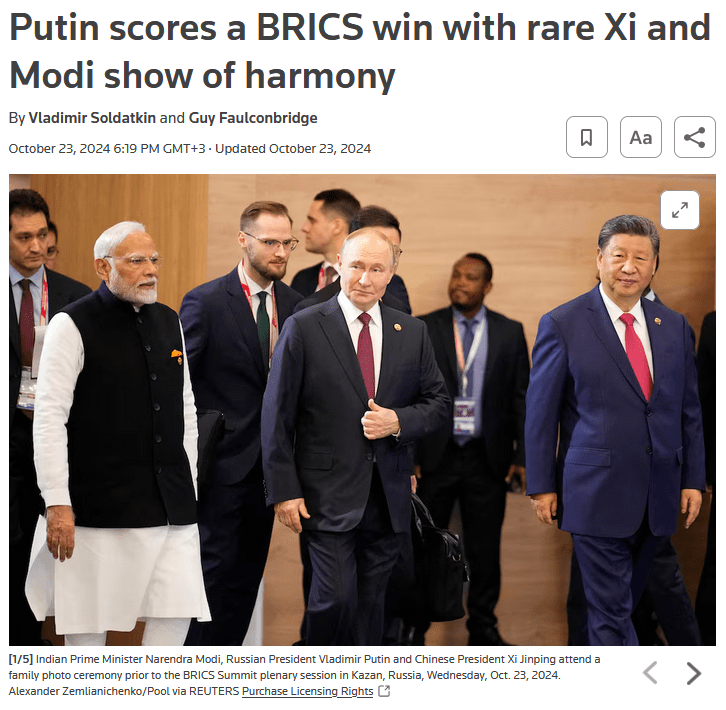
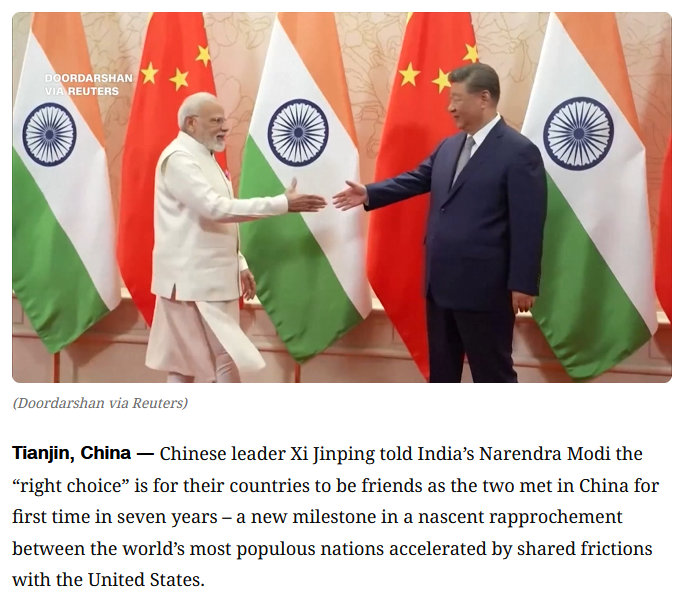
Three authoritarian leaders ‘pushed together’ by a fourth one… By the antics perpetrated by a guy pretending to uphold freedom. Absolute freedom…!

Probably the most important of the ‘solved‘ wars…

Xi needs Putin to remain in power. To keep the Western Europe focused on something else but China.
Trump needs Putin to remain in power. Otherwise the Western Union would stop begging for protection. And stop buying American built ‘defense hardware’…
Meanwhile, various ‘fragments of the world’ pursue their own interests… as perceived by their respective leaders, of course!

“Our measures do not tell us whether philosophy majors
go on to apply their newfound abilities in the service of truth and justice
or, conversely, for personal gain and glory.
Settling that question would require gathering a different kind of evidence.”

Reading it, https://theconversation.com/studying-philosophy-does-make-people-better-thinkers-according-to-new-research-on-more-than-600-000-college-grads-262681, brought back to memory another research subject. Linking a ‘reasonable consumption of alcohol’ to various health benefits.
A quick google search produced this:

The paper I found now, https://www.phcc.org.nz/briefing/glass-half-full-alcohols-health-benefits-cardiovascular-disease-still-controversial-and, is quite thorough.
More importantly, for me, it raises the points which bothered me when I first found out about the claim. On FB, more than five years ago.
I’ll put it in my own words.

Being able to drink for a relatively long time means one had a fairly strong health at the start of the whole process. And at least some degree of self-control.
Otherwise the drinker would have very soon become ill, an alcoholic, suffered some accidents… or any combination thereof.

Same thing regarding the findings of the first study.
Take a number of smart people. One has to be smart in order to be interested in philosophy! And able to graduate…
Train those people’s abilities. Help them develop whatever they’re good at. And like doing…
Then wonder about the good results you’ve achieved!

Writing this post made me realize that it goes far deeper than this.
No, this is not a self-congratulatory study. Far from it.
It’s stark warning!

“Public trust in higher education has hit record lows in recent years, according to polling by the Lumina Foundation and Gallup. Meanwhile, the rapid advance of generative AI has threatened the perceived value of a traditional college degree, as many previously vaunted white-collar skills are at risk of being automated.
Yet now more than ever, students must learn to think clearly and critically. AI promises efficiency, but its algorithms are only as good as the people who steer them and scrutinize their output.
The stakes are more than personal. Without citizens who can reason through complex issues and discern good information from bad, democracy and civic life are at risk.”

This paper is not about the virtues of learning!
It’s about us.
So many of us still have so much more to learn about the virtues of learning…

One possible explanation for what’s going on is that not enough of the learned people “go on to apply their newfound abilities in the service of truth and justice“.
Me starting this post with the distinct feeling that this was a self-congratulatory study is yet another confirmation of the generalized distrust which permeates the whole society.
We’ve reached that stage where we primarily look for reasons to refute.
Some say a little paranoia is good for you. That it keeps you safe.
I’m afraid we’ve reached exactly where ‘they’ want us to be.
Distrusting, paranoiac people cannot do anything together.

Constantly looking over your shoulder will never lead you forward.
Will only make you, us, susceptible to manipulation.
Remember, in this context, how many reasonable posts we get from people supporting various horrendous ideas.
How many ‘think with your own head’ messages we get from those ‘also’ promoting MAGA. How many times Putin says he only makes ‘reasonable’ demands.

How can we build trust?
I don’t know how but I do know we don’t have any alternative.

We either learn to respect each-other, and build trust together, or become subjects.
And I’ve already been a subject. To a communist regime. Don’t want to repeat the experience.

Things happen.
The consequences of which

reshape what we call ‘reality’.

‘Things happening’ is how ‘reality’ works.
Is how we came about…

Believers and nonbelievers alike, all of us are consequences of ‘things happening’. ‘Naturally’ or ‘as commanded by God’.

‘Reality’, on the other hand…
What we call ‘reality’ is determined by ‘us’.

(What we call) reality is the consequence of things happening inside itself.
Consider a huge cauldron full of ‘events’. What’s going on inside that cauldron, each stage ‘reached’ by its content depends on what happened inside that cauldron. And to that cauldron if we accept the ‘god’ hypothesis.
Which ‘god hypothesis’ only compounds the reality. Which can be construed as being simple, evolving in an unhindered manner, or being run by a (bunch of) god(s).
Examined in this manner, the existence of a putative god doesn’t change much, does it?

Reality being shaped by what’s happening inside it leads to further considerations:
We, humans as part of this reality, have had played a role in all this. And continue to contribute to the process.
We, humans, as part of this reality, are one of the many consequences engendered by this whole ‘evolutionary’ process.

Another way of looking at this produces another train of thoughts.
Until we had reached the conscious state, things had happened exclusively in a ‘natural’ manner.
Furthermore, until that moment there was no difference between ‘natural’ and ‘non-natural’.
For the simple reason that there was nobody to make it…
Nobody able, let alone willing, to make that difference!

The gist of today’s post being the fact that we are shaping reality according to our wishes.
Not entirely, not fully aware of what we’re doing, yet our actions have more and more important consequences.

Let me give you an example.
Until not so long ago – historically speaking, all empires – most socio-political arrangements, usually known as ‘states’, functioned as authoritarian regimes – used to crash under their own weight, had been crushed by the competing empires ‘happening’ in their vicinity or a combination thereof. The Western part of the Roman empire, weakened by the mistakes perpetrated by its rulers, had been ‘dismantled’ by the nomadic people who fancied the riches accumulated inside its borders.
The process had many iterations. An aggressor, a would be ‘imperator’, noticed an opportunity. What he considered to be an opportunity…
Mounted an aggression. And was either successful or defeated…

Until Napoleon Bonaparte had stirred so thoroughly the hornets nest that enough people noticed what was going on. Were aggravated enough to spring into action.
So they banded together, twice, and sent the initially successful aggressor where he belonged. In exile!

For the first time in modern history – as far as I know it – an aggressor had been ‘tamed’ by a ‘coalition of the willing’.
The same process had unfolded during WWI, WWII and WWIII. Otherwise known as the Cold War.

The only other example which comes to my mind – but I’m no historian – was the Persian Empire being defeated by a coalition led by Athens. Some 2500 years ago…

What’s keeping us from understanding this simple thing?
That unless we band together, we’re at the mercy of whoever puts up a fierce enough aggression?

https://www.britannica.com/event/Greco-Persian-Wars

Mind what you wish for,
for it might happen…

Putin wants to survive while Trump wants the same thing.
Xi also wants Putin to survive…

Without Putin(ism), Europe wouldn’t spend a dime on weapons. On American weapons!
America would have to develop and maintain alone the hardware needed to keep Xi at bay.

Once Putin gone, the Russian people will completely turn their attention towards Europe.
Leaving the ‘Chinese model’ stranded. In limbo…

What do we want?!?
Who cares?!? But now, that you’ve asked…

We want America back!
The already great America…
The one wise enough to save Europe from itself. Twice!
The one wise enough to help Japan back on its feet after WWII.
The one wise, and brave, enough to defend South Korea.
The one wise enough to understand that behaving like a bull in a China shop might be fun. For a while… but inexorably produces a fine mess… Specially when the bull owns much of the china being traded in that shop!

America does have a huge responsibility in maintaining the world in a working state. For the simple reason that America’s wealth depends, directly and indirectly, on the smooth functioning of the increasingly integrated world market.
Forgetting this, and concentrating your attention on ‘particular interests’, vested or not, is nothing short of blinding yourself. Of shutting reality out!

And we want Europe back!
Europe has already done the same mistake America is about to commit.
Behaved like the bull in the China shop. Literally. Then, overwhelmed by the consequences, left out without clearing up the mess.

Finally, but equally important, we need China – along with all other ‘wishful thinkers’ – to learn.
To understand that behaving like a bull in the China shop, even if you do it at home, doesn’t help anybody. Not in the long run.
Everybody, including the bull, ends up in tatters…

Deeds?
Or individuals?
What do you see first?

Most of you are more likely than not to be familiar with the ‘straw that broke the camel’s back’ metaphor.
My straw borrowed the shape of a book. Erich Fromm’s The Anatomy of Human Aggression.
At some point, when discussing the differences between Skinner and Freud, Fromm asks more or less the same question. His point of interest being different from mine… his thoughts follow a different path from mine…

So? What do you you reckon?

I feel the need to remind you a few things.
Fromm, a famous psychologist, had a PhD in sociology.
I, an engineer, have a BSc, in sociology.
Skinner, the entire behaviorist school of thinking, was contemporary with the dissolution of ‘God’.

Once the camel’s back had given way, things have started to fall into place.
Those who see ‘individuals’ first are psychologists, at heart, and those who see ‘deeds’ are sociologists.

‘So Skinner should have been a sociologist?!?’

I would never go as far as telling people what any of them should be doing!
I leave that to Marx’s followers. To all those, in general, who are confident enough to do it. I’m sure this is a wrong thing to do but I’m not here to judge. Only to express a few considerations.

‘You don’t tell people what to do, only what to NOT do! Semantics…’

There is an old story which sheds some light on this problem.

A teacher gave an after school assignment:
‘Do a good deed. Come back tomorrow and share the experience.’
John:
‘At a traffic light, sounding the right kind of beep, a blind person was already halfway across. A runaway truck was fast approaching without a sound. I pulled the person out of the danger. They was very grateful.’
Kevin:
‘An elderly lady was approaching a traffic light which was about to change. There was no chance in hell that she could have made it. I hoisted her over my shoulder and carried her across. She screamed and kicked like hell. She had no business on that side of the road. I felt ashamed and I left her there.’

Skinner, the behaviorists in general, do not care about ‘intent’. ‘I have no clue about what’s going on inside people’s heads. All I know, and can ‘measure’, is what they do. How they behave. In any given circumstances after whatever conditioning had been exerted upon them’.

Which makes a lot of sense, right? Specially for an engineer…

Freud, on the other hand, puts the onus on the manner in which each individual ‘digests’ – ‘internalizes’, according to the lingo – the whole history of interactions (conditioning?!?) they have experienced on the road towards their present state.

For Freud, behavior is something to be studied in order to understand the individual while for Skinner behavior is something to be fine-tuned.

Not so different, from my perspective.
Both Freud and Skinner somehow forget about the elephant in the room.
Who studies the individual? Who makes the (psycho)analysis? Who attempts to fine-tune ‘the behavior’?
I’m not going to go any further. And ask ‘why?’. What’s the end goal of any of those individual ‘experimenters’. ‘Motives’…
I’m no psychologist.

Being an engineer, I’m more interested in consequences. In what comes out…

In what we, ordinary people, have to survive in!

2010

Former Pennsylvania judge Michael Conahan has pleaded guilty to a racketeering conspiracy charge for helping put juvenile defendants behind bars in exchange for bribes.
He is accused along with former judge Mark Ciavarella of taking $2.8m (£1.8m) from a profit-making detention centres. Mr Ciavarella denies wrongdoing.

2024

“Conahan’s actions destroyed families, including mine, and my son’s death is a tragic reminder of the consequences of his abuse of power,” Sandy Fonzo said to the outlet. “This pardon feels like an injustice for all of us who still suffer. Right now I am processing and doing the best I can to cope with the pain that this has brought back.”
Similarly, Amanda Lorah, who at age 14 was wrongfully imprisoned as part of the scheme, told WBRE: “It’s a big slap in the face for us once again.
“We had … time taken away from us. We had no one to talk to, but now we’re talking about the president of the United States to do this. What about all of us?”

2025

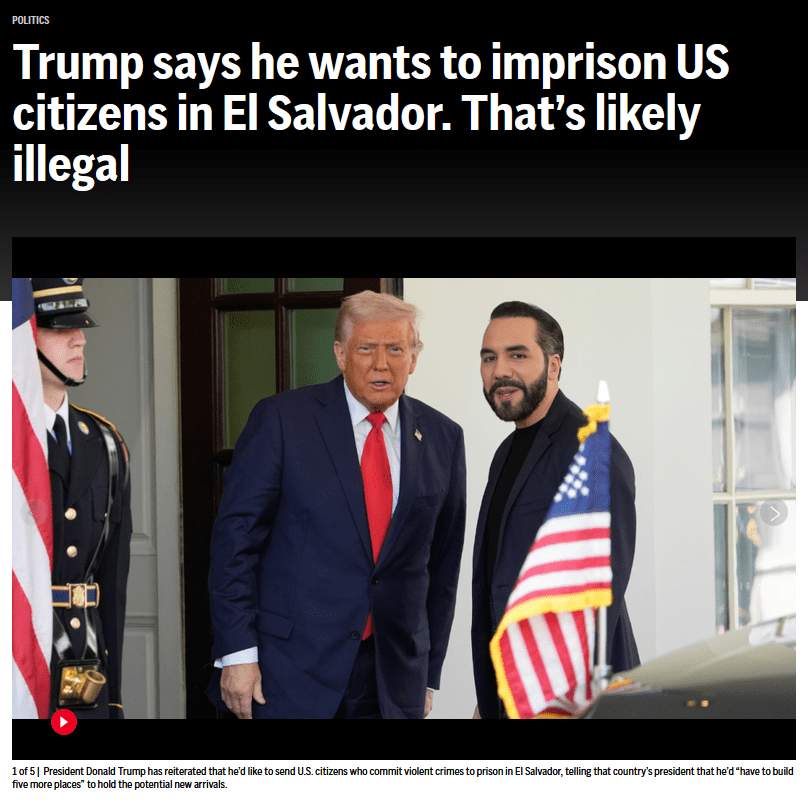
President Donald Trump on Monday reiterated that he’d like to send U.S. citizens who commit violent crimes to prison in El Salvador, telling that country’s president, Nayib Bukele, that he’d “have to build five more places” to hold the potential new arrivals.
Trump’s administration has already deported immigrants to El Salvador’s notorious mega-prison CECOT, known for its harsh conditions. The president has also said his administration is trying to find “legal” ways to ship U.S. citizens there, too.

Back in 2020

The question was posed, “Why do people continue supporting Trump no matter what he does?” A lady named Bev answered it this way:
“You all don’t get it. I live in Trump country, in the Ozarks in southern Missouri, one of the last places where the KKK still has a relatively strong established presence.
They don’t give a shit what he does. He’s just something to rally around and hate liberals, that’s it, period.
He absolutely realizes that and plays it up. They love it. He knows they love it.
The fact that people act like it’s anything other than that proves to them that liberals are idiots, all the more reason for high fives all around.
If you keep getting caught up in “why do they not realize this problem” and “how can they still back Trump after this scandal,” then you do not understand what the underlying motivating factor of his support is. It’s fuck liberals, that’s pretty much it.
Have you noticed he can do pretty much anything imaginable, and they’ll explain some way that rationalizes it that makes zero logical sense?
Because they’re not even keeping track of any coherent narrative, it’s irrelevant. Fuck liberals is the only relevant thing.
Trust me; I know firsthand what I’m talking about.
That’s why they just laugh at it all because you all don’t even realize they truly don’t give a fuck about whatever the conversation is about.
It’s just a side mission story that doesn’t matter anyway.
That’s all just trivial details – the economy, health care, whatever.
Fuck liberals.
Look at the issue with not wearing the masks.
I can tell you what that’s about. It’s about exposing fear. They’re playing chicken with nature, and whoever flinches just moved down their internal pecking order, one step closer to being a liberal.
You’ve got to understand the one core value that they hold above all others is hatred for what they consider weakness because that’s what they believe strength is, hatred of weakness.
And I mean passionate, sadistic hatred.
And I’m not exaggerating. Believe me.
Sadistic, passionate hatred, and that’s what proves they’re strong, their passionate hatred for weakness.
Sometimes they will lump vulnerability in with weakness.
They do that because people tend to start humbling themselves when they’re in some compromising or overwhelming circumstance, and to them, that’s an obvious sign of weakness.
Kindness = weakness. Honesty = weakness.
Compromise = weakness.
They consider their very existence to be superior in every way to anyone who doesn’t hate weakness as much as they do
.”

If it walks like a duck…
James Whitcomb Riley

By 1917 it seemed to Lenin that the war would never end and that the prospect of revolution was rapidly receding. But in the week of March 8–15, the starving, freezing, war-weary workers and soldiers of Petrograd (until 1914, St. Petersburg) succeeded in deposing the Tsar. Lenin and his closest lieutenants hastened home after the German authorities agreed to permit their passage through Germany to neutral Sweden. Berlin hoped that the return of anti-war Socialists to Russia would undermine the Russian war effort.

Do you remember the story about the early American Colonists “gifting of blankets and linens contaminated with smallpox” to the native inhabitants of the place?
It worked, to a degree, because the natives had no prior experience with the disease. Their immune systems had no prior experience with this pathogen. Which had been construed as an opportunity by those who had cooked up the plan, even though – in those times – nobody had any idea about ‘immunity’.

Lenin was also effective towards pulling the Czarist Empire out of WWI. Do we really care whether he was aware of the fact that he had been used as a 5-th column by Kaiser Wilhelm II’s strategists?

Do we learn anything?

History never repeats itself.
Only keeps teaching a lesson until we actually understand it.

‘In 1936, Hitler boldly marched 22,000 German troops into the Rhineland, in a direct contravention of the Treaty of Versailles. Hitler offered France and Britain a 25 year non-aggression pact and claimed: “Germany had no territorial demands to make in Europe” ‘.

“In the summer of 1938 Hitler demanded the annexation of the Sudetenland into Germany. At this point Hitler was aware that the Allies were desperate to avoid war, and thought it likely that they would appease his demands.
Hitler threatened war over the issue of the Sudetenland. On 29 – 30 September 1938 the British, Italian, French and German leaders met in Munich to discuss the issue.
The Allies agreed to concede the Sudetenland to Germany in exchange for a pledge of peace. This agreement was known as the Munich Pact.”

On May 3, 1939, Soviet leader Joseph Stalin fired Foreign Minister Maksim Litvinov, who was Jewish and an advocate of collective security, and replaced him with Vyacheslav Molotov, who soon began negotiations with the Nazi foreign minister, Joachim von Ribbentrop. The Soviets also kept negotiating with Britain and France, but in the end Stalin chose to reach an agreement with Germany. By doing so he hoped to keep the Soviet Union at peace with Germany and to gain time to build up the Soviet military establishment, which had been badly weakened by the purge of the Red Army officer corps in 1937. The Western democracies’ hesitance in opposing Adolf Hitler, along with Stalin’s own inexplicable personal preference for the Nazis, also played a part in Stalin’s final choice. For his part, Hitler wanted a nonaggression pact with the Soviet Union so that his armies could invade Poland virtually unopposed by a major power, after which Germany could deal with the forces of France and Britain in the west without having to simultaneously fight the Soviet Union on a second front in the east.

What is the lesson here?
That each tyrant believes they can outwit all other tyrants.
That tyrants are convinced they can outwit democratic alliances.
That, in the end, all authoritarian regimes fail. Abysmally. For the simple reason that inability to accept their own faillings makes all authoritarian leaders incapable of coping with change. Unable to adapt. Unable to evolve. Hence all authoritarian regimes are inherently fragile.

And who suffers the consequences?
We do. All of us. “World Wide Wars”, remember?