
The manner in which people chose to speak about the subjects they consider to be of great importance sheds a lot of light.
On the speakers!
The notion of “complementarity” was coined by John Paul II in 1979-1981. He was the reigning pope at that time.
I must remind you he was born Karol Wojtyla and his native language was Polish.
Well, nobody bothered to tell him that, in English, “complementary” has a rather limited ‘range’.
“Combining in such a way as to enhance or emphasize the qualities of each other or another. “they had different but complementary skills””
The notion was, and continues to be, used as the reason for which women cannot be made priests or deacons in the Catholic Church. And to deny marriage to the homosexual couples.
I find this whole thing rather baffling.
Man and Woman do not complement each-other. Not always, anyway.
Man and Woman survive together.
If you don’t understand the difference, don’t bother reading any further.
Now, if we need a certain ‘interaction’ between Man and Woman for the species to survive, then certainly we need to condemn homosexuality, right?
Wrong!
We have a series of facts here.
For the species to survive, Man and Woman are equally needed.
For the species to survive, it isn’t necessary for all men and women to bear children.
Homosexuality and gender dysphoria are realities. Regardless of what each of us thinks about each of them.
Humankind has survived. For now, at least.
The three facts I mentioned above have existed along the entire human evolution. We’re still here.
Back to square one.
I can ‘understand’, for the sake of the argument, the notion that homosexuality should not be ‘encouraged’. Homosexual couples are not naturally ‘productive’ so they shouldn’t be sanctioned by the church…
But if both Man and Woman are so indispensable, in their respective ‘natural roles’, for the survival of the humankind and “equal”, according to mainstream Catholic theology, then how can be explained the fact that Woman always comes second? And cannot be ordained?
Why do we allow a rather obscure thinker from the IV-th century B.C. to influence our decisions!?!
Prudence Allen, RSM: Man-Woman Complementarity, The Catholic Inspiration
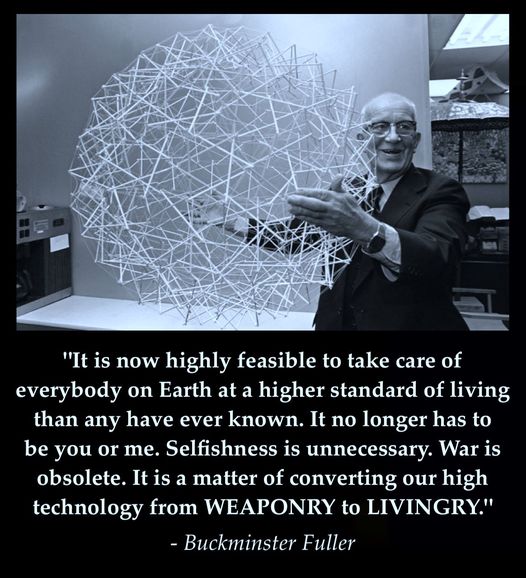
Buckminster Fuller prodded us to ‘convert our high technology’ into something really useful.
To do that, we need to perform a ‘self-actualization’ act.
Maslow considered self-actualization to be a need. An actual need, on par with the rest of them. Basic resources, safety, a place in society, esteem…
Maslow was right. Even if somewhat ‘incomplete’.
We need to crawl through the first four stages of Maslow’s pyramid in order to reach the fifth level. Where we have the opportunity to perform a self-actualization.
The result is up to us! There’s no rule nor any guaranteed outcome.
Eat and you’ll live another day. Feel safe and you’ll sleep well. Be loved and you’ll find your place. Feel good about yourself and you’ll be more ‘useful’. For yourself and for those around you.
To become a ‘better person’ you have first to find out what ‘better’ means.
And we really need self-actualization. In order to fulfill the first four needs, we’ve changed the ‘environment’. The place we call ‘home’.
We’ve built the technologies mentioned by Fuller! To make life easier…
To accept Woman as Man’s equal, as a full fledged equal, needs accepting that Man has been borne by Woman.
Some believe that Man has been made by God, ‘In His Image’. I can accept that but I must point out that God made only one Man. Adam.
All the rest have been given birth. By Woman. And raised by the extended family. By Men and Women, together.
After all, what’s keeping us from following Buckminster Fuller’s advice?!?
And is there any real difference between not allowing a woman to be ordained and not allowing her to speak ‘publicly’?

 nicichiarasa