Archives for posts with tag: Karl Marx


quote-the-philosophers-have-only-interpreted-the-world-in-various-ways-the-point-however-is-to-change-karl-marx-250986

Change it into what? And on what grounds?

I had spent the first 30 years of my life under communist rule and I’ve witnessed, first hand, the debacle produced by a bunch of people trying to transform the world according to their own liking. And it’s not only that they had brought a lot of misery to an awful lot of people but they also brought it upon their own heads. They, and their families, have been indeed living a lot better than the rest of the people but a lot worse than the ordinary people living in the free world. Not to mention the fact that many of them ended up really bad, some of them at the hands of their own insatiable, Minotaur-like, leaders and some others during and immediately after the regime change.

I’m writing this post after watching Jon Haidt’s excellent lecture “Two incompatible sacred values in American universities“, delivered at Duke’s Departement of Political Science on October 6, 2016.

The point of Haidt’s conference being that each university should clearly declare its ‘telos’ as belonging to one of these two clear cut options:

the-point-of-a-university_dxo

Don’t bother to search the quote attributed to John Stuart Mill.

It is only an interpretation belonging to Haidt himself, who had inferred it from one of Mill’s famous quotes excerpted from  “On Liberty”:
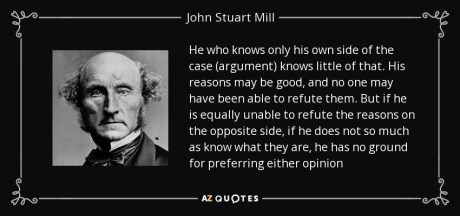
quote-he-who-knows-only-his-own-side-of-the-case-argument-knows-little-of-that-his-reasons-john-stuart-mill-125-0-0981

So, what should it be?

Change or Truth?

Before proceeding any further I strongly suggest that you take some time and listen to Haidt’s excellent arguments.

Now I’d like to discuss a little about ‘Change’ and ‘Truth’.

What both Marx and Haidt have in mind when they speak about ‘change’ is both ‘purposeful’ and ‘centralized’.
When they say ‘change’ they mean an ‘effort towards increased social justice’, effort whose parameters would be determined by the wise men (and women) delving in the depths of the University’s libraries and which would be implemented without fail, preferably with a sanction from the higher authority.

I had already mentioned, at the beginning of my post, where such ‘change’ would lead anyone  attempting to put it into practice.
And Haidt gives us an excellent explanation for why anybody who will ever attempt such a thing would eventually fail. (I told you to watch his conference…It may be long but every minute of it is packed with very interesting things!)

So why is Haidt challenging us to make this choice instead of giving us a clearer piece of advice?

Well… maybe you should ask him that… I’d hate to believe that he, in his own words, ‘has become afraid of that too many of his students might feel that he is so distanced from what is generally accepted that too few of them would follow him’.

So what should we do?
Some of us should embark on a ‘sterile’ search for the (absolute) truth and then, after eventually finding it, nurse it quietly in our lap but refrain from an even minutely more drastic action while others should attempt to implement change based on already ‘over the hill’ principles?

I’m afraid that would be a dangerous road to follow.

There is no such thing as an ‘absolute’ truth that might be nursed in our lap and even if there was such a thing we are not able to find it – individually or even as a group. There’s plenty evidence about that in Haidt’s discourse.
And then what would be the use of the whole enterprise if we are not planning to use the results of our quest, whatever those might be?

And here lies the crux of the matter.

I’m sure Haidt knows what I’m going to tell you now and I’m very sorry that most of your teachers have never mentioned at class this very interesting story.

Marx was not the first revolutionary thinker of his time.
OK, you already know that. There were a certain number of French intellectuals whose writings have set the stage for the 1789 Revolution.
What is less known is that John Stuart Mill himself had been groomed by his father “as the future leader of this radical movement”, whose aim was supposed to be “social reform based on utilitarianism” with the goal of attaining “the greatest happiness of the greatest number“.

The only difference between James Mill (the father) and Karl Marx being that Mill didn’t advocate the the forceful confiscation of the ‘means of production’.
Otherwise both were faithfully following Plato’s dictum:
Until philosophers are kings, or the kings and princes of this world have the spirit and power of philosophy, and political greatness and wisdom meet in one, and those commoner natures who pursue either to the exclusion of the other are compelled to stand aside, cities will never have rest from their evils, –nor the human race, as I believe, –and then only will this our State have a possibility of life and behold the light of day. Such was the thought, my dear Glaucon, which I would fain have uttered if it had not seemed too extravagant; for to be convinced that in no other State can there be happiness private or public is indeed a hard thing“.

Well, the problem with this line of thought is that it doesn’t work.
Again, Haidt has already presented a solid case about this and I’m not going to re-count his arguments.

So, since there is no such thing as an absolute truth to be discovered, one way or another, and no priest-kings on any white stallions that might come to our rescue, what shall we do?

Simple.
Follow Haidt’s, and John Stuart Mill’s, advice and take it one small step further.

The point of a university is to understand the world because only if you commit to truth, I believe, can you actually achieve justice.

We need to understand, and accept, two things:
Change has to be allowed to come naturally, not pushed forward simply because we are momentarily convinced that ‘The Truth’ had downed on us,
And that (social)justice is a process which has to be implemented on an ‘as needed’ basis, not an independent goal?

In fact Mill’s personal destiny is eloquent enough for what happens when somebody tries to breed a ‘perfect’ Priest-King.
“But in 1826, Mill began to suffer from a severe depression, which he attributed to his excessive analytical training and the resulting impairment of his emotional capacities. Reading the romantic poetry of Wordsworth and Coleridge helped Mill to overcome this mental crisis. It also inspired him to form a more complex view on human flourishing than the Benthamite utilitarianism of his father’s generation, with its dogmatic rationalism and unidimensional concept of pleasure.”

And this is why Haidt is absolutely right when he tells us that we need to expose ourselves to a lot more than what we are already familiar, and comfortable, with.
And this is why Heidegger kept warning us that truth as conformity between our words, or even our understanding, and the reality of the fact that we try to understand, and describe to others, is a Fata Morgana which consistently eludes us and that the only way to get any closer to her is ‘unhidennes’.

In this sense there is nothing better than an open mind, both towards our innermost thoughts and to the people living, and thinking, around us.

A mind open enough as to be able to simultaneously attempt to implement whatever changes become necessary in the light of the newly discovered truths AND accept the possibility that those ‘newly discovered truths’ might be incomplete or even altogether false.

Does all this seem rather schizophrenic?

Then let me rephrase the question I started with.

What’s the use of ever trying to understand anything if we’re not going, ever, to change our behavior as a consequence of anything we might come to figure out and on what basis is anyone to attempt any change if he never tried to understand anything above what he already knew long before he even started to think about any change?

As I was ready to close this post I stumbled upon the thought that maybe Haidt meant to apply in the academic world a principle that has been proved invaluable in the political life.

‘Separation of powers’.

Some universities would busy themselves with finding ‘the truth’ while others would attempt to find ways to put ‘it’ into practice.

Leaving aside the fact that this would smack too much of Marxism for my taste I’ll have to remind you that the separation of powers has become necessary in the political realm only because the government has an effective monopoly on power and we need to make it so that it cannot abuse this situation.

No university has any monopoly on truth and/or change.
Furthermore, not even the Academia, as a system, has been able to implement such a monopoly. Not for lack of trying, but that’s another subject.

So, instead of acquiescing to such efforts – by accepting certain universities as official ‘truth seekers’ and others as ‘path finders’/’change implementers’, we’d better ask each and all of them to clean up their acts.

And open up their collective minds.


Karl Marx. The world is crooked – there is too much exploitation imposed by the haves upon the have-not’s – so it has to be righted by those who have the right answer to the problem. And because the world doesn’t know what’s good for it, the ‘enlightened’ – the communists who are at the forefront of the class struggle – have the duty to impose the revolution by force.
The crux of the ‘solution’ being the abolition of both private property and the state. The private property because it is the tool with which the haves dominate the have-not’s and the state because it is the tool used by the haves to protect their private property from the have-not’s who continuously try to steal it.
But what tool can be best used to enforce the dissolution of the private property and to insure that the misguided and the ill intended don’t revert to the ‘old and corrupt ways of the bourgeoisie’? The state, of course. Hence we’ll have to postpone a little its dissolution, only until the first chores would have been completed, of course.

Max Weber. The world is too complicated to be understood/run by a single man, no matter how capable. That’s why the decision making process must be rationalized. Weber’s main methodological tool was the ‘ideal type’, a mental construction that is to be substituted to replace the real problem that has to be solved or the real thing that is being studied. This ideal type being stripped of the ‘unimportant’ aspects of the reality will make it a lot easier for the ruler/decision maker/scientist to understand what is going on there and to come up with the ‘correct’ decision or ‘clear’ understanding of the matter. This means that Weber was convinced that individuals are able, in certain conditions, to reach valid conclusions. Which is, of course, OK. Furthermore Weber had ‘reached the conclusion’ that if larger problems are to be solved then the efforts of single individuals are not enough and that in order to fulfill this task in a satisfactory manner many rational decision makers (which have been properly trained in their strict domains) have to be inter-connected into a well structured ‘net’. This way the big problem will be sliced into more manageable sub-problems which will be analyzed by specialists and then the final solution will be re-assembled by people specially trained for exactly this task. Nowadays this entire concept is known as ‘bureaucracy‘. In theory it sounds right, doesn’t it? What could be better than an all encompassing net comprised of rational/professional decision makers who act according to a well considered and well intended ‘ideal type’? Whose ideal type? Good question, indeed. Just as good as ‘who and how trained the ‘decision makers’?’.
(There is something we must keep in mind when discussing Weber, as a person. He died relatively young, before having a chance to reach a ‘final conclusion’, or at least one to satisfy him. That also has to be the reason for which he hasn’t published much during his lifetime.)

Plato. Society (the city, the “Republic’) should be run by a specific kind of (dedicated) people and because “those with the philosopher’s natural abilities and with outstanding natures often get corrupted by a bad education and become outstandingly bad” this ‘special kind of people’ need to receive “the proper kind of education“. Meaning that ‘a true philosopher’ has to be versed in ‘the Forms of Good’, which are amply explained in ‘The Cave Allegory’.
The gist of the matter is two layered.
1. The reality is hidden behind some ‘veils’ (or in ‘shadows’ if you prefer the original metaphor) but properly trained professionals (the philosophers) can be taught to see what Plato describes as ‘the ultimate truth’.
2. These professional truth seekers have not only the right to lead the rest of the people ‘into the light’ but the obligation to do so! Furthermore, for Plato the ‘ideal political structure’ – the Republic – would be so organized as to ‘force’ into public duty those who have been specially ‘bred and trained’ to perform such duty:
“Observe, Glaucon, that there will be no injustice in compelling our philosophers to have a care and providence of others; we shall explain to them that in other States, men of their class are not obliged to share in the toils of politics: and this is reasonable, for they grow up at their own sweet will, and the government would rather not have them. Being self-taught, they cannot be expected to show any gratitude for a culture which they have never received. But we have brought you into the world to be rulers of the hive, kings of yourselves and of the other citizens, and have educated you far better and more perfectly than they have been educated, and you are better able to share in the double duty. Wherefore each of you, when his turn comes, must go down to the general underground abode, and get the habit of seeing in the dark. When you have acquired the habit, you will see ten thousand times better than the inhabitants of the cave, and you will know what the several images are, and what they represent, because you have seen the beautiful and just and good in their truth. And thus our State which is also yours will be a reality, and not a dream only, and will be administered in a spirit unlike that of other States, in which men fight with one another about shadows only and are distracted in the struggle for power, which in their eyes is a great good. Whereas the truth is that the State in which the rulers are most reluctant to govern is always the best and most quietly governed, and the State in which they are most eager, the worst.”

I believe that by now you have grasped where I’m headed to. There is not much difference between Marx and Plato and a very close relationship between these two and Weber. Still, the fact that Weber was not yet done thinking about this matter at the moment of his untimely death makes me believe that if he had some more time at his disposal he would have understood what Laozi taught us about the concept of “nonaction”:

And isn’t it very strange that the best (short) presentation I was able to find about Laozi is hosted by a site called “Plato.Stanford.edu”?

https://www.marxists.org/archive/marx/works/1848/communist-manifesto/
http://www.academia.edu/4192854/Weber_s_methodology_understanding_concept_of_ideal_type_as_necessary_element_of_Weberian_comprehensive_sociology_Working_paper_
http://www.cf.ac.uk/socsi/undergraduate/introsoc/weber12.html

http://www.historyguide.org/intellect/allegory.html
http://plato.stanford.edu/entries/laozi/
http://izquotes.com/quotes-pictures/quote-the-wicked-leader-is-he-who-the-people-despise-the-good-leader-is-he-who-the-people-revere-the-lao-tzu-188515.jpg

Karl Marx’s version or Max Weber’s?

“the difference between truth as the “unhiddenness of beings” and truth as the “correctness of propositions” (Martin Heidegger)

Only after reading (again) the Essence of Truth I started to grasp the huge mistake made by Marx and his followers.
His declared motives were ‘the emancipation of the oppressed’ and if we are to grasp his work we need to read him in this key.

Only this way I could finally understand why for him ‘capital’ means exclusively ‘trade-able wealth’, money or things easily measurable in monetary units.
Only this way I could finally understand why for him ‘capitalism’ was exclusively about personal profit and hence despicable.

All this had happened because Marx wasn’t really interested in understanding how capitalism works, what it means and how it generated a medium in which creative and hard working people could make better use of the available resources than in previous social settings.
Marx was a man of a mission (it’s not that clear for me if he considered himself a saint that was meant to free the working class, a con-man who swindled a lot of money from Engels under the pretext of helping the poor or both at the same time) and we need to accept that almost all he did write was dedicated to this mission of his, whatever that was.

On the other hand Max Weber was also a man of a mission only his was different from Marx’s.
What he set out to do was to understand the inner workings of capitalism, how it came about and what consequences it might have.

““The most trifling actions that affect a man’s credit are to be regarded. The sound of your hammer at five in the morning, or eight at night, heard by a creditor, makes him easy six months longer; but if he sees you at a billiard table, or hears your voice at a tavern, when you should be at work, he sends for his money the next day; demands it, before he can receive it, in a lump. ‘It shows, besides, that you are mindful of what you owe; it makes you appear a careful as well as an honest man, and that still increases your credit.’ “

This is a brief excerpt from Weber’s “The Protestant Ethic and the Spirit of Capitalism” – retrieved, ironically, from an internet site run by “marxists”, http://www.marxists.org.
Weber is quoting here Benjamin Franklin in an attempt to make us understand what is the true spirit of capitalism.
At the first glance we might say it corresponds closely to what Marx had said about the subject – that it all boils down to money – only after further consideration it becomes apparent that while Marx had stopped there, at ‘money’, Weber and Franklin had seen way deeper than that.

Capitalism is not that much about mere money as it is about credit. Trust that is.

No one would extend credit without trust, no one would enter a contract without mutual trust and so on.

So what would it be? Which version of capitalism would you prefer?
The one in which we would strive to get hold of as much money as possible or the one in which each of us is held responsible by the others for his actions and holds those around him responsible for their actions – this being the only manner in which real trust can be established among us?

Please note that in reality these two sides of capitalism are like the two hands of a working man. For a short time one can get along with only one of them but no sane individual would prefer to live, and work, with only one hand, right?

Then how come our obsession about mere money has come to trump almost everything else?