Archives for posts with tag: Collective identity

This doesn’t catch the entire picture – each of us is heavily dependent on the environment into which we happened to be born – but clearly states the difference between us humans and the rest of the animal kingdom.
We are able to make conscious decisions and we love to apportion blame.

When engaging into our favorite pastime we’d better take into consideration two things: Our consciousness/rationality is limited and we can speak about blame only if intent was present.
We don’t have unlimited access to other people thoughts, nor can we see very far, so, in reality, we are aware of a very limited portion of the world around us. Moreover, no matter how confident we are in our minds, our processing power is also limited. So both our decisions and our ability to accurately apportion blame are not at all infallible. Far from it.
On the other hand blaming natural causes or even people who are not aware of (some) of the consequences produced by their actions for what has happened to us doesn’t make sense. A lighting doesn’t know that it frightens people and may wreak havoc in a city if the electric grid is knocked out of order, just as the ‘financial engineers’ who came up with the concept didn’t know, at first, what effects ‘securitization‘ will have upon the global financial markets.

Hey, you promised us something about manipulation and management, not another essay about financial markets manipulation!

True enough so let me discuss first what manipulation is: nothing but a psychological tool. Please note that I’m concerned here with the lofty notion of ‘thought manipulation’, not with the mere ability of ‘juggling’ objects into position….
Regardless of why or for what purpose it’s performed, manipulation remains a simple and very efficient tool that can be used even ‘pre-consciously’ – if you don’t believe me remember how toddlers manipulate their parents into buying them diverse things that are not only a complete waste of money but also sometimes dangerous for their long term health. In this case the manipulation is twofold: the merchandisers position certain items near the cashiers’ desks so that the children might not miss them.

As with any tool it’s up to the user (a.k.a. manipulator) to set the standards, what’s acceptable and what not.

Really? But what if the manipulator is not fully aware of the consequences of his acts? (Remember my digression into the subject of limited rationality/consciousness?) Could it be that the entire world might be shaken, even worse that it has already been, by the yet unforeseen consequences of a manipulation already underway?
Well, as no manipulator is that skilled as to be able to avoid detection for very long, the sad part about the whole thing is that most of the time we know/feel that we are being manipulated and allow it to happen out of laziness or complacency… This being exactly the moment when we should start blaming ourselves for our own lassitude.

Even more ‘interesting’ is how we rationalize the daily use of manipulation:

“The uncomfortable truth is that when resolving all the different pressures from existing customers, your own organization, bids for new business, and the like, you are inevitably going to have to persuade people to do things that are not entirely in their own interests.”

So, how much ‘out of their own interests’ is it acceptable for us to manipulate the thoughts of other persons? Specially when they are, after all, our close associates – either clients, subordinates, bosses or even colleagues, friends, relatives, close family.

And, given that sooner or later everybody realizes at least some of the manipulation he has been subjected to, the survival of our entire social life basically depends on how much manipulation each of us is disposed to submit to.

Rather scary, don’t you think? Specially if we take into consideration the fact that manipulators do not always know exactly what they are doing….

Don’t despair. There are people, among the ‘movers and shakers of this world’, who have noticed at least part of what’s going on and have started to act:

“Fundamentally, I believe, the gap (between HR’s aspirations and actual role) arises from two complementary causes. First, executives and managers often think their job is to get financial results rather than to manage people. Second, when executives and managers neglect people management, the HR function worries about lapses and tends to “lean in” to right them itself. On the surface, this approach seems to meet an organization’s needs: management moves away from areas it views as unrewarding (and perhaps uncomfortable), while HR moves in, takes on responsibilities, solves problems, and gains some glory in the process.

But this approach is based on erroneous thinking. It is bad for management and bad for the company as a whole. When HR sees itself as manager, mediator, and nurturer, it further separates managers from their employees and reinforces a results-versus-people dichotomy. That’s why many HR teams refer to the rest of the company as “the business”; too often, they don’t really perceive themselves as a core part of that business.”

When more of us will get it that we’re all together in this, we’ll reinvent mutual respect and scale back manipulation to its natural status: a very useful tool for grabbing the attention of whomever we want to talk to. Used in this manner, like all decent advertisers do, manipulation becomes not only innocuous but also useful for both parties. One is able to get its message across and the other finds out easier what’s going on in this world.

There are costs to be incurred, of course. Those who refrain from more aggressive manipulation may loose some money at first and those who pay a lot of attention to the messages – precisely because they are no longer aggressively manipulative – may end up spending in this manner a lot more time than they used to until now. But if and when we’ll realize that long time survival is a lot more important than short time profit then we’ll foot the bill without much hassle.

Dr. Wayne W. Dyer, “Everything you do…” : https://www.facebook.com/drwaynedyer/photos/a.387583371029.167523.83636976029/10151331343881030/?type=1&theater
Segoviano, M., et all, Securitization, Lessons Learned and the Road Ahead: http://www.imf.org/external/pubs/ft/wp/2013/wp13255.pdf
Case Study, The Colapse of Lehman Brothers, Investopedia: http://www.investopedia.com/articles/economics/09/lehman-brothers-collapse.asp
Peeling, Nic, Principles of Management, Dorset House Publishing, http://www.dorsethouse.com/features/excerpts/exdpch1.html
Allen, Peter L., Toward a new HR. Philosophy, McKinsey Quarterly: http://www.mckinsey.com/insights/organization/Toward_a_new_HR_philosophy?cid=other-eml-alt-mkq-mck-oth-1504
Dolmanian, Sarchis, Profit, Might it be overrated?: https://nicichiarasa.wordpress.com/2013/10/08/profit-might-it-be-overrated/

Bill Gates Alex Wong Getty Images

Bill Gates disapproves of Thomas Piketty’s method of leveling the play-field – levying a capital tax – and proposes a different tack: a progressive tax on consumption.

While I agree with both Gates and Piketty that extreme economic imbalances are bad for the society I profoundly disagree with both about how we should deal with them.
First things first. Extreme economic imbalances being bad has nothing to do with morals and very little to the fact that the poor feel bad when exposed to the excesses of the ‘filthy rich’.
They are bad simply because the dirt poor cannot express their creative potential and because the rich end up concentrating too much of the decision power. The society as a whole – including the super rich – looses, specially on the long run.
Taking the decision power from the hands of the super rich and giving it to the governments, through increased taxation, would only complicate matters. Not to mention the byzantine mechanism needed to enforce Bill Gates’ consumption tax.
Encouraging the rich to donate more would somewhat alleviate the problem but not much since until the money were distributed, if ever, the decision power would still remain too concentrated for our own collective good.
How about those same very rich people, now that enough of them have understood the perils associated with extreme economic imbalances, simply setting an example and start calculating wages using a completely different principle than is used today?
What if instead of ‘as low as the market allows’ they would ‘compensate’ their employees, all of them, as generously as their businesses can reasonably afford to? Somewhat in line with what Ford did back at the start of the XX-Th century, with more than excellent results for both sides? And does again now!

And how about the same rich and powerful individuals using their ‘political muscle’ and insisting on better governance? After all if their businesses and trust funds would have been run as most governments are run today they would have gone under a very long time ago…
And then, after the governments would have been ‘fixed’, and tax money not wasted anymore, how about the very same 1% start paying in earnest their ‘normal’ taxes, like the rest of us?

Surprise, surprise…

The real dangers of extreme economic imbalances: https://nicichiarasa.wordpress.com/2014/10/29/extreme-fragility-dead-ahead/
Why Ford increased wages back then: http://www.forbes.com/sites/timworstall/2012/03/04/the-story-of-henry-fords-5-a-day-wages-its-not-what-you-think/
Ford increases wages now: http://www.wsj.com/articles/ford-to-move-hundreds-of-entry-level-workers-to-higher-pay-rate-1423026005

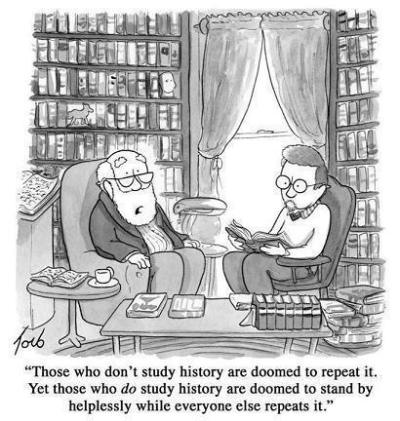
This image constantly pops up all over Facebook.

And while the caption does harbor some truth it somehow completely misses the point.

So:

– Those who don’t study the history have all the chances to repeat it but only if they are just as callous as their ancestors.

– Those who do study the history and stand by helplessly while everyone else repeats it have studied it in vain. They still haven’t got a clue about what really happened outside those books they’ve been reading. Had they learned a real understanding of what went on they would have been able, and willing, to explain it to their contemporaries and thus help them move forward, to a totally different set of mistakes waiting to be made.
Just as Plato (and Marx after him) thought of having found the absolute truth and did his best to lead his people to it …

But don’t despair. There is a safer way. To let things take their own course, to develop naturally. Just as Lao-Tzu taught us.

http://izquotes.com/quotes-pictures/quote-the-wicked-leader-is-he-who-the-people-despise-the-good-leader-is-he-who-the-people-revere-the-lao-tzu-188515.jpg

Karl Marx and Max Weber, two different pupils of Plato:

https://nicichiarasa.wordpress.com/2015/02/28/karl-marx-and-max-weber-two-different-pupils-of-plato/

Playing with fire is the ‘most efficient’ way to get burned.
Is this what we really wish for ourselves?

To be so afraid about the future as to allow (images of) babies to be used in this horrible way?

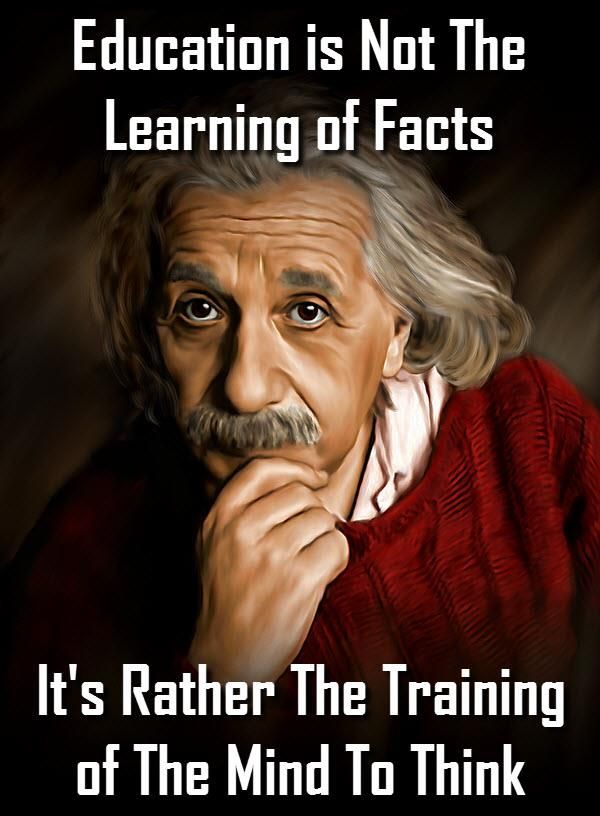
quotes-about-education-16

but also

So?

The way I see it ‘education’ is a blanket term that covers many things:

– Mental conditioning into obeying the prevailing rules of the moment/place
– Accumulation of information that is deemed useful by the educators.
– ‘Training of the mind to think’ – only this cannot be done without first supplying the student with some information on which to hone his mind.
– “Training of the mind to think” according to the rules of the moment/place – the term currently used for this kind of attitude towards thinking is ‘science’. If those rules are not obeyed then not only that the results of the thinking process won’t be recognized as valid by the community but the thinker won’t even be able to share them with those around him because those results won’t resemble anything known/familiar/acceptable to most of the members belonging to that community.

– Training of the mind to think outside of the box. To be able to do that a student needs first to learn what a box is so he must graduate through the first four stages AND to overcome some of the conditioning he was subjected to during the first stage.

Only after he “awakens” a student might start to discover for himself the rest of the world. And only if he uses his newly found awareness in a sensible way he will be able to share the results of his thinking with those around him and thus contribute to the long time survival of the society (family, community) that has nurtured him through his ‘coming of age’.

And only if that society (family, community) takes good care of its young it will have any chances to survive.
‘Taking good care of its young’ meaning encouraging them to open their wings in search of their full potential, not shackling them down to the nest in search for absolute safety.


At 45 I went back to school. Already a MSc in Mechanical Engineering this time my eyes were set on a BA in Sociology.

During my senior years I had my epiphany: that being able to pass information from generation to generation both considerably sped up human evolution, as a species, and opened wider expanses for us to conquer.
Big deal, I hear some of you muttering. Everybody knows that we became what we are only after we developed articulate speech and, specially, after we learned to write.

Well, you are right. Only time has come for us to learn to read!

Herbert Simon was presented a Nobel prize in 1977 for his ideas about how an abundance of information might prove to be, if inappropriately managed, a handicap instead of a bonus. “What information consumes is rather obvious: it consumes the attention of its recipients. Hence a wealth of information creates a poverty of attention, and a need to allocate that attention efficiently among the overabundance of information sources that might consume it.” That’s why we should learn how to sift through the available information if we are to avoid reenacting mistakes that have already been committed by our forefathers and abundantly documented for future referral.

Nowadays the world’s attention is highly strung by what is happening in the Middle East, the last development being Putin’s announcement that he is satisfied with the new openness displayed by the Iranians so he intends to fulfill a longstanding order from Teheran for sophisticated air defense missiles.
Trading with Iran is part of how the Iranian people can be encouraged to overcome the current impasse in their development as a nation.
Using every possible opportunity to advance on the international arena – and to ‘hurt’ those whom you have designated as your adversaries – by stirring already murky waters and then callously walking on corpses might prove to be counterproductive in the long run, to use the mildest words possible.

To illustrate my point I’m going to propose to you a list of articles describing some examples of ‘foreign intervention’ in the Middle East:

Sykes-Picot deal in the aftermath of WWI: The true story of Lawrence of Arabia

“Lawrence sought allies wherever he could find them. Surely the most remarkable was Chaim Weizmann, head of the English Zionist Federation. In January 1919, on the eve of the peace conference, Lawrence had engineered an agreement between Faisal and Weizmann. In return for Zionist support of a Faisal-led Syria, Faisal would support increased Jewish emigration into Palestine, tacitly recognizing a future Jewish state in the region. The pact was soon scuttled by the French.

But the most poignant what-might-have-been involved the Americans. Suspicious of the imperialist schemes of his European partners in Paris, President Woodrow Wilson sent a fact-finding commission to the Middle East. For three months, the King-Crane Commission toured Syria, Lebanon and Palestine, and what they heard was unequivocal: The vast majority of every ethnic and religious group wanted independence or, barring that, American administration. Wilson, however, had far more interest in telling other nations how they should behave than in adding to American responsibilities. When the commission returned to Paris with its inconvenient finding, the report was simply locked away in a vault.

Lawrence’s efforts produced a cruel irony. At the same time that he was becoming a matinee idol in Britain, courtesy of a fanciful lecture show of his exploits delivered by American journalist Lowell Thomas, he was increasingly regarded by senior British officials as the enemy within, the malcontent who stood in the way of victorious Britain and France dividing the spoils of war. In the end, the obstreperous lieutenant colonel was effectively barred from the peace conference and prevented any further contact with Faisal. That accomplished, the path to imperial concord—and betrayal—was clear.

The repercussions were swift in coming. Within the year, most all of the Middle East was aflame as the Arab world, enraged at seeing their Ottoman masters replaced by European ones, rebelled. Lawrence was particularly prescient about Iraq. In 1919, he had predicted full-scale revolt against British rule there by March 1920—“If we don’t mend our ways.” The result of the uprising in May 1920 was some 10,000 dead, including 1,000 British soldiers and administrators.”

Iran, the Mossadegh affair: In 1953 President Eisenhower prevaricated a lot before OK-ing the coup against Mossadegh because he “was afraid of destabilizing Iran and the region, which in his estimation, would inevitably lead to a communist takeover.” (Six Myths about the Coup against Iran’s Mossadegh)
He was right, only Iran hadn’t been taken over by communists but by Islamic fundamentalists yet I cannot stop wondering if Eisenhower, and those who urged him to proceed, were aware of what had happened 30 years before in ‘Arabia’.

In 1979, almost another 30 years later, the Soviets invaded Afghanistan. I don’t think this move had directly caused the fall of the Soviet Empire, but it certainly helped. The Soviet War in Afghanistan, 1879 – 1989As you all know the whole affair is still a festering wound.

In 1980 another war provided a scene where bad decisions could have been made. And were readily made: (Iran-Iraq War (1980-7988))
“Gradual Superpower Involvement (as if they weren’t already involved in that region, up to the hilt)
Iranian military gains inside Iraq after 1984 were a major reason for increased superpower involvement in the war. In February 1986, Iranian units captured the port of Al Faw, which had oil facilities and was one of Iraq’s major oil-exporting ports before the war.In early 1987, both superpowers indicated their interest in the security of the region. Soviet deputy foreign minister Vladimir Petrovsky made a Middle East tour expressing his country’s concern over the effects of the Iran-Iraq War. In May 1987, United States assistant secretary of state Richard Murphy also toured the Gulf emphasizing to friendly Arab states the United States commitment in the region, a commitment which had become suspect as a result of Washington’s transfer of arms to the Iranians, officially as an incentive for them to assist in freeing American hostages held in Lebanon. In another diplomatic effort, both superpowers supported the UN Security Council resolutions seeking an end to the war.

The war appeared to be entering a new phase in which the superpowers were becoming more involved. For instance, the Soviet Union, which had ended military supplies to both Iran and Iraq in 1980, resumed large-scale arms shipments to Iraq in 1982 after Iran banned the Tudeh and tried and executed most of its leaders. Subsequently, despite its professed neutrality, the Soviet Union became the major supplier of sophisticated arms to Iraq. In 1985 the United States began clandestine direct and indirect negotiations with Iranian officials that resulted in several arms shipments to Iran.

By late spring of 1987, the superpowers became more directly involved because they feared that the fall of Basra might lead to a pro-Iranian Islamic republic in largely Shia-populated southern Iraq. They were also concerned about the intensified tanker war.”

After the table was thus set there is ‘small wonder’ about what happened next: Iraq invaded Kuwait, the first Gulf War, 9/11, the second Gulf War, the intervention against the Taliban, what’s going on in the Horn of Africa…

Here is what Abdi Ismail Sanatar, a Somali, Professor of Geography at the University of Minnesota, was writing in the wake of the Nairobi Massacre 2013 (The Nairobi Massacre and the genealogy of the tragedy):”Given this, what must then be done to turn this tragedy into a victory for Somalis and Kenyans?
First, all of us must tend to the injured and those families who lost their loved ones.
Second, since al-Shabab’s main operations base is in Somalia, and since it has inflicted the greatest damage to ordinary Somalis, the international community should understand that the terror group must be defeated in that country. To do so, the EU and the US who support AMISOM must appreciate that only a professional and well-resourced Somali security force will drive al-Shabab into the sea. Consequently, they can divert half of AMISOM’s budget to this endeavor.
Third, Kenyan President Kenyatta and his government must heed legitimate Somali grievances against the occupation and urgently work with the Somali government and withdraw its troops from southern Somalia. Finally, the Somali government and particularly its top leadership should wake up to the fact that they have failed to inspire the Somali people and move them into massive civic mobilisation that will be the most effective defense against al-Shabab.
Such an engagement of the citizens will also be a fantastic boon for the Somalia’s reconstruction. If the international community and leadership in the region go back to business as usual then the victims of al-Shabab’s terror will endure a second death.”
Now, in 2015, his words have become tragically prophetic. “The victims of al-Shabab’s terror” were indeed murdered a second time, at Garissa University in Kenya.

And how does William Ruto, Kenya’s deputy president, plan to solve the situation? Simple (World’s largest refugee camp scapegoated in wake of Garissa attack):
“He told the High Commissioner for Refugees (UNHCR) to shut down Dadaab refugee camp near the border with Somalia within three months, or else Kenya would shut it down itself.
Officials have claimed that Dadaab is where al-Shabaab plans its acts of terror, such as Garissa and the 2013 Westgate Mall attack, and must be shut down.

“We have asked the UNHCR to relocate the refugees in three months, failure to which we shall relocate them ourselves,” said Ruto. “The way America changed after 9/11 is the way Kenya will change after Garissa… We must secure this country at whatever cost.”

Fighting talk, but talk was as far as it got. The UN has so far simply ignored the public demands for Dadaab’s closure, only commenting to praise Kenya’s commitment to refugees.
The UN has yet to receive any official communication on the subject. Although Kenya is eager to prove itself in the fight against terrorism while the country is still mourning the the victims of the attack, the government also needs to find someone to blame, other than its own poor national security system.
For now, Dadaab’s refugee population – voiceless in Kenyan society, and unable to defend itself – makes for 350,000 convenient scapegoats.”

I almost feel that some of you will oblige and remind me that hindsight is always 20/20 and that none of those who made the decisions that have led to those horrific outcomes could have known what was going to happen. Or that they even cared I might add.

True enough. Nassim Nicholas Taleb has a vey interesting idea on this subject. ‘Skin in the game‘ he calls it. His tenet being ‘if those who make the decisions do not directly experience the outcomes then the decision making process will be less diligent than if their own skin were in the game’.

The sad reality is that those who tend to use the ‘the full outcome could not have been predicted’ argument prove more than Taleb’s words. They are living proof to the fact that he who doesn’t read about it is doomed to repeat it.

Fortunately now there is a easier way out. The lazy ones can watch the movie if there’s too much for them to actually read Goethe’s The Sorcerer’s Apprentice.

A friend of mine shared this link on FB. Click on the picture above if you want to read a poem in which Nietzsche tells us that we have just killed God.

This notion of man being able to murder God suggests that man is also able to give birth to God.
In fact this is what we have done during all our history. We tried to recreate the world according to our needs. Most of the time we have been doing it naively, without a plan and without even being aware of what we were doing. And things went on relatively OK, in the sense that the lot of the entire humanity had gradually improved. Not in a linear manner, not equally distributed across the globe but nevertheless, on average, a certain improvement.
For the last 100 years or so we, or at least some of us, have started to figure out what was going on and to come up with ‘fresh’ ideas.
I wonder where this intended/looked for/carefully planned development will take us.
Meanwhile I cannot shake Goethe’s The sorcerer’s Apprentice from my head. Do we really know what are we doing?


http://germanstories.vcu.edu/goethe/zauber_e3.html

While the facts remain – there was a thinly clad teenager shivering in the middle of Manhattan and a lot of people passed by without offering any assistance – the whole incident raises some fresh issues besides those flagged by the ‘pranksters’ who staged the whole thing.
The person starring in the so called experiment was almost certainly underage. Exposing him to such temperature for so long is cruel. To do such thing in order to demonstrate the obvious – that we, the inhabitants of larger cities, have become rather insensitive – is rather… you name it!
Self serving callousness, to say the least?
It doesn’t matter that the authors purportedly want to promote a good cause. That’s no way of winning somebody to your side.

“Public shaming as a blood sport” is the difference between keeping the public up to date with what is going on in the public square and transforming the same public square into a stand up comedy venue.
When this happens the public becomes hypnotized by the antics presented there and forgets to choose himself which are the really important issues and what to be done about them.
The public becomes easy prey for callous political operators (they don’t deserve to be named ‘politicians’ since they don’t give a damn about the ‘polis’) and democracy becomes mob-rule.
That’s what happened before the fall of (Ancient) Rome.

If you want to watch her speaking you can also click here to open the original TED page about her:
http://www.ted.com/talks/monica_lewinsky_the_price_of_shame#t-86823

What’s the connection? Besides the obvious tank, of course…

How about both being extreme alpha males who display a comprehensive disdain towards what the rest of us consider to be common courtesy?

Then how come both of them enjoy the unflagging support of millions of fans?

“James May and Richard Hammond – who have refused to work without him despite the former calling him “a knob” – might be expected to stand up for their co-star and (presumably) friend. But even the Prime Minister has called him “a friend” and “a huge talent”. Meanwhile, a petition to “Bring Back Clarkson” now has more than one million signatures.
Maybe it’s because he (Jeremy Clarkson) represents a particular group in society: financially middling white people who feel under assault from wider issues which they do not understand and who are happy to buy into the scapegoats of immigration, human rights and health and safety. These are the people who are most likely to complain about “PC gone mad”, and in Clarkson they have someone who appears to rail against all of that which constrains them. As one signatory commented: “Jeremy is a bastion of light in a dark PC world.” Of course, it is hard to work out what they aren’t actually allowed to say, given the headlines the Daily Mail gets away with every day, and the police officers who walk free after asking their black colleagues about eating bananas. (Judith Wanga, The Telegraph)

Simetrically:

“I have lost count of how many nations my country has bombed in just the last few years. We bombed Afghanistan and the result is chaos. We bombed Iraq and the result is chaos. We bombed Libya and the result is chaos. We almost bombed Syria, but your President, Vladimir Putin, helped save us from that madness. Our policy seems to be that if we kill enough Muslims the survivors will believe in Jeffersonian democracy and wear bikinis.
I know it is tempting to think that the rulers of my country are evil, but they are not evil. It would be better if they were evil because it would be easier to unmask them and replace them. No, they genuinely believe that they are bringing enlightenment, modernity, freedom, and happiness to the world.
Of course, the United States government is not the same as the American people. There are many Americans, like me, who are dismayed by the arrogance and blindness of our government. Our voices are seldom heard, but we are there. And we support a strong and sovereign Russia that defends its traditions against all attacks. We support a Europe of nations and of regions, each with its own wonderful, irreplaceable traditions.” (Jared Taylor, American Renaissance, speaking before the Russian Conservative Forum, Sankt Petersburg, March 23, 2015)

So how come BBC dropped Clarkson despite Top Gear bringing in some 50 million pounds each year while Putin is still at the helm of the second most powerful nation, from the military point of view at least, in spite of the heavy economic hardships the Russian population has to endure as a result of Putin’s antics?

First of all BBC is a not for profit organization. So money is important but there are limits. “For me a line has been crossed. There cannot be one rule for one and one rule for another dictated by either rank, or public relations and commercial considerations.” (Tony Hall, BBC’s director general, the Independent). Besides that the wider public has sanctioned promptly Clarkson’s previous ‘slips’, preparing the ground for what had just happened.

Meanwhile ‘Russia’ is a country, not a company, so there is no such thing as a ‘wider public’. More over it is operated on a completely different set of principles:
““Even in its current inefficient form, Russia’s economy is sustainable as long as the citizenry is willing to live with hardship and lost opportunity,” Sucher points out. “History suggests that one should not underestimate the capacity of the Russian people to endure the unendurable.”
Russians’ presumed endurance, combined with their capability to put up with hard times and losses, are among the reasons why some experts don’t believe that social protests will happen in the foreseeable future. 
However, the problem appears to be more complicated than it does at first glance. Even though Russians might have stamina to deal with economic hardships, will they trust the authorities in the future?
Trust in the government and the president remains crucial for maintaining a country’s social capital, as Ngaire Woods, dean at Oxford University’s Blavatnik School of Public Diplomacy, and her counterpart from China’s Tsinghua University, Xue Lan, agreed during the Gaidar Forum. So far, Russian President Vladimir Putin approval ratings are robust. But it remains to be seen if that will be the case in two to three years….
.
After all, some of Russia’s prominent sociologists and historians believe that the Kremlin manipulates the mentality of Russians to legitimize its regime. For example, Lev Gudkov, director of Russia’s Levada Center for public opinion polling, points out that Russians are experiencing a deep inferiority complex and a sort of psychological trauma after the collapse of the Soviet Union, all of which makes them easier to manipulate.” (Pavel Koshkin in Russia Direct, relating about what has been discussed at the Gaidar Economic Forum in January 2015)

So, while Clarkson – no matter how brazen he is as a person or adulated as a TV personality – is not high enough above the rest of the world to be impervious to the effects of his own deeds, Putin stands, at least for the moment, atop a very tall pedestal. So tall, in fact, that I’m afraid he no longer sees clearly what’s going on at the street level.
Only this pedestal is made of the flimsiest of construction materials – popular sentiment. When the Russians will finally understand that ‘the emperor is naked’…

https://www.youtube.com/watch?v=frTBy4My9Qc
http://persephonemagazine.com/wp-content/uploads/2013/02/clarkson-bird.gif
https://www.youtube.com/watch?v=d2M5l__vCwo
http://www.telegraph.co.uk/news/celebritynews/11482655/In-Jeremy-Clarkson-BBC-bosses-have-created-a-monster.-Now-its-their-job-to-slay-him.html
http://www.ft.com/cms/s/0/176f7c04-d2f9-11e4-a792-00144feab7de.html#axzz3VUKcO3GQ
http://www.independent.co.uk/news/people/clarkson-sacked-piers-morgan-writes-open-letter-to-extop-gear-presenter-10134437.html
http://www.russia-direct.org/analysis/here%E2%80%99s-why-russia%E2%80%99s-economic-problems-won%E2%80%99t-lead-social-protests