Archives for posts with tag: authoritarianism

So what’s new…

Not so fast. There is more to it than the classic complaints – that high taxes discourage the working people while government hand-outs, made possible by those taxes, encourage the lazy to stay home.
If taxes are collected evenly – from all those that should pay them – and distributed sparingly – only to those who really need those hand-outs – nobody feels cheated so no disincentive is felt.

There is a more malignant phenomenon at work here. If taxes are really high – as a percentage – then being able to not pay them becomes a huge competitive advantage.

Not paying becomes attractive only after you are due a certain amount of money – you have to hire a tax consultant, pay some fees and commissions, etc. – but once you belong in that league not paying becomes a huge advantage over your competition. For instance over your competitors that are smaller and who won’t gain as much, or anything at all, by doing the same thing as you do.

And this is why the market becomes so polarized, why some of the really big brass do not push, in earnest, towards fiscal discipline and how the middle class gets squeezed out.

Each of us is constantly bombarded by barrage of information, most of it getting through even without us noticing what’s going on.
At the same time our conscious mind is constantly prodded: ‘do this, don’t do that, behave, lay low, stand up, be proud of yourself, don’t be so cocky’…

And we need to choose. This is how we become who we are.
Our past choices have determined who we are now and our present choices pave the way towards who we are going to be tomorrow.

Meanwhile some of the most pervasive pieces of advice we get are “don’t judge”, “love your neighbor as you love yourself” and “take care, anger blinds your reason and eats away your empathy”.

The last one is a ‘piece of cake’, it is so reasonable that it make no sense to comment on it.

The second one is so classic that most of us forget it’s importance.
Helped by the fact that it’s not at all easy to put it into practice. Loving isn’t like judging, it doesn’t come as easily and one cannot make himself love another on the spur of the moment.
Yet, in practically no time, we can pass judgement on almost anything, sometimes even without giving much thought about it.

The third one, “don’t judge”, is the one I find the most interesting.

Had I been a cocky brat I’d tell you that those who dispense this advice so generously as if they were aspirin want to keep all the judgement power for themselves, after all the firsts to give it to us were the mythical sages of the ancient times…
I can’t vouch for them all but I don’t think this was the real reason. The authoritarian paradigm is so destructive for a society as a whole that if a community sticks to it for a significant amount of time it ends up badly so this advice must have survived for another reason.

Yet.
How to refrain from judging and, even more important, what would we become if we gave it up completely?

Merriam Webster, the place where I go every time I have the least inkling that I’d be missing something when it comes to the meaning of words, defines “to judge” as:

: to form an opinion about (something or someone) after careful thought

: to regard (someone) as either good or bad.

So. Could we go through life without having opinions or preferences? Could we even preserve our individuality? What would happen if all of us would act as the members of a bee hive do?
OK, some of you will say now that we’d be easy pray for anybody who had managed to preserve a shred of his own individuality and who, presented with such an opportunity, would not be able to refrain itself.
As someone who had spent his first 30 years under communist rule I’d say ‘yes, you are right, only history shows us that such arrangements are untenable. Every time a society has given up too much of it’s power to choose and delegated too much of it to its ruler, situation know as an ‘imperium’ (dictatorship, absolute monarchy, monopoly, call it what you like), that society had passed through unpleasant historical periods’.

So what are we to do? To judge or not to judge?

How about using our common sense? How about reversing the order of those three advices?

What if we start with anger management and then work up our empathy?

After graduating from that stage we can start loving our neighbors. Not all of them at once, of course. If we keep in mind that our goal is to learn how to love – or at least to respect – even the most unpleasant of them we can start with the the one we like most. Only don’t forget to get to the end of the line.

And yes, while we go through the first two stages it would help to stop condemning people. Don’t kid yourself, you’ll never be able to stop judging, no matter how hard you’ll try. What you can do, quite easily, as soon as you catch yourself in the act of judging, is to consider the situation as calmly and compassionately as possible and then to halt the process just before it’s conclusion, before the ‘condemnation’ part.
Remind yourself that you don’t have all the pertinent information – we seldom do, even when we really need to make an important decision, and that your ‘sentence’ is, most of the times, irrelevant for the person you were judging.

You have, of course, noticed that I was speaking about the ‘casual’ and every day judgement we perform all the time, not about the instances when we do have to make a decision.
The point is that, very shortly after you start implementing the first two steps, you’ll notice a gradual shift in your general attitude towards the world.
And no, that will not happen simply because you’ve went through the motions. You will be able to complete the motions only after you convince yourself that being judgemental is actually bad for yourself, in the first and foremost place.

You see, every time you pass a harsh condemnation you actually coral yourself into a corner. Even when fresh information comes and refutes your judgement you feel the need to stand by your ‘standards’ – cause yes, every time you pass a judgement you do set a standard. So standard after standard, each time you pass a new judgement you erect a new fence between you, and those who agree with you, and the rest of the world.
And fences are strange things… some are good, those who keep the cattle in and the burglars out while some are so thick that prevent you from seeing what’s going on in the rest of the world.

After all our fences are our responsibility, we erect them, we maintain them…

Now please tell me how many of you did judge me for starting this post with a picture of a strange looking fence and how many figured out that that fence was in fact a very ingenuous play ground designed by Tejo Remy?

I don’t think the American Dream is in anyway toxic.
The real problem arises from what those who have fulfilled their dreams choose to do afterwards…
It’s one thing that if from some point on the ‘winners’ start helping others to fulfill their dreams and quite another if they keep fulfilling (gorging on) they own dream long past the ‘waking hour’…

Most probably Michael Clark is right, things started to go South from the moment the American Dream had been corrupted from ‘I dream to make it out’ to ‘I’ll stop at nothing in my quest to the top and nothing else matters’.

And no, I’m no fan of Big government.
If the urge to help doesn’t come from within it doesn’t help any if an outside agent keeps pestering you. It doesn’t matter who is ‘number one’, private or government, it’s the very fact that we, as a species, still have the obsession to reach that position that’s dragging us down.

Clark, Michael, “Is the American Dream toxic?“: http://seekingalpha.com/instablog/428250-michael-clark/882441-is-the-american-dream-toxic
Dolmanian Sarchis, “Why keep wasting money on toothless constitutional monarchies?“: https://nicichiarasa.wordpress.com/2015/02/25/why-keep-wasting-money-on-toothless-constitutional-monarchies/

Bill Gates Alex Wong Getty Images

Bill Gates disapproves of Thomas Piketty’s method of leveling the play-field – levying a capital tax – and proposes a different tack: a progressive tax on consumption.

While I agree with both Gates and Piketty that extreme economic imbalances are bad for the society I profoundly disagree with both about how we should deal with them.
First things first. Extreme economic imbalances being bad has nothing to do with morals and very little to the fact that the poor feel bad when exposed to the excesses of the ‘filthy rich’.
They are bad simply because the dirt poor cannot express their creative potential and because the rich end up concentrating too much of the decision power. The society as a whole – including the super rich – looses, specially on the long run.
Taking the decision power from the hands of the super rich and giving it to the governments, through increased taxation, would only complicate matters. Not to mention the byzantine mechanism needed to enforce Bill Gates’ consumption tax.
Encouraging the rich to donate more would somewhat alleviate the problem but not much since until the money were distributed, if ever, the decision power would still remain too concentrated for our own collective good.
How about those same very rich people, now that enough of them have understood the perils associated with extreme economic imbalances, simply setting an example and start calculating wages using a completely different principle than is used today?
What if instead of ‘as low as the market allows’ they would ‘compensate’ their employees, all of them, as generously as their businesses can reasonably afford to? Somewhat in line with what Ford did back at the start of the XX-Th century, with more than excellent results for both sides? And does again now!

And how about the same rich and powerful individuals using their ‘political muscle’ and insisting on better governance? After all if their businesses and trust funds would have been run as most governments are run today they would have gone under a very long time ago…
And then, after the governments would have been ‘fixed’, and tax money not wasted anymore, how about the very same 1% start paying in earnest their ‘normal’ taxes, like the rest of us?

Surprise, surprise…

The real dangers of extreme economic imbalances: https://nicichiarasa.wordpress.com/2014/10/29/extreme-fragility-dead-ahead/
Why Ford increased wages back then: http://www.forbes.com/sites/timworstall/2012/03/04/the-story-of-henry-fords-5-a-day-wages-its-not-what-you-think/
Ford increases wages now: http://www.wsj.com/articles/ford-to-move-hundreds-of-entry-level-workers-to-higher-pay-rate-1423026005

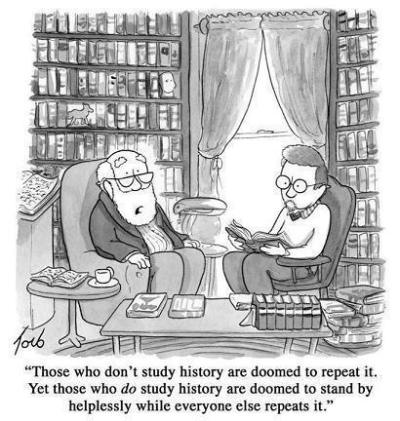
This image constantly pops up all over Facebook.

And while the caption does harbor some truth it somehow completely misses the point.

So:

– Those who don’t study the history have all the chances to repeat it but only if they are just as callous as their ancestors.

– Those who do study the history and stand by helplessly while everyone else repeats it have studied it in vain. They still haven’t got a clue about what really happened outside those books they’ve been reading. Had they learned a real understanding of what went on they would have been able, and willing, to explain it to their contemporaries and thus help them move forward, to a totally different set of mistakes waiting to be made.
Just as Plato (and Marx after him) thought of having found the absolute truth and did his best to lead his people to it …

But don’t despair. There is a safer way. To let things take their own course, to develop naturally. Just as Lao-Tzu taught us.

http://izquotes.com/quotes-pictures/quote-the-wicked-leader-is-he-who-the-people-despise-the-good-leader-is-he-who-the-people-revere-the-lao-tzu-188515.jpg

Karl Marx and Max Weber, two different pupils of Plato:

https://nicichiarasa.wordpress.com/2015/02/28/karl-marx-and-max-weber-two-different-pupils-of-plato/

Some of you might know that ‘ratio’ comes from Latin, where it’s original meaning was linked with the mental operation of dividing.
Yep, the first ‘rational’ thing made by man was resource allocation: how much food each member of the clan will get, according to a huge, and variable, set of criteria. I won’t get into details now.

My point is that we shouldn’t be bragging about how rational we are. At most we are ‘rationalize-rs’.

You see, for a decision to be perfectly rational it has to fulfill three criteria. The decision maker must:
– Have at his disposal all pertinent information regarding the entire situation under consideration,
– Be able to act in a completely unemotional way,
– Be in possession, and willing to use it to the maximum, of a brain not only in perfect working order but also able to process that huge amount of information in such a short time that nothing significant changes while the decision is being made.

So, which of you still thinks we are actual able of reaching actually rational decisions?

In reality we function in a completely different way.

From time to time an IDEA flashes in our heads. Again I won’t enter into details about how this outcome is influenced by our needs, emotions and previous experiences, for now I’ll just deal with what happens after that idea has already ‘sparked’.

Depending on a plethora of individual characteristics people differently when something like this happens to them.

Some shun it as if displaying any degree of originality was a mortal sin.
Some honestly and straightforwardly set to examine it as thoroughly as they can. They take into account as many information as they can muster about the subject and not only carefully balance costs against possible benefits but also try to determine as many stakeholders as possible and determine, to the best of their knowledge, whatever consequences might befall upon them if that idea is put into practice. And they proceed only after this entire process has been followed step by step.
Some take a different route after the cost analysis. If they reach the conclusion that the whole thing might prove to be profitable enough for them they start identifying who might object, for what ever reasons – no matter if valid or not – and thoroughly plan how to stifle the opposition.Some don’t even care about the costs. If they become, by any means considered to be proper by themselves, convinced that that particular idea has to be implemented then they will stop at nothing. They will employ all means at their disposal in order to put that idea into practice, no matter what those around them might feel, think or even suffer.

Please observe that the last three are all using their rational brain to the utmost. Yet only the second one might be described as reasonable, right?
Most of us are culturally conditioned to think about the third that he is a callous manipulator and about the fourth that he is an aggressive bastard. Right again, ain’t I?

Well, not so fast.
According to Plato the fourth is doing the right thing. ‘He who sees the light has not only the right but also the obligation to take the others with him towards that light’. (Plato’s Republic). One might think that this is a very dictatorial attitude that doesn’t, in any way, resemble Socrates’ manner of dealing with things – after all he was convicted exactly for teaching the young how to make their own decisions – but this is another discussion. Coming back to the manner advocated by Plato it is indeed extremely authoritarian – all dictators have followed it to the letter – but it is not altogether without merit. What should a doctor do when you are brought to his ER with a mangled leg? Wait for a couple of days for you to come about and decide if you’ll accept the amputation – while the already dead tissue poisons you beyond any therapeutic possibilities – or proceed with cutting away your limb and thus saving your life but assuming the risk that you’ll sue him for his last dollar?
According to the modern business practices the third guy is acting in a quite conventional way. Most of us agree that planned obsolescence is good thing – it provides a lot of jobs – doesn’t it? Well, I don’t, not on the scale we are using it anyway, but that again is another subject.
And now that we have reached the presumably respectable and the only reasonable ‘second decision maker’ I’ll just add some of George Bernard Show’s words on this matter:

the-reasonable-man-gbs

So it seems that there isn’t such a thing as an always valid manner of thinking, right? Things depend a lot more on our individual judgement than a lot of people feel comfortable with. Rational thinking isn’t at all that panacea some people believe it to be and in reality reason is nothing but a mental tool and the manner in which we use falls squarely in  our individual responsibility
That’s why Plato thought he was doing a service to his fellow citizens when he wrote: “I said, the intention of the legislator, who did not aim at making any one class in the State happy above the rest; the happiness was to be in the whole State, and he held the citizens together by persuasion and necessity, making them benefactors of the State, and therefore benefactors of one another; to this end he created them, not to please themselves, but to be his instruments in binding up the State.” Let me remind you that Plato was contemporary with the Golden Age of the ancient Greek civilization and with the last days of the Athenian democracy. I’m not going to pretend now that the demise of the Greek democracy  or the relative rapid decay of the Greek civilization after Pericles and its replacement by the Roman and Persian ones were influenced by Plato’s writings. No. In fact it’s all the way around. Plato had only witnessed and put in writing the attitudinal changes that affected the Athenian/Greek society and which eventually caused those developments.

And now that we have reached the subject of democracy here is why maintaining a democratic attitude is extremely important for the long time survival of a society. Real democracy means that a considerable part of the people pay active attention to what is happening to their lives and have the ‘constitutional’ possibility to intervene peacefully if they don’t like where their leaders take them. We have seen that we cannot depend, as Plato urges us to, on the wise guidance of a ‘specialist leader’ since there is no such thing as ‘perfectly rationality’ being attained by a man. A widely disseminated attitude of the general population is the only way in which individual mistakes made by the leaders are eventually acknowledged and fixed. Any other ‘political arrangement’ leads to these mistakes being rationalized away and their (disastrous) results constantly accumulating until the entire system collapses.

One other thing before I wrap this up. The first argument I made, that the first rational thing made by man was the rational allotment of food among the members of the clan, is also a rationalization. That’s how we, who like to believe about ourselves of being rational, think it must have happened. That the inhabitants of the temperate Europe were the most rational among the peoples of the Earth and that’s why they have reached such a dominant position as they used to enjoy until not so very long ago.
Sorry, it happened exactly the opposite way. Europeans, because of the harsh conditions they had to face – coupled with the relative abundant resources and a special geographical layout – they have developed a (relatively) rational way of thinking. It was this or else… just as Ernst Myer says: ‘evolution is not about the survival of the fittest but about the demise of the unfit’. In order for us to develop ‘rational thinking’ we needed the very special environment to force us to do it.
We are any special – if at all – not because we are any different but because we had the good fortune of being born in the right place. OK, we made good use of that happy act of hazard but that’s all.

For those of you who want to read about how ‘mere’ geography decisively determine evolution I highly recommend Jared Diamond’s Guns Germs and Steel.

“Public shaming as a blood sport” is the difference between keeping the public up to date with what is going on in the public square and transforming the same public square into a stand up comedy venue.
When this happens the public becomes hypnotized by the antics presented there and forgets to choose himself which are the really important issues and what to be done about them.
The public becomes easy prey for callous political operators (they don’t deserve to be named ‘politicians’ since they don’t give a damn about the ‘polis’) and democracy becomes mob-rule.
That’s what happened before the fall of (Ancient) Rome.

If you want to watch her speaking you can also click here to open the original TED page about her:
http://www.ted.com/talks/monica_lewinsky_the_price_of_shame#t-86823

What’s the connection? Besides the obvious tank, of course…

How about both being extreme alpha males who display a comprehensive disdain towards what the rest of us consider to be common courtesy?

https://www.youtube.com/watch?v=d2M5l__vCwo

Then how come both of them enjoy the unflagging support of millions of fans?

“James May and Richard Hammond – who have refused to work without him despite the former calling him “a knob” – might be expected to stand up for their co-star and (presumably) friend. But even the Prime Minister has called him “a friend” and “a huge talent”. Meanwhile, a petition to “Bring Back Clarkson” now has more than one million signatures.
Maybe it’s because he (Jeremy Clarkson) represents a particular group in society: financially middling white people who feel under assault from wider issues which they do not understand and who are happy to buy into the scapegoats of immigration, human rights and health and safety. These are the people who are most likely to complain about “PC gone mad”, and in Clarkson they have someone who appears to rail against all of that which constrains them. As one signatory commented: “Jeremy is a bastion of light in a dark PC world.” Of course, it is hard to work out what they aren’t actually allowed to say, given the headlines the Daily Mail gets away with every day, and the police officers who walk free after asking their black colleagues about eating bananas. (Judith Wanga, The Telegraph)

Simetrically:

“I have lost count of how many nations my country has bombed in just the last few years. We bombed Afghanistan and the result is chaos. We bombed Iraq and the result is chaos. We bombed Libya and the result is chaos. We almost bombed Syria, but your President, Vladimir Putin, helped save us from that madness. Our policy seems to be that if we kill enough Muslims the survivors will believe in Jeffersonian democracy and wear bikinis.
I know it is tempting to think that the rulers of my country are evil, but they are not evil. It would be better if they were evil because it would be easier to unmask them and replace them. No, they genuinely believe that they are bringing enlightenment, modernity, freedom, and happiness to the world.
Of course, the United States government is not the same as the American people. There are many Americans, like me, who are dismayed by the arrogance and blindness of our government. Our voices are seldom heard, but we are there. And we support a strong and sovereign Russia that defends its traditions against all attacks. We support a Europe of nations and of regions, each with its own wonderful, irreplaceable traditions.” (Jared Taylor, American Renaissance, speaking before the Russian Conservative Forum, Sankt Petersburg, March 23, 2015)

So how come BBC dropped Clarkson despite Top Gear bringing in some 50 million pounds each year while Putin is still at the helm of the second most powerful nation, from the military point of view at least, in spite of the heavy economic hardships the Russian population has to endure as a result of Putin’s antics?

First of all BBC is a not for profit organization. So money is important but there are limits. “For me a line has been crossed. There cannot be one rule for one and one rule for another dictated by either rank, or public relations and commercial considerations.” (Tony Hall, BBC’s director general, the Independent). Besides that the wider public has sanctioned promptly Clarkson’s previous ‘slips’, preparing the ground for what had just happened.

Meanwhile ‘Russia’ is a country, not a company, so there is no such thing as a ‘wider public’. More over it is operated on a completely different set of principles:
““Even in its current inefficient form, Russia’s economy is sustainable as long as the citizenry is willing to live with hardship and lost opportunity,” Sucher points out. “History suggests that one should not underestimate the capacity of the Russian people to endure the unendurable.”
Russians’ presumed endurance, combined with their capability to put up with hard times and losses, are among the reasons why some experts don’t believe that social protests will happen in the foreseeable future. 
However, the problem appears to be more complicated than it does at first glance. Even though Russians might have stamina to deal with economic hardships, will they trust the authorities in the future?
Trust in the government and the president remains crucial for maintaining a country’s social capital, as Ngaire Woods, dean at Oxford University’s Blavatnik School of Public Diplomacy, and her counterpart from China’s Tsinghua University, Xue Lan, agreed during the Gaidar Forum. So far, Russian President Vladimir Putin approval ratings are robust. But it remains to be seen if that will be the case in two to three years….
.
After all, some of Russia’s prominent sociologists and historians believe that the Kremlin manipulates the mentality of Russians to legitimize its regime. For example, Lev Gudkov, director of Russia’s Levada Center for public opinion polling, points out that Russians are experiencing a deep inferiority complex and a sort of psychological trauma after the collapse of the Soviet Union, all of which makes them easier to manipulate.” (Pavel Koshkin in Russia Direct, relating about what has been discussed at the Gaidar Economic Forum in January 2015)

So, while Clarkson – no matter how brazen he is as a person or adulated as a TV personality – is not high enough above the rest of the world to be impervious to the effects of his own deeds, Putin stands, at least for the moment, atop a very tall pedestal. So tall, in fact, that I’m afraid he no longer sees clearly what’s going on at the street level.
Only this pedestal is made of the flimsiest of construction materials – popular sentiment. When the Russians will finally understand that ‘the emperor is naked’…

https://www.youtube.com/watch?v=frTBy4My9Qc
http://persephonemagazine.com/wp-content/uploads/2013/02/clarkson-bird.gif
https://www.youtube.com/watch?v=d2M5l__vCwo
http://www.telegraph.co.uk/news/celebritynews/11482655/In-Jeremy-Clarkson-BBC-bosses-have-created-a-monster.-Now-its-their-job-to-slay-him.html
http://www.ft.com/cms/s/0/176f7c04-d2f9-11e4-a792-00144feab7de.html#axzz3VUKcO3GQ
http://www.independent.co.uk/news/people/clarkson-sacked-piers-morgan-writes-open-letter-to-extop-gear-presenter-10134437.html
http://www.russia-direct.org/analysis/here%E2%80%99s-why-russia%E2%80%99s-economic-problems-won%E2%80%99t-lead-social-protests

Bloody Caesar


Did you know this maxim was attributed to Philip II of Macedonia and was heavily used by both Caesar and Napoleon?

Also, did you know that it covers a lot more than ‘divide and conquer’?

For instance, a rather successful computer game and a problem solving methodology  that recommends the original problem be divided into smaller, and hence easier to manage, sub-problems.

Going back to the original meaning I must admit that both the ancient Macedonians and the ancient Romans made ‘good’ use of it. Alexandre the Great had conquered everything between Greece and India while the Ancient Rome had been, for a while, the most powerful empire known to man.

In more modern times the same strategy had been used by Germany, among others. Again, with relative success. During WWI the Kaiser had facilitated Lenin’s access to Russia and by doing so he had split the coalition he was trying to defeat – as a result of this manoeuvre Russia had asked for a separate peace treaty, eventually signed at Brest Litovsk. During WWII Hitler took great care to keep Russia at bay while he conquered the Western part of Europe.

Now the same strategy is being used by Vladimir Vladimirovich Putin, the current Czar of Russia.

On Sunday, March 22, 2015, Sankt Petersburg – Putin’s birth place and political trampoline – hosted the Russian Conservative Forum. It was attended by a “a motley crew of representatives of fringe right-wing political organizations in Europe and the United States” which “including Hitler apologists, Holocaust deniers, apartheid fans, and a Russian skinhead who once decapitated a puppy as a publicity stunt, gave it an air of dark surrealism. Speakers condemned the U.S. as the enslaver of Europe and sang the praises of Russian President Vladimir Putin, holding up Russia as the last fortress of Christendom in the war waged on it by liberalism and multiculturalism.
“In the West, we are brainwashed to hate Vladimir Putin,” said British anti-abortion-rights campaigner Jim Dowson. He went on to say that Russia is blessed to be ruled by “a real man” while the U.S. is led by the “feminized” Barack Obama.”

On Tuesday, March 24, “The UN General Assembly’s budget committee … rejected a proposal submitted by Russia that called for withdrawing a July 2014 administrative ruling by UN Secretary-General Ban Ki-moon. He ordered the world body to recognize same-sex unions of any of its 60,000 global staff who wed in countries that legally recognize such partnerships.
The dispute turned an internal UN personnel policy into a microcosm of the differences that pit the U.S. and EU nations against more socially conservative countries over recognizing rights of those who are lesbian, gay, bisexual or transgender.”

If we put two and two together and then add the result to what has already become evident – that the Russian (more exactly Putin’s) Propaganda machine has been revved up in a massive way for quite a while now – the pattern becomes visible.
Putin is ‘doing his worst’ to convince those uncomfortable with the spread of ‘liberal values’/globalization that if they want to ‘preserve their national traditions’ they have to ‘unite closely around’ the only leader that can save them from being engulfed by the ‘decadence of the West’. Around him, that is.

In fact this is exactly what the ’emperors of old’ I mentioned at the beginning of the post used to recommend. Instil as much fear in your opponents, individually, as you can and try to rekindle the smallest differences that ever existed between them.

There is a small problem though with this line of thinking.
No matter how much we respect/admire some of them or hate/despise the others none of those who had used this strategy ended up in a ‘comfortable’ manner.
And all of them had brought great misery to the people under their rule. Including Caesar. A civil war is no small thing, not now, not then!

While we ponder what to do in order to counter this nefarious propaganda, we need to keep in mind that Russia is not Putin and that the Russian people has never had a taste of what real democracy feels like. Blaming the entire people, wholesale, for what Putin does in their name ‘is worse than a crime, it’s a mistake’.

PS. Same counter-strategy should be applied to all would be ‘dividers’ who try to become ’emperors’.

http://scarlet.unl.edu/scarlet/archive/2008/02/28/story9.html
http://rsif.royalsocietypublishing.org/content/royinterface/12/104/20141335.full.pdf
http://history.stackexchange.com/questions/14608/did-the-germans-purposefully-arrange-to-send-lenin-to-russia-to-start-a-revoluti
http://www.historylearningsite.co.uk/treaty_of_brest-litovsk.htm
http://www.newyorker.com/news/daily-comment/a-hateful-sort-of-love
http://www.nytimes.com/2015/03/23/world/europe/right-wing-groups-find-a-haven-for-a-day-in-russia.html?ref=europe
http://www.bloomberg.com/news/articles/2015-03-23/is-russia-against-fascism-or-isn-t-it-
http://www.bloomberg.com/news/articles/2015-03-24/russian-bid-to-block-same-sex-benefits-for-un-workers-rejected
http://www.theguardian.com/world/2014/mar/17/crimea-crisis-russia-propaganda-media
http://www.unrv.com/fall-republic/caesars-civil-war.php

https://www.youtube.com/watch?v=GtJM84tMYMk

Politics were always about getting things done.

Modern politics used to be about dialog. People talked to each other and when a conclusion was accepted by a majority it became a policy and was put into practice.

Contemporary politics seem to be about hiding behind ideological smoke screens – values, rights, political correctness, platforms, you name them – while scheming about how to implement usually self serving and too often very short sighted policies.

I’ve spent the first 30 years of my life – practically my entire youth – under communist rule. The worst thing was the complete lack of alternatives. One ruler, one party, only one opinion that automatically became law. No way to escape the mistakes made by whomever happened to be in power and who, unfailingly, ‘lost it’ gradually as he spent more time at the top precisely because there were no ‘checks and balances’, no real dialogue between the various sections of the society.

The Western part of Europe – the area currently known as the EU and which was the starting place for the most destructive wars in human history – is crisscrossed by water filled channels. Some of natural origin and some build by the people living nearby. In peaceful times they were used as shipping lanes, in wars as trenches.

Political parties evolved as public platforms. Virtual places where likely minded people got together and discussed their opinions before proposing them to the society at large. Now-a-days they seem to have become fortresses where ‘frightened’ individuals congregate so tightly that no outside influence penetrates to their ears.

Bona fide negotiations have all but disappeared and have been replaced by ‘pork barrel’ laced with veiled threats.

What are we going to do from now on? Resume trading in good faith or prepare for war?
And no matter what the ‘talking heads’ are babbling incessantly IT’S UP TO US. After all it’s our own lives that are at stake.

If you think I’m exaggerating click here and read some of the comments. They were posted by regular people, the likes of you and me. For now they are still willing to share their feelings but don’t you think the atmosphere is just a little too tense for our own good and that nobody really listens anymore?

In Romania we have a saying that goes like this: ‘A fish rots from the head and should be scaled/gutted from the tail’.

We need to clean up our own, individual, act first. Only this way we’ll be able to convince the powerful-s of the day that we really mean it.
We can start by paying attention, real attention, to the persons living next to us. To our colleagues, to our employees… Of course we pay attention to our bosses and to our families, that’s how we survive in the short term.
Time has come to pay attention to the rest of the people. If we want to thrive in the long run.

http://thehill.com/blogs/ballot-box/236101-glenn-beck-im-out-of-the-republican-party#disqus_thread
https://d2k9njawademcf.cloudfront.net/post_promo_images/11202/original/scaling_fish.jpg?1409694449