Archives for category: The kind of world we live in

text neck

“At this point, it seems like our electronics are out to kill us because a doctor is warning rabid texters of a new condition called “text neck.” “ according to an article recently published by Gizmodo

Anyway the writer has a funny sense of humor: ‘…our electronics are out to kill us because a doctor is warning rabid texters of a new condition…’?!?
Am I to understand that ‘our electronics’ got mad at us because of the good doctor’s warning and this might constitute the reason for which “… our electronics are out to kill us…”? And it’s ‘the health craze’ that’s going to injure us, not our bad habits, eh?

Oh boy….

At some point the significant individual involved in a situation will have to make the relevant decision.

And here comes the difference between a human and a horse.

The horse will wait until it becomes thirsty, no matter how ample opportunities to drink would present themselves before him while the human will first make sure that the water is safe to drink and only then decide what to do: drink pre-emptively, fill a flask, take a nap by the spring…

The point I’m trying to make here is that while animals, no matter how ‘sophisticated’, act according to their instincts (or ‘training’) we humans sometimes act instinctively/emotionally and some other times ‘rationally’ – we ‘identify opportunities’ and try to use them to further our goals.

And here lies the watershed…

Our ‘rational’ decisions can be good or bad and there is no real way to tell before hand which is which. Hence the ‘primum non nocere‘ (“first do no harm”) rule used by the professional healers of this world.
The problem with our rationality is that we  never have all the pertinent information at our disposal, enough time to process whatever information we do have nor the wisdom to realize the first two limitations. And this is why we too often proceed as if those two limitations never existed….

Why haven’t we failed miserably until now? (Miserably enough as to never be able to stand up again or to finally learn the lesson?)
Because we relied heavily on ‘tradition’/’religion’. Usually these two are taken together but I prefer to treat them separately. You see, it is true that both of them are nothing but information accumulated in time as a result of the social cooperation that takes place even without us being aware of it but there is a fundamental difference between them.
‘Tradition’ usually has to do with ‘technology’, the way we do things, while ‘religion’ (which comes from the Latin word ‘reliegare’ = ‘connecting to’) is mostly about sharing a common understanding of the world and acting, collectively, according to that ‘Weltaunschauung’.

And here comes the interesting part. Being the member of a certain religious cult/church is nothing but a set of circumstances. Each individual is ultimately/personally responsible for the path he chooses ‘inside’ his religious tradition, for the way he interprets/acts upon the religious teachings he has received during his upbringing.
moderate Islam

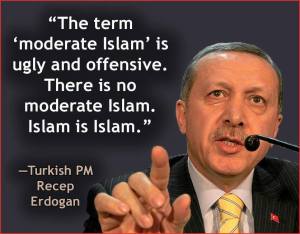
And this is exactly why I am in full agreement with Erdogan: “There is no moderate Islam. Islam is Islam”.
You see, I grew up in communist Romania and in those times we had a saying that went like this: “it’s not the “ism” but the “ist” who causes the trouble!”.

When placed in a certain situation some people act naturally – they drink if they feel thirsty – or they may decide to use whatever opportunity they identify in order to further their goals.
You can study communism in a library or conspire to impose it on people exactly as you can practice Islam in your community or try to impose it by force to all your neighbors.
It’s neither  ‘communism’s nor ‘Islam’s fault, it’s the communists who cannot understand that communism doesn’t work and the hard-line Islamists who fail to understand  that by acting exactly as the Catholic Inquisitors did during the Dark Ages they’ll eventually drive their flock away from their pulpits.

The real problems arise from the arrogance that blinds those “ists”, individuals so ‘concentrated’ on their self-assumed/assigned goals (no matter if they are well intended, like trying to spread – by force – the wealth around and to – administratively – reduce social inequality, or on the contrary – obsessed with becoming filthy rich at the expense of everybody else and/or accumulating dictatorial power over those around them) that they forget/fail to realize that human rationality is inherently limited. And so they fail to understand that ‘the law of unintended consequences’ will eventually bring them back down to where they belong – with a bang!

There are three sets of social circumstances that these kind of ruthless ‘political actors’ perceive as opportunities: inflamed nationalistic feelings, strong religious beliefs, wide spread social malaise due to economic hardships.

For instance the French Revolution (remember, today is Bastille Day) was fueled by the desperation that ‘doused’, at that time, the French people. They were not only hungry but they also felt abandoned/neglected by their rulers. Marie-Antoinette, the French Queen beheaded during the Revolution, was described as being so callous/ignorant of the real life of her subjects that when informed that her people didn’t have enough bread she interjected: ‘Let them eat cake instead!’
Some historians debate whether this really happened, one of their arguments being that the same words have been attributed to many other historical figures that lived before her but the simple fact that the utterance itself was so widely circulated remains and speaks volumes.
A century later Lenin was able to manipulate the same kind of public sentiment and imposed the Soviet rule over the Russian imploded empire while Ataturk, the leader of the Young Turks, fashioned the freshly minted Turkish nationalism into the glue that held together, until recently, the modern – and secular – Turkish state that succeed the ailing Turkish empire by 1925. It is often forgotten but if we really want to understand Turkey we should always remember that until the late XIX-th century it still was a feudal empire and the social costs of such a short/hasty transformation into a modern nation state were tremendous. Unfortunately in the last decade Erdogan has been working hard, with the unwitting help of the Euro-skeptics who reject Turkey’s efforts to join the EU, to replace secular, and relatively moderate, nationalism with religious zealotry as the backbone of the Turkish republic.
Coming back into Central Europe we have the classic example of how Hitler used nationalistic tensions exacerbated by the economic crises deepened by the unwisely imposed war reparations to implement his demented dream of a Reich that was supposed to last for a thousand years.

The same process is happening again, under our own noses. This time all three ‘components’ are present. The economy of the region is in shambles, arguably because of foreign intervention, nationalistic tensions are rife while religious ones are heated way beyond boiling point.
So why wonder that the al-Baghdadi led Isis uses Islam as a pretext to impose a new dictatorship in a region that has no real need for another one?

“Though al-Baghdadi constantly invokes the early history of Islam, the society he envisions has no precedent in history. It’s much more like the impossible state of utopian harmony that western revolutionaries have projected into the future. Some of the thinkers who developed radical Islamist ideas are known to have been influenced by European anarchism and communism, especially by the idea that society can be reshaped by a merciless revolutionary vanguard using systematic violence. The French Jacobins and Lenin’s Bolsheviks, the Khmer Rouge and the Red Guards all used terror as a way of cleansing humanity of what they regarded as moral corruption.

Isis shares more with this modern revolutionary tradition than any ancient form of Islamic rule. Though they’d hate to hear it, these violent jihadists owe the way they organise themselves and their utopian goals to the modern West. And it’s not just ideas and methods that Isis has taken from the West. Western military intervention gave Isis its chance of power.”

Now it’s up to us. Just as our great fathers used the opportunity presented to them at the end of WWII and helped Germany refashion itself, both economically and socially, by including it in the Marshall Plan instead of making it pay for the rebuilding of the war ravaged Europe we should try to help the peoples in the Middle East find their own respective ways instead of impose on them whatever we might think it would be better for them. And I mean real help, not just let/prod them fight each other to exhaustion.
In fact it would serve our interests also.
The Balkans were considered the powder keg of Europe and indeed the tensions accumulated there helped ignite the WWI. After communism imploded those tensions resurfaced precisely because the previous arrangements were imposed, more or less, from ‘above’. Exactly as the map of the Middle East was drawn by Sykes-Picot.
No, I’m not advocating wholesale dismantling of borders, as it happened in ex-Yugoslavia. If they find a way, by themselves, to preserve the present situation we should encourage and help them to do so. But we should never try to impose something on them just because we consider it would serve our (short term at best) interests.

Lebanon might serve as a good example, both to them and to us.

It won’t be simple, every major power has vested interests there, including Russia, but it can, and should, be done. Specially since the the alternative would be horrible.


I ran across this article published by CNS News.

Unusual Answer from Panelist Receives Standing Ovation at Benghazi Coalition Meeting.

It is about a meeting organized by Heritage Foundation to discuss the terrorist attack that took place in in Benghazi  in 2012.
At some point a young ‘Muslim student’ asked “…how can we fight an ideological war with weapons? How can we ever end this war? The jihadist ideology that you talk about – it’s an ideology. How can we ever end this thing if we don’t address it ideologically?”.
One of the panelists answered her that ‘there might be some 75% peaceful Muslims in the world but this is of no consequence: they follow the lead of the extremists, they don’t make their voices heard and, because of that, ‘the peaceful majority are irrelevant’ ‘. The panelist’s answer was received with standing ovations.

I’m afraid those people are making a huge mistake.

For those of you who don’t have time to read the article I’ll summarize the arguments used by Brigitte Gabriel, the panelist:
– The Germans are known as peaceful people yet the Nazis imposed their agenda and provoked horrible massacres.
– The Russians are normally peaceful people yet the Communists among them caused tens of millions of deaths, among their own people, without significant protest from the general population.
– The same happened in China.
– The otherwise peaceful Japanese allowed the militarists to take power and to start a war (the Pacific ‘portion’ of the WWII) in which another 12 million people found their death, “mostly killed by bayonets and shovels.”
– “On September 11th in the United States we had 2.3 million Arab Muslims living in the United States. It took 19 hijackers – 19 radicals – to bring America to its knees, destroy the World Trade Center, attack the Pentagon and kill almost 3000 Americans that day,” Gabriel said. “So for all our power of reason, and for all us talking about moderate and peaceful Muslims, I’m glad you’re here. But where are the others speaking out?” Gabriel asked.
The people in attendance began to applaud.”

First of all we need to differentiate between the two situations presented here.
The Germans, the Japanese and the “19 radicals” committed acts of international aggression while the Russians and the Chinese allowed themselves to be overrun by ‘misguided’ people.
Not at all the same thing.
On the other hand the German and Japanese examples are extremely interesting. A significant number of historians agree that the WWII was produced, at least in part, by the manner in which the defeated Germany was treated after WWI – they were imposed crippling war reparations which burdened Germany during the Great Depression so heavily as to produce the set of social circumstances that allowed Hitler to accede to power. This lesson was well understood so after the WWII Germany was included in the Marshal plan instead of made to pay for it. As a consequence we had, since then, 69 years if uninterrupted peace in Europe.
Japan was a ‘closed society’ until Commodore Perry forcefully ‘opened’ it in 1854, at first for trade and then to other western influences: Centralized state administration, modern army, modern management and technology, etc. And in those times the Japanese were treated, by the ‘white people’, with a ‘healthy dose’ of disdain, just as all the other non-European nations were. After the WWII all this has changed and nowadays the ‘peaceful majority’ of the Japanese have found a way, with a lot of help received from the Americans, to build a democratic society not at all different from what can be currently found in Western Europe and in North America.
Something rather similar happened with the Chinese. After Nixon went there and started to treat them as partners they basically stopped killing each-other.
But, unfortunately, this change of attitude didn’t come about between the West and Russia after the end of the Cold War. For instance we call the Ukrainian rebels  ‘pro-Russian’. Are they of any real service to Russia or to the Russian people? On the contrary… Somehow the old habit of blaming the entire Russian people for actions perpetrated by their leaders survived. Maybe because we can no longer understand the workings of a non-democratic society…since we are so accustomed with censuring our leaders.

So…

My point is that of course we have to defend ourselves from the direct actions of the ‘radicals’ – ‘shoot back’, effectively and efficiently, when ever somebody attacks us. Yet there is something else we dearly need to do, at the same time. Find a way to connect, in a respectful manner, with the ‘peaceful, yet silent, majorities’. They are “irrelevant” only as long as we treat them with the same disdain they are receiving from their own rulers. Even worse, confronted with two different kinds of disdain they’ll naturally prefer the one they are accustomed with – the one displayed by their own rulers – so if we keep packing together radicals with peaceful people and treat them as one the result will be that we’ll have to deal with an ever increasing number of radicalized ex-peaceful individuals. I propose we learn something from our parents, the ones who found a way to change the atmosphere between them and the German and the Japanese people. And since we pretend to be wiser – as all children do – than our parents were, how about doing this without wagging all-out wars? (Unless attacked, off course)

japanese kids earthquake

israeli kids rockets


Japanese kids learn what to do when earthquake strikes while Israeli kids learn how to deal with incoming rockets.
When are we, the grown ups, going to learn?

Quite a large number of us, regular people, are concerned about ‘survival’. From what to do in order to feed our children to how to protect wealth from being eroded by the inflation.
Some others, more ‘extreme’ or more sensitive, are actively preparing for what is known, by them, as ‘the imminent ending of the world’. There is no consensus on what will bring about this catastrophe – from the odd meteorite falling on Earth before the appropriate measures being taken to the unsustainable way we manage our economy or the environment but this is no deterrent for the hardcore survivalists.
In a way, they are right. After all it doesn’t matter how it happens, the main thing is to be prepared.
And this is exactly were the ‘fun’ part starts.
Most of them concern themselves with learning how to survive out in the open, how to build and stock an ‘anti-atomic’ bunker, how to use firearms, etc., etc… In fact what they do is recreate the medieval ‘castle’ mentality where the world was disputed by strong armed thugs who tried to control as many resources as possible. In time, tired by the slow burning conflict that occasionally burst into open fighting, they ‘invented’ the rules of ‘chivalry’, a framework that provided both a venue for their need to ‘prove themselves into ‘battle’ (the jousting tournaments) and enough social predictability which enabled relative stable economic relations between human ‘settlements’ that were ruled by different land lords.
From that moment on survivability was no longer improved by simply erecting higher and thicker walls but rather by maintaining a workable equilibrium between the members of a certain community – be it group of people, ‘commonwealth of villages’ or federation of states.

Fast forward to the XX-th century and we find out that the survival problem hasn’t been fixed yet. Andre Malraux, a Frenchman who started as a communist writer and ended up as an anti-totalitarian philosopher once wrote that “le vingt-et-unieme siecle sera religieux ou ne sera pas”. A rough translation would be ‘in the XXI-th century people will rediscover religion or they will perish’. Coming from a professed agnostic this continues to create huge controversy as to its real meaning.

A solution to both the riddle and the survival problem might not be so hard to find.

Lets turn to the utmost survival specialists, the Jews. For the first 15 centuries or so they survived living in ‘history’s turn-still’ – Palestine – while for the next 20 they made do even without the benefit of having a place to call their own.
How did they do it?
By fighting each other? No, on the contrary.
By fighting against the people they were living amongst? They would have been wiped out long ago. Even when they were used as escape-goats by reckless and callous temporal rulers the Jews somehow found a way to survive, mainly because enough members of the general population remembered the normalcy of the situation before the pogroms were instigated, normalcy during which the Jews were adept at conserving their traditions yet playing their role as useful members of the wider community.

And, maybe, this is also the key of Malraux’s riddle. Religion is more than following ritual, considerable more than that.
The word itself comes from the Latin ‘reliegare’, ‘connecting to’. It can mean both the connections that appear between members of the same community but also the connections that appear between the community itself and its environment. So it doesn’t really matter if religious teachings are said to have been handed down from a God or are considered to be a distillation of long accumulated tradition. All it matters is ‘have those teachings proven useful?’ Were they helpful enough to their followers so they could cope with whatever history has thrown at them?

Well… in the case of Judaism they did that, for more than three and a half millennia. And nowhere in those teachings one can find ‘if things get rough leave everybody behind and hide someplace waiting for the worst to pass’. Every religion, be it based on a God or not – Buddhism, for instance does not have a godlike figure in its center – teaches its followers that it is a lot easier to survive helping the others than fighting against all others.

Honing individual survival skill is of course important. But we should not forget that crises come and go. What we really need is to learn how to survive the long stretches of apparent stability, during which we allow the build up of immense tensions that end up by tearing apart our livelihood. As it is about to happen.

Initially politics was an activity. “Was” and not “were” because it was something in which every concerned citizen played an part, a collective effort. Oh, I forgot to tell you that this happened in Ancient Greece during what we now call the ‘first stage of democracy’.

Then, after a little less than two millennia, it became an occupation. People who had successful careers behind them were deemed trustworthy by the rest of the community and elected into government positions. The countries which used this ‘democratic mechanism’ thrived: the US, Britain, France, …to name just a few of them.

Lately politics have become a profession. People study it in Universities and engage in it without any prior experience outside the field. I believe you all know what ‘community organizer‘ means, right?

No, I’m not going to discuss this notion right now. The results can be both good or bad, exactly as it happens with almost all human professions: both Mengele and Albert Schweitzer were MDs…

For now I’ll refrain myself to observing that people have less and less tolerance for digression on the part of the politicians.

“Nicholas Sarkozy arrested over corruption allegations”

Gerhard Schroeder, lionized in his time for cutting down to size the German welfare state is now widely criticized for his involvement with GAZPROM.

Silvio Berlusconi is serving time, disguised as ‘community service’, for tax evasion.

Need I go on?

And this is happening in what we call ‘democratic countries’. In other places former rulers are stabbed to death  or brought to justice in a cage.

In fact we have indeed progressed, as a species. The last time the French got really pissed off by their leaders quite a few people lost their heads…

The most disturbing thing in all this is that the politicians were supposed to be the ones capable/willing of doing ‘the good thing’ AND professional enough as not to exaggerate in anything they do….

Is there anything to be done about all this?

How about upping the ante?

I keep hearing ‘we need a strong leader’ or ‘we need more true leaders’. Are we really sure about that? Leaders would do almost anything to take us where THEY see fit.
How about politicians acting as ‘administrators’?
Right now politics is played, in a lot of places, as a beauty pageant. Would be rulers (leaders) come up-stage to make promises and we choose the ‘best-looking’ charmer. After a while he unfailingly fails so we ‘boo’ him out of office.
Switzerland, for instance, has another way of doing things. They talk a lot more among themselves, many ideas are put forward and then some of them get to become policies and other get dumped.
When have you last heard about a Swiss political leader or about a Swiss political scandal?

rocking the boat

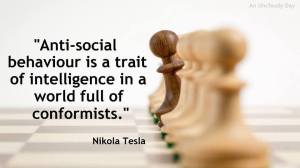
Tesla was a great physicist and a very intelligent man but his wording was rather lousy.

I get the gist of what he wanted to say and I basically agree with him but I don’t think “anti-social behaviour” aptly describes what he had in mind.

The real meaning of ‘anti-social’ is ‘acting against the interests of the group of which the perpetrator is a member”: from stealing to high treason.
What I understand of Tesla’s words are gestures made against ingrained habits which induce social stiffness – social rigidity that inhibits innovation and adaptation.
And in fact all these gestures are pro-social, they are good for the society at large and not at all bad or anti-social.

It is true that today ‘anti-social behaviour’ has been ‘stretched’ to include all actions that disturb ‘social norms, socially sanctioned customs and widely held beliefs’ but this would be true only as long as these ‘habits’ were still useful to the society we are speaking about.

I don’t think Tesla would have condoned theft or any other criminal activity, no matter how anti-social, but he would have applauded, had those things happened during his life, what Copernicus, Giordano Bruno and Darwin had done. Or Martin Luther King.


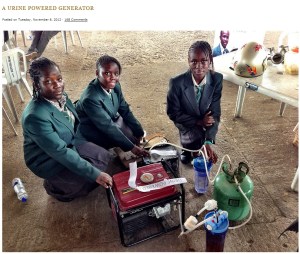
urine powered generator

So what do we have here?

Four crafty teenage Nigerian girls have put together an ingenuous rig for a ‘science and technology’ fair.

“The system works like this:

Along the whole way there are one-way valves for security, but let’s be honest that this is something of an explosive device…”

A well meaning ‘eager beaver’ journalist wanting to help promote their exploit  has branded the whole contraption as an ‘urine powered generator’.

An then the hell broke loose:

It is all over the Internet and news, three Nigerian school girls have invented a urine-powered generator that can produce electricity for 6 hours from a single litre of urine!

Really? Sadly, no.

I can’t find an original source for this story, where did it come from? [was it here?] Are there really some Nigerian school girls with a urine-powered generator or is this just a hoax? Either way, all those journalists that repeated the story really should be ashamed of themselves, it is so obviously wrong and/or untrue.”


I’m not in the business of apportioning blame all over the internet but after finding out about this succession of events I started to have serious doubts about who is wrong and who should be ashamed of themselves….

I’m sure that most of you have already understood where I’m headed to but please bear with me.

So OK, the ‘eager beaver’ has indeed stretched the reality a little bit. It’s not an ‘urine powered generator’ but an ingenuous ‘science project’ presented by some teen age students.
So what was it that brought the wrath of the ‘eco-scammer’ on those ‘poor’ girls? Or even on the writer of the original article…
Who, and where, claimed that the contraption produced more energy than it consumed? Yes, those arguments involving thermodynamics and all that scientific mambo-jumbo that he is mentioning inside his article are absolutely correct (“trust me, I’m an engineer”, a real one that is) but perfectly misplaced.
As is the original title but while that title is an innocent exaggeration the second article is a malicious  (or myopic?) and undeserved rebuttal.

Getting back to what had started all this, that ‘thing’ is not a ‘generator’ but can be used as an accumulator!
Solar panels produce energy when the sun is up but people need light at night, obviously.
Even more importantly, solar panels produce a type of current (DC) which can be used to ‘split’ water into hydrogen and oxygen and to light a special kind of bulb but for little else. If you want to power a ‘modern appliance’, a refrigerator for instance, you need an inverter – a pricy device that transforms DC into AC.
On the other hand the type of gas powered generator used by those crafty students is relatively cheap and common enough almost everywhere in the world. Adapting it to run on hydrogen is easy, this feat was not even mentioned in the original article.

So the real meaning of what those 4 girls did is that they came up with a way to replace a costly scheme comprising a lot of batteries and an inverter with a gas bottle, an already largely available gas powered generator, an electrolytic cell and two filters.

Not a small feat, by any means!
If you take some time to think about it, of course.

And yes, there are four girls that did this, not three like the ‘eco-scammer’, who probably didn’t even bother to read the original article, wrote insouciantly after merely taking a glance at the photo that came with the inappropriately titled  news.

The original story can be read here: http://makerfaireafrica.com/2012/11/06/a-urine-powered-generator/
and the ‘eco-scammer’ rebuttal here: http://www.eco-scams.com/archives/790


no piggy back

For some 30 years now the western press is periodically awash with news about the impending doom that is going to engulf China. If not now then soon, very soon.

While I’m not particular fond of the Chinese communists – every political force that enjoys monopolistic control over the space where it resides eventually becomes too rigid and looses ability to cope with the day to day challenges – I must give them what is theirs.

By drawing from the rich experience of the Imperial China the current rulers have learned something. Don’t push it unnecessarily hard, don’t appear to be callous when there is no need for such thing. Not because it would be immoral or anything like that but because it is ‘a mistake’ to do such a thing.

In most countries if something like that would have happened it would have meant that the ordinary people were getting fed with the callousness of the government officials and that generalized riots will follow. Like what happened in Tunisia at the start of the Arab spring.
In  China when ever something like this grabs the attention of the public eye the ‘Party’ springs into action and promptly punishes the perpetrator instead of trying to shield him/cover up for him. This way the ‘Party’ preserves it role in the society and makes sure it remains relevant.

So please put those doom scenarios on hold, at least for as long as things like that will continue to be severely sanctioned by the ubiquitous ‘Party’.

Click here http://www.dailymail.co.uk/news/article-2666147/No-free-rides-Chinese-government-worker-sacked-picture-emerges-riding-employees-flood-avoid-getting-wet.html if you want to read the whole story and thanks Veooz http://www.veooz.com/news/WHHU7ev.html for the picture

There is a intense debate going on in some circles about this subject.
Some think that vaccines are poisonous because some of them contain traces of mercury.
Some others believe that autism can appear, at least in part, as a reaction to certain vaccines.

No real proof has ever been presented for any of those assertions yet the storm is raging on.

Here is my take on this.

Basically we have two kinds of infectious diseases that can be prevented through vaccination.
Some that have high mortality rates or survivors are left with permanent damages: small pox, polio and rabies come to my mind right now.
Others that are milder or just a nuisance, for most people at least. Measles, mumps, chickenpox… Of course, there are people who develop serious consequences from having one of these, for instance mumps can be a real problem if had at an older age and chickenpox is really dangerous for pregnant women, but on the whole this second category is less dangerous than the first.
Now what I would really like to know is would anyone seriously consider not vaccinating their children for the first category of diseases IF MOST OF THE GENERAL POPULATION HADN’T ALREADY BEEN VACCINATED?

I know that there are some religious extremists who try to disrupt immunization against polio in their countries. This only fuels my dilemma: what does it really mean to be a rational human being?