Archives for category: The kind of world we live in

Does he have any ‘right to exert his authority, inside the limits that have been delineated for him’?

Somebody who has real authority enjoys a certain degree of autonomy, if not outright independence. ‘Authority’ is almost never clearly delineated, there is always a gray area where the discretion of the individual in charge is the one that calls the shots.
More over if we, the ‘subjects’, consider that he has ‘the right’ to exercise that authority then it’s us who are in deep trouble.
‘Exertion of authority’ ‘smacks’ of the situation  when the ‘authority man’ had conquered his position against the wish of his subjects – like the emperors of the old. (Or like the communist dictators of not so long ago, only they pretended to exercise their authority for the benefit of the people while the emperors of the old were more straightforward and declared themselves ‘gods’)
Nowadays, at least in the democratic states, authority is, theoretically, used as a tool, towards the accomplishment of what the person in charge is supposed to achieve, not as a right enjoyed by that person.
In fact the notion of a right to exert authority inside some limits is akin to what has been described as ‘feudalism’, a social arrangement not that different from the Athenian democracy. The people were divided in two categories, just as in the previous situation – the ‘imperiums’ of the Antiquity, the difference being that in an imperium the top class was inhabited by a single individual – the emperor/dictator, while in feudalism/Athenian democracy the top class was inhabited by the free people, whose authority/freedom extended only as far as it started to encroach the authority of the equivalent individuals. I have to remark here that in many circumstances feudalism has very quickly degenerated back to imperium – for instance in absolutist France, ‘L’etat c’est moi’, or in tsarist Russia, while England successfully avoided that due to the spirit enshrined in Magna Charta.
The difference between feudalism/Athenian democracy and the modern democracy being that currently we can no longer speak of individual authority simply because nowadays no one has the “right” to own slaves – as the Athenian ‘democrats’ had, nor even enjoy extensive authority (bar the right of life and death) over other people – the serfs, as the feudal barons did not so long ago.

A fact is just that, a mere fact.
An acknowledged fact asks for an interpretation, otherwise the human mind finds it hard to accept its very existence.

An interpretation that seems to make sense becomes an understanding and regardless of that understanding being right or wrong it generates a belief.
Until that understanding is proven wrong and even then… eventually a new understanding is generated and, in its turn, it leads to a new belief.

That’s why we should indeed reserve the right Patton Oswalt speaks about and then use it sparingly, only when other believers tries to forcefully impose their beliefs on us.

In fact Oswalt is right. We don’t have to respect other people’s beliefs, only their right to have their own beliefs.

So what’s new…

Not so fast. There is more to it than the classic complaints – that high taxes discourage the working people while government hand-outs, made possible by those taxes, encourage the lazy to stay home.
If taxes are collected evenly – from all those that should pay them – and distributed sparingly – only to those who really need those hand-outs – nobody feels cheated so no disincentive is felt.

There is a more malignant phenomenon at work here. If taxes are really high – as a percentage – then being able to not pay them becomes a huge competitive advantage.

Not paying becomes attractive only after you are due a certain amount of money – you have to hire a tax consultant, pay some fees and commissions, etc. – but once you belong in that league not paying becomes a huge advantage over your competition. For instance over your competitors that are smaller and who won’t gain as much, or anything at all, by doing the same thing as you do.

And this is why the market becomes so polarized, why some of the really big brass do not push, in earnest, towards fiscal discipline and how the middle class gets squeezed out.

Three questioned bothered me while watching this:
– What drove that crow to behave like this? Who was bored to death, the crow itself or the small devil that seemed to poses it?
– Why is it that so many of us think this is funny? (I couldn’t stop laughing myself!)
– When is it that a photographer should stop shooting images that might interest (or not) some future viewers and help those who were, involuntarily, ‘modeling’ for him?

Yeah, I know, it would have been rather strange to see a man defending a dog against a crow… and sometimes it is impossible to help everybody, specially during a war or a major crises… but…

Maybe we, the watchers, share some of the responsibility for what’s going on during our lifetime.

Bill Gates Alex Wong Getty Images

Bill Gates disapproves of Thomas Piketty’s method of leveling the play-field – levying a capital tax – and proposes a different tack: a progressive tax on consumption.

While I agree with both Gates and Piketty that extreme economic imbalances are bad for the society I profoundly disagree with both about how we should deal with them.
First things first. Extreme economic imbalances being bad has nothing to do with morals and very little to the fact that the poor feel bad when exposed to the excesses of the ‘filthy rich’.
They are bad simply because the dirt poor cannot express their creative potential and because the rich end up concentrating too much of the decision power. The society as a whole – including the super rich – looses, specially on the long run.
Taking the decision power from the hands of the super rich and giving it to the governments, through increased taxation, would only complicate matters. Not to mention the byzantine mechanism needed to enforce Bill Gates’ consumption tax.
Encouraging the rich to donate more would somewhat alleviate the problem but not much since until the money were distributed, if ever, the decision power would still remain too concentrated for our own collective good.
How about those same very rich people, now that enough of them have understood the perils associated with extreme economic imbalances, simply setting an example and start calculating wages using a completely different principle than is used today?
What if instead of ‘as low as the market allows’ they would ‘compensate’ their employees, all of them, as generously as their businesses can reasonably afford to? Somewhat in line with what Ford did back at the start of the XX-Th century, with more than excellent results for both sides? And does again now!

And how about the same rich and powerful individuals using their ‘political muscle’ and insisting on better governance? After all if their businesses and trust funds would have been run as most governments are run today they would have gone under a very long time ago…
And then, after the governments would have been ‘fixed’, and tax money not wasted anymore, how about the very same 1% start paying in earnest their ‘normal’ taxes, like the rest of us?

Surprise, surprise…

The real dangers of extreme economic imbalances: https://nicichiarasa.wordpress.com/2014/10/29/extreme-fragility-dead-ahead/
Why Ford increased wages back then: http://www.forbes.com/sites/timworstall/2012/03/04/the-story-of-henry-fords-5-a-day-wages-its-not-what-you-think/
Ford increases wages now: http://www.wsj.com/articles/ford-to-move-hundreds-of-entry-level-workers-to-higher-pay-rate-1423026005

Ever wondered why sometimes diamonds are called ‘rocks’?
Well, tell me you’d let your wife carry one of this size on her hand…

‘On the other hand’… playing with it for a while might prove to be a completely different experience!

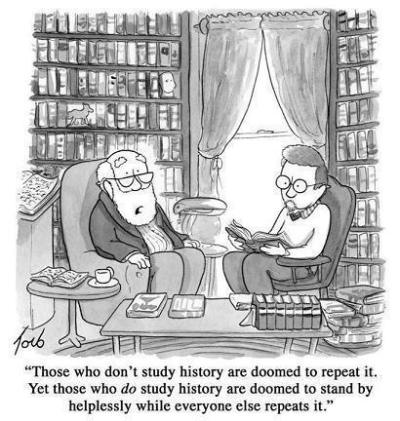
This image constantly pops up all over Facebook.

And while the caption does harbor some truth it somehow completely misses the point.

So:

– Those who don’t study the history have all the chances to repeat it but only if they are just as callous as their ancestors.

– Those who do study the history and stand by helplessly while everyone else repeats it have studied it in vain. They still haven’t got a clue about what really happened outside those books they’ve been reading. Had they learned a real understanding of what went on they would have been able, and willing, to explain it to their contemporaries and thus help them move forward, to a totally different set of mistakes waiting to be made.
Just as Plato (and Marx after him) thought of having found the absolute truth and did his best to lead his people to it …

But don’t despair. There is a safer way. To let things take their own course, to develop naturally. Just as Lao-Tzu taught us.

http://izquotes.com/quotes-pictures/quote-the-wicked-leader-is-he-who-the-people-despise-the-good-leader-is-he-who-the-people-revere-the-lao-tzu-188515.jpg

Karl Marx and Max Weber, two different pupils of Plato:

https://nicichiarasa.wordpress.com/2015/02/28/karl-marx-and-max-weber-two-different-pupils-of-plato/

What on Earth is ‘itall’ and why would anyone bother about it?

Let me re-frame that.
Why on Earth are we so obsessed with winning in the first place?
It’s indeed nice to win from time to time but aren’t we overdoing it? Regardless of costs?

“Suppose that you are charged with selling a single food item to at least a hundred million people in a highly diverse society.  You can pick whatever item you wish, but you can pick only one.  If you fall short of getting at least 100,000,000 people to voluntarily choose your item over a rival item that will be offered by a competitor, you lose.  (Your competitor is playing by the same rules that you are playing by.)

Being highly competitive, you hate losing.  So you carefully go about selecting which item to choose.”

Already been there? You must surely understand where I’m driving at. Even if you are not ‘that competitive’ yourself you must’ve been wondering why hamburgers taste the same almost all over the world, and not only those mass produced by McDonald’s.

You see, there are two sides of the winning game. No, not those two obvious ones – the two players.
There are the players and the spectators. None could exist without the others but only the players, and the trainers, are aware of this.
Yet the very existence of the game and the manner in which it is played heavily influences the life of the people belonging to both categories.

As Don Boudreaux explains us in “Insipidness Guaranteed” our very fondness of winning big leads to the market being inundated by the very blandest – but generally acceptable – of products. Originality becomes stifled, contrary to the very fact that, from time to time, it’s exactly the original thing that gets the jackpot.

Three things concur to this.

I already mentioned the first.
Most players, or at least those at the top, know what’s going on while most of the (paying) spectators don’t. This leads to the spectators watching mesmerized what’s happening in the pitch while the players ratchet up the tension till it becomes unbearable least the spectators become bored and leave. So the spectators spend their time, and resources, watching instead of creatively using their brains to build something new – and potentially useful.

Our culturally enhanced obsession for winning.
Those players insist because they are plainly ‘hooked’. ‘Adrenaline is one of the most powerful drugs‘. This is true, if you don’t believe me check it on Snopes.com. The problem with this particular addiction is that adrenaline is produced naturally in our body when we compete and that the winning moment is ‘scored’ in the brain by a powerful shot of dopamine, another hugely addictive natural drug.
On top of winning being highly pleasurable, and addictive, it is also positively sanctioned by the society. Drunkenness and being high on drugs are shunned by a considerable number of people while winning is applauded by all.

It also helps.
Yes, winning helps a lot. Otherwise ‘the quest for winning’ would have withered away a long ago by the very same mechanism that encouraged the advent of the moderate altruistic behavior – natural evolution.
No, this is not about ‘the survival of the fittest’ – that’s a mirepresentation of Darwin’s words, set straight by Ernst Mayr in ‘What Evolution Is: ‘It’s not about the survival of the fittest but about the demise of those who cannot cope’.
So, competition is good in the sense that it’s telling the loosers ‘stop trying this and look for another venture if you want to thrive/survive’. The real winners are exactly those who understand something when they loose.

Just as we need to balance altruism with the need to preserve our own personae, both physically and psychologically, by constantly adjusting that balance according to the prevailing circumstances, we also need to understand where our obsession for winning has brought us.

When all we want is to win, we tend to forget that survival is, most of the times for individuals and at all times for the communities, more important than winning.
Darwin had titled his most important work ‘On the origin of species by means of natural selection‘ and had amply demonstrated there that ‘natural selection’ (= competition) is just a means toward the ultimate survival. Evolution, that is.
That’s why we are hard wired to compete among ourselves – so those more adapted to a certain environment might continue doing what they are good at while the others are ‘encouraged’ to look for something else to do. But natural selection never works on the premises that ‘the winner takes it all’: very seldom competitors that belong to the same species kill each other.

Ernst Mayr demonstrates in the book I already mentioned that overspecialization is bad for you. ‘Survival of the fittest’ is stupid precisely because of that. ‘Being the fittest’ – and doing it for any considerable amount of time – means gradually becoming unable to cope with the slightest change that might occur in your environment.
That’s why natural selection includes a mechanism through which small alterations appear haphazardly in our DNA – those who are benign enough survive and provide the individuals that carry them with additional capabilities, so that they might take advantage of slightly different conditions than those where their ancestors have evolved.

We, the humans, have raised this to a new level. By becoming self-conscious – ‘aware of our own awareness’ in Humberto Maturana’s terms – we have developed a certain individual originality – and the need not only to manifest it but also to convince those around us that our ideas are better than theirs. Sometimes by any means at our disposal.
If you don’t believe me read again Plato’s Republic: “Then, I said, the business of us who are the founders of the State will be to compel the best minds to attain that knowledge which we have already shown to be the greatest of all-they must continue to ascend until they arrive at the good; but when they have ascended and seen enough we must not allow them to do as they do now.”

Maybe it is high time for us to understand that a 2500 years old fallacy is still a fallacy. Plato marked the pinnacle of the Greek civilization, not it’s start. After he published his works, and Pericles had finished building his architectural wonders, Athens went slowly downwards and gradually lost it’s significance. Telling people what to think is the sure fire recipe for disaster. Ask the Soviets if you think what happened to the disciples of Plato isn’t convincing enough.

Coming back to where we started, winning, I have to remind you that a fundamentally aggressive attitude leads to the complete disappearance of respect. The aggressor becomes so engrossed in what he does that not only ceases to respect those around him – “He who is not for us is against us” was how Lenin used to see the world – but also looses sight of what he does to himself and to where he is leading his followers.

At the end of the article that spurred me into writing this, Dan Boudreaux, the author, bitterly ejaculates: “No one should be surprised that candidates for the U.S. presidency transact mostly in platitudes and are forever performing deeds on the campaign trail that any self-respecting person with independent judgment and a genuine sense and appreciation of his or her uniqueness would never in a million years dream of doing.  And the closer a candidate gets to the political promised land, the more intense becomes the pressure for him or her to be the political equivalent of a Bud Lite.”

Why, I ask all of you, would they – or any other of the putatively democratic candidates – do any different if we, the voters, continue to behave as hapless spectators and choose to watch as they fight for power instead of reminding them that they are being interviewed for a job, not wrestling for the privilege to take home the prom-queen?

And if they don’t get it – cause they’re too busy flaunting their feathers, we don’t get it – cause we’ve been hypnotized by those very same feathers as they are, how come the trainers – those close advisers who handle the players at every occasion – don’t get it that the whole bandwagon has started to go astray?!?

Real democracy means that the would be leaders put on the table the important issues, discuss them honestly till the voters develop a real understanding of what is going on and then some of them get elected by a knowledgeable community to implement a set of policies.

Where do you see this happening in our days?

http://cafehayek.com/2015/04/insipidness-guaranteed.html
http://www.everythingaddiction.com/science-of-addiction/addiction-news/adrenaline-the-strongly-addictive-drug-with-serious-life-consequences/http://thebrainbank.scienceblog.com/2013/11/26/gamblers-mind-the-thrill-of-almost-winning/
https://nicichiarasa.wordpress.com/2014/10/23/altruism/
http://www.amazon.com/What-Evolution-Science-Masters-Series/dp/0465044263
http://books.google.ro/books/about/On_the_Origin_of_Species.html?id=sX_hAwAAQBAJ&redir_esc=y
Animal Talk: Breaking the Codes of Animal Language: https://books.google.ro/books?id=r49kIaUMrC0C&pg=PA25&lpg=PA25&dq=bluffing+instead+of+fighting+natural+selection&source=bl&ots=lI9Po_MjLw&sig=6a-7QhZLVGsZlTpEXU3YK85fm_0&hl=en&sa=X&ei=qlEzVa2KLIKzPNTqgYgO&ved=0CEYQ6AEwCA#v=onepage&q=bluffing%20instead%20of%20fighting%20natural%20selection&f=false
http://www.univie.ac.at/constructivism/pub/hvf/papers/maturana05selfconsciousness.htmlhttps://books.google.ro/books?id=xxGttzFXqaYC&pg=PA130&lpg=PA130&dq=lenin+who+is+not+with+is+against+us&source=bl&ots=t1mdQsdmGh&sig=kbxcK2ctK2Q_fw79k0nJN8yBQNs&hl=en&sa=X&ei=6V0zVd9GptXIA7uRgcAD&ved=0CEQQ6AEwBg#v=onepage&q=lenin%20who%20is%20not%20with%20is%20against%20us&f=false

At 45 I went back to school. Already a MSc in Mechanical Engineering this time my eyes were set on a BA in Sociology.

During my senior years I had my epiphany: that being able to pass information from generation to generation both considerably sped up human evolution, as a species, and opened wider expanses for us to conquer.
Big deal, I hear some of you muttering. Everybody knows that we became what we are only after we developed articulate speech and, specially, after we learned to write.

Well, you are right. Only time has come for us to learn to read!

Herbert Simon was presented a Nobel prize in 1977 for his ideas about how an abundance of information might prove to be, if inappropriately managed, a handicap instead of a bonus. “What information consumes is rather obvious: it consumes the attention of its recipients. Hence a wealth of information creates a poverty of attention, and a need to allocate that attention efficiently among the overabundance of information sources that might consume it.” That’s why we should learn how to sift through the available information if we are to avoid reenacting mistakes that have already been committed by our forefathers and abundantly documented for future referral.

Nowadays the world’s attention is highly strung by what is happening in the Middle East, the last development being Putin’s announcement that he is satisfied with the new openness displayed by the Iranians so he intends to fulfill a longstanding order from Teheran for sophisticated air defense missiles.
Trading with Iran is part of how the Iranian people can be encouraged to overcome the current impasse in their development as a nation.
Using every possible opportunity to advance on the international arena – and to ‘hurt’ those whom you have designated as your adversaries – by stirring already murky waters and then callously walking on corpses might prove to be counterproductive in the long run, to use the mildest words possible.

To illustrate my point I’m going to propose to you a list of articles describing some examples of ‘foreign intervention’ in the Middle East:

Sykes-Picot deal in the aftermath of WWI: The true story of Lawrence of Arabia

“Lawrence sought allies wherever he could find them. Surely the most remarkable was Chaim Weizmann, head of the English Zionist Federation. In January 1919, on the eve of the peace conference, Lawrence had engineered an agreement between Faisal and Weizmann. In return for Zionist support of a Faisal-led Syria, Faisal would support increased Jewish emigration into Palestine, tacitly recognizing a future Jewish state in the region. The pact was soon scuttled by the French.

But the most poignant what-might-have-been involved the Americans. Suspicious of the imperialist schemes of his European partners in Paris, President Woodrow Wilson sent a fact-finding commission to the Middle East. For three months, the King-Crane Commission toured Syria, Lebanon and Palestine, and what they heard was unequivocal: The vast majority of every ethnic and religious group wanted independence or, barring that, American administration. Wilson, however, had far more interest in telling other nations how they should behave than in adding to American responsibilities. When the commission returned to Paris with its inconvenient finding, the report was simply locked away in a vault.

Lawrence’s efforts produced a cruel irony. At the same time that he was becoming a matinee idol in Britain, courtesy of a fanciful lecture show of his exploits delivered by American journalist Lowell Thomas, he was increasingly regarded by senior British officials as the enemy within, the malcontent who stood in the way of victorious Britain and France dividing the spoils of war. In the end, the obstreperous lieutenant colonel was effectively barred from the peace conference and prevented any further contact with Faisal. That accomplished, the path to imperial concord—and betrayal—was clear.

The repercussions were swift in coming. Within the year, most all of the Middle East was aflame as the Arab world, enraged at seeing their Ottoman masters replaced by European ones, rebelled. Lawrence was particularly prescient about Iraq. In 1919, he had predicted full-scale revolt against British rule there by March 1920—“If we don’t mend our ways.” The result of the uprising in May 1920 was some 10,000 dead, including 1,000 British soldiers and administrators.”

Iran, the Mossadegh affair: In 1953 President Eisenhower prevaricated a lot before OK-ing the coup against Mossadegh because he “was afraid of destabilizing Iran and the region, which in his estimation, would inevitably lead to a communist takeover.” (Six Myths about the Coup against Iran’s Mossadegh)
He was right, only Iran hadn’t been taken over by communists but by Islamic fundamentalists yet I cannot stop wondering if Eisenhower, and those who urged him to proceed, were aware of what had happened 30 years before in ‘Arabia’.

In 1979, almost another 30 years later, the Soviets invaded Afghanistan. I don’t think this move had directly caused the fall of the Soviet Empire, but it certainly helped. The Soviet War in Afghanistan, 1879 – 1989As you all know the whole affair is still a festering wound.

In 1980 another war provided a scene where bad decisions could have been made. And were readily made: (Iran-Iraq War (1980-7988))
“Gradual Superpower Involvement (as if they weren’t already involved in that region, up to the hilt)
Iranian military gains inside Iraq after 1984 were a major reason for increased superpower involvement in the war. In February 1986, Iranian units captured the port of Al Faw, which had oil facilities and was one of Iraq’s major oil-exporting ports before the war.In early 1987, both superpowers indicated their interest in the security of the region. Soviet deputy foreign minister Vladimir Petrovsky made a Middle East tour expressing his country’s concern over the effects of the Iran-Iraq War. In May 1987, United States assistant secretary of state Richard Murphy also toured the Gulf emphasizing to friendly Arab states the United States commitment in the region, a commitment which had become suspect as a result of Washington’s transfer of arms to the Iranians, officially as an incentive for them to assist in freeing American hostages held in Lebanon. In another diplomatic effort, both superpowers supported the UN Security Council resolutions seeking an end to the war.

The war appeared to be entering a new phase in which the superpowers were becoming more involved. For instance, the Soviet Union, which had ended military supplies to both Iran and Iraq in 1980, resumed large-scale arms shipments to Iraq in 1982 after Iran banned the Tudeh and tried and executed most of its leaders. Subsequently, despite its professed neutrality, the Soviet Union became the major supplier of sophisticated arms to Iraq. In 1985 the United States began clandestine direct and indirect negotiations with Iranian officials that resulted in several arms shipments to Iran.

By late spring of 1987, the superpowers became more directly involved because they feared that the fall of Basra might lead to a pro-Iranian Islamic republic in largely Shia-populated southern Iraq. They were also concerned about the intensified tanker war.”

After the table was thus set there is ‘small wonder’ about what happened next: Iraq invaded Kuwait, the first Gulf War, 9/11, the second Gulf War, the intervention against the Taliban, what’s going on in the Horn of Africa…

Here is what Abdi Ismail Sanatar, a Somali, Professor of Geography at the University of Minnesota, was writing in the wake of the Nairobi Massacre 2013 (The Nairobi Massacre and the genealogy of the tragedy):”Given this, what must then be done to turn this tragedy into a victory for Somalis and Kenyans?
First, all of us must tend to the injured and those families who lost their loved ones.
Second, since al-Shabab’s main operations base is in Somalia, and since it has inflicted the greatest damage to ordinary Somalis, the international community should understand that the terror group must be defeated in that country. To do so, the EU and the US who support AMISOM must appreciate that only a professional and well-resourced Somali security force will drive al-Shabab into the sea. Consequently, they can divert half of AMISOM’s budget to this endeavor.
Third, Kenyan President Kenyatta and his government must heed legitimate Somali grievances against the occupation and urgently work with the Somali government and withdraw its troops from southern Somalia. Finally, the Somali government and particularly its top leadership should wake up to the fact that they have failed to inspire the Somali people and move them into massive civic mobilisation that will be the most effective defense against al-Shabab.
Such an engagement of the citizens will also be a fantastic boon for the Somalia’s reconstruction. If the international community and leadership in the region go back to business as usual then the victims of al-Shabab’s terror will endure a second death.”
Now, in 2015, his words have become tragically prophetic. “The victims of al-Shabab’s terror” were indeed murdered a second time, at Garissa University in Kenya.

And how does William Ruto, Kenya’s deputy president, plan to solve the situation? Simple (World’s largest refugee camp scapegoated in wake of Garissa attack):
“He told the High Commissioner for Refugees (UNHCR) to shut down Dadaab refugee camp near the border with Somalia within three months, or else Kenya would shut it down itself.
Officials have claimed that Dadaab is where al-Shabaab plans its acts of terror, such as Garissa and the 2013 Westgate Mall attack, and must be shut down.

“We have asked the UNHCR to relocate the refugees in three months, failure to which we shall relocate them ourselves,” said Ruto. “The way America changed after 9/11 is the way Kenya will change after Garissa… We must secure this country at whatever cost.”

Fighting talk, but talk was as far as it got. The UN has so far simply ignored the public demands for Dadaab’s closure, only commenting to praise Kenya’s commitment to refugees.
The UN has yet to receive any official communication on the subject. Although Kenya is eager to prove itself in the fight against terrorism while the country is still mourning the the victims of the attack, the government also needs to find someone to blame, other than its own poor national security system.
For now, Dadaab’s refugee population – voiceless in Kenyan society, and unable to defend itself – makes for 350,000 convenient scapegoats.”

I almost feel that some of you will oblige and remind me that hindsight is always 20/20 and that none of those who made the decisions that have led to those horrific outcomes could have known what was going to happen. Or that they even cared I might add.

True enough. Nassim Nicholas Taleb has a vey interesting idea on this subject. ‘Skin in the game‘ he calls it. His tenet being ‘if those who make the decisions do not directly experience the outcomes then the decision making process will be less diligent than if their own skin were in the game’.

The sad reality is that those who tend to use the ‘the full outcome could not have been predicted’ argument prove more than Taleb’s words. They are living proof to the fact that he who doesn’t read about it is doomed to repeat it.

Fortunately now there is a easier way out. The lazy ones can watch the movie if there’s too much for them to actually read Goethe’s The Sorcerer’s Apprentice.