Archives for category: Psychology

It seems that people have finally started to understand what rape really means and to care about the victims.

But why rape in the first place?

When considering this subject we need to clearly define the concepts if we really what to understand what all it’s about.
Sometimes people get carried away. Maybe under some ‘influence’, she (half) willingly agrees at first and gets cold feet at some point but he doesn’t stop. That is indeed rape and should be punished as such but that is not the kind of rape I’m concerned about now.
What I had in mind when starting this is the ‘predatory’ rape. That kind of rape that is planned before hand by the perpetrator and cannot, under any circumstances, be treated with any degree of understanding. For instance gang or serial rape.

At this moment I feel the need to draw your attention to some less obvious kinds of predatory rape. For example the kind of ‘big game hunting’ that is going on now in Africa. Regardless of who does it. Law abiding citizens who pay for their permits and then bend the rules or poachers who act in a completely callous manner.

Another kind of predatory rape that is less discussed about is prostitution. Some of you will tell me that whatever takes place between consenting adults (two or even more) is nobody’s business. True enough but have you considered the role played by the pimp? You know, that guy who under the pretext of taking care of the ‘sexual worker’ exploits her savagely? Have you noticed that most of the prostitutes come from someplace else and have usually been lured under some false pretexts? That so many of them are very young and not so bright?
I can’t stop wondering what kind of satisfaction can be had during or after such an encounter… Specially today when there are so many single’s bars and internet dating services… But there one has to pass a certain exam, the partner has to agree, has to find you at least acceptable. There is a certain risk that you might be found wanting. While when hiring a prostitute there is no such risk. She has no say about her ‘clients’. And that’s why this IS rape.

So could it be that rape, predatory rape, is an action through which the rapist proves to himself that he is in ‘total control’?
And in the case of gang rapes – which are usually initiated and led by one of the gang members, very seldom this kind of things happen ‘spontaneously’ – the initiator does it to prove not only to himself but also to the rest of the gang who is the ‘top dog’.

To be continued.

There are a lot of definitions available for these concepts. I’ve found out that Google offers the blandest ones so I’ll use those. You’ll understand why.

a. “An experience involving the apparent perception of something not present
b. “An extraordinary and welcome event that is not explicable by natural or scientific laws and is therefore attributed to a divine agency.”
c. “An optical illusion caused by atmospheric conditions, especially the appearance of a sheet of water in a desert or on a hot road caused by the refraction of light from the sky by heated air.

If we follow the ‘dispassionate’ line used by Google we’ll notice that the ‘real’ problem is us, not a. b. or c.

We are the ones who are not able to figure out the source of the perception in a, the explanation for what happens in b and to reconcile what we know with what we see in c.

More than 35 years ago, while in college, I had to study ‘Marxism’. It was considered a science by the communists and all students had to take that class.
Marxism is a reaction against the idealist thesis that reality consists entirely of minds or spirits and of their experiences or ideas. The materialist conception of history, Marx and Engels contend, postulates the existence of an objective, concrete reality that is independent of human consciousness and is also its determinant“.

For a future engineer, and one that wasn’t particularly concerned with religion, the concept seemed appealing.
Something was nagging me though. In time I understood that Marx was making a huge mistake when conflating ‘objective’ with ‘real’ and individual consciousness with the collective one.
Also what he termed ‘reality’ is not that independent from consciousness as he would liked it to be.

I’ll start with the second idea.

We coined the term/concept of reality.
How’s that for ‘real’ independence?

Is there anything outside my individual knowledge/consciousness?
A lot.
Do I care?
Sometimes yes but most of it is both absolutely inconsequential for me and way out of my grasp. So my accepting its very existence depends decisively on ‘hearsay’ and faith…

Is there anything outside our collective knowledge/consciousness?
Probably yes. Hard to believe that we already know everything, right? Particularly since we discover something new each moment…
‘We discover’?!?
So it’s us who are ‘conquering’ more and more ‘reality’?!?
Wasn’t it supposed to be independent from us?

OK, you probably got it, I won’t bother you anymore with this.

Let me go back to ‘objective’ versus ‘real’.

Not influenced by personal feelings or opinions.
Actually existing as a thing or occurring in fact; not imagined or supposed.”

If we gather five children who haven’t yet seen a tarmac road scorched by the July Sun and take them to Arizona they’ll tell us, excitedly but objectively, that the road is boiling out there near the horizon.
We, the grown ups, know that’s a mirage. For them, it’s a miracle.
For a single child – one that knows the concept, of course – it might seem a hallucination, specially if he doesn’t have another person to speak to about what he sees.

Some independence… But wait, there’s more.

You are reading this on a computer. (If you call it a smartphone you are deluding yourself. It’s a computer that you can also use as a phone). Is it ‘really’ real?
According to Marx, I mean.
If your consciousness hasn’t yet digested effectively its ‘user manual’ that computer is little more than an useless  piece of junk… Not to mention the fact that its processor would still be a little pile of sand if not for an entire string of consciousnesses – from INTEL’s CEO to the driver who delivered it to the assembly plant and they are only a few of those involved in the process.

The fact is that we change the reality around us. We build cities, roads to connect them and power plants so we can cool our homes in summer.

And then we pretend reality is independent from us.
Who’s delusional now?

Western philosophy at it’s best.
Or worse?
I’m gonna admit that I’m ‘mentally deficient’ and that I don’t really care about the why of the matter.
The world exists by pure chance. That’s it.
Get over it and concentrate on doing something nice.

Now that we’re here why waste such a good opportunity?

Or ‘what can be learned from a stand-up comedian’s long standing career?’:

OK, there are at least two sides of this and until recently there was no sure fire way of ascertaining either:.
1 – he did it and then we have to ask ourselves how come nothing came up for so long or
2 – he didn’t do it and then we have to ask ourselves how come such an obscene thing can happen to a ‘pillar of the society’: “You’ve got to stop beating up your women because you can’t find a job, because you didn’t want to get an education and now you’re (earning) minimum wage,”

Now, after “newly unsealed court documents revealed that the comedian has admitted to giving at least one woman quaaludes before sex”, we have to answer a very clear question. One that every rape victim that has not yet find justice has been yelling at us since the moment of her being violated:

Why are we so willing to overlook the really aberrant behavior of the perpetrator while attempting to make excuses that throw the guilt on the victim?”

(I used quotation marks because I borrowed this from a FB wall. I didn’t provide a link because the owner of that wall has a ‘friends only’ policy. Nevertheless, this is my way of offering thanks for a very well asked question. So well asked in fact as to prod the following answer:)

The fact is that we, modern humans, are so entangled between two conflicting emotions that we sometime behave quite erratically.
On one hand we admire success and successful/powerful figures and on the other we hate/fear failure.
This conflict that tears us apart drives some of us to admire the ‘predators’ – at least as long as they are not caught – and to despise the victim – as long as it is not one of ‘us’.
This might appear as a perversion but maybe this is exactly what we need to do in order to survive as conscious human beings: to constantly adjust our behavior as close to the straight and narrow as possible.
After all it is us who came up with the concept of ‘the end justifies the means’… which, seen from the other side, might be read as ‘Be careful what you wish for, lest it comes true’.

Some of Cosby’s victims might have doubted not only the ability of the judicial system to adequately take care of the matter (“The district attorney on the case told the Daily Mail that at the time, he thought Cosby was probably guilty, and he wanted to arrest him, but he didn’t have sufficient proof of the alleged assault.”), the consequences of filing a complaint but also their value as a person: “What could I say? I was 19 years old. I felt, ‘He’s Bill Cosby. He’ll lawyer himself up. I don’t have a lawyer. It’s going to be he said, she said, and they’ll look at me like I’m crazy.’ … My reputation would have been ruined.”

There is also a way bigger problem. This attitude of ours, the inner conflict, manifests itself in even more pernicious ways.
The German culture is a very strict one. It’s almost inconceivable for a German national to offer a bribe to a fellow German. Yet Siemens had no qualms to shower graft money on foreigners: “Siemens and the battle against bribery and corruption“.
Same thing is valid for the US. Most of the world thinks, backed by the very strong anti-corruption legislation that has been put in place there and by the insistence with which American government officials preach abroad on this subject, that the Union must be a corruption free heaven. Yet things are not exactly as they should be. “An associate warned him that he’d have to “pay to play” “, “Judge Gets ‘Life Sentence’ for Prison Kickback Scheme”, and “Lockheed Wants Out of 40-Years-Old Disclosure Demand”.

This attitude also influences International politics. Putin was lionized in the Western media up to the summer of 2014 despite his ‘antics’ (or rather because of them?!?) and even now almost 22% of the Americans still have confidence in him…not to mention his huge popularity at home, bolstered precisely after the latest events.

The explanation is quite simple. What happened in Putin’s case, as well as in the Siemens/Lockheed Martin developments, follows the pattern we can discern in the dual career of Bill Cosby – stand up comedian and sexual molester. For as long as the perpetrators are seen as being successful, they garner strong collections of fans. As soon as enough of those fans understand that it’s precisely those ‘successes’ that jeopardize the general well being – including their own, the erstwhile fans suddenly wise up.

” “Completely disgusted,” tweeted singer Jill Scott, who had vociferously defended her mentor.” 
PS. Now what about this:
“Bill Cosby’s private art collection at Smithsonian withstands controversy”
““It just raises a little eyebrow that a trustee of a museum is lending [her] own collection, funding part of the exhibition and the exhibition is highlighting works … by less well-known artists whose work is considered by some to be undervalued,””
Normal development or over-reaction?

“Why should the European taxpayers bail out the profligate Greeks?”

That’s the mantra I’ve been hearing for some time now, even though a way bigger, and darker, cloud slowly builds up on the other side of the world.

As almost all mantras there is a small nugget of truth in here, even if things are not at all as some want us to believe. wrote this almost prophetic article for Reuters, more than two years ago.

So?

First of all I’d like to quote the definition proposed by Investopedia.com for ‘moral hazard’:

“The risk that a party to a transaction has not entered into the contract in good faith, has provided misleading information about its assets, liabilities or credit capacity, or has an incentive to take unusual risks in a desperate attempt to earn a profit before the contract settles.
Moral hazard can be present any time two parties come into agreement with one another. Each party in a contract may have the opportunity to gain from acting contrary to the principles laid out by the agreement…..
.
.
.
Moral hazard can be somewhat reduced by the placing of responsibilities on both parties of a contract….”

The way I understand this definition is that it is the job of both parties who enter into a contract to perform every diligence they see fit before committing to that contract  and to assume the responsibility afterwards.
Let’s see if this definition sheds any light on today’s subject.
The Western World tends to act as if all countries were functioning as communities. If we don’t like what Putin does in Ukraine we impose sanctions that hurt the entire Russia in the hope that people will do something about the situation. That tactic works very rarely – see what happens in N. Korea and in Iran. Even more, sometimes it even backfires. Look at how popular Putin has become after the sanctions have been put in place.
Coming back to Greece we have become fed up with the shenanigans of the Greek politicians – right, left and middle – and now we insist on harsh ‘austerity measures’ in the hope that the Greek voters will somehow find among themselves an honest knight in a shinning armor that will appear from somewhere and teach them to pay their taxes – and by doing so they’ll dully repay the entire debt that has accrued over the time.
After all it’s their responsibility, isn’t it?
It was them, the Greek voters, that have elected the corrupt politicians in the first place. It was them, the Greek voters, that didn’t do anything when they noticed that their Government was corrupt. Even more, some of the ordinary Greeks must have helped the corrupt politicians – nobody can be corrupt by it’s own, somebody must be at the other side of the deal. On top of that dodging taxes was, and still is, a national sport in Greece – well, that’s actually a rational thing to do: ‘who in it’s right mind would willingly pay his taxes, knowing that most of the money would be squandered away’?
Does that mean that the Greeks should be made to reimburse, in integrum, what their creditors demand of them?
OK, lets forget for one moment that this not possible and that if Greece defaults not only the Greek people will have to endure harsh conditions for a while but also the creditors will loose a considerable amount of what they are due.
Let’s presume that a completely different Tsipras somehow convinces the Greek people to accept pension cuts, tax hikes and, lo and behold, to pay their taxes in an honest way.

Then we’ll still have a fine example of ‘moral hazard’.
We have just established that in a democracy the voters have the final responsibility for the actions of those elected/hired into meaningful positions.
And what did the elected officials, from Brussels as well as those from the rest of the EU capitals? Turned a blind eye when Greek politicians ‘cooked the books’ before Greece was admitted into the EU and, after that, into the Euro zone? Then, when the private banks that had unwisely extended credit to the profligate Greeks had troubles recouping their money, the same elected officials said nothing while Jean Claude Trichet, the then president of the ECB, helped transfer the entire burden – mind you, no ‘haircuts’, unto the ‘wider’ shoulders of the European tax-payer? Who said absolutely nothing!
Only now some of the elected politicians, afraid that their constituents might finally protest, have started to notice the irresponsible attitude of Greece, to demand harsh austerity measures and to refuse even the idea of any debt relief.
So how come we can speak of moral hazard when we describe what the Greeks (governments, tax dodgers and general public) did but never mention in this context the lack of financial responsibility displayed by the investment bankers that helped the Greek governments cover up their shenanigans, the European officials who turned a blind eye to what was going on and the wide European public who didn’t care about what was done with their money by those hired to take good care of the European finances?
What is going to happen from now on?
Before trying to gouge that we need to understand what sets Greece apart from the countries that have dragged themselves out of the worst phases of the latest crises – Ireland, Spain and Portugal: Greece is a country deeply divided by rampart corruption.
In most of Europe corruption is a cancer that reaches across the entire social organism, in Greece it divides the population in two almost equal parts: those who work for or do business with the Government and all the rest.
The situation is made worse by the fact that Greece has become independent rather lately, specially compared with the Western Europe. Furthermore, the process was a lengthy one, it started in 1821 and ended right after WWI, only to recommence during WWII. Add to that the long list of authoritarian leaders and you’ll understand the deep mistrust between the people and the Government – which is not at all ‘their’, despite Greece calling itself a democracy. I have a distinct impression that even those who work for or do business with the Government doesn’t really trust it – they know too much about what is going on there. Small wonder, in these conditions, that dodging taxes is a national sport…
What we have now is, on one side, some European leaders who were elected on a conservative/popular ticked and who have already introduced some austerity at home and, on the other side, a leader who has promised to end austerity.
For these people to reach an agreement both sides have to admit failure: the European leaders must accept the past errors and take responsibility for them and Tsipras must convince his constituents that they need to change their attitude. Completely.
Does any of this have any chance to come true?

Can you imagine something like that?

Let’s consider one thing.
There are an infinite number of numbers up and down from 0, till the infinity.
At the same time there are an infinite number of numbers between, say, 0 and 1.

Now go figure where Knowledge ends…

“Science might be based on a foundation of rational thought and trial-and-error, but the roots of religion lie in something much more incalculable, and thus much harder to counter.”

I haven’t read the book so I’m not going to comment on it, yet.

What bothers me is the idea of countering ‘religion’.

Why would anyone do something like that?

If any of us sees an error in the ‘scientific’ realm that error is brought forward and fixed but nobody questions the entire realm.
Meanwhile if a religious individual does a stupid thing, like all of us have done in our lives, quite a lot of people blame it on ‘religion’ and ‘faith’.

Rather irrational – hence unscientific – don’t you think?

After all science and religion are about something different.
Science is about how the nature works while religion (‘reliegare’ in Latin means ‘connecting’) is about the ties that transform a mob into a community. Some religions use Gods to achieve this, some don’t – Buddha was a ‘mere’ teacher and Buddhism has no need for any God.

So, again, why counter ‘religion’?

The real problem produced by ‘organized religion’ is that it encourages some people to act in blind faith instead of thinking with their own heads while it offers come callous manipulators the opportunity to use religious teachings as a way to further their petty interests.
‘Faith’ can induce blindness very easily, you know.  No matter if that faith is placed in a religious hierarchy/teaching or in the power of rational thinking.
Just as reputable scientists, Herbert Simon and Daniel Kahneman  among others, have amply demonstrated the human thinking process is not at all infallible.That’s why our pride about our ability to think scientifically should not be allowed to grow into self-sufficiency. After all that was how Marx, on the footsteps of Plato, reached the conclusion that it was possible for a small number of people (the ‘enlightened’ communists) to know better than the rest of the population how things must be organized… The Soviet Union, the biggest social experiment ever, was ample proof that he was plain wrong.

On the other hand the one thing that all religions have in common is that they teach their members to respect each other – something that the ‘scientific communists’ never did. Some religions even teach that all human beings, irrespective of their creed, are to be respected. Just think about how most nomad people welcome visitors – those that come in peace, of course.

So how come there are so many ‘scientists’ are ready to counter, entirely, something as wide as ‘religion’?

Faith versus Fact, Jerry Coyne

Can Religion and Science coexist? Jeffery Tayler

“The world’s 400 richest people lost a combined $70 billion on Monday as equity markets around the globe were hammered on fears about Greece and declines in China fueled by leveraged investors exiting the market.”

So. Just because a smallish country failed to pay a mere 1.6 billion euros and because China finally joined the rest of the globe – both moves being obvious for some time now for all who wanted to see – the 400 richest people lost a total of $70 billion.

Does any of this make any sense?

Why didn’t some of those guys get together and used their absolutely huge resources to do something to avoid their losses – saving the planet as a by product? And what’s the use of them being so ‘resourceful’ if they weren’t able to do this?

Things are even stranger because these guys can act without having to look over their shoulders. Political leaders depend on their constituents, the CEO’s of the big international corporations depend on their boards… the 400 depend on absolutely nobody but their own judgement.

Or maybe this is the real problem? That too many resources are concentrated in too few hands?

‘Too big to fail’?!?

Shouldn’t Warren Buffett and the company step on it about the Giving Pledge while there still is something left to give?

Not to mention the fact that we, the people, should hold our elected governments responsible for their shenanigans,,,

By the way. Taxing our way out of this huge imbalance wouldn’t work. It would just move concentrated decision power from one set of hands into another. The cause of what is going now is that power has become too concentrated for our own good, not who exerts it. Just take a peek back in history. Every imperium has crumbled under its own weight very soon after decision has become centralized. From the Roman Empire to the Soviet Union who tried to run a centrally planned economy. And the same is valid for economic ventures, monopolies end up badly.

PS I’ve just read an article by Hans-Werner Sinn, a Professor of Economics and Public Finance at the University of Munich, and President of the Ifo Institute for Economic Research who serves on the German economy ministry’s Advisory Council.
He analyzes the current developments as a ‘game’ between the Tsipras/Varufakis team – who are supposedly using the good cop/bad cop tactic and the ‘naive’ ECB who doesn’t make up its mind to start acting responsibly towards the profligate Greeks.

Maybe this is exactly the problem. Some of the top decision makers have forgotten that the ordinary people, those who bear the brunt of the decisions taken at the highest levels, are human beings. Not numbers to be interpreted using the ‘game theory’… or masses (herds) to be managed (manipulated) according to the latest ‘political science’ theories…

‘Varufakis’s Great Game’.

Further reading:

How we got here:
“Greek Debt Crisis:
How Goldman Sachs Helped Greece to Mask its True Debt”
“Why Greece is in trouble (again)”

How some of the international financial institutions envision that the economies of the EU new entrants should be run:

“These public institutions, funded by taxpayers and owned by governments, have explicit mandates to increase local development in the countries where they spend their money.”
“Lidl has received almost $1bn in public development funding”

Time and time again history has taught us that systems where decisions are taken in a centralized manner eventually fail. The Soviet Union had a centrally planned economy and even privately owned monopolies end up in failure. United Fruit is only one of the many examples that we have at our disposal.

Going back to Greece we have two sides that have promised so much that they cannot back down without personal damage.
The Greek political establishment has promised eternal bliss for those linked with the state – and used borrowed money to fund their promises. Now, that the entire system needs a thorough reform no one is daring even to speak about this subject. Things there are compounded by the fact that the Greek bona fide entrepreneurs, those that keep the economy going, are used to dodge taxes – a somewhat understandable position, who would pay willingly knowing that the money would be squandered?
The European decision makers, those who have turned a blind eye to the Greek shenanigans and later bailed out the banks who have lavished money into those shenanigans, now have to explain to their constituents how come so much money has been sunk into this mess and why so much of it will never be recouped – Greece cannot ever repay the whole amount and survive as a working economy.

Quite a complicated mess that cannot be solved until all the cards are thrown on the table.

Cristobal Colon (Christopher Columbus for the English speaking world) was a man who cherished his ‘libertad’.
He did what he had to do in order to fulfill his dream – finding a new way to the treasures of India.
The mere fact that he discovered a completely different India than the one he was looking for doesn’t change anything about the relationship between he and the concept of freedom.

Yet one of the first things he did when he reached the shores of South America was to catch some parrots, which he eventually brought home with him.

I’m not going to argue here about the fate of the people ‘discovered’ by Columbus nor about that of the black slaves brought later to work on the islands and continents discovered by him. I’ll refrain myself to the fate of the parrots of this world.

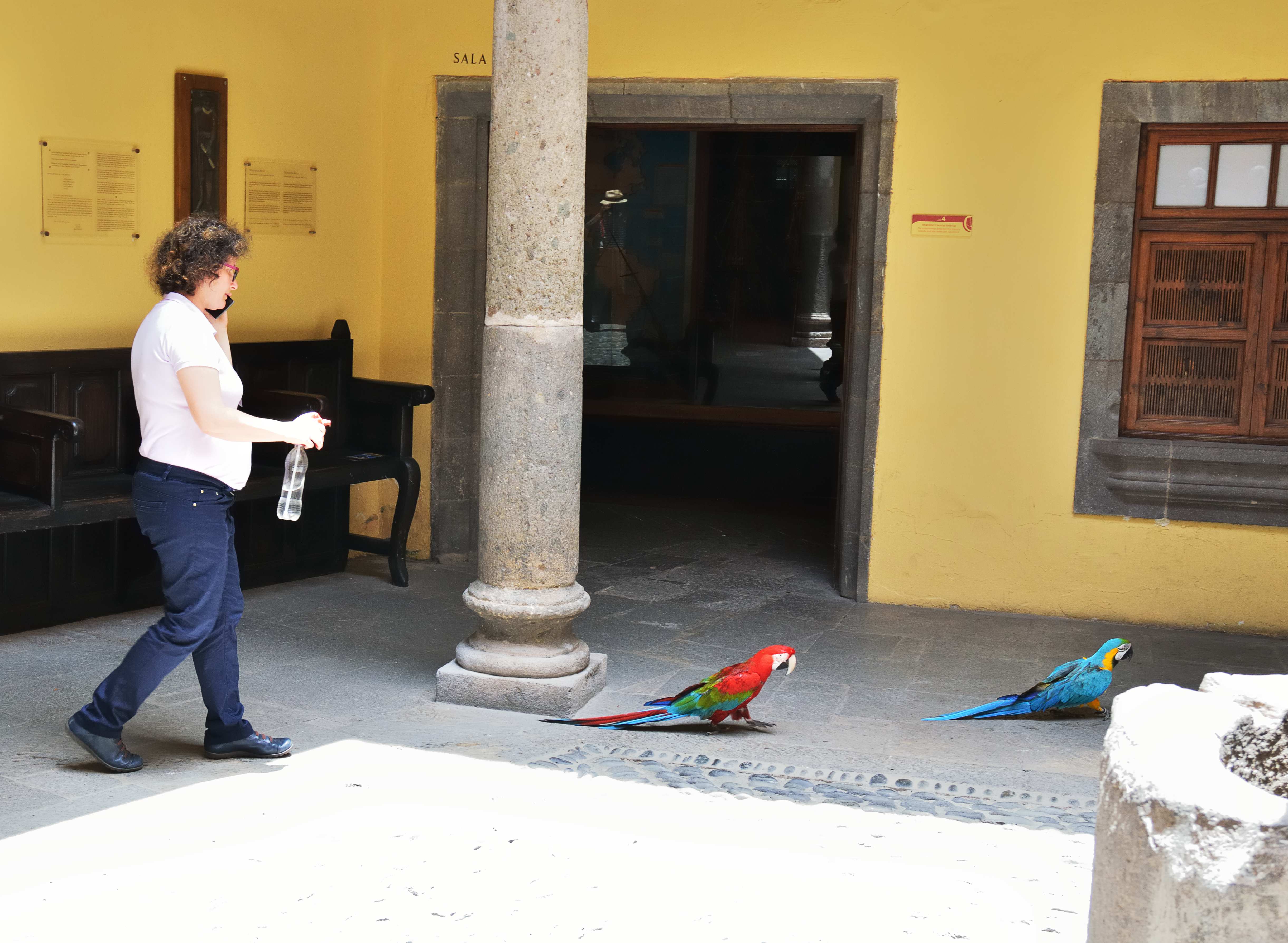
Two of them are permanent, even if unwitting, guests of Casa de Colon – a lodging Columbus has used during his stop overs in Gran Canaria.

As we entered the patio the pair was climbing back into their enclosure, after being ‘encouraged’ (squirted with water) by a janitor.

back to your cage

‘Now tell me, do we really deserve something like this?’

chiar asa

During the half hour or so that I spent there they ‘escaped’

La plimbare

at least four times,

here we go again

only to be either unceremoniously carried

papagal pe bat

or even herded back to their ‘playing pen’,

inapoi mars

where their only entertainment was to engage the visitors with their antics

balet pe sarma

or to ‘shave’ wood from their ‘feeding tables’.

wood shaving

feeding station

Now, really, is this the proper way to treat a ‘mocking bird’?

what kind of life is

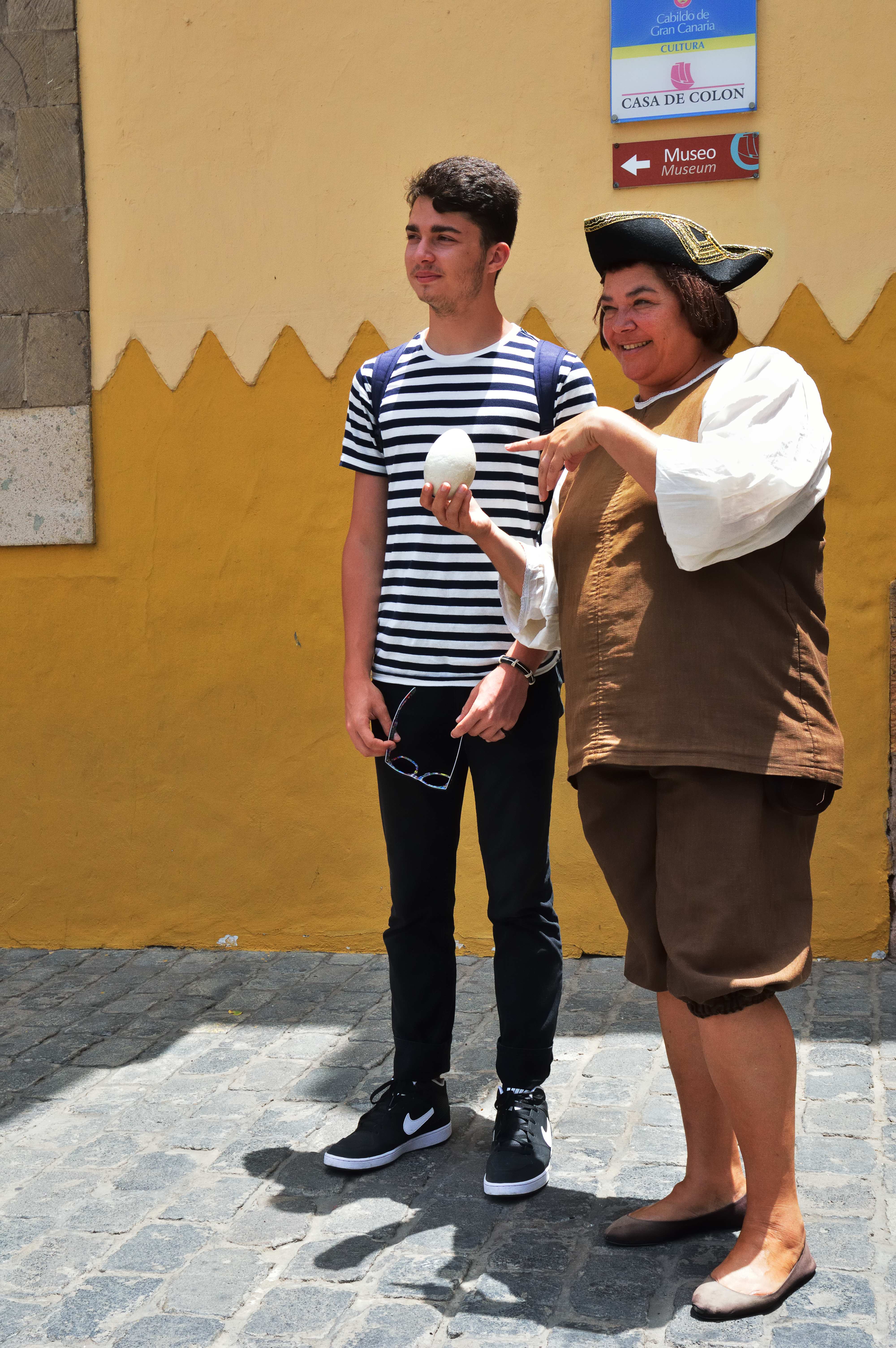
We figured out how to make an egg stand on its head and we can’t yet understand that there will be no real liberty for any of us until all of us will be ‘free as a bird’?

oul lui Columb

There is a small difference between the first two and the last one.
The car and the pills where supposed to be safe while the guns have been purposefully designed to be deadly.
Just as ‘beauty is in the eye of the beholder’, guns are dangerous only if used inappropriately while a badly designed car or some tainted pills are dangerous no matter what!