Archives for category: Mutual Respect

Just stumbled upon a text over the Internet and now I’m wondering: what’s the real meaning of this word, ‘witch’?

“Young King Arthur was ambushed and imprisoned by the monarch of a neighboring kingdom. The monarch could have killed him but was moved by Arthur’s youthful happiness. So he offered him freedom, as long as he could answer a very difficult question.  Arthur would have a year to figure out the answer. If, after a year, he still had no answer, he would be killed.

The question was: What do women really want?

Such a question would have perplexed even the most knowledgeable man, and, to young Arthur, it seemed an impossible query. Since it was better than death, however, he accepted the monarch’s proposition to have an answer by year’s end He returned to his kingdom and began to poll everybody; the princess, the prostitutes, priests, the wise men, and the court jester.
 In all, he spoke with everyone but no one could give him a satisfactory answer.
What most people did tell him was to consult the old witch, as only she would know the answer. The price would be high as the witch was famous for the exorbitant prices she charged.
The last day of the year arrived and Arthur had no alternative but to talk to the witch.
She agreed to answer his question, but he’d have to accept her price first; the old witch wanted to marry Gawain, the most noble of the Knights of the Round table and Arthur’s closest friend!
Young Arthur was horrified, she was hunchbacked and awfully hideous, had only one tooth, smelled like sewage water and often made obscene noises.
He had never run across such a repugnant creature.  He refused to force his friend to marry her and to have to endure such a burden.
Gawain, upon learning of the proposal, spoke with Arthur. He told him that nothing was too big a sacrifice compared to Arthur’s life and the preservation of the Round table.

Hence, their wedding was proclaimed, and the witch answered Arthur’s question;

What a woman really wants is to be able to be in charge of her own life.

Everyone instantly knew that the witch had uttered a great truth and that Arthur’s life would be spared. And so it went. The neighboring monarch spared Arthur’s life and granted him total freedom.

What a wedding Gawain and the witch had! Arthur was torn between relief and anguish.  Gawain was proper as always, gentle and courteous.
The old witch put her worst manners on display. She ate with her hands, belched and farted, and made everyone uncomfortable.
The wedding night approached: Gawain, steeling himself for a horrific night, entered the bedroom.
What a sight awaited!
The most beautiful woman he’d ever seen lay before him! Gawain was astounded and asked what had happened.
The beauty replied that since he had been so kind to her when she’d been a witch, half the time she would be her horrible, deformed self.
And the other half, she would be her beautiful maiden self.
Which would he want her to be during the day and which during the night?
What a cruel question! Gawain began to think of his predicament;
During the day a beautiful woman to show off to his friends, but at night, in the privacy of his home, an old spooky witch?
Or would he prefer having by day a hideous witch, but by night a beautiful woman to enjoy many intimate moments?
 
What would you do?
What Gawain chose follows below, but don’t read until you’ve made your own choice!
   >*
   >*
   >*
   >*
   >*
   >*
   >*
   >*
   >*
   >*
   >*
   >*
   >*
   >*
   >*
   >*
   >*
   >*
   >*
   >*
   >*
   >
Noble Gawain replied that he would let her choose for herself.
Upon hearing this, she announced that she would be beautiful all the time, because he had respected her and had let her be in charge of her own life.

What is the moral of the story?
 
The moral is that it doesn’t matter if a woman is pretty or ugly, smart or dumb.
Underneath it all, she’s still a fucking witch!”

OK, VW couldn’t figure out how to balance the ever stricter polution norms with the public demand for simultaneously more powerfull  and cheaper to run/cleaner diesel engines so they decided to fake it. And it seems they were not the only ones to do that.

This development poses some questions.

– What were they hoping for? Did they really think that something like this could have gone unnoticed for ever?
– What were the regulators thinking? That it’s possible to solve pollution by simply changing some norms?
“Moore’s Law” (“overall processing power for computers will double every two years” has been valid, for a while, in a very young technological field.
Internal combustion engines have been around for more than a century, they are rather old. Everybody knows that it is hard to teach new tricks to an old horse yet we tried to clean exhaust gases well beyond the reasonable instead of radically changing the technology. Computers seemed to be able to help, but only for a while…

Could this be just another ‘application’ of the Peter Principle? “Managers rise to the level of their incompetence?” GM was, sometime ago, the No. 1 Automobile Company. It recently went through a painful bailout. Toyota, the next champion – its methods were studied at the most prestigious management schools – was hugely embarrassed lately by a technological failure.
OK, you might argue that what went on at VW was an ‘upfront’ fraud, not at all an ‘honest’ mistake. Indeed but still a mistake, even if a potentially catastrophic one. Mainly for the shareholders, of course, but also for the rest of us.
A certain dose of distrust towards established authority is healthy for the society, as a whole, while too many proofs of the established figureheads behaving callously generate a diffused disrespect for the law which is really bad for everybody.

In fact what happened at VW is exactly what people tend to do when they do not see any way out of a certain situation.
When they don’t really think that anything bad can happen to them, regardless of whatever they do.
Or both.

So. Is there anything to be learned from here? Except for the oldest lesson history keeps teaching us: ‘reaching the top is easy, staying there is the really tough job’?
Maybe.
Toyota says that transparency, “both inside and outside the company“, is a good way towards avoiding this kind of mistakes. “You have to be able to listen to your customers, not just hear them.

Please notice the importance of teamwork!
No matter which of the two partners makes a false move because he/it doesn’t really trust the other, the rider ends, legs up, in the ditch.
It’s also true that from time to time it’s the horse that gets a broken leg but the ultimate looser is, again, the rider – he has to continue on foot!

“A top GOP pollster tried to find out why people love Donald Trump – and left with his legs ‘shaking’ “.

His conclusion? Republican Leadership “need to wake up. They don’t realize how the grassroots have abandoned them. Donald Trump is punishment to a Republican elite that wasn’t listening to their grassroots.”

I can agree with that but this is only the tip of the iceberg. According to Lowell Weicker, former Republican Senator and independent Governor, there is a “total disconnect…between reality and Republican Party”.
Most civilized people believe that democracy is ‘good for you’ but only a few of them are able to differentiate between bona fide democracy – a political space where all things are discussed openly and which is dominated by a hefty dose of mutual respect among those involved – and ‘mob rule’ – where a portion of the electorate is manipulated into voting for one party/candidate or another.
Mob rule sucks. It divides the society into barricaded compounds that hardly exchange any information. Business slowly grinds to a halt because of mutual distrust and the nation dissolves itself into a collection of individuals too concerned about their private interests to notice what is going on around them.
Real democracy works. Not because more brains think better than one  – that is not necessarily true – but because all ‘brains’ make mistakes. And if the brain at the top goes around unchallenged those mistakes might have huge repercussions for the entire society. During the negotiation phase of a democratic process (otherwise known as the electoral campaign) there are huge chances that most of the potential mistakes will be pointed out and eventually purged. But that happens only if the process is really free. If not, if the public discourse is hijacked by special interests or if the public itself suffers from (temporary?) blindness  things do not go as smoothly as they are supposed to happen.
And here comes Donald Trump.
It’s very hard to say on which side of the things he really is.
Until recently he was saying that he funds his campaign with his own money so that nobody will be able to ask anything from him ‘afterwards’. Now he says he’ll accept donations, big and small.
OK, people can have second thoughts. I have no problem with that. Not even when somebody flips a lot.
I have a big problem though with the con artists who say what the people want to hear instead of honestly speaking up their minds.
In this sense both Lowell Weicker and Frank Luntz, the GOP pollster, are right. The Republican elite has primed their grass roots so hard against the ‘liberals’ that no dialogue seems possible between the two sides. And when dialogue dies out, misunderstanding promptly catches up from behind.
I’m afraid that people who are happy that Trump voices, very loudly, some topics that have either been neglected and/or mismanaged, don’t understand that he doesn’t do it with the intention of solving any of them but because he knows that this is the sure way of mesmerizing the public.
Maybe all this is for the better. The neglected subjects are out in the open and must now be addressed.
Just as important, the pundits, on both sides of the political divide, should have understood by now that it’s high time for them to clean up their act.
Or get replaced by the Trumps of this world.

Bashing ‘religion’ has become a pastime…

But did you know that it was a catholic priest that came up with the Big Bang Theory

and that Darwin was at least as interested in religion as he was in the theory of evolution? OK, in time he had become agnostic, like I am, but that doesn’t mean he wasn’t religious.

A real scientist knows that knowledge is infinite and that he has no chance of mastering it all.
A truly religious person believes that there is something ‘above’ him and that his partaking in that something produces a strong bond between those who share that belief.
The person who barely reads one book, or more, and thinks that he knows it all is a fundamentalist, not at all a religious person.
A scientist can be a religious person and a religious person can be a scientist but neither a scientist nor a truly religious person can ever become a fundamentalist.
Religion is, above all, about respecting the others. So much so as to be able to cooperate with them.
Being convinced that you are in possession of the whole truth and that (most of) the rest of the world is wrong is the dead opposite of being religious.

The way I see it, the God we, humans, speak so often about is our creation, not all the way around.
There might be a real one out there, of course, but there is no sure fire way of knowing that until he chooses to convince us.
If, when and by which ever method it will see fit.

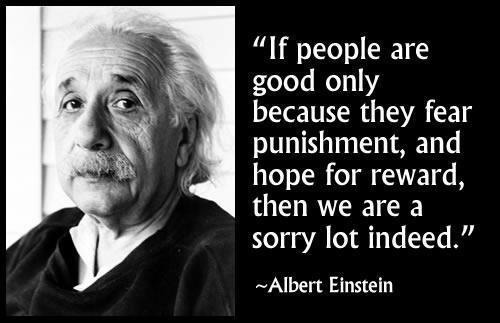
The problem arises from the fact that even after we invented ourselves the concept of God, and derived from this concept some very wise precepts, we still don’t follow, consistently enough, our own advice. Just as the man says in the video.

Do we really need to be under constant threat in order to behave?

I believe you are already familiar with this meme.
Here’s what I’d have used as a caption:
The older I get the more I realize that during my last days I might depend heavily on those around me.
Hence I started to treat them fairly, just as I expect them to treat me towards the end of my life.
Most of them responded in kind.
Therefore the older I get, the more I enjoy life.

“Muslim Marine Murderer’s father sexually assaulted wife and beat son”

A Facebook friend of mine shared this Daily Mail article with the following comment:
“Sad… well educated, accomplished, but lost spiritually… perfect for being radicalized…”

I was haunted by this ever since Mohamed Atta and his gang of terrorists forced us to consider it.

What made them snap?

It couldn’t be their religion.
First of all mainstream Islam, like all other bona fide religions, does not condone senseless murder.
Secondly only a very small minority of the Islamic immigrants become ‘radicalized’.
Thirdly, some of them even turn on their own people.

What if they use religion, Islam in this case, as a pretext for destruction rather than a way to connect with the others? As religion was meant to – reliegare, in Latin, means ‘connecting to’.
What if for them religion is more about ritual than about true spirituality?

I’ve slowly reached the conclusion that what these guys are doing can be interpreted as a form of ‘assisted suicide’. They are pissed off by what has happened to/around them, they blame it on the ‘society’ and they just want out. So they commit suicide and exact vengeance at the same time.

Maybe we need to pay closer attention to what the classics have taught us.

Emile Durkheim, Suicide.:

“Suicide is used by Durkheim as a means of demonstrating the key impact of social factors on our personal lives and even our most intimate motives. The book succeeds brilliantly, both as a technical study of suicide and as a fundamental contribution to this broader issue. Students of sociology will continue to be required to study this book, which will remain on the sociological agenda for many years yet to come.” Anthony Giddens.

I borrowed this title from the BBC because it frames nicely what I wanted to say.

First of all I’m at a loss to understand why so many people considers this to be a ‘Greek debacle’? Did the Greeks lend money to themselves and then refused to pay or this whole mess started years ago, when some private banks supplied huge amounts of money to a country notorious for her shoddy ways?
Then, when Greece was way outside the European norms about how much debt a country might have if it wished to join the Eurozone, the Greek Government lied blatantly and the European officials knowingly turned a blind eye in that direction.
Later, when Brussels started to make noises about this issue the Greek Government, instead of finding a way to pay some of the debt, used another ‘creative solution’ – a currency swap organized by Goldman Sachs. This time Euro-stat rubber-stamped the deal. Now the blame is put entirely on Goldman Sachs.

In 2010, after it became apparent that Greece was no longer able to service its foreign debt – at that time owned mostly by private banks, a first bailout plan was arranged. In 2011 a second one. This way ownership of most of Greece’s debt was transferred from private to public hands.

On the other hand giving Greece a ‘haircut’ now, before they had even started to mend their crooked ways, would be an insult towards the Irish, the Portuguese and the Spanish – who had all swallowed the bitter austerity pill.

And yet.
Moral hazard aside we have to consider two things. Greece is different from the rest of the Euro-zone and Greece’s accrued debt is so huge relative to it’s GDP that none in his right mind would ever expect it to be payed back. In this respect what is happening now is nothing but an exercise of ‘kicking the can down the alley’.

Now let me explain in which way Greece is different and why this is important for the future of the EU.
s

Samuel Huntington has put forward a very interesting theory in which he argues that “The fault lines between civilizations will be the battle lines of the future.” And as you can see in this map, borrowed from Huntington’s book, via Wikipedia, Greece does not belong to the same cultural space as the ‘Western Europe’.
Huntington has drawn that map using the dominant religion as a criterion, in Europe as well as in other parts of the world. Nevertheless he probably has ‘felt’ that his method has it’s shortcomings. America is divided into ‘Latin American’ and ‘Western’ but Europe is not divided into ‘Catholic’ and ‘Protestant’.
And rightly so because what happened in Catholic South America is currently happening in ex Soviet dominated Eastern Europe AND in Greece: rampant and casual corruption that tears apart the social fabric.
What if the nations that inhabit these two cultural spaces have something more in common than ‘top-down’ religious systems – both Orthodox and Catholics have a rather rigid ecclesiastical hierarchy?
Relatively little experience at being independent? At thinking with their own heads, as nations? At being proud of their constant success as teams instead of defining themselves relative to something that had happened in their distant past?

A modern independent nation is, or more precisely used to be, defined by the fact that the elite understands its mission and takes it seriously. Because of that – the positive results, that is, the masses are content with their current elite and follow it – consciously or not so consciously.
A country where the population hasn’t fully reached the ‘national’ stage of development experiences an almost schizophrenic situation. The individuals who should gather together, coalesce into an elite and run country are more preoccupied with their individual short term well being than with making sure that their own children will be able to live in a fully functional country when they grow up. For this reason the general public doesn’t trust the ‘leaders’. And this mutual distrust/disrespect has a very practical consequence: corruption becomes the modus vivendi of the entire society.

It is relatively simple to understand that a relationship of mutual respect between the elite and the general public needs a rather long time to develop and that the process has to take place unhindered by outside intervention. That’s why it cannot take place while the country is dominated by a colonial power, by an imperium or in any other way.
That’s why the peoples that live in South America have only recently started to make peace with their politicians – and not in all countries yet:  they might have conquered their independence from Spain and Portugal almost 200 years ago only their elites had everything in their minds but the general well being of the countries they were running. On top of that the former colonial powers and later the US have all intervened in the daily life of their former colonies/neighbors, further hindering their natural development.
Same thing happened in Eastern Europe. The Baltic States, Poland and Hungary have been, on and off, under foreign occupation but not for so long as to severely damage their development. In contrast Romania, Bulgaria and Greece had not enjoyed real freedom since the XIV-th century. And after they did became independent their elite went looking elsewhere for inspiration. Towards Western Europe at first and to the Soviet Union afterwards.  A somewhat natural thing, given the circumstances, but which did little to forge fully functional nations out of their populations.
Meanwhile the ‘man in the street’ has developed a particular strategy for surviving. He trusts nobody but his family  and close friends and doesn’t pay taxes unless he really has to. He has no qualms to take ‘bribes’ from the state – early retirement, subsidies, etc. – but that doesn’t mean he will trust the politicians that ‘distributed’ those ‘gifts’.

What is happening now, when the European elites are supposed to take their cue from Brussels, is not helping much. Ms Merkel is preoccupied primarily with her own constituency and the EU top brass are fully aware that Berlin has the last word about who gets what top notch European position. Any wonder smaller nations feel ‘neglected’? We should keep in mind that, as Great Britain is just one example, that Europeans do not feel towards the EU what the Americans feel towards the good old US of A.
Eastern Europeans have a particularly hard time. They want to get in the EU – they are both fed up with their local politicians and would like to be part of a working environment but at the same time they have a rather ambivalent attitude towards the EU institutions. This institutions enjoy a lot of respect from the Easterners, because they had worked properly – until not so long ago, at least, but at the same time they are watched with great apprehension. People who have had to take, in the past, their cue from ‘foreigners’ are somewhat weary of this whole thing.

So yes, I’m afraid that the euro-zone will be damaged by the current crises only I don’t think we should be speaking of a ‘Greek debacle’.  In fact the union itself – the European elite, to be more precise – has not entirely fulfilled its duty.

The sooner we understand that, the sooner we’ll know what to demand of it. And maybe we’ll be able to bridge the cultural divide mentioned by Huntington.

The alternative would be dire. The Russian elite – not the Russian people itself, only a fragment of its elite – will grab the opportunity to extend their influence. And by doing so to continue to hinder the natural development of the Eastern European nations. Including Modern Greece.

“Why should the European taxpayers bail out the profligate Greeks?”

That’s the mantra I’ve been hearing for some time now, even though a way bigger, and darker, cloud slowly builds up on the other side of the world.

As almost all mantras there is a small nugget of truth in here, even if things are not at all as some want us to believe. wrote this almost prophetic article for Reuters, more than two years ago.

So?

First of all I’d like to quote the definition proposed by Investopedia.com for ‘moral hazard’:

“The risk that a party to a transaction has not entered into the contract in good faith, has provided misleading information about its assets, liabilities or credit capacity, or has an incentive to take unusual risks in a desperate attempt to earn a profit before the contract settles.
Moral hazard can be present any time two parties come into agreement with one another. Each party in a contract may have the opportunity to gain from acting contrary to the principles laid out by the agreement…..
.
.
.
Moral hazard can be somewhat reduced by the placing of responsibilities on both parties of a contract….”

The way I understand this definition is that it is the job of both parties who enter into a contract to perform every diligence they see fit before committing to that contract  and to assume the responsibility afterwards.
Let’s see if this definition sheds any light on today’s subject.
The Western World tends to act as if all countries were functioning as communities. If we don’t like what Putin does in Ukraine we impose sanctions that hurt the entire Russia in the hope that people will do something about the situation. That tactic works very rarely – see what happens in N. Korea and in Iran. Even more, sometimes it even backfires. Look at how popular Putin has become after the sanctions have been put in place.
Coming back to Greece we have become fed up with the shenanigans of the Greek politicians – right, left and middle – and now we insist on harsh ‘austerity measures’ in the hope that the Greek voters will somehow find among themselves an honest knight in a shinning armor that will appear from somewhere and teach them to pay their taxes – and by doing so they’ll dully repay the entire debt that has accrued over the time.
After all it’s their responsibility, isn’t it?
It was them, the Greek voters, that have elected the corrupt politicians in the first place. It was them, the Greek voters, that didn’t do anything when they noticed that their Government was corrupt. Even more, some of the ordinary Greeks must have helped the corrupt politicians – nobody can be corrupt by it’s own, somebody must be at the other side of the deal. On top of that dodging taxes was, and still is, a national sport in Greece – well, that’s actually a rational thing to do: ‘who in it’s right mind would willingly pay his taxes, knowing that most of the money would be squandered away’?
Does that mean that the Greeks should be made to reimburse, in integrum, what their creditors demand of them?
OK, lets forget for one moment that this not possible and that if Greece defaults not only the Greek people will have to endure harsh conditions for a while but also the creditors will loose a considerable amount of what they are due.
Let’s presume that a completely different Tsipras somehow convinces the Greek people to accept pension cuts, tax hikes and, lo and behold, to pay their taxes in an honest way.

Then we’ll still have a fine example of ‘moral hazard’.
We have just established that in a democracy the voters have the final responsibility for the actions of those elected/hired into meaningful positions.
And what did the elected officials, from Brussels as well as those from the rest of the EU capitals? Turned a blind eye when Greek politicians ‘cooked the books’ before Greece was admitted into the EU and, after that, into the Euro zone? Then, when the private banks that had unwisely extended credit to the profligate Greeks had troubles recouping their money, the same elected officials said nothing while Jean Claude Trichet, the then president of the ECB, helped transfer the entire burden – mind you, no ‘haircuts’, unto the ‘wider’ shoulders of the European tax-payer? Who said absolutely nothing!
Only now some of the elected politicians, afraid that their constituents might finally protest, have started to notice the irresponsible attitude of Greece, to demand harsh austerity measures and to refuse even the idea of any debt relief.
So how come we can speak of moral hazard when we describe what the Greeks (governments, tax dodgers and general public) did but never mention in this context the lack of financial responsibility displayed by the investment bankers that helped the Greek governments cover up their shenanigans, the European officials who turned a blind eye to what was going on and the wide European public who didn’t care about what was done with their money by those hired to take good care of the European finances?
What is going to happen from now on?
Before trying to gouge that we need to understand what sets Greece apart from the countries that have dragged themselves out of the worst phases of the latest crises – Ireland, Spain and Portugal: Greece is a country deeply divided by rampart corruption.
In most of Europe corruption is a cancer that reaches across the entire social organism, in Greece it divides the population in two almost equal parts: those who work for or do business with the Government and all the rest.
The situation is made worse by the fact that Greece has become independent rather lately, specially compared with the Western Europe. Furthermore, the process was a lengthy one, it started in 1821 and ended right after WWI, only to recommence during WWII. Add to that the long list of authoritarian leaders and you’ll understand the deep mistrust between the people and the Government – which is not at all ‘their’, despite Greece calling itself a democracy. I have a distinct impression that even those who work for or do business with the Government doesn’t really trust it – they know too much about what is going on there. Small wonder, in these conditions, that dodging taxes is a national sport…
What we have now is, on one side, some European leaders who were elected on a conservative/popular ticked and who have already introduced some austerity at home and, on the other side, a leader who has promised to end austerity.
For these people to reach an agreement both sides have to admit failure: the European leaders must accept the past errors and take responsibility for them and Tsipras must convince his constituents that they need to change their attitude. Completely.
Does any of this have any chance to come true?