
Cultural Dementia by David Andress
My rating: 4 of 5 stars
One of those books which function as a magnifying mirror.
The older you get – and the more mistakes you’ve made, the less you like of what you see when facing it.
View all my reviews
Archives for category: evolution
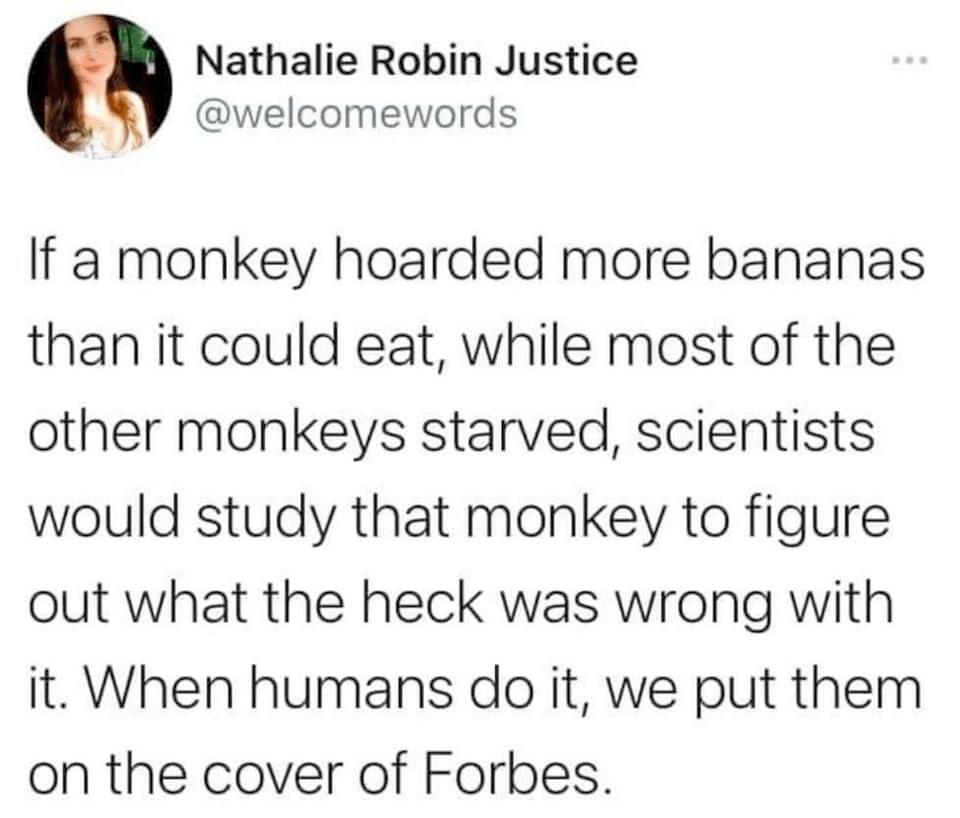
Well… Money doesn’t get spoiled as easily as bananas do…
On further consideration, money can be understood as a tool with many uses.
Hoarding, for instance. Bananas, among other things …
And, as with all other tools, the responsibility for its use falls squarely on the user, not on on the tool itself.
Tinkering with the tool won’t change that, ever.
My point being that monkeys would also hoard bananas if bananas were hoard-able.
There’s nothing wrong with that. For as long as the hoard is meant to feed the hoarder till the next crop, of course.
Hoarding is bad only when done for its own sake.
And this is something for philosophers to study, not for scientists.
The teachings of the Chicago School of Economics had been very scientific yet following them was what brought us where we are now. Into a very uncomfortable cul-de-sac…
Blindly following them… mislead precisely because of their scientific nature!
I challenge you to try an experiment.
Click the illustration bellow, copy the link and post it to your favorite social media.
Then observe the likes you’ll get. I wasn’t surprised to notice that many people on the right side of the political divide were quite fond of it’s spirit…

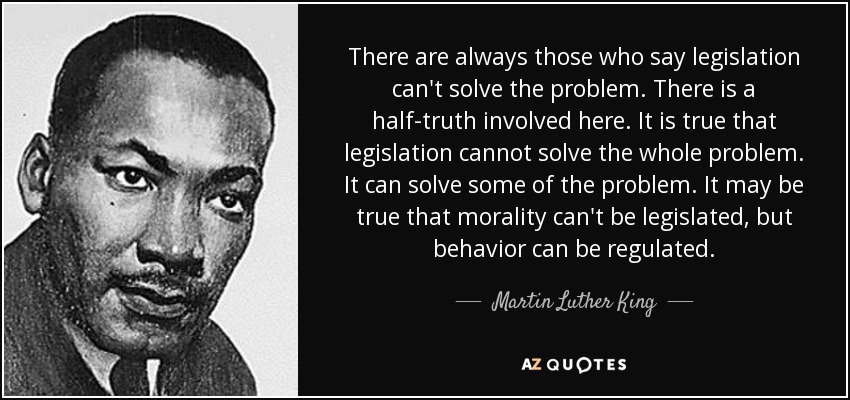
‘Yeah, only MLK hadn’t been “formally affiliated with either political party“…”
Well… how about this one?
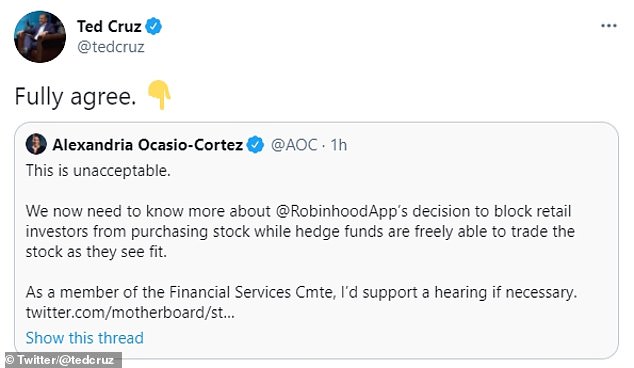
‘OK, and your point is…?’
That there’s not much real difference between the radicals. Between the radical members of both parties.
Both are so convinced that they ‘know better’ that neither have any qualms trying to impose their vision upon everybody else.
Both are so convinced that they are right that they ‘hate’ all other authority but their own. And they hate each-other’s guts… only that comes with the territory…
Let me start with the beginning.
I grew up under a communist regime. Drowning in propaganda. The education system was finely tuned to raise us, children, as ‘the New Man’. All cultural effort – culture was ‘sponsored’ by the communist state and heavily censored, was meant to achieve the same goal. Immediately after the communist regime had grabbed the absolute political power, the legislation had been altered to reflect the ‘new reality’. And then used to convince the people to change their behavior according to the new rules.
According to whatever the new masters had in mind …
So that they could control everything. That nobody else could have exerted any authority. That nobody else could have had any real influence over anything.
And, as you might know, the communist regime – most of them, anyway, had eventually crumbled. Under its own weight.
Which teaches us two things.
That whenever a system is run in an authoritarian manner, mistakes keep piling. One on top of the previous one. Constituting the dead-weight which will eventually sink the ship.
That no artificial ‘New Man’ will ever survive for long. Yes, you may ‘legislate behavior’ – even against the true wishes of the general population, only the ‘new’ arrangement will not last for long. For a ‘legislation’ to be able to survive for any substantial amount of time it has to reflect the ‘true heart’ of those called to put it into practice. To ‘follow the rules’. That you ‘can restrain the heartless’ but for only as long as the ‘heartless’ remain a small minority.
Want to ‘change’ something? Then open people’s eyes first. Only that way they’ll eventually open up their hearts.
‘What about the spat between AOC and Ted Cruise? Where’s the link between what happened with GameStop and MLK’s attempt to regulate behavior?’
Both AOC and Ted Cruise hate the fact that there are independent agents. Besides them, of course. That there still are people who call their own shots. Private companies they cannot control, media venues, independent authorities… The ‘AOC’-s and the ‘Ted Cruise’-s of this world hate each-others guts but have more or less the same convictions.
That they are right – and everybody else is wrong.
And that there must be a way!
That there must be a way, a ‘rational’ way, in which their righteousness may be imposed upon the rest of the world.
That ‘rational’ way implying two things.
Control over the ‘material’ resources and control over people’s minds.
That’s why the communists had ‘abolished’ private property. That’s why the (no longer free market) contemporary capitalists are OK with extreme wealth polarization. As long as they on the right side of the ‘in-equation’, of course…
That’s why education has become such a hot subject.
That’s why control over the legislative process has become so important.
Why controlling the markets – controlling them, not preserving their freedom, is paramount…
The only bright thing in this whole mess being that the two sides still hate each-other’s guts.
Which gives us some more lee-way.
Time to understand that for progress to be possible we need to take care of our roots. To ‘conserve’ them!
Time to remember that ‘pruning’ needs to be done carefully.
That we have to ‘cut’ only what’s ‘wrong’, not everything we don’t like.
How to tell those two apart?
‘Humility’ comes very handy in these moments….
Freedom isn’t for free. Nobody is free by itself, only together.
Those who really want to be free must start by respecting each-other.
That’s how mistakes are avoided. By asking for a second-opinion. By listening to what others have to say on the matter.
That’s how normalcy is being defined. And preserved.
How we learn what’s ‘wrong’. How to tell what works from what needs to be pruned.
I cannot wrap this up before giving you a fine example of how ‘propaganda’ works.
It starts with cutting up the truth. By actually pruning it to fit the purpose. Then let’s our already primed brains to do the rest.
See what I mean?

Crows are deemed to be the smartest birds around.
“Crows are the hominins of the bird kingdom,”
“Like our own ancestors, they evolved proportionally massive brains by increasing both their body size and brain size at the same time, with the brain size increase happening even more rapidly.”
Dr. Jeroen Smaers
Crows have also witnessed our evolution.
All life transforms its habitat.
Living things actually pass ‘segments’ of their habitat through their digestive systems. Digest them. Consume the useful components and discard the rest. And, finally, excrete whatever their metabolism had turned the useful components into. Urea and carbon dioxide, to name but a couple. For us, mammals. Other living creatures contribute something else to their environments.
The blue-green algae of yore are believed to have produced the oxygen we breathe now.
“Wolf Reintroduction Changes Ecosystem in Yellowstone“.
Humans alter their ‘nesting’ places in ways sometimes detrimental to their own well being.

So, basically, we – as a society, actually ‘digest’ our planet. Our home… Our only home!
Are we happy with the results?

To OUR home?
I don’t know anything.
I don’t know everything hence, logically, I cannot pretend to know anything.
Seems odd, since I obviously know something… to type, for instance!
Indeed, only the key word here is ‘logically’.
From a logical point of view, you either know something or you just don’t.
Not very reasonable… This line of thinking leads up, fast, into a dead end!
As soon as I realize I know ‘nothing’, I must stop!
I can no longer ‘do’ anything.
Because I cannot control – in an absolute manner, each and every consequence of any of my actions.
Further more, there is no justification for me to continue thinking.
Again, because I will never be able to achieve ‘knowledge’.
Yet so many things are being done around me…
From the sun rising in the morning to the ant helping its mates to dig a nest.
From the electron ‘flying’ around the nucleus of a Hydrogen atom to a man developing a computer application.
How can all these actions be performed when nobody, not even the ‘performers’ themselves, is able to determine the ultimate consequence of what’s going on?
How can so many thoughts be ‘spun’, and books published, when the ‘thinkers’ themselves – well… some of them, actually, are fully aware of their intellectual limits?
What drives this frenzy?
And, if I may allow myself a thought, why ‘logic’?
How can such a ‘paralyzing habit’ survive?
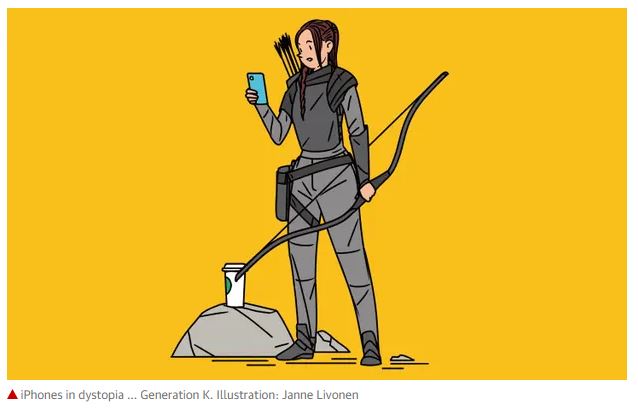
Each successive generation has to make do with the situation they had inherited from the old one.
And whatever it ‘builds’ on top of that will constitute the starting point for the next one.
We – those born between the early 50-ies and the middle 70-ies, and who constitute the vast majority of today’s significant decision makers, have had a ‘once in the entire history’ opportunity. The fall of the communist regimes almost all over the world had lifted many of the ‘practical’ hurdles left around from the previous generations. We had been freed from all limitations but those we’ve imposed – willingly and/or unwittingly, upon ourselves. So much so that Francis Fukuyama had described the situation as ‘the end of history’.
We’ve been, indeed, the first generation in modern history – or ‘contemporary’?!?, which didn’t start a ‘wholesale’ war… if we discard the ‘war on terror’! Or that ‘on drugs’…
The point being that we’ve failed. To use the huge opportunity presented to us.
By Lady Luck… our fathers had done nothing but continued the traditions imposed upon them by their fathers…
We, on our turn, don’t have that excuse.
We didn’t have had to continue anything… Conditions had been perfect for a fresh start!
Yet we had ‘preferred’ to ‘carry on’… As if we had learned nothing from what had just happened!
Fukuyama himself, after having been lionized by his peers and then contradicted by Clio, had ‘relapsed’.
After prophesying that ‘liberalism uber alles’ he had recently attempted to explain away his failure using ‘the need for recognition‘.
In fact, he wasn’t exactly wrong in 1989 – we did have a chance to move in that direction, nor is he totally off the mark now. ‘The need for recognition’ did play a role in our failure.
Fukuyama – along with the rest of us, had made the capital error of over-trusting his own intellect.
Of convincing himself that ‘the world’ can be understood.
Hence predicted.
And who has to make do in the present situation?
To deal with our failure?
As always, the next generation!
Our children…


40 years ago, the car manual was about how to adjust the carburetor.
Nowadays it starts with a stark warning. “Don’t drink the cooling liquid!”
Then it teaches us how to use the infotainment system and how to adjust the electric seats…
In those times, most of us – regardless of what country we lived in, had nothing fancier than a washing machine. And a TV set capable of receiving no more than 12 channels. But we had a lot of time to spend with our friends and relatives.
Nowadays, our houses are choke full of appliances designed to make our lives easier… So we break our backs working to pay for this paraphernalia! And we get so tired in the process that when we finally get back home, late at night, we’re so exhausted that we cannot do anything else but watch one of the 200+ channels our cable feeds into the huge TV which dwarfs everything else in the living room.
Meaning that we wrap up most of our days watching yet another mind numbing news-bulletin… which informs us about how bad tomorrow will be… unless we follow whatever advice that channel is determined to ‘sell’ to us!
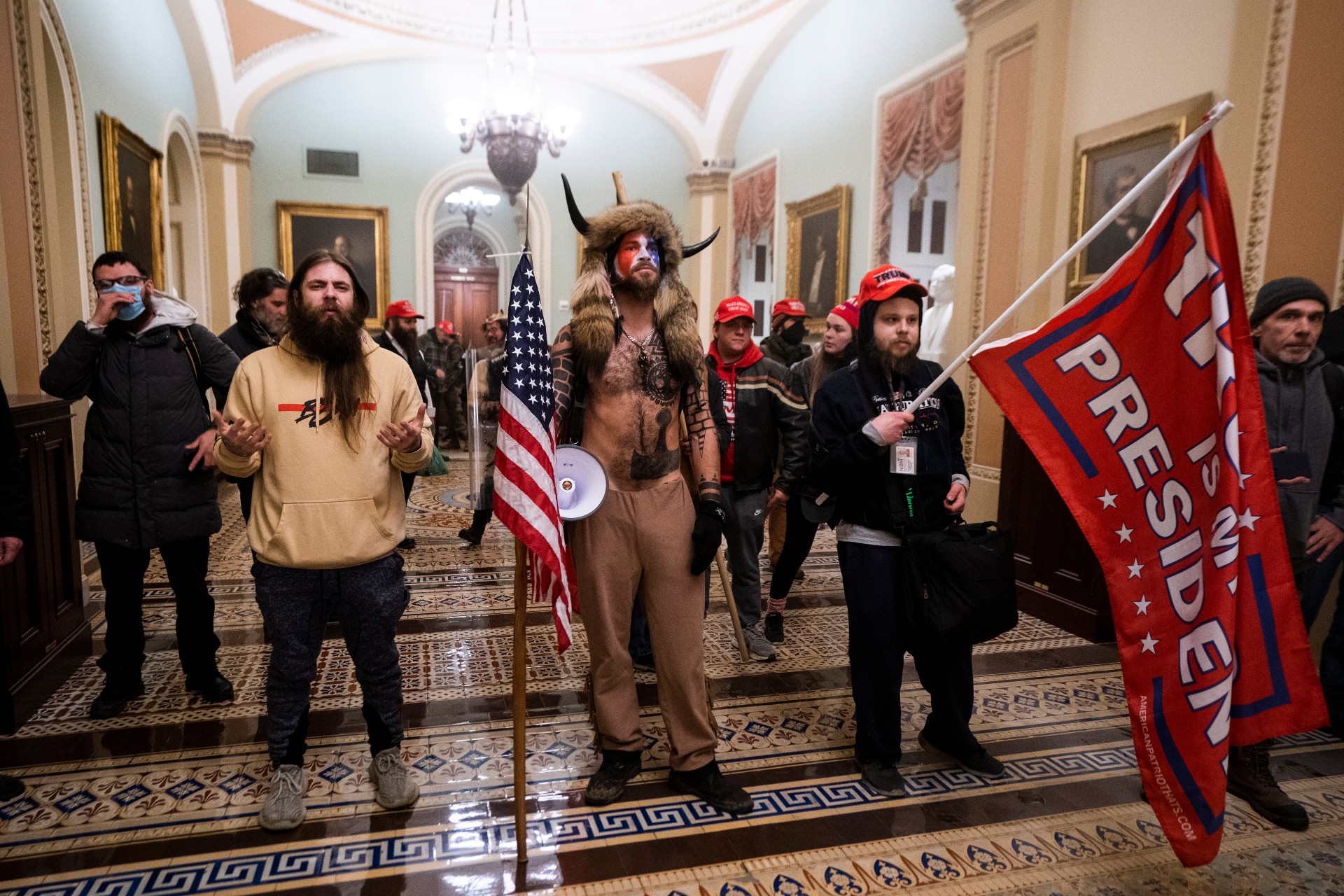
One of my high-school mates had emigrated to Canada. From Romania. He’s been living there for 25 years now. We keep in touch. A few years ago, he told me:
“We come from their future. I currently experience things which had already happened in Romania.”
His prophecy had been fulfilled, and then some, yesterday. The sixth of January, 2021.
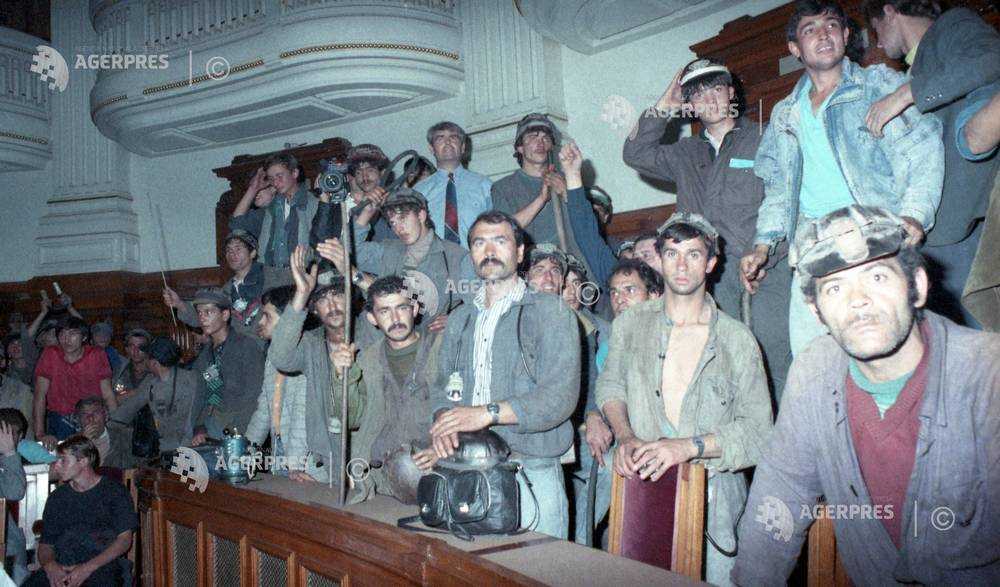
The differences between the two instances exist and they are not insignificant.
Both Trump and Iliescu – the Romanian president at that time, had been democratically elected. Both on populist platforms, even if the concept wasn’t as widely used in 1991 as it is now.
Only 1991 wasn’t the first time the miners had come to Bucharest.
In 1990 Ion Iliescu – the ‘cripto’ communist leader who had risen to power as a consequence of the 1989 uprising, had ‘thanked’ the miners for quelling a ‘festering’ anti neo-communist protest organized mainly by students.
In fact, this had been yet another precedent. ‘Occupy’ Piata Universitatii 1990 versus Occupy ‘Everything’ 2011.
In 1991, the miners had, again, ‘occupied’ Bucharest. Again, ‘supposedly’, under their own volition. The then prime minister, Petre Roman, had adopted some very stringent free market reforms. Which had fallen foul of both Iliescu and certain swaths of the population. Hence the miners had not been driven back to Valea Jiului until Petre Roman had been revoked from office.
And 1991 wasn’t the last time the miners had attempted to make themselves noticed…
As the old saying goes, it’s harder to quiet down a hornet’s nest than to stir it up!
We’ll see, as the blind man always says.
“How absurd to imagine that something we can make could actually deliver us from problems we could not free ourselves from!”
Dr. Allen Ross, Dead Idols or the Living God
According to Abraham Maslow, people’s lives are ‘staged’.
During the first four, each individual ‘must’ – ‘inside’ whatever circumstances Mother Luck had granted them, provide for their ‘needs’.
Only after they had reached the fifth stage, individuals have the opportunity – but no ‘obligation’ other than that each of them impose upon themselves, to ‘reinvent’ their own personae. Maslow had used ‘self-actualization’ to describe the process.
In religious terms, the whole thing is known as ‘coming to peace with oneself’.

No more ‘absurdity’ here!
There’s so much each of us can do in order to move ‘forward’…
‘And where is this famous ‘forward’?!? How are we, individually and/or collectively, to determine which is the ‘good’ direction?!?’
Is our ‘imagination’ good enough to come up with a solution for the “problems we could not free ourselves from”?
The carpenter measures with a line
and makes an outline with a marker;
that it may dwell in a shrine.
or perhaps took a cypress or oak.
He let it grow among the trees of the forest,
or planted a pine, and the rain made it grow.
It is used as fuel for burning;
some of it he takes and warms himself,
he kindles a fire and bakes bread.
But he also fashions a god and worships it;
he makes an idol and bows down to it.
Half of the wood he burns in the fire;
he roasts his meat and eats his fill.
He also warms himself and says,
“Ah! I am warm; I see the fire.”
From the rest he makes a god, his idol;
Is ‘induction’ a comprehensive enough solution?
Or ‘too much of a good thing’ will never fail to become ‘bad for you’?
Confused?
Let me put it another way.
‘One size fits all’.
How many times have you been really satisfied by such a ‘solution’?
Do you really think an ‘idol’ fashioned by a carpenter – by the most talented carpenter, even, will ever satisfy the needs of at least one blacksmith?
‘But how about the idols fashioned by Plato’s king-priests?’
To answer this question – this excellent question, if I may say so myself, we must turn back to Dr. Allen Ross’ Dead Idols. To the difference between the Dead Idols and the Living God, to be more precise.

‘Criterion for what?’
If you pay close enough attention to what’s written above, you’ll notice that not passing the falsifiability test doesn’t mean than an assertion is false! Far from it, actually!
Not passing the falsifiability test – ‘if a claim is compatible with all and any states of affairs’, only means that that claim is both ‘true’ and unscientific! Simultaneously true and not scientific!
‘And what has any of these to do with God?!? With the Living God or with any of the Dead Idols humankind has built for itself? And later discarded?’
I’m afraid you’ll have to come back for the answers.
Or, to put it differently, I’ll gladly welcome you back!

This was one of the favorite slogans shouted by the anti-communist protesters in Romania’s ‘Piata Universitatii‘.
And the anthem used by those who opposed the regime which had ‘confiscated’ the political power after 1990.
The only problem with this notion being that it doesn’t make much sense. Not on the ‘face of it’. Not in any rational way…
You see, most individuals would choose life against any other ‘alternatives’.
When ‘the going gets tough’ most of us would accept almost any compromise in order to stay alive.
I’m not offering any examples. Use your own ‘imagination’.
Let me explain what ‘being a communist’ meant in Romania during Ceausescu’s rule.
First of all, in 1989 the ‘party’ was 4 million strong. 18% of the population were ‘proud’ carriers of the red membership card!
Were all of them ‘die hard’ communists?
Not at all!
Most of them had accepted to become members simply because they had no other alternative. Without the party’s ‘approval stamp’ one could not ‘accrue’ any significance. Nada! Nothing!
Could not get any promotion. Get an education higher than the equivalent of a college degree. Go visit a foreign country – not even a communist one!
Nor could you move out from your parents home!
Not easily, anyway. To be granted your own apartment, you had to submit an application to the relevant authority. Which application had to ‘checked’ by the relevant party official if you were to have any chance of success. Which ‘relevant party official’ was way more likely to approve your application if you were already a ‘member’.
And so on.
Then why would anyone refuse to become a member?!?
Thirty years later, I finally figured out the real meaning of the whole concept.
For you to get the whole picture, I must introduce you to a few more verses.
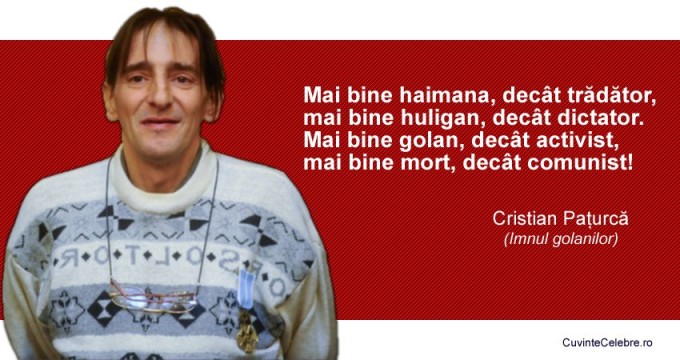
“Bum better than traitor
Hooligan better than dictator
‘Good for nothing’ better than activist
And dead better than a communist!”
By now, I’m sure most of you already had your Eureka moment.
‘Better to be dead than an ‘active’ communist’!
You don’t know what ‘activist’ exactly meant in communist Romania?
For starters, a ‘regular’ communist was just a ‘member’. You did have some ‘potential perks’ but you had to ask for them. And you were never sure your wishes were going to come true.
The activists, on the other hand, were paid for their efforts. Their ‘well compensated’ job was to put in practice whatever the party had decided. What the brass had decided, actually…
To convince the regular members – and, through them, the rest of the population, that whatever the brass had decided was ‘in the people’s best interest’!
And to inform the higher-ups about the real situation ‘in the field’.
In a nutshell, it was the party activist’s job to keep the party together!
‘OK, to keep the party together… that makes sense… but … whose interests were promoted by the almighty party?
And why had the whole thing collapsed like a house of cards?’
Let me answer your second question first.
The whole thing had collapsed like a house of cards because there was no other alternative.
Because there was no alternative to ‘the’ party!
Because those at the top had drifted away from reality.
Because those at the top had been driven away from reality by those below them. Who had been acting in a rational manner!
Who in their right mind would contradict a powerful figure?!? Specially when there’s no alternative? When you, the ‘middle man’ see no way out? What alternative do you have but to become an yes-man? Who utters only what the higher-ups want to hear and keeps mum about everything else?
See what I mean?
Do you finally understand Frank Herbert’s message?
Do you still wonder why all authoritarian regimes eventually succumbs, being eaten from inside out by corruption?

‘Now you’ve lost me!
Are you implying that by actively promoting ideas, and acting as a back-bone for a political party, one becomes an ‘accomplice’? An enabler?!?’
Well, let me answer your first question now!
‘Whose interests were promoted by the almighty party?’
On the face of it, the main ‘beneficiary’ was ‘the people’.
Practically… the people had become ‘hungry’.
‘Hungry’ enough to applaud when the dictator had been assassinated on Christmas Night in 1989 …
You see, every established system tends to put its own survival before anything else.
Every individual member of the system wants to conserve its position. Which is a reasonable thing.
The problem with ‘single’ parties being what I’ve mentioned above. The party slowly drifts away from reality for the simple reason that there’s no competition to keep them ‘moored’.
‘No real alternative in sight’ allows any ‘single system’ to construe their own ‘alternative’ reality. Made of “alternative facts”.
So!
You may promote whatever ideas you want. How ever actively you want to do it.
Be the back-bone of any political party – or any other organization, you see fit.
But don’t be surprised that if you promote the ‘flat Earth alternative‘ you’ll eventually fall over.
Fall over the face of the Earth, that is!
 nicichiarasa