Most of you are probably aware that French was THE Lingua Franca until some 60 or 70 years ago, long after Britain had displaced France as the dominant world power.

Why? Because English is a lot more flexible than French and, as such, a lot more suitable as a medium for negotiation.
Why had we, as a species, waited for so long? Because until then international exchanges were, basically, more of an imperial nature than anything else. Only when people started to engage in meaningful negotiation medium became important. Orders can be given in any language, sooner or later the subordinate will figure out the message if the imperator is insistent enough but for meaningful negotiation to be possible the medium needs to be simultaneously expressive enough for the participants to be able to make themselves understood yet imprecise enough to leave room for ‘diplomatic’ manoeuvres.

Image


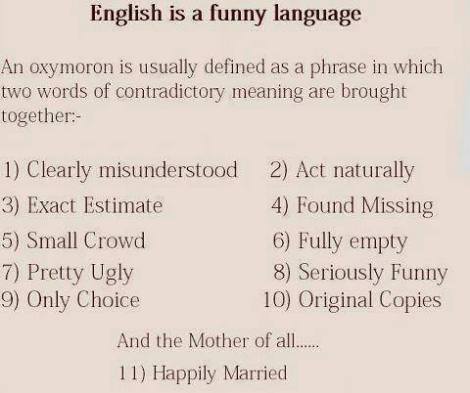
See what I mean?
The last entry is indeed the pinnacle of ambiguity, it is extremely descriptive and it can be simultaneously an oxymoron and a pleonasm, depending on which half of the couple is using it!

Here are some more examples from the FB wall where I found the picture:

Benjamin Adams: “In greek oxy means sharp. In English moron means dull. Oxymoron is an oxymoron.”

Matt Mailand: “civil war”

Reece Matthew Van Gameren “Clearly confused”

Travis Fox “Jumbo shrimp.”

Once upon a time, for if it hadn’t taken place people wouldn’t be still mentioning it, things were so similar as to be indistinguishable.

There was no male nor female, no black nor white, no pointed nor flat… everything was so bland as if there was nothing at all.

Until one day. One day when somebody named something for the first time and by doing so brought that something to life while leaving all the rest behind. As if on cue somebody else named something else and then again and again until everything in sight bore a name.

Then people started to speak about what they had seen and about what they were going to do and by doing so they created new realities out of the old, unique, one.
And very seldom these new realities, spoken by various people, resembled one another even if they started from the same point and the speakers themselves were using the same language and belonged to the same ‘species’. 

Scriind comentariul precedent despre evolutia de la stadiul de tara ‘bananiera’, care se bazeaza in principal pe exploatarea resurselor naturale,  la cel de economie industrializata care isi valorifica cat mai bine potentialul uman, mi-am adus aminte de ‘nu ne vindem tara’.

Lasa ca in loc sa o vindem am lasat sa fie pradata…din pacate semnificatia ‘strigaturii’ e chiar mai adanca!
Poate ca initiatorii ei, ‘raspandaci’ care aveau ca misiune crearea unui etos care sa permita ramanerea la putere a ‘esalonului 2’, erau ‘sinceri’ in sensul ca le era intr-adevar frica ca daca ar fi venit niste investitori seriosi ar fi cerut instaurarea unei ordini firesti…cam asa cum cere acum Dacia sa fie construita autostrada Pitesti-Sibiu…

Problema este insa ca zicala a prins la public ori asta inseamna ca publicul respectiv nu trecuse inca de etapa de dezvoltare a organismului social in care identitatea proprietarului este mai importanta decat efectul folosirii proprietatii. Bineinteles ca acestea doua sunt strans legate numai ca orice exagerare, in oricare dintre directii, duce la izbirea oistei de gard sau chiar mai rau.

Pai daca societatea romaneasca, populatie + guvernanti, ar fi reusit sa gaseasca o cale de a conduce eficient economia pe vremea cand toate erau ‘proprietatea intregului popor’ s-ar mai fi prabusit vreodata comunismul? Si atunci de ce am insistat sa lasam friele in mana acelorasi oameni care le tinusera si pana atunci? De ce ne-a fost frica de venirea unora care sa ne invete un nou model?

Bine, asta nu inseamna adoptarea necritica de comportamente doar pentru ca acestea provin ‘din afara’, acest lucru ar fi cel putin la fel de daunator ca refuzul aprioric de a intra macar in contact cu ele, din simpla frica de contaminare. Intotdeauna oamenii sunt cei chemati sa fie masura tuturor lucrurilor precum si motorul evolutiilor sociale.

Atunci nu ne-am ridicat la inaltimea provocarilor. Acum insa se pare ca avem parte de un nou start.

Dacia a depasit SNP Petrom si are acum cea mai mare cifra de afaceri dintre companiile din Romania.

In ciuda scrasnelilor din dinti ale unora dintre jucatorii de pe bursa de la Bucuresti – SNP se tranzactioneaza, evident, in usoara scadere, in timp ce Dacia a fost retrasa de mult de pe piata – cat si a unei ‘parti a presei’ – de multe ori se subliniaza mai ales scaderea Petrom si nu atat cresterea remarcabila a Dacia – repozitionarea semnaleaza o transformare calitativa a statutului economic al Romaniei.

Aceasta da semne ca vrea sa depaseasca stadiul de ‘granar al Europei’ si de tara care isi exploateaza la sange resursele naturale – gaze, petrol, paduri, pamant arabil, mine de aur – si incepe sa isi puna in valoare imensul potential uman.

Acest potential este arhicunoscut, romana fiind cea de a doua limba din campusul Microsoft iar medicii romani extrem de apreciati in vestul Europei. Iata ca acum acest potential incepe sa fie dezvoltat si aici, la el acasa. Pentru inceput de o firma straina.

Daca ne dadeam seama mai devreme ca ‘Nu ne vindem tara’ a fost o prostie imensa poate nu treceam prin acesti 20 de ani in care cuvantul de ordine a fost: ‘Romania, o tara deosebita, pacat ca este locuita’.

Felicitari inca o data tuturor celor care au facut ca acest lucru sa fie posibil. Atat celor care au avut incredere in Romania, de ambele parti ale granitei, cat si celor a caror munca a stat la baza acestor realizari.

Image

I share his concern about the huge social and economic effects produced by extreme wealth polarization but I don’t think that beating anybody may solve anything.
On the contrary, starting a fight instead of a dialog only compounds the problem and worsens the perspectives.
As to why the Icelanders where successful in what they did…this is indeed very simple.
They focused on the wrong doers, not on the 1%.
Belonging to the 1% is not a sin.
Trying to get/remain there by wrongful means is the place where problems are generated and it is here where we should concentrate our attention.

Image


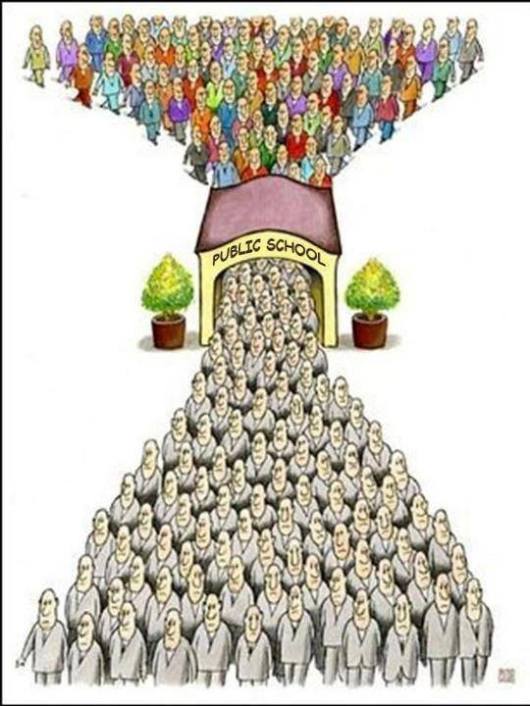
“The public school system: Usually a twelve year sentence of mind control. Crushing creativity, smashing individualism, encouraging collectivism and compromise, destroying the exercise of intellectual inquiry, twisting it instead into meek subservience to authority.” —Walter Karp

I remember discussing this topic with one of my favorite teachers, Petre Anghel. He once said:
– After all teaching is one of the most ‘conservative’ human endeavors. Not only that it endows the young with a wealth of information but it also means teaching them useful time proven survival strategies.
– ?!?
– Traditions, my son (I was 45 at that time), are nothing but time proven survival strategies. Yet at the same time we, teachers, have an immense responsibility. Besides passing over traditions and the ability to take orders we need to teach you how to adapt those traditions if life demands it. And this is where the real conservatism is. How to determine that a change is really necessary and how to implement it with minimum side effects needs a hefty dose of humility. Implementing wholesale discretionary change and then ‘training’ everybody into submission is not that hard, even Lenin and Stalin were able to pull this stunt, but what does this mean to the society, in the long run?

On the other hand the institutionalized education system, be it public or private, is an immensely powerful tool in the hands of the current generation. When using it “this” generation should be aware that power implies responsibility. The psychological conviction that ‘my way is the best way’ is understandable. After all if it weren’t good enough we wouldn’t have been here to pester the new generation with our advice: ‘this is how things should be done!’. Yet we should always remember how it was when we were growing up and how we rebelled against our parents. The mere fact that we have less children than our parents did and hence it’s easier for us to dominate them by sheer numbers doesn’t mean anything has changed, each generation defines itself ‘against’ the old one.
If the old one is wise enough to understand that, to let go, to encourage the next generation to experiment – just as the eagles encourage their young to fly away from the nest – after a while the ‘hatchlings’ will come back to the nesting ground for further instructions, to take care of their old and eventually to build their own nest and to continue the tradition. But while gone away they would have learned new skills and discovered new things so they’ll be able to adapt that tradition if needed.


If the old generation insists in keeping a tight leash the rambunctious will leave anyway, but never to return, and the old nesting ground will be left with the frightful and the meek to try to continue their parents work. It’s up to us to decide which way we want it to be.

It’s our children’s future at stake here, and ours too, so we’d better take care.

Unii sustin ca ‘barbatii sunt de pe Marte iar femeile de pe Venus’.
Eu continui sa ma intreb daca tot s-au hotarat sa traiasca impreuna pe Pamant de ce nu se adapteaza oare noilor conditii?”

Ca de obicei in aceste  cazuri multumesc celor care mi-au trimis bancurile pe mail.

“Un om s-a intrebat daca e pacat sa faca sex in ziua Domnului, deoarece nu era sigur daca sexul este o munca sau o joaca.
Asa ca s-a dus mai intai si a intrebat un calugar asupra problemei in cauza. Calugarul i-a raspuns:
– “Fiul meu, dupa indelungate cercetari asupra Cartii Sfinte sunt in masura sa-ti zic ca sexul este o munca, asadar este pacat sa-l faci in ziua Domnului”.
Neincrezator, si gandind “ce stie un calugar despre sex?”, omul s-a dus apoi la un preot cu experienta si casatorit. A primit acelasi raspuns: sexul este o munca.
Pentru a se lamuri definitiv s-a gandit sa se duca si la rabin. Rabinul i-a raspuns:
– “Dragul meu, cu siguranta sexul este un joc si poti sa-l faci linistit asadar in ziua de Sabat.”
Curios, omul nostru l-a intrebat:
– “Cum poti fi asa de sigur?”
Zambind, rabinul i-a raspuns:
– “Daca sexul ar fi fost o munca, nevasta-mea ar fi pus-o pe menajera sa-l faca.”


Intr-o zi sotul vine mai devreme acasa si uimit o gaseste pe nevasta-sa cu amantul ei.Surprins,acesta ii spune amantului: 
− Sunt un om relativ calm, hai in camera cealalta sa discutam.
Amantul bucuros ca nu are probleme se duce in camera de alaturi si sta de vorba cu sotul femeii ca de la barbat la barbat
− Fii atent ce facem,zise sotul. Voi trage doua focuri de arma in aer si ne vom preface morti la cine va veni nevasta-mea acela o va pastra.
– OK.
Sotul trage cele doua focuri de arma si din camera de vizavi se aude:
− Costele, poti sa iesi de sub pat ca dobitocii aia s-au impuscat intre ei.


Orice mamă trage nădejde ca fiica ei să aibă noroc de un soț mai bun decît a avut ea.
Pe de altă parte, e absolut convinsă că fiul ei nu va avea noroc de o femeie cum a avut taică-su.


Image

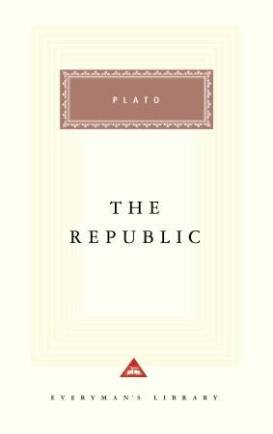
Our admiration for Plato speaks volumes about who we are and about where we are on the historical ladder.

Toward the end of the astonishing period of Athenian creativity that furnished Western civilization with the greater part of its intellectual, artistic, and political wealth, Plato wrote The Republic, his discussion of the nature and meaning of justice and of the ideal state and its ruler.”

What had happened, back then, was that Athens had invented a certain kind of democracy (based on ample opportunities and relative abundance) and, using that political system, had build a very successful society.

In time, the system became perverted – mainly because pampered people loose their edge – and its future demise started to become apparent for the open minded thinkers. Among them, Socrates was one of the most vocal critics and had payed dearly for not keeping his mouth shut.

We should remember now, if we are to believe Plato’s words, that ‘the Republic’ is nothing but the faithful reproduction of an actual conversation. Socrates own thinking, in spirit and in words.

Let me take a break at this moment and remind you two things:

1. Rome, which had also started as a democracy, at some point had conquered the entire Greece – including Athens, discovered the works of Plato, admired them and, a little later, its political system also degenerated into authoritarianism and eventually failed miserably.

2. Western Europe had forgotten about Plato for more than a millennium and rediscovered him because the Arabs had preserved his work. Moreover until recently  only specialized scholars had any idea about who Plato was…

Back to the ruling process…

I’ll assume the translation was faithful and Plato really meant ‘rule’ as opposed to ‘govern’, ‘impose your own will upon the community’ instead of ‘putting in practice the will of the people’…

Now let me remind you that no matter how wise a ruler and how proficient a builder Pericles was, his reign ended the epoch of grandeur for Athens. After that, the great city had experienced a 2000 years decline…And here are some other interesting thoughts about that era: “There is no little irony in the fact that one of the things we most admire in the ancient Greeks is their love of freedom – and yet one of the chief manifestations of that love was their constant striving to control in some way the futures of their neighbors.” (Robin Waterfield, Athens, a History…)

So what was Plato really trying to say?

“The heaviest penalty for declining to rule is to be ruled by someone inferior to yourself.”

Well, I have no way of knowing exactly what went through his head when he was writing this but I can infer a thing or two from his words:

– He was speaking about an epoch were bona fide democracy was no longer the prevailing political system. Not only that he used ‘rule’ instead of ‘govern’ but, according to the written texts which have survived, the public offices were up for grabs and the ‘important’ person itself was the one to decide whether to ‘rule’ or to govern.

– People were rather arrogant at that time… who’s job was to decide who was ‘above’ and who was ‘below’? How come am “I” so sure that “I” am the most qualified (superior) to rule and that everybody else is/should be considered my inferior?

Then what made Athens, and then Rome, fall from the pinnacles where they had managed to climb while they governed themselves as democracies?

As for Plato maintaining that all he did was to ‘faithfully’ record Socrates’ words… allow me to have some doubts.

Socrates was asked to kill himself because of his teachings – ‘you should learn to think with your own head’ – were perceived, by the powerful-s of the day, as being dangerous for the younger generations.

Was it be possible that the same thinker might have uttered, as Plato pretended:

[Socrates]Then, I said, the business of us who are the founders of the State will be to compel the best minds to attain that knowledge which we have already shown to be the greatest of all-they must continue to ascend until they arrive at the good; but when they have ascended and seen enough we must not allow them to do as they do now.

[Glaucon] What do you mean?

[Socrates] I mean that they remain in the upper world: but this must not be allowed; they must be made to descend again among the prisoners in the cave, and partake of their labors and honors, whether they are worth having or not.

[Glaucon] But is not this unjust? he said; ought we to give them a worse life, when they might have a better?

[Socrates] You have again forgotten, my friend, I said, the intention of the legislator, who did not aim at making any one class in the State happy above the rest; the happiness was to be in the whole State, and he held the citizens together by persuasion and necessity, making them benefactors of the State, and therefore benefactors of one another; to this end he created them, not to please themselves, but to be his instruments in binding up the State.

There is absolutely no difference between this line of thinking and that which was taught by Marx to his followers:

The Communists, therefore, are on the one hand, practically, the most advanced and resolute section of the working-class parties of every country, that section which pushes forward all others; on the other hand, theoretically, they have over the great mass of the proletariat the advantage of clearly understanding the line of march, the conditions, and the ultimate general results of the proletarian movement.

The immediate aim of the Communists is the same as that of all other proletarian parties: formation of the proletariat into a class, overthrow of the bourgeois supremacy, conquest of political power by the proletariat.

The theoretical conclusions of the Communists are in no way based on ideas or principles that have been invented, or discovered, by this or that would-be universal reformer.

They merely express, in general terms, actual relations springing from an existing class struggle, from a historical movement going on under our very eyes. The abolition of existing property relations is not at all a distinctive feature of communism.

What we have here is nothing but two examples of extreme arrogance.

Both posit that ‘I (disguised as ‘the thinkers’/’communists’) know better than all of you so you’d better obey me. Or else.’

For both the State is instrument of oppression, not the expression of the free will of its inhabitants.

I refuse to accept that Socrates actually thought like that.

On the other hand Plato wrote his Republic during Pericles’ reign and Aristotle, Plato’s favorite pupil, was the teacher of Alexander the Great.
And no matter how many exploits Alexander had ‘committed’, we shouldn’t forget that he was nothing but yet another ruthless dictator. More successful than most but still a dictator. Same thing for Pericles. He was indeed a great builder and administrator but his reign marked the end of the Athenian democracy. Very soon after him the entire Greece had lost her independence and political significance.

All that was left was the Greek culture. The habit of thinking with one’s own head. Socrates’ legacy, not Plato’s.

PS.

Now what if Plato had written his dialogs as a warning rather than as a set of guidelines? ‘This will happen’ – historical facts were already clear enough, ‘if you do such and such things’.

It’s up to us, his readers, to choose what we consider to be the proper interpretation!

Which reminds me of the diehard Marxists who still believe ‘the bearded one’ was right and that his ideas had been badly put in practice by the likes of Lenin, Stalin, Pol Pot, Ceausescu…

Ce e nou in asta? Din cauza nenorocitului de Ceausescu care adusese tara intr-un asfel de hal incat copii prematuri sau bolnavi erau transfuzati cu sange testat superficial si in felul asta a aparut o intreaga generatie de bolnavi?

Pentru aceia dintre voi care nu stiu cum e cu SIDA asta, treaba sta cam asa.
Iei virusul, de cele mai multe ori prin contact sexual dar se poate si prin transfuzii sau pe alte cai, dupa cateva saptamani sau luni ai niste simptome ca de raceala si boala intra in latenta. In timp virusul se imprastie in intregul sistem imunitar si il slabeste in asa hal incat, netratat, bolnavul moare din cauza unor infectii cu germeni ‘oportunisti’ (prezenti in mod curent si de obicei nepericulosi) sau a unor cancere rare si ciudate.
Perversitatea acestui virus consta exact in faptul ca ‘adoarme’ vigilenta sistemului imunitar. In felul asta organismul nu mai recunoaste agresorii (virusul cu pricina isi face ‘un culcus’ chiar in interiorul sistemului imunitar, pe care il slabeste treptat) si apoi cade prada atacului patogenilor oportunisti.


Bine, numai ca eu nu la felul asta de SIDA ma gandeam acum.
La nivel societal rolul sistemului imunitar este jucat de triada libertate de exprimare (presa)/justitie/politie. In felul asta ies la iveala comportamentele aberante/antisociale ale acelora dintre noi care incearca sa o ia ‘pe scurtatura’ iar societatea poate sa se protejeze de efectele nefaste ale activitatii acestora. Pe termen lung toti avem are de castigat, tocmai prin mentinerea intregului mecanism in stare de functionare iar intr-o societate normala cei mai interesati de bunul mers al acestor mecanisme sunt chiar cei care au cel mai mult de pierdut daca totul se duce dracului.
Adica oamenii cu dare de mana care au de pierdut averile stranse cu greu si oamenii educati care inteleg ce se intampla.

Acum hai sa ne uitam in jur.

” “O parte semnificativă a presei este în continuare folosită de patroni ca armă în vederea obţinerii unor avantaje politice şi economice sau pentru a pune presiune pe justiţie”, se spune în raport, precizându-se că “politizarea discursului mediatic a fost evidenţiată de decizia unor jurnalişti de a migra în mediul politic şi de atacurile tot mai frecvente între oamenii din presă, în care predomină ameninţările, injuriile şi limbajul vulgar”.

În raportul ActiveWatch se spune şi că media îşi abandonează adeseori misiunea de a informa, în schimbul promovării unor mesaje favorabile intereselor unor entităţi private.

Totodată, conform raportului FreeEx, unele instituţii media folosesc abuziv dreptul la liberă exprimare pentru a intimida alte persoane/grupuri sociale/ justiţia/grupări politice, iar, pe de altă parte, “mai mulţi politicieni au cerut închiderea unor instituţii media”.

“Abaterile etice tot mai frecvente ale presei au fost sancţionate de instanţe, în baza noului Cod Civil”, se spune în raport.

Potrivit aceluiaşi raport, unele instituţii media şi unii oameni din presă îşi somează colegii de breaslă să nu mai relateze critic despre ei, ameninţând cu procese.”


Adica exact o parte dintre cei care au cel mai mult de pierdut, investitori si ‘oameni de cultura’, comploteaza pentru a deturna ‘triada de protectie’ de la functia ei fireasca – apararea intregului organism social – catre promovarea unor interese de grup.

SIDA, mâncați-aș!!!

Si noi, astialalti, stam ca fraierii si asteptam sa ne manance ‘oportunistii’ de cur.
OK, aia care fac treaba asta nu isi dau seama ca isi taie singuri creanga de sub picioare, cred ca vor putea fugi la timp din tara, or fi convinsi ca sunt deasupra ‘tutulor’… da’ chiar toti… parca a dat cineva cu praf de orbu’ gainilor … nu ne mai vine odata mintea cea de pe urma la cap…

PS 1. Pentru cine vrea sa citeasca intregul raport Active Watch, iata-l aici: http://www.activewatch.ro/ro/freeex/publicatii/raport-freeex-2013-video/


Image

Now why would anyone who finds itself in a boat be drilling holes in it?
Insanity?
Not that it doesn’t happen…