

Click on the picture to see some others on Flickr
Click on the picture to see some others on Flickr
This doesn’t catch the entire picture – each of us is heavily dependent on the environment into which we happened to be born – but clearly states the difference between us humans and the rest of the animal kingdom.
We are able to make conscious decisions and we love to apportion blame.
When engaging into our favorite pastime we’d better take into consideration two things: Our consciousness/rationality is limited and we can speak about blame only if intent was present.
We don’t have unlimited access to other people thoughts, nor can we see very far, so, in reality, we are aware of a very limited portion of the world around us. Moreover, no matter how confident we are in our minds, our processing power is also limited. So both our decisions and our ability to accurately apportion blame are not at all infallible. Far from it.
On the other hand blaming natural causes or even people who are not aware of (some) of the consequences produced by their actions for what has happened to us doesn’t make sense. A lighting doesn’t know that it frightens people and may wreak havoc in a city if the electric grid is knocked out of order, just as the ‘financial engineers’ who came up with the concept didn’t know, at first, what effects ‘securitization‘ will have upon the global financial markets.
Hey, you promised us something about manipulation and management, not another essay about financial markets manipulation!
True enough so let me discuss first what manipulation is: nothing but a psychological tool. Please note that I’m concerned here with the lofty notion of ‘thought manipulation’, not with the mere ability of ‘juggling’ objects into position….
Regardless of why or for what purpose it’s performed, manipulation remains a simple and very efficient tool that can be used even ‘pre-consciously’ – if you don’t believe me remember how toddlers manipulate their parents into buying them diverse things that are not only a complete waste of money but also sometimes dangerous for their long term health. In this case the manipulation is twofold: the merchandisers position certain items near the cashiers’ desks so that the children might not miss them.
As with any tool it’s up to the user (a.k.a. manipulator) to set the standards, what’s acceptable and what not.
Really? But what if the manipulator is not fully aware of the consequences of his acts? (Remember my digression into the subject of limited rationality/consciousness?) Could it be that the entire world might be shaken, even worse that it has already been, by the yet unforeseen consequences of a manipulation already underway?
Well, as no manipulator is that skilled as to be able to avoid detection for very long, the sad part about the whole thing is that most of the time we know/feel that we are being manipulated and allow it to happen out of laziness or complacency… This being exactly the moment when we should start blaming ourselves for our own lassitude.
Even more ‘interesting’ is how we rationalize the daily use of manipulation:
So, how much ‘out of their own interests’ is it acceptable for us to manipulate the thoughts of other persons? Specially when they are, after all, our close associates – either clients, subordinates, bosses or even colleagues, friends, relatives, close family.
And, given that sooner or later everybody realizes at least some of the manipulation he has been subjected to, the survival of our entire social life basically depends on how much manipulation each of us is disposed to submit to.
Rather scary, don’t you think? Specially if we take into consideration the fact that manipulators do not always know exactly what they are doing….
Don’t despair. There are people, among the ‘movers and shakers of this world’, who have noticed at least part of what’s going on and have started to act:
When more of us will get it that we’re all together in this, we’ll reinvent mutual respect and scale back manipulation to its natural status: a very useful tool for grabbing the attention of whomever we want to talk to. Used in this manner, like all decent advertisers do, manipulation becomes not only innocuous but also useful for both parties. One is able to get its message across and the other finds out easier what’s going on in this world.
There are costs to be incurred, of course. Those who refrain from more aggressive manipulation may loose some money at first and those who pay a lot of attention to the messages – precisely because they are no longer aggressively manipulative – may end up spending in this manner a lot more time than they used to until now. But if and when we’ll realize that long time survival is a lot more important than short time profit then we’ll foot the bill without much hassle.
Dr. Wayne W. Dyer, “Everything you do…” : https://www.facebook.com/drwaynedyer/photos/a.387583371029.167523.83636976029/10151331343881030/?type=1&theater
Segoviano, M., et all, Securitization, Lessons Learned and the Road Ahead: http://www.imf.org/external/pubs/ft/wp/2013/wp13255.pdf
Case Study, The Colapse of Lehman Brothers, Investopedia: http://www.investopedia.com/articles/economics/09/lehman-brothers-collapse.asp
Peeling, Nic, Principles of Management, Dorset House Publishing, http://www.dorsethouse.com/features/excerpts/exdpch1.html
Allen, Peter L., Toward a new HR. Philosophy, McKinsey Quarterly: http://www.mckinsey.com/insights/organization/Toward_a_new_HR_philosophy?cid=other-eml-alt-mkq-mck-oth-1504
Dolmanian, Sarchis, Profit, Might it be overrated?: https://nicichiarasa.wordpress.com/2013/10/08/profit-might-it-be-overrated/
Click on the picture and read a very interesting article about what’s going on in some schools.
Before that I’d like you to consider something.
How, and what, am I supposed to teach you about a certain activity if the gist of my lesson is going to be that the best thing you can do, supposedly for a while (?!?), is to refrain yourself from engaging in that activity?
Duh…

Bill Gates Alex Wong Getty Images
Bill Gates disapproves of Thomas Piketty’s method of leveling the play-field – levying a capital tax – and proposes a different tack: a progressive tax on consumption.
While I agree with both Gates and Piketty that extreme economic imbalances are bad for the society I profoundly disagree with both about how we should deal with them.
First things first. Extreme economic imbalances being bad has nothing to do with morals and very little to the fact that the poor feel bad when exposed to the excesses of the ‘filthy rich’.
They are bad simply because the dirt poor cannot express their creative potential and because the rich end up concentrating too much of the decision power. The society as a whole – including the super rich – looses, specially on the long run.
Taking the decision power from the hands of the super rich and giving it to the governments, through increased taxation, would only complicate matters. Not to mention the byzantine mechanism needed to enforce Bill Gates’ consumption tax.
Encouraging the rich to donate more would somewhat alleviate the problem but not much since until the money were distributed, if ever, the decision power would still remain too concentrated for our own collective good.
How about those same very rich people, now that enough of them have understood the perils associated with extreme economic imbalances, simply setting an example and start calculating wages using a completely different principle than is used today?
What if instead of ‘as low as the market allows’ they would ‘compensate’ their employees, all of them, as generously as their businesses can reasonably afford to? Somewhat in line with what Ford did back at the start of the XX-Th century, with more than excellent results for both sides? And does again now!
And how about the same rich and powerful individuals using their ‘political muscle’ and insisting on better governance? After all if their businesses and trust funds would have been run as most governments are run today they would have gone under a very long time ago…
And then, after the governments would have been ‘fixed’, and tax money not wasted anymore, how about the very same 1% start paying in earnest their ‘normal’ taxes, like the rest of us?
Surprise, surprise…
The real dangers of extreme economic imbalances: https://nicichiarasa.wordpress.com/2014/10/29/extreme-fragility-dead-ahead/
Why Ford increased wages back then: http://www.forbes.com/sites/timworstall/2012/03/04/the-story-of-henry-fords-5-a-day-wages-its-not-what-you-think/
Ford increases wages now: http://www.wsj.com/articles/ford-to-move-hundreds-of-entry-level-workers-to-higher-pay-rate-1423026005
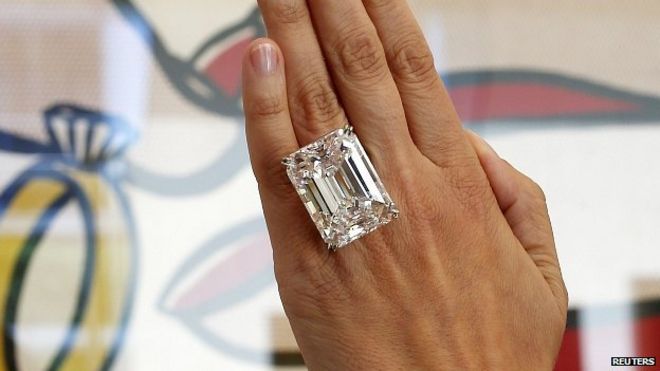
Ever wondered why sometimes diamonds are called ‘rocks’?
Well, tell me you’d let your wife carry one of this size on her hand…
‘On the other hand’… playing with it for a while might prove to be a completely different experience!

This image constantly pops up all over Facebook.
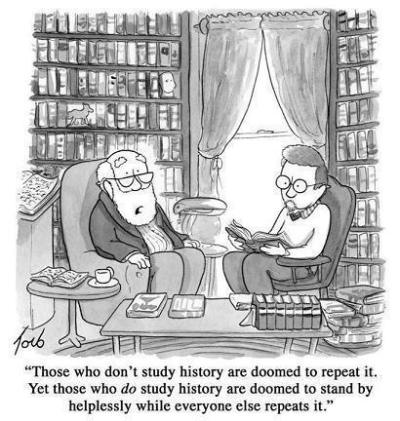
And while the caption does harbor some truth it somehow completely misses the point.
So:
– Those who don’t study the history have all the chances to repeat it but only if they are just as callous as their ancestors.
– Those who do study the history and stand by helplessly while everyone else repeats it have studied it in vain. They still haven’t got a clue about what really happened outside those books they’ve been reading. Had they learned a real understanding of what went on they would have been able, and willing, to explain it to their contemporaries and thus help them move forward, to a totally different set of mistakes waiting to be made.
Just as Plato (and Marx after him) thought of having found the absolute truth and did his best to lead his people to it …
But don’t despair. There is a safer way. To let things take their own course, to develop naturally. Just as Lao-Tzu taught us.
Karl Marx and Max Weber, two different pupils of Plato:
https://nicichiarasa.wordpress.com/2015/02/28/karl-marx-and-max-weber-two-different-pupils-of-plato/
We need to let our hearts acknowledge beauty wherever and whenever we encounter it before telling to ourselves ‘I cannot understand (accept) what is going on there’.
If we’ll do that, ‘not understanding’ will no longer stand in the path of our acceptance of something different than we were accustomed to.
If humans have been created equal why some cannot express themselves just as freely as all the others?
First take a look here:
Had your laugh? Wiped your tears?
Now tell me whose question was the mommy answering?
Her daughter’s?
Or was she trying to get off her chest something that was nagging her since she’d been told by the good doctor: ‘congratulations, you have a beautiful baby girl!’?



 nicichiarasa
