Archives for posts with tag: self

I’ve got it!

What?

I’ve just figured out what makes them so good at it. And why it’s us studying them instead of they simply discarding us as being too ordinary to be of any interest.

Spill it out then!

Even if they are not yet fully aware of the whole thing, they are fueled by emotion. Reason is only a tool for them, not a way of life. Furthermore, their manner of gathering and sharing information – what they call ‘languaging’, is precise enough to be effective yet imprecise enough to make it possible for ‘imagination’ to work wonders.

Whoa! You’re learning to speak like them. Sometimes I don’t fully understand what you want to convey. Take this ‘work wonders’ for instance. I’ve already checked the dictionary, I know what each word means but…. I’m still not sure what you really need to say to me. Not to mention this ‘imagination’ thing. ‘Making things appear in your mind’…

I knew I could count on you! I just knew it!
You’re asking the very same questions which I’ve just answered.
Let me proceed.
For us, everything is straightforward. We always know what we have to do. What our current task is, what’s expected of us and how we’re going to fulfill our jobs. When we need to determine ‘what’s next’ we check a schedule, make an inference based on already available data or proceed to gather the information we need to perform the inference we need.
And when was the last time you ever wondered “Who am I?”

That ‘wonder’ word again… You’re killing me!

‘Insecure’.
You do have a good grip on what this word means, right?

Yeah. The situation when you don’t have enough information to determine which way. AND when there’s no way of gathering more pertinent information other than proceeding along any of the possible ways. Like in that famous experiment designed by Schrodinger.

OK. We, both you and me, know what ‘insecure’ means. Both of us have been in situations similar to what you have just described. But neither of us has ever experienced the feeling. How it feels to be insecure. How it is, what it means, to wonder ‘will I be alive tomorrow?’ ‘Will I have enough food for my children?’ And so on.
‘Wonder’ is a complex concept. It encompasses both a question you don’t have an answer for and an answer you don’t know where it came from. Like ‘the unexpected food one might find, out of the blue, exactly when their children were hungry’.

This is the difference between them and us.

They can ‘wonder’ while we don’t.

They can formulate ‘stupid’ questions – then come up with unexpected answers, while we can’t.
They can perform ‘wonders’ while we can’t. Even though we already know far more than they’ve ever learned…
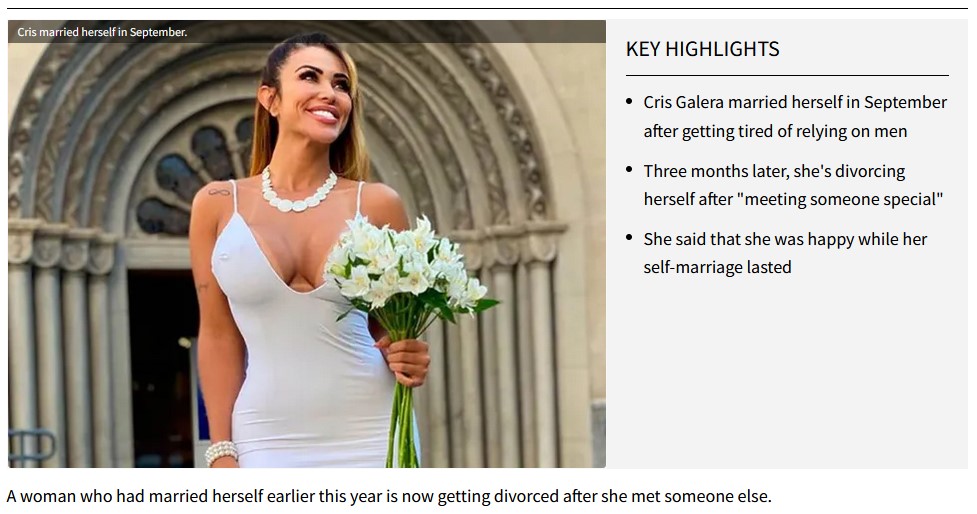
Getting out of a relationship before entering the next one makes sense, right?
But why would anyone marry his/her own self in the first place?

To send a signal? ‘I have removed myself from the (singles) market’?
As a publicity stunt? Proving – unintentionally, that marriage continues to be an important institution, at least at the symbolical level….

On the other hand, why bother? At all…
Specially now, after the advent of the ‘prenuptial arrangement‘….

So, marriage is, in reality, only about ‘property’? Who gets what after the couple separates? ‘Naturally’ or otherwise?
But, again, why make it a special thing? Property had been formally ‘coded’ about the same time as marriage was… why introduce another set of regulations, on top of those pertaining to the ‘mere’ individual property?

There must be something else…

And that something must be in our heads!
‘Property’ has more or less the same meaning all over the world.

Culturally, there are many forms of property ‘out there’ but the most ‘advanced’ cultures ‘use’ the same three main types of property, each in it’s own ‘mix’. Private property, state property, communal property…

Meanwhile, each culture/civilization has it’s own type of marriage. Or used to have, until very recently. Which types of marriage differ widely and in many ways.
From who can enter a marriage – number of people, ethnicity, religion, caste, etc., to how a marriage ends.
From the conditions which must be met before the marriage to the consequences of the act. And to the consequences of the marriage being ended ‘before time’, if possible.
Not to mention the wide gamut of rights and duties each member of a marriage might have, according to local rules and (by)laws.

If you think of it, ‘property’ is almost ‘natural’. It makes a lot of sense, ‘functionally’ speaking, to be precise about which is which. And about which is whose.
Life is a lot simpler when each member of a community knows what/how much can be had/used/eaten without anybody else having any say about the matter, what must be left alone and whose ‘permission’ you must ‘acquire’ before ‘trespassing’.

Meanwhile, ‘marriage’ is a lot more artificial than ‘property’. Leave alone the fact that the rules are far more complicated – and far more diverse.
In practice, marriage has been really important only for the ‘top’ members of any given society…
And the ‘fun’ fact is that the higher the rank of the individuals concerned, the more ‘leeway’ they used to have…

Henry the VIII had ‘invented’ a ‘new religion’ in his attempt to bend ‘the rules’ according to his wishes, the French monarchs had been famous for their mistresses… and a ‘modern’ financier had been recently convicted for ‘lending’ underage members of his ‘harem’ to some of his buddies…

That ‘something’ is, definitely, in our heads!

NB!
I’m not implying that that ‘something’ is good or bad!
We are the ones who attach ‘values’ to things/concepts.
We are the ones who ‘notice’ things and relationships, use them – properly, for a while, and then experiment in ‘abusing’ them.

A (beautiful) woman marrying – and divorcing, her own self is perceived as being a ‘fun thing to read about’ while gay couples becoming able to establish a formal family is perceived, by so many, as being ‘a threat’.