Archives for posts with tag: immortality

Evolution is not about ‘survival of the fittest’.
Evolution is about the demise of the unfit.

Ernst Mayr, What Evolution Is, 2001

Well, it actually makes a lot of sense.

Being healthy is relative.
On having a diagnostic hanging over your head.

Here’s another way of looking at things.

Functional versus dysfunctional.
For as long as one is functional, that person is not a burden for anybody. Regardless of any diagnostic.
Even a dysfunctional person can be useful for those around them. Even if that person is completely dependent on those taking care of them. A good word spoken at the right moment makes wonders.

So yes, I would also love to die ‘healthy’. As in trying to do my best to be useful.
At least, to be as light a burden as possible.

On the other hand, health is yet another virtual thing. ‘Virtual’ as in man made…
Until not so long ago, ’cause of death’ for people over a certain age was always ‘old age’.
No longer. No matter how old the deceased, the body is transported to a medical facility and the particular cause of death is forensically determined.
It makes perfect sense. Scientifically speaking. There is no such thing as too much data, specially when it comes to something as precious to us as human life.
And it raises a ‘somewhat’ unreasonable kind of hope. That sometime, somehow, all causes of death will be mitigated. Diagnosed and treated.
That life will become ‘longer’. That we, humans, will live if not forever… then until an accident will happen to shorten our destiny.

Can you imagine something like that?
People living for 3 or 4 hundreds of years?

No retirement.
No risk taken.
No change…
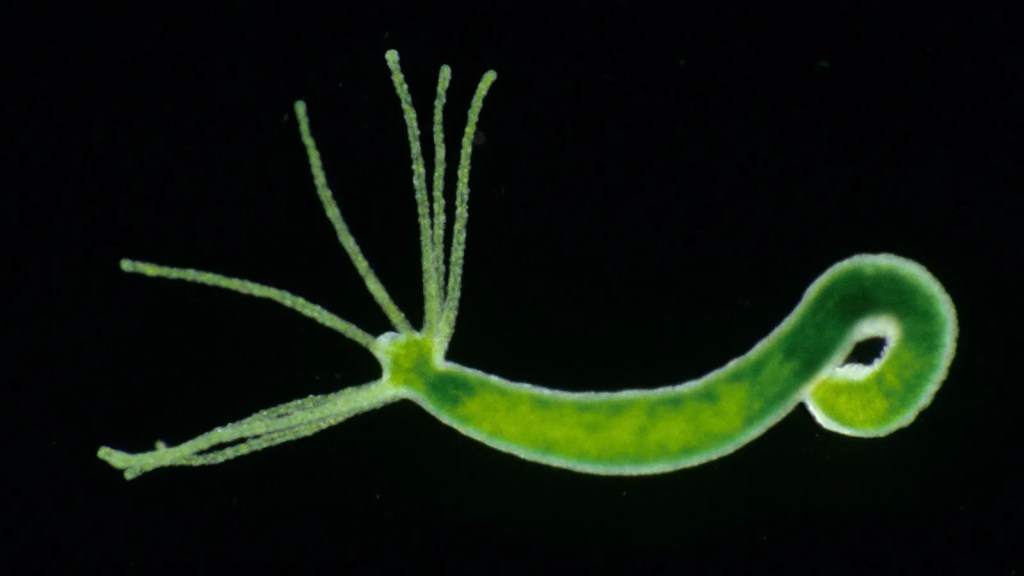
Named after the Ancient Greek mythological serpent, the freshwater hydra has a remarkable ability to regenerate (Credit: Natural Visions/Alamy)

Just finished reading a very interesting article on BBC.com/future. Why do we die. Authored by William Park.
Just click on the picture above and read it.

Despite the “we” in the title, it’s a compendium of plausible explanations for why most individual organisms eventually die. And an interesting row of examples of species comprised of individuals which live practically for ever.

Here’s another explanation.

Charles Darwin’s Evolution was about ‘species’. Not about individuals!

Very few species have been able to survive without ‘killing’ their individual ‘members’.
Hydra, the species of fresh water jellyfish pictured above, is one of those species. Each individual hydra is able to survive practically everything but total annihilation. Cut it into pieces and each piece would regenerate the rest of the organism. Allow a big enough (?!?) piece of it to survive while attempting to eat a hydra… and you may be able to eat it again! If you live long enough for the encounter to happen again…

Since when have we been observing this species? A hundred years? Two hundred? Have we had preserved an individual hydra since the start of our observations? Is is still alive? In the ‘original form’?
And even if ‘yes’, so what? That would only prove that an individual hydra is able to survive for more than, say, two hundred years. Not that it would live forever….
Again, being able to regenerate a portion of an organism doesn’t mean the whole organism would be able to live indefinitely. As in live forever. Never die…
The way I see it, being able to regenerate the rest of the organism is only yet another form of ‘reproduction’, not the ability to live forever. Bacteria use the very same mechanism. We the ones who use a different name for it, under the pretext that bacteria are unicellular organisms…

Now, the fact that there are so few species whose individual members are able to regenerate parts of their organisms does tell us something.
And the fact that it’s only the ‘simply organized’ species – among the animal kingdom, at least – which share this ability must surely mean something. Evolutionary wise!