Archives for posts with tag: Collective identity

Bloody Caesar


Did you know this maxim was attributed to Philip II of Macedonia and was heavily used by both Caesar and Napoleon?

Also, did you know that it covers a lot more than ‘divide and conquer’?

For instance, a rather successful computer game and a problem solving methodology  that recommends the original problem be divided into smaller, and hence easier to manage, sub-problems.

Going back to the original meaning I must admit that both the ancient Macedonians and the ancient Romans made ‘good’ use of it. Alexandre the Great had conquered everything between Greece and India while the Ancient Rome had been, for a while, the most powerful empire known to man.

In more modern times the same strategy had been used by Germany, among others. Again, with relative success. During WWI the Kaiser had facilitated Lenin’s access to Russia and by doing so he had split the coalition he was trying to defeat – as a result of this manoeuvre Russia had asked for a separate peace treaty, eventually signed at Brest Litovsk. During WWII Hitler took great care to keep Russia at bay while he conquered the Western part of Europe.

Now the same strategy is being used by Vladimir Vladimirovich Putin, the current Czar of Russia.

On Sunday, March 22, 2015, Sankt Petersburg – Putin’s birth place and political trampoline – hosted the Russian Conservative Forum. It was attended by a “a motley crew of representatives of fringe right-wing political organizations in Europe and the United States” which “including Hitler apologists, Holocaust deniers, apartheid fans, and a Russian skinhead who once decapitated a puppy as a publicity stunt, gave it an air of dark surrealism. Speakers condemned the U.S. as the enslaver of Europe and sang the praises of Russian President Vladimir Putin, holding up Russia as the last fortress of Christendom in the war waged on it by liberalism and multiculturalism.
“In the West, we are brainwashed to hate Vladimir Putin,” said British anti-abortion-rights campaigner Jim Dowson. He went on to say that Russia is blessed to be ruled by “a real man” while the U.S. is led by the “feminized” Barack Obama.”

On Tuesday, March 24, “The UN General Assembly’s budget committee … rejected a proposal submitted by Russia that called for withdrawing a July 2014 administrative ruling by UN Secretary-General Ban Ki-moon. He ordered the world body to recognize same-sex unions of any of its 60,000 global staff who wed in countries that legally recognize such partnerships.
The dispute turned an internal UN personnel policy into a microcosm of the differences that pit the U.S. and EU nations against more socially conservative countries over recognizing rights of those who are lesbian, gay, bisexual or transgender.”

If we put two and two together and then add the result to what has already become evident – that the Russian (more exactly Putin’s) Propaganda machine has been revved up in a massive way for quite a while now – the pattern becomes visible.
Putin is ‘doing his worst’ to convince those uncomfortable with the spread of ‘liberal values’/globalization that if they want to ‘preserve their national traditions’ they have to ‘unite closely around’ the only leader that can save them from being engulfed by the ‘decadence of the West’. Around him, that is.

In fact this is exactly what the ’emperors of old’ I mentioned at the beginning of the post used to recommend. Instil as much fear in your opponents, individually, as you can and try to rekindle the smallest differences that ever existed between them.

There is a small problem though with this line of thinking.
No matter how much we respect/admire some of them or hate/despise the others none of those who had used this strategy ended up in a ‘comfortable’ manner.
And all of them had brought great misery to the people under their rule. Including Caesar. A civil war is no small thing, not now, not then!

While we ponder what to do in order to counter this nefarious propaganda, we need to keep in mind that Russia is not Putin and that the Russian people has never had a taste of what real democracy feels like. Blaming the entire people, wholesale, for what Putin does in their name ‘is worse than a crime, it’s a mistake’.

PS. Same counter-strategy should be applied to all would be ‘dividers’ who try to become ’emperors’.

http://scarlet.unl.edu/scarlet/archive/2008/02/28/story9.html
http://rsif.royalsocietypublishing.org/content/royinterface/12/104/20141335.full.pdf
http://history.stackexchange.com/questions/14608/did-the-germans-purposefully-arrange-to-send-lenin-to-russia-to-start-a-revoluti
http://www.historylearningsite.co.uk/treaty_of_brest-litovsk.htm
http://www.newyorker.com/news/daily-comment/a-hateful-sort-of-love
http://www.nytimes.com/2015/03/23/world/europe/right-wing-groups-find-a-haven-for-a-day-in-russia.html?ref=europe
http://www.bloomberg.com/news/articles/2015-03-23/is-russia-against-fascism-or-isn-t-it-
http://www.bloomberg.com/news/articles/2015-03-24/russian-bid-to-block-same-sex-benefits-for-un-workers-rejected
http://www.theguardian.com/world/2014/mar/17/crimea-crisis-russia-propaganda-media
http://www.unrv.com/fall-republic/caesars-civil-war.php

Politics were always about getting things done.

Modern politics used to be about dialog. People talked to each other and when a conclusion was accepted by a majority it became a policy and was put into practice.

Contemporary politics seem to be about hiding behind ideological smoke screens – values, rights, political correctness, platforms, you name them – while scheming about how to implement usually self serving and too often very short sighted policies.

I’ve spent the first 30 years of my life – practically my entire youth – under communist rule. The worst thing was the complete lack of alternatives. One ruler, one party, only one opinion that automatically became law. No way to escape the mistakes made by whomever happened to be in power and who, unfailingly, ‘lost it’ gradually as he spent more time at the top precisely because there were no ‘checks and balances’, no real dialogue between the various sections of the society.

The Western part of Europe – the area currently known as the EU and which was the starting place for the most destructive wars in human history – is crisscrossed by water filled channels. Some of natural origin and some build by the people living nearby. In peaceful times they were used as shipping lanes, in wars as trenches.

Political parties evolved as public platforms. Virtual places where likely minded people got together and discussed their opinions before proposing them to the society at large. Now-a-days they seem to have become fortresses where ‘frightened’ individuals congregate so tightly that no outside influence penetrates to their ears.

Bona fide negotiations have all but disappeared and have been replaced by ‘pork barrel’ laced with veiled threats.

What are we going to do from now on? Resume trading in good faith or prepare for war?
And no matter what the ‘talking heads’ are babbling incessantly IT’S UP TO US. After all it’s our own lives that are at stake.

If you think I’m exaggerating click here and read some of the comments. They were posted by regular people, the likes of you and me. For now they are still willing to share their feelings but don’t you think the atmosphere is just a little too tense for our own good and that nobody really listens anymore?

In Romania we have a saying that goes like this: ‘A fish rots from the head and should be scaled/gutted from the tail’.

We need to clean up our own, individual, act first. Only this way we’ll be able to convince the powerful-s of the day that we really mean it.
We can start by paying attention, real attention, to the persons living next to us. To our colleagues, to our employees… Of course we pay attention to our bosses and to our families, that’s how we survive in the short term.
Time has come to pay attention to the rest of the people. If we want to thrive in the long run.

http://thehill.com/blogs/ballot-box/236101-glenn-beck-im-out-of-the-republican-party#disqus_thread
https://d2k9njawademcf.cloudfront.net/post_promo_images/11202/original/scaling_fish.jpg?1409694449

Karl Marx. The world is crooked – there is too much exploitation imposed by the haves upon the have-not’s – so it has to be righted by those who have the right answer to the problem. And because the world doesn’t know what’s good for it, the ‘enlightened’ – the communists who are at the forefront of the class struggle – have the duty to impose the revolution by force.
The crux of the ‘solution’ being the abolition of both private property and the state. The private property because it is the tool with which the haves dominate the have-not’s and the state because it is the tool used by the haves to protect their private property from the have-not’s who continuously try to steal it.
But what tool can be best used to enforce the dissolution of the private property and to insure that the misguided and the ill intended don’t revert to the ‘old and corrupt ways of the bourgeoisie’? The state, of course. Hence we’ll have to postpone a little its dissolution, only until the first chores would have been completed, of course.

Max Weber. The world is too complicated to be understood/run by a single man, no matter how capable. That’s why the decision making process must be rationalized. Weber’s main methodological tool was the ‘ideal type’, a mental construction that is to be substituted to replace the real problem that has to be solved or the real thing that is being studied. This ideal type being stripped of the ‘unimportant’ aspects of the reality will make it a lot easier for the ruler/decision maker/scientist to understand what is going on there and to come up with the ‘correct’ decision or ‘clear’ understanding of the matter. This means that Weber was convinced that individuals are able, in certain conditions, to reach valid conclusions. Which is, of course, OK. Furthermore Weber had ‘reached the conclusion’ that if larger problems are to be solved then the efforts of single individuals are not enough and that in order to fulfill this task in a satisfactory manner many rational decision makers (which have been properly trained in their strict domains) have to be inter-connected into a well structured ‘net’. This way the big problem will be sliced into more manageable sub-problems which will be analyzed by specialists and then the final solution will be re-assembled by people specially trained for exactly this task. Nowadays this entire concept is known as ‘bureaucracy‘. In theory it sounds right, doesn’t it? What could be better than an all encompassing net comprised of rational/professional decision makers who act according to a well considered and well intended ‘ideal type’? Whose ideal type? Good question, indeed. Just as good as ‘who and how trained the ‘decision makers’?’.
(There is something we must keep in mind when discussing Weber, as a person. He died relatively young, before having a chance to reach a ‘final conclusion’, or at least one to satisfy him. That also has to be the reason for which he hasn’t published much during his lifetime.)

Plato. Society (the city, the “Republic’) should be run by a specific kind of (dedicated) people and because “those with the philosopher’s natural abilities and with outstanding natures often get corrupted by a bad education and become outstandingly bad” this ‘special kind of people’ need to receive “the proper kind of education“. Meaning that ‘a true philosopher’ has to be versed in ‘the Forms of Good’, which are amply explained in ‘The Cave Allegory’.
The gist of the matter is two layered.
1. The reality is hidden behind some ‘veils’ (or in ‘shadows’ if you prefer the original metaphor) but properly trained professionals (the philosophers) can be taught to see what Plato describes as ‘the ultimate truth’.
2. These professional truth seekers have not only the right to lead the rest of the people ‘into the light’ but the obligation to do so! Furthermore, for Plato the ‘ideal political structure’ – the Republic – would be so organized as to ‘force’ into public duty those who have been specially ‘bred and trained’ to perform such duty:
“Observe, Glaucon, that there will be no injustice in compelling our philosophers to have a care and providence of others; we shall explain to them that in other States, men of their class are not obliged to share in the toils of politics: and this is reasonable, for they grow up at their own sweet will, and the government would rather not have them. Being self-taught, they cannot be expected to show any gratitude for a culture which they have never received. But we have brought you into the world to be rulers of the hive, kings of yourselves and of the other citizens, and have educated you far better and more perfectly than they have been educated, and you are better able to share in the double duty. Wherefore each of you, when his turn comes, must go down to the general underground abode, and get the habit of seeing in the dark. When you have acquired the habit, you will see ten thousand times better than the inhabitants of the cave, and you will know what the several images are, and what they represent, because you have seen the beautiful and just and good in their truth. And thus our State which is also yours will be a reality, and not a dream only, and will be administered in a spirit unlike that of other States, in which men fight with one another about shadows only and are distracted in the struggle for power, which in their eyes is a great good. Whereas the truth is that the State in which the rulers are most reluctant to govern is always the best and most quietly governed, and the State in which they are most eager, the worst.”

I believe that by now you have grasped where I’m headed to. There is not much difference between Marx and Plato and a very close relationship between these two and Weber. Still, the fact that Weber was not yet done thinking about this matter at the moment of his untimely death makes me believe that if he had some more time at his disposal he would have understood what Laozi taught us about the concept of “nonaction”:

And isn’t it very strange that the best (short) presentation I was able to find about Laozi is hosted by a site called “Plato.Stanford.edu”?

https://www.marxists.org/archive/marx/works/1848/communist-manifesto/
http://www.academia.edu/4192854/Weber_s_methodology_understanding_concept_of_ideal_type_as_necessary_element_of_Weberian_comprehensive_sociology_Working_paper_
http://www.cf.ac.uk/socsi/undergraduate/introsoc/weber12.html

http://www.historyguide.org/intellect/allegory.html
http://plato.stanford.edu/entries/laozi/
http://izquotes.com/quotes-pictures/quote-the-wicked-leader-is-he-who-the-people-despise-the-good-leader-is-he-who-the-people-revere-the-lao-tzu-188515.jpg

This was inspired by the title of a Facebook post that shared an article from The Telegraph.
The guys ‘in charge’ of Saudi Arabia must be in a terrible situation.
Punishing the guy according to their own laws will further the perception of Islam as a ‘violent religion’ and thus make it less acceptable for the rest of the world.
Not punishing him would mean tacit acceptance of the fact that laws are made and applied by humans, not by any God, thus totally demolishing the brand of legitimacy the Saudi’s have worked hard to build for themselves.
Terrible predicament. I suggest we allow them to settle this among themselves.
Blaming ‘Islam’ indiscriminately for some horrible acts perpetrated in its name by a bunch of zealots would make things worse for everybody. So yes, let’s ‘move along’!
What we can, and definitely should do, is to insist on the ‘humanitarian’ side of the whole business.
PS Here is an interesting article about Sharia: http://www.pewforum.org/2013/04/30/the-worlds-muslims-religion-politics-society-beliefs-about-sharia/

I happened to stumble on an article about the tragic fate of Sophie Chotek.

The beautiful daughter of an impoverished aristocratic family attracts the attention and later becomes romantically involved with the heir of one of the most important European thrones of the time. Looks like a prequel for ‘Love Story’, right? … only worse, unfortunately. The reigning Monarch wasn’t happy about the whole thing and, to make things worse, ‘the law’ wouldn’t allow their union.

After huge complications that involved the intervention of Kaiser Wilhelm II, Tsar Nicholas II and Pope Leo XIII in favour of the ‘young lovers’ Emperor Franz Joseph gave in and yielded to the marriage, on condition that the children of the couple will not be able to inherit the throne and that the bride will never be treated as a queen or attend official functions at the side of her future husband.
And the worse was yet to come. After 14 years, to a day, of happy marriage both she and Franz Ferdinand, her husband, were assassinated together in Sarajevo.

Reading about the treatment she had to endure cannot but make me wonder about why would modern democracies still ‘entertain’ royal courts? Specially after what happened to Lady Di…

“The Emperor expressed his disapproval by not attending his heir’s wedding, as did Franz Ferdinand’s brothers and nearly every member of his family. The Imperial court, led by its chief overseer the Prince of Montenuovo (who was the child of a morganatic marriage himself) continued to humiliate the new “Princess of Hohenberg” at every opportunity. If for example the Imperial family were to hold a ball then Sophie would not only have to sit apart from her husband but be last in line to enter behind every other Hapsburg relation no matter how obscure. All contemporary reports state that Sophie never complained or even show displeasure at this treatment in public, earning the sympathy of many outside the court for her dignified response. Less inclined to forgiveness than his wife, Franz Ferdinand allegedly drew up a list of particularly obnoxious aristocrats for whom he intended payback when he became Emperor.”

So?

Well… It’s not so easy to dismiss the fact that some of the most successful nations, by any standards, are exactly those that have managed to balance the survival of the monarchy with ‘full blown’ democratic government. Not only in Europe.
Great Britain, Sweden, The Netherlands, Belgium, Denmark, Norway, Thailand, Japan … There must be something here!

Two things constitute the common denominator between these countries, besides being run as constitutional monarchies. They have all found their own road to democracy/rule of law and they had traveled this road in a relatively peaceful manner. Don’t be fooled by the fact that Japan had been ‘opened’ up by Matthew Perry and then defeated in the WWII. The Japanese emperor had been powerless since long before Perry and the ‘fathers’ of the Meiji Constitution might have been inspired by the German Imperial one but the transformation was instrumented by the Japanese politicians themselves, not by nor after being prodded by a ‘foreign power’. Furthermore by 1915 the Japanese Constitution was modified to include universal male suffrage.

Meanwhile the XX-th century has witnessed a very mixed performance by the rest of the democracies, with the notable exception of the US. No, I haven’t forgotten Canada, Australia or New Zealand. They are constitutional monarchies too.
Latin America. I don’t think you’re going to dispute the fact that there is no single nation inhabiting this part of the world which hasn’t ‘enjoyed’ at least a few years of dictatorship that has started with ‘free elections’.
Africa. Until very recently there wasn’t a single functional democracy on this continent.
Asia. With the notable exception of India – which has inherited strong democratic values from her imperial power and enjoys special circumstances – no other real democracy besides Thailand and Japan until very recently.
Europe, the birth place of democracy. Hitler and Mussolini were democratically elected before becoming two of the most horrendous dictators in the history of humankind. Eastern Europe countries, including Russia, were governed for many decades as ‘popular democracies’. In reality they were ruled by oligarchies which were hiding their criminal nature behind ideological smoke screens.

Any explanation for this?

http://www.dailykos.com/story/2014/06/28/1310194/–Franzi-and-Soph-the-personal-tragedy-that-sparked-WWI#
http://www.britannica.com/EBchecked/topic/373298/Meiji-Constitution

Do you have any qualms about ‘what’s going to happen when these children grow up’?

Have you considered the fact that it was us who raised them?

That we, their parents, presented them with clothes like these when they were young and that it was a member of our own generation who had fashioned this design and then organized manufacturing and distribution?

That we, their parents, are those who share jokes like the one I just found in my mail?

“Today be my baby girl’s 18th birthday. I be so glad that this be my last child support payment! Month after month, year after year, all those payments!
So I call my baby girl, LaKeesha, to come to my house, and when she get there, I say, “Baby girl, I want you to take this check over to yo momma house and tell her this be the last check she ever be gettin’ from me, and I want you to come back and tell me the ‘spression on yo mama’s face.”
So, my baby girl take the check over to her momma. I be anxious to hear what she say, and bout the ‘spression on her face.
Baby girl walk through the door, I say, “Now what yo momma say ’bout that?”
She say to tell you that “you ain’t my daddy” …and watch the ‘spression on yo face.”

This post is dedicated to my friends who do not yet accept that rituals still play a huge role in our lives.
No matter if we are religious or not, in the conventional sense of the word, we all feel something special when witnessing rituals being observed.

To me this is a powerful proof that we need to belong, that our need to be an accepted member of a community is ingrained somewhere deep inside us. And for good reason because none of us would be able to survive on its own for more than a very short time.
In fact this is the real meaning of ‘religion’.
“Religion (derived from the Latin religare, meaning ‘to bind’) binds people together.”

From time to time religious teachings become perverted, in most instances by precisely those who were supposed/’entrusted with the divine mission’ to preserve and pass them on to future generations. We shouldn’t allow these manipulators to destroy our livelihood.

Maybe time has come for us to understand the entire process and to rebuild religiosity/togetherness on mutual respect?

https://www.youtube.com/embed/HW3QVLlK-kE?feature=player_embedded
https://www.youtube.com/watch?v=X0W7YdKYPl0
https://www.wordnik.com/words/religare

Some of us go by ‘the winner takes it all’.
For them each ‘win’ is another step that must be climbed on the ladder towards ‘success’.

Until the inevitable failure, and a single one is enough for the kind of game this people choose to play, brings them back at the foot of the ladder.

Samuel Becket suggested and then Nicholas Nassim Taleb amply demonstrated that there is an alternative to this scenario.

Next time ‘fail better’ was how Beckett taught us to deal with life’s inevitable downs while Taleb’s notion of ‘antifragility’ is the key that unlocks the door towards the understanding that the real success is to be able to survive everything that life throws at you.

In fact that’s what we’ve done, as a species, until now. We are still here, right? Even more, we managed to overcome all hurdles and became the dominant species on  Earth.

There is one small thing though. We’ve apparently grown close to the limits of our planet. We’ve explored almost all of the land mass and we’ve discovered many of it’s natural resources. And now we have become aware of all this.

We have some obvious venues in front of us.
Start fighting among ourselves for the control of what ever resources still are out there. Depending on what kind of weapons we’ll use this scenario might lead to total destruction or to a long war of attrition that will be won by those who have the less to loose. Any of these two will lead to a lot of misery.
Or extend competitive cooperation – the kind that is currently known as ‘really free market’, no monopolies/bullying allowed – to cover up the entire planet. The demographic pressure will ease up considerably – what we currently describe as ‘advanced nations’ have a lot less children than the rest of the population – so we’ll be able to stretch out existing resources for longer. This way we’ll have a lot more time at our disposal to develop sustainable technologies that will enable us to survive on the really long run, potentially until the Sun will grow nasty on us.
And who knows what will happen until then.

But to find out what the future has in store for us we’ll have to survive til that moment. And in order to do that we’ll have to re-learn what it means to trust, respect and love our fellow human beings. All of them.

http://songmeanings.com/songs/view/4362/

https://www.facebook.com/PrinceEaHipHop/photos/a.10150198151749769.315787.71760664768/10153123610239769/?type=1&theater

I started to comment on “The reason the economy crashed and has been slow to rebound is because of government intervention, not the market mechanism” by Nick Sorrentino and got carried away. So I transformed the comment into a post of my own.

I fully agree with your conclusion “I prefer an open sourced economy to one which is manipulated by programmers writing in a language which is full of bugs and which brings the system down periodically.” but I find your initial assumption to be too vague.
The current situation was indeed heavily influenced by government decisions. And yes, they were completely out of touch with reality – central planning never works.
But here is where our ways depart.
The solution for the current situation is not at all ‘less’ government. Or, god forbid, ‘no government’!.
Free market is the most efficient way of running an economy only it has two limitations. It is populated by people and the total amount of trade-able goods is limited. Hence the market is never really free. We do need a free market only the natural evolution of any limited system is to gradually loose it’s freedom. So it is us who have to guard the freedom of the market.
And this is what ‘government’ business should really be. Not to tell us what to do – to plan for all of us – but to make sure that nobody becomes so powerful as to be able to dictate to others what to do.

Some of you might wonder “Why should we not accept any monopoly if it has been ‘lifted to power by the free market'”?
I mentioned earlier that there is no such thing as a really free market.
OK, you might disagree with that, after all we both advocate freedom and I’ll use a reason we both agree upon: “central planning doesn’t work“. Ever! So why do you think that a private monopoly would be able to function any better than a public one? Just because it’s private? I assure you that Lenin saw the entire Russia as his back yard and that didn’t stop him from messing that country so big that it’s still reeling under the consequences. King George saw the American colonies as his private possessions and that didn’t make the early Americans any happier.
So what we have to implement is a completely different kind of government, not a weaker one. Blaming ‘the (notion of) government’ instead of specific government decisions only induces the impression that ‘government’ as a whole is useless/despicable and that drives people away from (the concept of) government.

What we really need, that different kind of government I was speaking about, is a government that is closely watched by the people and who jealously defends both the political and economic freedom of the individuals, not either notion of ‘central planning’ or ‘vested interests’ – which, in the end, are uncannily similar.

http://www.againstcronycapitalism.org/2015/01/the-reason-the-economy-crashed-and-has-been-slow-to-rebound-is-because-of-government-intervention-not-the-market-mechanism/

Interesting .
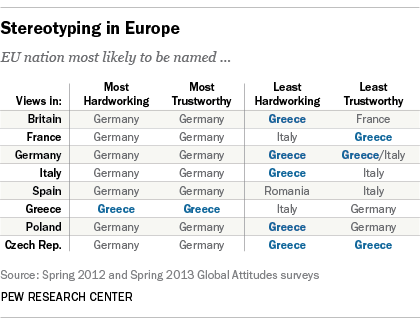
Cannot stop wondering how is it to belong to a people/tribe and reach the conclusion that the members of another people/tribe are more trustworthy than your own ‘mates’?!?

http://www.pewresearch.org/fact-tank/2015/01/27/greek-election-reflects-countrys-differences-with-the-eu/