Archives for posts with tag: authoritarianism

Karl Marx. The world is crooked – there is too much exploitation imposed by the haves upon the have-not’s – so it has to be righted by those who have the right answer to the problem. And because the world doesn’t know what’s good for it, the ‘enlightened’ – the communists who are at the forefront of the class struggle – have the duty to impose the revolution by force.
The crux of the ‘solution’ being the abolition of both private property and the state. The private property because it is the tool with which the haves dominate the have-not’s and the state because it is the tool used by the haves to protect their private property from the have-not’s who continuously try to steal it.
But what tool can be best used to enforce the dissolution of the private property and to insure that the misguided and the ill intended don’t revert to the ‘old and corrupt ways of the bourgeoisie’? The state, of course. Hence we’ll have to postpone a little its dissolution, only until the first chores would have been completed, of course.

Max Weber. The world is too complicated to be understood/run by a single man, no matter how capable. That’s why the decision making process must be rationalized. Weber’s main methodological tool was the ‘ideal type’, a mental construction that is to be substituted to replace the real problem that has to be solved or the real thing that is being studied. This ideal type being stripped of the ‘unimportant’ aspects of the reality will make it a lot easier for the ruler/decision maker/scientist to understand what is going on there and to come up with the ‘correct’ decision or ‘clear’ understanding of the matter. This means that Weber was convinced that individuals are able, in certain conditions, to reach valid conclusions. Which is, of course, OK. Furthermore Weber had ‘reached the conclusion’ that if larger problems are to be solved then the efforts of single individuals are not enough and that in order to fulfill this task in a satisfactory manner many rational decision makers (which have been properly trained in their strict domains) have to be inter-connected into a well structured ‘net’. This way the big problem will be sliced into more manageable sub-problems which will be analyzed by specialists and then the final solution will be re-assembled by people specially trained for exactly this task. Nowadays this entire concept is known as ‘bureaucracy‘. In theory it sounds right, doesn’t it? What could be better than an all encompassing net comprised of rational/professional decision makers who act according to a well considered and well intended ‘ideal type’? Whose ideal type? Good question, indeed. Just as good as ‘who and how trained the ‘decision makers’?’.
(There is something we must keep in mind when discussing Weber, as a person. He died relatively young, before having a chance to reach a ‘final conclusion’, or at least one to satisfy him. That also has to be the reason for which he hasn’t published much during his lifetime.)

Plato. Society (the city, the “Republic’) should be run by a specific kind of (dedicated) people and because “those with the philosopher’s natural abilities and with outstanding natures often get corrupted by a bad education and become outstandingly bad” this ‘special kind of people’ need to receive “the proper kind of education“. Meaning that ‘a true philosopher’ has to be versed in ‘the Forms of Good’, which are amply explained in ‘The Cave Allegory’.
The gist of the matter is two layered.
1. The reality is hidden behind some ‘veils’ (or in ‘shadows’ if you prefer the original metaphor) but properly trained professionals (the philosophers) can be taught to see what Plato describes as ‘the ultimate truth’.
2. These professional truth seekers have not only the right to lead the rest of the people ‘into the light’ but the obligation to do so! Furthermore, for Plato the ‘ideal political structure’ – the Republic – would be so organized as to ‘force’ into public duty those who have been specially ‘bred and trained’ to perform such duty:
“Observe, Glaucon, that there will be no injustice in compelling our philosophers to have a care and providence of others; we shall explain to them that in other States, men of their class are not obliged to share in the toils of politics: and this is reasonable, for they grow up at their own sweet will, and the government would rather not have them. Being self-taught, they cannot be expected to show any gratitude for a culture which they have never received. But we have brought you into the world to be rulers of the hive, kings of yourselves and of the other citizens, and have educated you far better and more perfectly than they have been educated, and you are better able to share in the double duty. Wherefore each of you, when his turn comes, must go down to the general underground abode, and get the habit of seeing in the dark. When you have acquired the habit, you will see ten thousand times better than the inhabitants of the cave, and you will know what the several images are, and what they represent, because you have seen the beautiful and just and good in their truth. And thus our State which is also yours will be a reality, and not a dream only, and will be administered in a spirit unlike that of other States, in which men fight with one another about shadows only and are distracted in the struggle for power, which in their eyes is a great good. Whereas the truth is that the State in which the rulers are most reluctant to govern is always the best and most quietly governed, and the State in which they are most eager, the worst.”

I believe that by now you have grasped where I’m headed to. There is not much difference between Marx and Plato and a very close relationship between these two and Weber. Still, the fact that Weber was not yet done thinking about this matter at the moment of his untimely death makes me believe that if he had some more time at his disposal he would have understood what Laozi taught us about the concept of “nonaction”:

And isn’t it very strange that the best (short) presentation I was able to find about Laozi is hosted by a site called “Plato.Stanford.edu”?

https://www.marxists.org/archive/marx/works/1848/communist-manifesto/
http://www.academia.edu/4192854/Weber_s_methodology_understanding_concept_of_ideal_type_as_necessary_element_of_Weberian_comprehensive_sociology_Working_paper_
http://www.cf.ac.uk/socsi/undergraduate/introsoc/weber12.html

http://www.historyguide.org/intellect/allegory.html
http://plato.stanford.edu/entries/laozi/
http://izquotes.com/quotes-pictures/quote-the-wicked-leader-is-he-who-the-people-despise-the-good-leader-is-he-who-the-people-revere-the-lao-tzu-188515.jpg

I happened to stumble on an article about the tragic fate of Sophie Chotek.

The beautiful daughter of an impoverished aristocratic family attracts the attention and later becomes romantically involved with the heir of one of the most important European thrones of the time. Looks like a prequel for ‘Love Story’, right? … only worse, unfortunately. The reigning Monarch wasn’t happy about the whole thing and, to make things worse, ‘the law’ wouldn’t allow their union.

After huge complications that involved the intervention of Kaiser Wilhelm II, Tsar Nicholas II and Pope Leo XIII in favour of the ‘young lovers’ Emperor Franz Joseph gave in and yielded to the marriage, on condition that the children of the couple will not be able to inherit the throne and that the bride will never be treated as a queen or attend official functions at the side of her future husband.
And the worse was yet to come. After 14 years, to a day, of happy marriage both she and Franz Ferdinand, her husband, were assassinated together in Sarajevo.

Reading about the treatment she had to endure cannot but make me wonder about why would modern democracies still ‘entertain’ royal courts? Specially after what happened to Lady Di…

“The Emperor expressed his disapproval by not attending his heir’s wedding, as did Franz Ferdinand’s brothers and nearly every member of his family. The Imperial court, led by its chief overseer the Prince of Montenuovo (who was the child of a morganatic marriage himself) continued to humiliate the new “Princess of Hohenberg” at every opportunity. If for example the Imperial family were to hold a ball then Sophie would not only have to sit apart from her husband but be last in line to enter behind every other Hapsburg relation no matter how obscure. All contemporary reports state that Sophie never complained or even show displeasure at this treatment in public, earning the sympathy of many outside the court for her dignified response. Less inclined to forgiveness than his wife, Franz Ferdinand allegedly drew up a list of particularly obnoxious aristocrats for whom he intended payback when he became Emperor.”

So?

Well… It’s not so easy to dismiss the fact that some of the most successful nations, by any standards, are exactly those that have managed to balance the survival of the monarchy with ‘full blown’ democratic government. Not only in Europe.
Great Britain, Sweden, The Netherlands, Belgium, Denmark, Norway, Thailand, Japan … There must be something here!

Two things constitute the common denominator between these countries, besides being run as constitutional monarchies. They have all found their own road to democracy/rule of law and they had traveled this road in a relatively peaceful manner. Don’t be fooled by the fact that Japan had been ‘opened’ up by Matthew Perry and then defeated in the WWII. The Japanese emperor had been powerless since long before Perry and the ‘fathers’ of the Meiji Constitution might have been inspired by the German Imperial one but the transformation was instrumented by the Japanese politicians themselves, not by nor after being prodded by a ‘foreign power’. Furthermore by 1915 the Japanese Constitution was modified to include universal male suffrage.

Meanwhile the XX-th century has witnessed a very mixed performance by the rest of the democracies, with the notable exception of the US. No, I haven’t forgotten Canada, Australia or New Zealand. They are constitutional monarchies too.
Latin America. I don’t think you’re going to dispute the fact that there is no single nation inhabiting this part of the world which hasn’t ‘enjoyed’ at least a few years of dictatorship that has started with ‘free elections’.
Africa. Until very recently there wasn’t a single functional democracy on this continent.
Asia. With the notable exception of India – which has inherited strong democratic values from her imperial power and enjoys special circumstances – no other real democracy besides Thailand and Japan until very recently.
Europe, the birth place of democracy. Hitler and Mussolini were democratically elected before becoming two of the most horrendous dictators in the history of humankind. Eastern Europe countries, including Russia, were governed for many decades as ‘popular democracies’. In reality they were ruled by oligarchies which were hiding their criminal nature behind ideological smoke screens.

Any explanation for this?

http://www.dailykos.com/story/2014/06/28/1310194/–Franzi-and-Soph-the-personal-tragedy-that-sparked-WWI#
http://www.britannica.com/EBchecked/topic/373298/Meiji-Constitution

I started to comment on “The reason the economy crashed and has been slow to rebound is because of government intervention, not the market mechanism” by Nick Sorrentino and got carried away. So I transformed the comment into a post of my own.

I fully agree with your conclusion “I prefer an open sourced economy to one which is manipulated by programmers writing in a language which is full of bugs and which brings the system down periodically.” but I find your initial assumption to be too vague.
The current situation was indeed heavily influenced by government decisions. And yes, they were completely out of touch with reality – central planning never works.
But here is where our ways depart.
The solution for the current situation is not at all ‘less’ government. Or, god forbid, ‘no government’!.
Free market is the most efficient way of running an economy only it has two limitations. It is populated by people and the total amount of trade-able goods is limited. Hence the market is never really free. We do need a free market only the natural evolution of any limited system is to gradually loose it’s freedom. So it is us who have to guard the freedom of the market.
And this is what ‘government’ business should really be. Not to tell us what to do – to plan for all of us – but to make sure that nobody becomes so powerful as to be able to dictate to others what to do.

Some of you might wonder “Why should we not accept any monopoly if it has been ‘lifted to power by the free market'”?
I mentioned earlier that there is no such thing as a really free market.
OK, you might disagree with that, after all we both advocate freedom and I’ll use a reason we both agree upon: “central planning doesn’t work“. Ever! So why do you think that a private monopoly would be able to function any better than a public one? Just because it’s private? I assure you that Lenin saw the entire Russia as his back yard and that didn’t stop him from messing that country so big that it’s still reeling under the consequences. King George saw the American colonies as his private possessions and that didn’t make the early Americans any happier.
So what we have to implement is a completely different kind of government, not a weaker one. Blaming ‘the (notion of) government’ instead of specific government decisions only induces the impression that ‘government’ as a whole is useless/despicable and that drives people away from (the concept of) government.

What we really need, that different kind of government I was speaking about, is a government that is closely watched by the people and who jealously defends both the political and economic freedom of the individuals, not either notion of ‘central planning’ or ‘vested interests’ – which, in the end, are uncannily similar.

http://www.againstcronycapitalism.org/2015/01/the-reason-the-economy-crashed-and-has-been-slow-to-rebound-is-because-of-government-intervention-not-the-market-mechanism/

https://www.youtube.com/watch?x-yt-cl=85027636&v=Me9yrREXOj4&x-yt-ts=1422503916

Most people tend to be passionate about what they do, parents in particular.
This is absolutely normal, what could be more important than ‘the future of mankind’?

And the more passionate we are about something, the more we want to reach the best results in what we do, right?

Only sometimes we are so busy trying to demonstrate that our best is the best there is that we neglect some of the basic aspects of the day to day reality.
The most neglected one being that very seldom ‘one size fits all’.

http://www.huffingtonpost.com/chris-routly/where-similac-and-the-mother-hood-go-wrong-and-why-it-matters_b_6536280.html

“Shooters storm Paris headquarters of satirical weekly Charlie Hebdo, which has stoked Islamist anger over its depictions of the Prophet”

In 1914 WWI started just because European countries had backed themselves into so tight corners that they weren’t able to ‘leave them behind’ and ‘come up into the open space where some mutual ground could have been found’  while the entire ‘house’ ‘went up in flames’.

So what do we do now, a century later?

Some people heap ‘fun’ (?!?) on the ‘others’ and ‘the others’ reply with bullets.

Regardless on which side of the many divides that crisscross our society (societies) each of us belongs to we all try to find explanations, and culprits, for what is happening. Only none of the explanations that have been proposed until now has been found acceptable ‘for the other side’.

I propose something else.

If we look closer all this can be boiled down to (mutual) ignorance intensified by intolerance and arrogance.
While real people bleed in the streets some callous puppeteers/mindless ‘activists’, from all sides, laugh contentedly in their hideouts and plan new ways to prod the rest of us into even more reckless extreme actions.

There are two ways out of here.
We can fight it off, like the Germans and the French did. But they needed 150 years of gruesome warfare (from the Napoleonic wars to the end of WWII) to understand that there were no insurmountable differences between them.
Or we could try something new.

All we need is some mutual respect. The rest would come naturally.

Read more: 12 killed in attack on offices of French newspaper | The Times of Israel http://www.timesofisrael.com/10-said-killed-in-attack-on-offices-of-french-newspaper/#ixzz3O96OfXZa
Follow us: @timesofisrael on Twitter | timesofisrael on Facebook

Very few notions are simultaneously evident and hard to grasp. Liberty is one of them.

If we look around it is self evident that some things are freer than others.
For instance wheel-chairs can be moved a lot easier than table chairs on a flat surface but are harder to be carried up and down the stairs or on rugged terrain. Or, on a different level of discussion, chained dogs are less free than stray ones.
Yet nobody in his right mind wastes a thought on whether wheel chairs might be concerned about their lack of ‘upward mobility’ while some of us, but not so many, do think about how come the vast majority of chained dogs usually come back after having accidentally been set free and wonder about why dogs which have grown up on their own can indeed become good companions but would never accept to be tied down for very long.

So what is this ‘liberty’?

Is it objective – a fact that exists irrespective of our will or wish – or nothing but a construct of our busy minds?
And how many kinds of liberty are there? After all the freedom ‘enjoyed’ by the wheel-chairs is a lot more different from that enjoyed by dogs than the latter is from that experienced by us, conscious people, right?
I’ll come back to this at the end of my post.

Three definitions of freedom are currently in fashion.

– Being free means being able to do whatever my (fucking) mind/imagination comes up with!
“Liberty is the only thing you cannot have unless you are willing to give it to others.” (William Allen White)
“Freedom is the consciousness of necessity” (Karl Marx)

You’ll notice very easily that they all have some things in common yet each of them is slightly slanted towards the central pillar of the philosophical school it belongs to.

The commonalities are there precisely because all three definitions are about the same thing while the different slants come from the different scopes of those philosophical schools – each of them, or more precisely the figure head of each school, having their ulterior motives behind the apparent explanation/definition.

Hence different uses.

Yes, liberty has uses. Otherwise why bother? Without our ability to consciously use our freedom there would be no difference between us and the dogs I mentioned earlier!

So what could be those different uses?
Nietzsche – you recognized his ‘ghost’ behind the first definition, didn’t you? – used the notion of freedom to explain the reasons for which he coined the concept of the Uebermensch. He went berserk afterwards, maybe after realizing that what he did was nothing but giving theoretical explanations about why the likes of Genghis Han and Pol Pot did what they did throughout the entire human history. Simply because there was no one to stop them. For the moment at least.
Most of the libertarians continue the natural trend that was so brilliantly described and then completely misunderstood by Marx – that human history is nothing else but the story of how the individual human being became progressively more and more autonomous from the community to which it belongs and how the entire community became more and more viable exactly because of this process.
And finally the totalitarians, of all ‘flavors’, use the concept of ‘assumed necessity’ to cloak the fact that all their teachings are nothing but ‘propaganda’.

OK, let me keep my promise and come back to ‘what is liberty’.
Since I couldn’t find a philosophical explanation to suit my ‘necessities’ I’ll try a different tack.

“You shall be free indeed when your days are not without a care nor your nights without a want and a grief. But rather when these things girdle your life and yet you rise above them naked and unbound.”
(Kahlil Gibran)

Am I trying to convince you that liberty is something that has a simple psychological explanation? Believe in it and that’s sufficient cause for it to exist?

Yes and no.

Individual liberty has indeed an important personal/psychological component. Until a person understands what liberty is and assumes for itself that ‘state of grace’ that person cannot be free.

Yet no individual can be free by itself. Besides the primordial condition of having to be born first, in order for an individual to become a consciously free person it needs to be raised into a fully functional adult with a sophisticated enough understanding of the world around it. It needs to learn at least a language which he/she will use both to communicate with its peers AND to think, about freedom amongst other things. It also needs to learn the necessary skills for survival – from how to walk, eat and drink to how to earn its keep. Only after these ‘prerequisites’ – or, in Gibran’s terms, ‘cares’, ‘wants’ and ‘griefs’ – are met, the individual may try to ‘rise above them naked and unbound’.
And even then it would be extremely helpful if it had an example to follow. Spartacus, for instance, tried to become free precisely because he was in close contact with people who considered themselves to be free – his master, for one. Now consider the state of those third or fourth generation of African slaves who toiled the ground in the deep South, born in a barn to a slave mother, who came in contact exclusively with fellow slaves and with some white ‘supervisors’, half drunk most of the time and who from time to time sexually assaulted their mothers. Or even the situation of the modern children who come to this Earth only because their parents want to get free housing and some more food stamps from the government.

The way I see it ‘liberty’ is something that has two ‘parents’. On one side there is the ‘community’, the environment into which each individual is born and where it is raised. On the other side it’s the individual itself who, at some point of its coming of age – if the circumstances provided by the community are right, understands what freedom is and decides to ‘declare’ its personhood/freedom.
Personal contribution is indeed huge. In particular circumstances that declaration might be made ‘in petto’ (for itself only) or, contrastingly, in plain knowledge that it could lead to that person losing its life.
I’m thinking now of the free spirits of the Antiquity – for instance of Epictetus, who had freed his mind long before he was ‘freed’ from slave-hood – and also of the freedom fighters who streaked the skies of human history: the early Christians who professed their creed even though they knew that it would lead to they being fed to the lions to the lonely Chinese man who single-handedly stopped, for a while, the tanks charging the Tienanmen Square in 1989.

In any case both conditions must be met simultaneously. The individual itself must reach first a certain level of ‘intellectual sophistication’, with the help and in the environment provided by the community to which that individual belongs, and then that individual must do its part: ‘open its wings and start flying on its own’. No further than the ‘natural limits specific for that community’, of course, but nevertheless bearing full responsibility for the outcome of its acts.

Or, in a different spelling, freedom – just as language and consciousness – cannot be achieved by any individual on itself nor be maintained/developed without the willing and ‘jealous’ diligence of all those involved.

And the sooner we understand, individually and collectively, that the well being of both individual members of the community and of the community itself depend on each of us developing its own liberty and on each of us respecting the liberty of all the others, the brighter our future will be.

http://www.britannica.com/EBchecked/topic/1563915/Freedom-and-Necessity

New York Times has published recently an article about various unexpected effects of automation. The way I see it the whole thing can be boiled down to:

“Artificial intelligence has become vastly more sophisticated in a short time, with machines now able to learn, not just follow programmed instructions, and to respond to human language and movement.

At the same time, the American work force has gained skills at a slower rate than in the past — and at a slower rate than in many other countries. Americans between the ages of 55 and 64 are among the most skilled in the world, according to a recent report from the Organization for Economic Cooperation and Development. Younger Americans are closer to average among the residents of rich countries, and below average by some measures.”

The point is that ‘classic’ automation freed the individual from the repetitive chores that transformed man into a machinery, as depicted by Chaplin in ‘Modern Times’, and allowed him to pursue more challenging/interesting ways to ‘make ends meet’. The current phenomenon turns the tide in exactly the opposite direction, demeaning the individual to the role of a ‘servant’ for the almighty machine. That’s why people become less and less skillful and, even worse, less and less proud about what they do for a living.

Dangerous situation.

‘We already know that, why are you bothering us?’

“labour-power can appear upon the market as a commodity, only if, and so far as, its possessor, the individual whose labour-power it is, offers it for sale, or sells it, as a commodity”

“labour is not a commodity”

OK, reconcile these two declarations… The first belongs to Marx himself while the second is an integral part of the 1944 Philadelphia Declaration made by the International Labor Organization… And if any of you has any doubts about the ILO thinking not being heavily tainted by Marxism please check this out: “the war against want requires to be carried on with unrelenting vigour within each nation, and by continuous and concerted international effort in which the representatives of workers and employers, enjoying equal status with those of governments, join with them in free discussion and democratic decision with a view to the promotion of the common welfare.” Not exactly the Communist Manifesto itself but too close to it for my comfort.

So is it or is it not?

No it isn’t. Not even Marx ever thought it was.

When Marx speaks of labor power as a commodity he only wants to demonstrate the need for the worker to be free in order for the system to function. For him this is the difference between feudalism – when the peasant (the worker of those times) was heavily dependent on the land owner – and capitalism – where the possesor of the labour power is free to sell ‘his commodity’ to the higher bider – is the existence of the free market where commodities – including ‘labour power’, which is traded as if it was a commodity – are exchanged. And the fact that the market is free also determines individual freedom of both the worker and the capitalist, seller and buyer of the labour power.

But this trading of labour power as if it was a commodity doesn’t transform it into a real commodity.

In fact labour is more a form of communication than anything else.
By labouring the worker transforms something into something else, usually in a way that is not so easily reproduced, not even for low skilled jobs. Had it been possible to automate the working process we would have used exclusively robots or morons. Do you really think a robot or a moron could flip burghers at McDonald’s? Are you sure you’d like that to happen?

Confused?
It’s not that complicated. Marx had an insight – that human history is nothing but the story of the individual man enjoing more and more autonomy – and then blew it. He took it upon himself not only to speed up the history of the mankind but also to lead us (even against our will) where he thought that we should finally arrive (communism). Rather arrogant, don’t you thing?
In time that arrogance seems to have mellowed somewhat (or became more conceited?) but it is still very much alive: ‘the war against want requires to be carried…to the promotion of the common welfare’….

What is that ‘the common welfare’? Can something like that ever be determined? Even in a ‘democratic’ way?!?

Had Marx refrained himself at studying the effects of increased individual autonomy on the workings of the human society he would have been considered the undisputed thinker of the second millennium and we’d have been sparred from witnessing (or experiencing) the horrors of communism…  I know, I know, counter-factual history is not acceptable… just saying…

I came across this extremely interesting article about Hitler being a socialist.

After making his point, impeccably, Daniel Hannan – the author – ends up with: “My beef with many (not all) Leftists is a simpler one. By refusing to return the compliment, by assuming a moral superiority, they make political dialogue almost impossible. Using the soubriquet “Right-wing” to mean “something undesirable” is a small but important example.”

To me this article is nothing but another reminder that the the only reasonable alternative to any extremism is the living center, not the dead opposite extremism.

Every time that the functional equilibrium between the content (because of their affluence, carelessness or both) and the strugglers (people who are on a constant quest for new solutions, irrespective of their motivation) has been breached things tended to become rather ugly before coming back towards normalcy.
Just compare how people around the Mediterranean sea used to live during the four centuries straddling AD 1 with what happened during the next millennium, otherwise known as the Dark Ages.
Why? Just because the Roman emperors used ‘panem et circensis’ as their main political concept and the population obliged. Until things went so far that the whole empire failed abysmally…
Same things happened before the French Revolution and before Lenin and Hitler came to power in Russia and Germany, respectively. Nowadays it is currently happening in Russia and the huge gap between the oligarchs and the modern muzhiks is the sole explanation I need for how come Putin has such a stronghold on the Russian people – he is keeping both categories happy by feeding their imagination with dreams about the Greater Russia and their bellies full with the money he gets from selling oil and natural gas.
For people on both sides of the political spectrum to restart a real dialogue all of them need to understand that the other side has legitimate concerns too.
Nowadays most on the left insist on ‘equality’ while most on the right speak of nothing but ‘individual freedom’. And both of them blame the state. The left accuses the government for not doing enough to promote the sacrosanct ‘equality’ while the right blames the state for infringing on the individual’s right to do whatever it wants…  As if equality (of chances) is in anyway different from individual freedom… As if authoritarianism could exist without the guys at the top enjoying a lot  more freedom than those at the bottom of the social ladder… As if functional social order could be maintained without people cooperating among themselves based on mutual respect, said cooperation  having evolved through time and currently reaching the modern form known as “the democratic state”…
I agree with concerned people on the both sides of the divide that the state could, and has indeed in more than one occasions, represent an extremely powerful repression tool in the hands of callous political operators but the answer to this is to make sure that the democratic mechanisms work smoothly, not to thoroughly dismantle the state itself….  Precisely because a skeleton state is a lot more easily highjacked by the ‘political thugs’ than one which has respected and balanced (hence functional) institutions in the right places.
Now please allow me to end my post by extending the invitation made by Daniel Hannan and urge you, all of you, to stop assuming ‘moral superiority’ based exclusively on ideological motives. Ideology is fine but we should never forget that it is nothing but a tool and it is us who do things and are responsible for both our deeds and our fate.
If ideology is diverse enough as to help us see how complex the world really is then we are better off because of it. If, instead, we use our diverse ideologies as filters to shun whatever ‘the others’ are trying to tell us… then it’s curtains for all of us, together at last… but not in the right place.
PS
To read the article – it is brilliant – you can either click on the yellow highlight near the top of my post or here: http://blogs.telegraph.co.uk/news/danielhannan/100260720/whenever-you-mention-fascisms-socialist-roots-left-wingers-become-incandescent-why/.

layered smoke screens

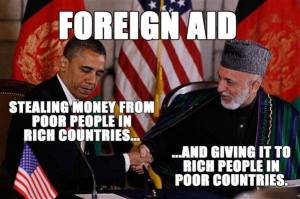
This post is not about Foreign aid per se but rather about how a generous idea becomes thwarted in the hands of some callous people who are left to their own devices by the public’s initial lassitude.
This is also about how the public’s justified frustration (after they had realized what was going on behind their backs) is misguided by the same kind of callous people like the ones who orchestrated the shenanigans in the first place.