Am primit bancul asta pe mail si mi s-a parut ca se potriveste:

Vine limuzina sa-l ia pe Papă de la aeroport. Şoferul ia bagajele, le bagă in portbagaj (şi nu erau chiar puţine)…
Papa aştepta si nu se urcă….
– Sfinţia Ta, vă rog sa poftiţi.
– Ştii fiule, pe mine nu mă lasă niciodată nimeni să conduc maşina…
Lasă-mă de data asta tu, te rog.
– Sfinţia ta, e imposibil. Mi-aş pierde slujba.
– Te rog, şi să ştii ca sunt extrem de generos….
Şoferul până la urmă cedează. Papa la volan. Calca acceleratia… şi 120 Km /h.
Şoferul:
– Sfinţia Ta, vă rog, puţin mai uşor, ne prinde poliţia.
Papa, nimic. Bagă tare si… 160 Km/h.
In spate, masina poliţiei, ding dong, ding dong.
Papa opreste şi lasă geamul in jos. Vine poliţaiul, salută, şi rămâne cu gura căscată….
Se intoarce la maşina de poliţie. Ia staţia şi comunică:
– Sunt 1435. Dă-mi-l pe şefu…
– Care-i treaba, bă?
– Şefu, nu ştiu ce să fac. Am prins pe cineva cu 160 km/h.
– Arde-l.
– Nu cred că pot, e tare.
– Cine e bă, primaru?
– Nuu, mai important.
– Un guvernator, senator ceva?
– Şefu, e mai tare!
– Cine e bă?
– Cred că-i Dumnezeu, şefu! La volan e Papa!

Cica puscariile romanesti sunt pline de telefoane mobile.
Detinutii posteaza filmulete pe Youtube sau fac tot felul de excrocherii, fiecare dupa cum il duce mintea. Si nu, chestia cu excrocheriile nu e un caz izolat, nu doar la Colibasi se intampla asta ci si la Giurgiu sau la Bacau.

Cum ajung telefoanele mobile in puscarii sau in aresturile politiei? Simplu. Duse de oameni, contracost bineinteles. De politisti, de preoti … Si se pare ca cel putin o parte din aceasta activitate este ‘centralizata’…
Bineinteles ca situatia trebuia sa primeasca si o reactie. Mai intai una de natura ‘statistica’: fenomenul a fost studiat ca amploare si ca dinamica, 10 000 de telefoane confiscate in puscarii tot anul trecut si 8500 pana la 1octombrie anul acesta.

Si atunci ce facem? Recalificam personalul din puscarii? Ii invatam cum sa reziste tentatiilor atunci cand sunt abordati de ‘apartinatorii’ care ofera cate 250 de euro pentru fiecare telefon transportat ‘inauntru’? Cam complicat… Nu mai bine rezolvam problema cu o masinarie? Nu? Totul a inceput de la niste ‘dispozitive’ – telefoanele mobile, rezolvam problema tot cu un dispozitiv – de bruiaj de data asta!

Si uite asa viata noastra este controlata din ce in ce mai mult cu ajutorul aparatelor: ajungem la puscarie nu pentru ce facem ci pentru ca vorbim ce nu trebuie la telefon, o data acolo in loc sa ne potolim continuam activitatea infractionala cu ajutorul acelorasi aparate si nici macar statul nu e in stare sa isi controleze angajatii asa ca pentru a rezolva situatia face apel la alte aparate, la cele de bruiaj de data asta.
Asistam deja la un salt calitativ, daca pana la nivelul asta aparatele erau folosite pentru comunicare – individual, iar fiecare individ avea ocazia sa isi exercite liberul arbitru si sa folosesca comunicarea dupa propriile sale norme etice – de data asta aparatele, cele de bruiaj, vor fi folosite in masa si ‘distructiv’ – nu mai comunica mimeni, nu se mai tine cont de bine si de rau.

Si noi, spectatorii intregului fenomen, dam vina pe ‘aparate’ in loc sa intelegem ca este exclusiv responsabilitatea noastra, a celor care le folosim, sa dam sens moral actiunilor noastre.
Iar unii dintre cei care mai inteleg cate ceva dau vina pe ‘ochiul dracului’: ‘Deh maica, daca a vrut sa faca si el un ban…?!?” De parca banul n-ar fi si el tot un fel de ‘aparat’, tot o ‘unealta’ menita pentru a fi folosita de catre om si nu de a il impinge, unealta pe om, in ispita…


In the ’70 the US was going up, fast.
“Since college has entered the realm of big business” it’s going sideways, with a confused look on its face.
I know, correlation is not always equivalent with causation, but shouldn’t we look deeper into this?
Thanks Rob Stewart for your thoughts.

Yesterday I picked up this book from the British Council in Bucharest.
Actually it is not so much about flying itself but more about how we individual human beings allow ourselves to be transformed into ‘consumers’ so we could be better ‘fleeced’.
Read it.

Some say freedom comes from inside, some others need to shed their material belongings in order to find it…
Yesterday I followed a radio show where a philosopher and an entrepreneur were discussing freedom. The philosopher said that inside an institution/company freedom is suspended according to the contract between the employer and the employee, in the sense that the employee takes it upon himself to perform his task, but that the employee should have the liberty to do his job as he sees fit while the entrepreneur said that employees need guidance (naturally) and that the employer should be very careful as to how much freedom he gives to his employees.
So freedom can also be given to others. Or kept away from them.
At the whim of whom? How does a person get to ‘give’ freedom to others?
What kind of society are we building for our children? Why are so many who want out of it?

zookid

This image epitomizes current politics, not only in America:
The political actors put on elaborate shows in order to impress their hard core constituencies under the pretense that they are striving “for the common good” while the costs are payed exclusively by the ‘hapless man in the street’.
I’m really worried about what’s going to happen when ‘the man in the street’ will understand that he’s been duped for so long…

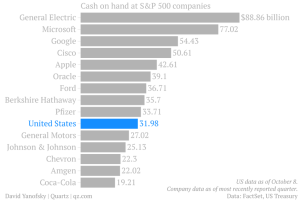
So much cash laying around…

yanofsky_cash-on-hand_chartbuilder
Some twenty years ago the general mantra was ‘use borrowed money so you’ll improve the return on your own capital’. After that businesses leveraged too much and some of them crashed. Now the survivors sit on piles of cash while start-ups have a hard time finding working capital.

And then we call ourselves rational beings… sheesh

More than 60 years ago Isaac Asimov published a series of novels which somehow quelled our fears about robots:
because they were going to obey the “Three laws of robotics” robots would not represent any danger to humans:

1. A robot may not injure a human being or, through inaction, allow a human being to come to harm.
2. A robot must obey orders given it by human beings except where such orders would conflict with the First Law.
3. A robot must protect its own existence as long as such protection does not conflict with the First or Second Law.

Lets see what’s going on now:

– We use robotic drones to kill other human beings
-Robotic computer applications scour our communications for key-words  in order to supervise what we do in the virtual world – not only the NSA, purportedly for a good cause, the Chinese and the Iranians are doing the same thing in order to quell dissidence.
– Besides taking over the hard, dangerous or plain repetitive jobs robots are starting to displace specialist jobs.

Now you’re going to tell me robots have nothing to say about this so they are innocent. Right, it is us humans who use robots, not the other way around – for now, anyway.
The real problem resides in the fact that no matter how brilliantly programmed no robot will ever be able to innovate anything. This way by displacing specialists from their reasonably well payed jobs to low paying ones two nasty things beggin to happen:
– The aggregate demand in the economy decreases and
– The ability of the society to innovate also decreases. The individual specialist doesn’t disappear overnight but a disgruntled person doesn’t care about ‘thinking’ nor has any real opportunity to do so – he has been insulated from his domain of expertise and he cannot continue to innovate: he no longer has any contact with the realities he was familiar with and specialized in.

Mind you, I’m not speaking here about the Newton’s or Edison’s of this world, they’ll continue to exist and create. This is about the run of the mill ‘small scale’ innovator praised by every ‘human resources’ book that deals with ‘improving the innovative process in your organization.’

“Currency should be backed by assets (not necessarily by gold) and not by debt as it is now”
Interesting information ‘inside’ but what I find really troublesome is how come this information comes to us via Moscow?
Why haven’t I heard about this from an American source?

It seems that wealth is getting more and more concentrated.

The only clear thing that I’m able to understand from the study of history is that a freer society works better than a more authoritarian one. The ancient Roman Empire, based on slavery, fell to make place for feudal countries, where the ‘man in the street’ enjoyed more freedom than the Roman slave. Similarly feudalism disappeared and was replaced by capitalism, a system where people, at least theoretically, are completely free. And soon after capitalism took off people thought again and introduced antitrust legislation, which only apparently limits the economic liberty of the individual while in fact preserving the freedom of the markets.
My hunch is that the explanation for this phenomenon – freedom insuring a better working society – is about how decisions are made in various societies.
– (Ancient) societies where a lot of people were slaves: decisions were made by the few slave owners who controlled everything in a certain area, including who lived and who died.
– Feudalism: the most important decisions were taken by the landlords but they weren’t as powerful as the slave owners, they didn’t have the right to kill anybody for example. Besides that  the advent of the free cities where manufacturing started to flourish further diluted the power of the landlords.
– Capitalism: everybody is his own master, or it should be, so the power of the individual has, at least theoretically, been brought down to Earth. One caveat though, capitalism works properly only where the market is free and the society is democratic, otherwise the situation degenerates quite rapidly (Venezuela for example)

Do you get where am I drifting to? When too many resources (wealth) will depend on the whim of a very few people we would have turned back the wheels of history. What is the difference between a Soviet Union where decisions were made by a bunch of people who got there by violence or a hypothetical state where important decisions will be made by the few guys who happen to control two thirds of the net worth of that country? Have you seen this video about ‘the Lesterland‘?
I’m not discussing here the honesty, intelligence or even common sense of those hypothetical guys, they could be anyone or the heirs of anyone. The problem is that by being few the probability of they being wrong multiplied by the certitude of being extremely powerful gives us a dark perspective: Rome fell after becoming an empire, the French Revolution took place soon after the French monarchs successfully imposed their absolute power over the whole French territory, the communist states proved once again that too much concentration of power is bad…

How to fix this? First of all this is not something that can be ‘fixed’. The only way out is by educating ourselves about the difference between instrument the the goal we try to reach by using that instrument.
I’ve already mentioned money and profit as instruments we currently confuse for legitimate goals.
I’m going to discuss another one today. Happiness. Most of us try desperately to be happy by applying recipes learned from others, including from paying too much attention to commercial advertisements.
There is a guy, Csikszentmihalyi, who discovered that real happiness comes from doing what you really like to do or from involving yourself in something you really care about and and termed the state of mind one reaches this way as Flow. You don’t get to experience being in Flow by owning stuff or by controlling people. Only by doing things you care or feel about or by being significantly involved in something  you deem worthwhile.
Neuroscience discovered that buying things produces the same kind of response from the brain as doing drugs:  it produces more dopamine. And what do we do with this knowledge? Do we educate people to buy only what they need? No, we do better advertisements, ones that start the flow of dopamine even before the actual buying takes place… Why? Because we all are still convinced that having more money will get us closer to happiness.
Once we’ll educate ourselves about Csikszentmihalyi’s Flow it will no longer matter who has what or how much money. We’ll be free!