It seems that wealth is getting more and more concentrated.

The only clear thing that I’m able to understand from the study of history is that a freer society works better than a more authoritarian one. The ancient Roman Empire, based on slavery, fell to make place for feudal countries, where the ‘man in the street’ enjoyed more freedom than the Roman slave. Similarly feudalism disappeared and was replaced by capitalism, a system where people, at least theoretically, are completely free. And soon after capitalism took off people thought again and introduced antitrust legislation, which only apparently limits the economic liberty of the individual while in fact preserving the freedom of the markets.
My hunch is that the explanation for this phenomenon – freedom insuring a better working society – is about how decisions are made in various societies.
– (Ancient) societies where a lot of people were slaves: decisions were made by the few slave owners who controlled everything in a certain area, including who lived and who died.
– Feudalism: the most important decisions were taken by the landlords but they weren’t as powerful as the slave owners, they didn’t have the right to kill anybody for example. Besides that  the advent of the free cities where manufacturing started to flourish further diluted the power of the landlords.
– Capitalism: everybody is his own master, or it should be, so the power of the individual has, at least theoretically, been brought down to Earth. One caveat though, capitalism works properly only where the market is free and the society is democratic, otherwise the situation degenerates quite rapidly (Venezuela for example)

Do you get where am I drifting to? When too many resources (wealth) will depend on the whim of a very few people we would have turned back the wheels of history. What is the difference between a Soviet Union where decisions were made by a bunch of people who got there by violence or a hypothetical state where important decisions will be made by the few guys who happen to control two thirds of the net worth of that country? Have you seen this video about ‘the Lesterland‘?
I’m not discussing here the honesty, intelligence or even common sense of those hypothetical guys, they could be anyone or the heirs of anyone. The problem is that by being few the probability of they being wrong multiplied by the certitude of being extremely powerful gives us a dark perspective: Rome fell after becoming an empire, the French Revolution took place soon after the French monarchs successfully imposed their absolute power over the whole French territory, the communist states proved once again that too much concentration of power is bad…

How to fix this? First of all this is not something that can be ‘fixed’. The only way out is by educating ourselves about the difference between instrument the the goal we try to reach by using that instrument.
I’ve already mentioned money and profit as instruments we currently confuse for legitimate goals.
I’m going to discuss another one today. Happiness. Most of us try desperately to be happy by applying recipes learned from others, including from paying too much attention to commercial advertisements.
There is a guy, Csikszentmihalyi, who discovered that real happiness comes from doing what you really like to do or from involving yourself in something you really care about and and termed the state of mind one reaches this way as Flow. You don’t get to experience being in Flow by owning stuff or by controlling people. Only by doing things you care or feel about or by being significantly involved in something  you deem worthwhile.
Neuroscience discovered that buying things produces the same kind of response from the brain as doing drugs:  it produces more dopamine. And what do we do with this knowledge? Do we educate people to buy only what they need? No, we do better advertisements, ones that start the flow of dopamine even before the actual buying takes place… Why? Because we all are still convinced that having more money will get us closer to happiness.
Once we’ll educate ourselves about Csikszentmihalyi’s Flow it will no longer matter who has what or how much money. We’ll be free!

‘Profit is everything’.
This is the current mantra but is it true?

At first glance yes – what company can survive producing nothing but loses?!? – but then another concept starts jumping before our eyes, the ‘non-profit organizations’.
Ouch!

So let’s take a step back and have a second look.

“Pecunia non olet” – Money has no smell – was how Vespasian, an Roman emperor, replied to his critics who were ‘bewildered’ about how low could an emperor get – to levy taxes on urinals. So if this kind of attitude is OK coming from an emperor who are we, mere mortals, to have a different opinion? The only difference is that today we are a little more prudish and we put it differently: “Money is fungible“!
Really? Try using your grocery money for gambling and  see what happens….

“The ends justify the means”. This quote is attributed to Nicollo Machiavelli but it seems that what he really meant, that ‘people will accept a certain course of action when coming from a ‘prince’ ‘ is quite different from what we understand of it today: ‘if you want it badly enough grab it and deal with the consequences latter’.
Same with money, specially now that they don’t smell anymore after Vespasian taught us how to launder them…

‘Survival of the fittest’. Now what on Earth Darwin has to do with being profitable?!? Just bear with me for a little longer.
You see, we are rational human beings. As such we are consummate optimizers: we cannot settle for anything less than the ‘best’. Well…more exactly for anything less than what WE, with our limited knowledge of which we are so proud, consider to be the best …

There is a guy, Ernst Mayr, who opened my eyes about this. As an expression ‘Survival of the fittest’ was not even used by Darwin in any of his works and besides that it doesn’t make any sense from the evolutionary point of view. Being ‘fit’ to one particular environment (not to mention ‘fittest’) means being practically unable to survive in any other environment so your capacity to evolve is severely limited if not altogether absent. In reality evolution, as Mayr aptly puts it, ‘is not about the survival of the fittest but about the demise of the unfit’.

Now lets get back to what profit is about and see if any of this makes any sense in an economic environment. By the way, ‘economy’ comes from ‘oekonomia’, a Greek word meaning making the ends meet in a household.
So what is the ultimate scope of any economic venture? For the entrepreneur to become rich, no matter what?
Or is it about the whole team involved – the so called ‘stakeholders’ –  having an as good as possible life as a consequence of their combined efforts ?
OK, both options are at the very extreme so I’ll propose a less ambitious one. How about the real scope of a company being long term survival? This way the shareholders would have a (steady) income and the employees a job.
Yes, for that to happen the company would have to have a certain profit but if the long term goal is ‘survival’ the management and the board will have to take care not to sacrifice the long term prospects of the company for a short term profit boost – just for the sake of the handouts that management currently gets at the end of an ‘exceptional’ year. (Do you still wonder how come every year is ‘exceptional’ nowadays and the bonuses keep flowing, regardless?)

In this circumstances ‘profit’ would no longer be THE exclusive goal of every economic venture. It would still be a very good thing indeed but just an efficiency indicator, one of the indicators that show if a company might be able to survive for the long run.

PS.

And what if the ‘intensity’ with which a certain company exerts itself in the quest for ‘profit’ drives the customers away? And invites some competition, who until then didn’t even considered it, to enter the field? And steal some more of the already disgruntled customers?

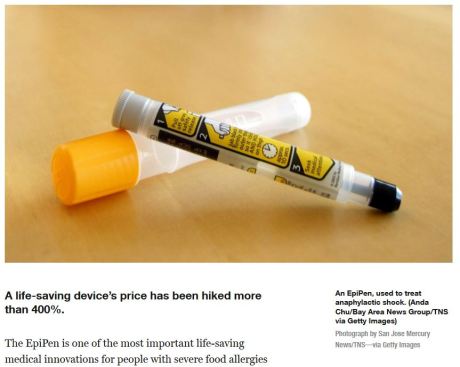
400% hike

“The EpiPen is one of the most important life-saving medical innovations for people with severe food allergies—which affect as many as 15 million Americans and 1 in 13 children in the United States. But its price has exploded over the last decade despite few upgrades to the product itself. And that’s led to criticism from a consortium of critics which includes consumer advocacy groups and notorious drug price-hiker Martin Shkreli himself.” (, How Mylan Got Away With Its Enormous Price Hike for the EpiPen, Fortune.com)

This is something I wrote a couple of years ago, when I started to understand that the financial market had gone wildly astray. I’ve been tinkering at it since and I’m still not happy with it but I need to post it as a stepping stone for what I’m going to publish next.

Money appeared, at first, as a trade facilitator: instead of changing five measures of grain for one of oil people started to use as an intermediary step of the process whatever the local civilization called “money”. From shells to beads to holed pebbles or whatever else.
Then some people wanted to delay consumption, stock up for “black days”, or wanted to trade further apart. That was when they “invented” gold.
It was not only generally accepted, relatively easy to divide without sizable loses but also practically indestructible. This was fine from the monetary point of view but also created the illusion that gold (and later money) was the supreme value per-se. Everybody ‘forgot’ that things have ‘value’ only as long as people have a use for them. The simple fact that there is no such thing as ‘value’ but that which we – buyer and seller, attach to each object when it passes through our hands.
Do you remember the alchemists trying to transform everything into gold? What if they succeeded? Probably we would have roofed our houses with some very cheap and everlasting gold shingles.
Since it was indestructible it created another illusion: that its role/value will last forever. And so, for some two thousand years, until let’s say 1100 AD, gold, as money, played its roles as trade facilitator and hoarding device.
Until then resources available to the society had been allocated at the discretion (whim?) of the local ruler (the “strongest” guy around). Who later used to pretend he had a divine blessing to decide the fate of the commoners. For example the feudal system consecrated that the king ruled who had the use of what piece of land or of whatever other natural resource.

An old habit had resurfaced at the same time. Civilizations restarted to trade goods and ideas between them.  (Christian and Islamic around the Mediterranean Sea, for example). The advent of new transportation technologies created new opportunities for travel and trading. This was when a quantity of gold (money) became itself a resource, albeit not a natural one.
You could use it to start a trading cycle yourself. Or you could “rent” it to somebody else, for a fee. The interest. That way, somebody else – the ‘renter’ of capital, could do the actual buying, transporting/transforming and reselling.
Money, and interest, took on a new role. The amount of interest asked was specific to each occurrence – if I trust you are a capable (of doing whatever you are trying to do) person then I’m going to ask a smaller interest from you. In the end a lender gets paid for assessing risk – at the end of the day some deals get sour, some get through, and if the risks were correctly measured – and the corresponding interests asked – the investor/lender ends up with some profit. Meanwhile the same lender does another thing: he is distributing resources among the competing entrepreneurs and so the ones that are more creditworthy can start their businesses a little easier.
This way resources  are no longer allocated at the whim of a single person – the feudal lord – but by the business  acumen and experience  of  a  multitude of  operators, the “free market” – theoretically  a more natural, and thus  more efficient,  process.

As a consequence money was no longer a mere trade facilitator and a humble hoarding device but also a resources allocating tool. In a way, money (and interest) started to measure not only value but also trust, which became by itself a kind of resource.
Remember this is roughly the same time when “paper/fiat money” started to appear, at first having a gold equivalent and dispensing with it later. And ‘paper’ money have value (and are accepted as tender) only as long as people have reasons to trust the country that printed it.
But this whole line of reckoning presumes that the “efficient market hypothesis” is true – this would translate into the assumption that the risks are measured rationally and, as a consequence, that the resources are appropriated reasonably. Not entirely true, is it? Elliot’s Wave Principle says it’s not, Nicholas Nassim Taleb says it’s not, George Soros (The New Paradigm for Financial Markets – The Credit Crisis of 2008 and What it Means) concurs and so on.
A symptom of this lack of reason is the financial effervescence that is, only now, starting to ebb out. People “foregot” that money is a second class resource (only as long as people think it is and that it has any value) and started to treat it as a first class/real one. As a consequence inflation is perceived as inherently bad and not as a normal mechanism for economic adjustment and, more importantly, people now want to obtain “money”, and lots of it, directly from “money”.
No transformation whatsoever. The cycle “money traded for resources transformed into merchandise and traded back into money” has been replaced by money conned from one hand to another. Currently, quite a lot of people are convinced they can retire with no (little) public pensions and that they’ll be able to live of the revenue (and not the capital itself) received from investing whatever small fortune they have saved (delayed consumption), or inherited.
This means that these people have to enter the “resources (trust) allocating” game, the ‘financial market. Since most of them don’t have the necessary skills they rely on others: bank or fund managers or even the CEO-s of the companies whose stock they have bought. And all these managers, under pressure, have started to (mis)use a lot of instruments, originally designed as insurance/hedging, in order to make money out of thin air (speculation).
That’s how the derivative markets became bigger than the spot market. Making an analogy we can consider speculators as some kind of carnivores whose very important role is to keep the herds in top condition by culling the misfits. The benefit of the ‘landlord’, the one who from time to time hunts himself (buys or sells stock), is that the herds (companies) are OK, don’t get degenerated and don’t overgraze. But no sane landlord, not until now at least, would consider lions’ meat (or whatever else might be obtained from them) as a desirable food but only hunts (gets involved with paper issued by highly speculative investment funds) them for sport or when they threaten the well being of the herds. So why am I not surprised by the last moves in the world of investment banking? Or even banking in general?
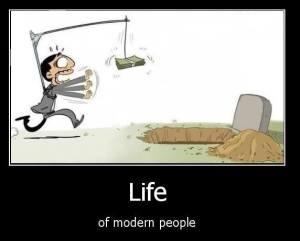
follow the money

2021 edit.

Some people still have a hard time understanding how Trump had come to be.

I was speaking above about those money managers hard pressed to produce yield.
Some of them had fulfilled their task by exporting ‘real’ jobs to places where the work force was cheaper. And/or by replacing people with robots.
This development has deepened the divide between the haves and the have nots.
Those who had happened to have some invested capital at the start of the process only got richer.
Those who didn’t had found that getting richer was way harder than for their parents. Education had become way more expensive while the good paying jobs were no longer available.

Trump had promised to bring back those jobs. And to ‘ease’ the tax ‘burden’.
By doing this he was able to endear himself to people competing for the same thing. Money. Mere money….
To those people convinced that having money is enough.
That mere possession of money can get you there. No matter where that ‘there’ might be…

To put it briefly, Trump – and his followers, ignore the fact that money is, by definition, a convention.
A convention which is based on trust. On mutual trust between the members of the society.

On the trust that when push will come to shove, each of us will do what is expected of them.
What the community, as a whole, will need them to do.

You see, what Trump – and his followers, seem to ignore is the fact that no individual – no matter how rich/powerful/skilful/bright, can survive, sustainably, on their own. And even less ‘against the grain’.
What many of Trump’s detractors ignore is the corespondent fact. That no community will survive sustainably if it is reduced to a herd. That only a community composed of autonomous – also known as ‘free’, individuals have a fighting changes at being flexible enough to survive indefinitely.

The problem being that people chasing money as the ultimate goal are not free.
Are not free to pursue alternative goals. To explore.
They are so mesmerized that are behaving like moths lured to a flame.

2022 edit

It just downed on me that until recently money have been used by the powerful to maintain their power.
Kings minted coins to pay their armies and to feed their people.
Governments printed money to pay for whatever was needed so that the society kept going.

Nowadays those in power use their positions to hoard money.
Accept bribes. Use their connections to arrange deals. To promote legislation. For a ‘fee’, of course!

2024 edit

Adams Smith’s capitalism was about getting things done.
The baker/butcher/brewer toiled, for a fee, towards ‘feeding’ people.
Today’s capitalism is about making money. Being of service, getting things done, has become a cost. Something you have to ‘pay’ in order to get what you want. Money! Hence less and less service is being offered for more and more money. Efficiency, remember?

The Economy’s Greatest Illness Rana Faroohar

An extremely interesting article just published by the NYTimes: “Dogs are people too!”

“The ability to experience positive emotions, like love and attachment, would mean that dogs have a level of sentience comparable to that of a human child. And this ability suggests a rethinking of how we treat dogs.”

One caveat though, ‘not all dogs are raised equal’: “For the past two years, my colleagues and I have been training dogs to go in an M.R.I. scanner — completely awake and unrestrained. Our goal has been to determine how dogs’ brains work and, even more important, what they think of us humans.” This amount of interaction with humans must have surely changed something in their brains. It cannot be that humans might have any monopoly when it comes to neuroplasticity

Coming from Daniel Goleman this ‘sentence‘ caries a certain weight.

Now can we turn this on its head?
What if  (some) rich people care less not because of they being rich but because in today’s world being callous represents a competitive advantage when it comes to getting rich?
Modern neuroscience has proved that there is some plasticity in adult brains so becoming rich might alter one’s behavior but this process is also culturally determined, if callousness would be socially unacceptable this behavior would certainly have a cost attached and would slowly disappear…

Rubin Hurricane Carter.

“The actual story is more harrowing because it exposes an underlying frailty in a criminal-justice system that convicted Mr. Carter, not once but twice. The convictions were obtained not by a lone, malevolent investigator but by a network of detectives, prosecutors and judges who countenanced the suppression and tainting of evidence and the injection of racial bias into the courtroom.”

And this is not a lonely example, Henri Papillion Charriere being the  second example that comes to mind.

So why do all these half truths grab the public’s imagination, besides the artistic quality of the representations?
May this be happening exactly because of the ‘true’ parts? After all no matter how simplified or spruced up with ‘borrowed’ episodes both stories have a certain something that comes from them happening first in the real life and only then becoming representations.
And the fact that both imagination and reason are not infinite is the simple explanation for why no representation was ever able to fully encompass a single real life event.

Still one should never underestimate the power of human imagination:
Karl May, who died 100 years ago, was an impostor, a liar and a thief — and one of Germany’s most widely read authors. He embellished his own biography with as much fantasy as the scenarios in his adventure novels, and when the deceit was finally exposed, he never recovered. But his legend lives on.
Just another reminder that we should take anything, at least at first, with the legendary grain of salt!

Se pare ca nu scapam chiar asa usor de “Limba de Lemn”.

De unde rezulta ca aceasta nu a fost o inventie comunista ci este o necesitate.

Unii au nevoie de ‘comunicare’ pentru a ascunde si nu pentru a transmite informatie….

AXN  a ‘dat’ “The Cave” cu Marcel Iures.

O pestera peste a carei intrare cei din vechime construisera o biserica pentru a izola ‘raul’ dinauntru de lumea noastra.
Cu treizeci de ani in urma niste oameni ‘fara Dumnezeu’ forteaza intrarea pentru a cauta comori si intalnesc ceva infricosator.

In zilele noastre pestera este redescoperita si o echipa pluridisciplinara incepe explorarea. Printre ei si niste scafandri americani trecuti prin ciur si darmon.
Dupa multe aventuri horror aflam ca in pestera sunt niste paraziti care intra in simbioza cu orice animal cazut inautru si il transforma ajutandu-l sa supravietuiasca dar in acelasi timp oferindu-i posibilitatea sa isi arate adevarata natura. Iar ultimii vizitatori nu fusesera chiar usa de biserica.
Unul dintre scafandri este contaminat si el dar controleaza efectele parazitului iar cu ajutorul simturilor exacerbate de acesta gaseste iesirea din pestera. Din pacate nu supravietuieste luptei finale cu ultimii supravietuitori din echipa de hoti de acum treizeci de ani.

In finalul filmului aflam ca biologul echipei de speologi fusese infectata si ea de paraziti si ca acestia incerca acum sa vada cum e in afara pesterii.

Sa fie acesti paraziti germenii coruptiei si filmul una dintre multele metafore care incearca sa ne spuna ca aceasta poate fi invinsa?
Sa fiu eu prea optimist?

Definitia clasica a statului, cel putin cea europeana, face apel la notiunea de ‘contract’ – explicit sau implicit – intre cetatenii care il populeaza si despre care se presupune ca ‘impartasesc’ dorinta/nevoia de a supravietui in comun. De unde si ideea de natiune ca o comunitate care are suficient de multe in comun astfel incat sa se poata autoguverna, sa poata genera suficient de multa democratie astfel incat guvernarea sa fie incluziva si nu centripeta.
In principiu statul este reprezentat de institutii iar acestea sunt populate de oameni, care au liber arbitru. Iar acestia pot alege sa trateze statul ca pe o resursa si nu doar ca pe un mecanism de cooperare.
Sa ma explic. In definita de mai sus statul este in realitate instrumentul politic prin care comunitatea nationala isi indeplineste, constient sau nu, scopul minimal de a-si asigura supravietuirea. In anumite conditii unii operatori politici, lipsiti atat de scrupule cat si de o viziune mai lunga decat propriul nas, pot ajunge sa priveasca statul ca pe un instrument de imbogatire sau de autopromovare, ca si cum locul pe care ei il ocupa in interiorul institutiilor ar fi o resursa si nu o responsabilitate. Astfel statul (impreuna cu institutiile sale) devine instrumentul prin care acesti indivizi isi impun dominatia lor, sau a ideilor lor, asupra celorlalti – de la autoritaristi de tip religios la ‘social progresives’, de la mullahii Iranieni la comunistii de tip sovietic – sau prin care sa acumuleze resurse materiale – coruptii de pretutindeni. Din nefericire practica ne arata ca ‘instrumentul’ este polivalent, poate fi folosit in ambele scopuri simultan.
Iar ‘problema’ apare in momentul in care ‘parazitii’ ajung sa consume suficient de multe resurse incat ‘activitatea’ lor sa puna in pericol supravietuirea celorlalti. Acela este momentul in care reincepe razboiul descris de Pareto, cel dintre lei si vulpi…

I was watching an episode from ‘Ghost Whisperer’ on AXN when a certain (evil) character said: “All I have to do is convince them!”
And then I realized that in reality the devil is powerless. In order for anything evil to happen a human has to make the decision: the serpent only told them what to do, it was Adam and Eve who did bite into the apple.
And the same for any-other bad thing that comes into being. For one reason or another a wicked thought might come into my mind but it is my ‘reasonable’ self that ‘validates’ it and turns it into an action.

And then how come there are humans who feel free or even compelled ‘to do the right thing’ unto the other without his prior consent or sometimes even against his expressed refusal?
From baptizing the two weeks olds under the conviction that unbaptized toddlers go directly to hell if they happen to die to the innumerable rules and regulations imposed unto the unsuspicious citizen by the overbearing modern state.