Archives for category: Uncategorized

I ran across this article published by CNS News.

Unusual Answer from Panelist Receives Standing Ovation at Benghazi Coalition Meeting.

It is about a meeting organized by Heritage Foundation to discuss the terrorist attack that took place in in Benghazi  in 2012.
At some point a young ‘Muslim student’ asked “…how can we fight an ideological war with weapons? How can we ever end this war? The jihadist ideology that you talk about – it’s an ideology. How can we ever end this thing if we don’t address it ideologically?”.
One of the panelists answered her that ‘there might be some 75% peaceful Muslims in the world but this is of no consequence: they follow the lead of the extremists, they don’t make their voices heard and, because of that, ‘the peaceful majority are irrelevant’ ‘. The panelist’s answer was received with standing ovations.

I’m afraid those people are making a huge mistake.

For those of you who don’t have time to read the article I’ll summarize the arguments used by Brigitte Gabriel, the panelist:
– The Germans are known as peaceful people yet the Nazis imposed their agenda and provoked horrible massacres.
– The Russians are normally peaceful people yet the Communists among them caused tens of millions of deaths, among their own people, without significant protest from the general population.
– The same happened in China.
– The otherwise peaceful Japanese allowed the militarists to take power and to start a war (the Pacific ‘portion’ of the WWII) in which another 12 million people found their death, “mostly killed by bayonets and shovels.”
– “On September 11th in the United States we had 2.3 million Arab Muslims living in the United States. It took 19 hijackers – 19 radicals – to bring America to its knees, destroy the World Trade Center, attack the Pentagon and kill almost 3000 Americans that day,” Gabriel said. “So for all our power of reason, and for all us talking about moderate and peaceful Muslims, I’m glad you’re here. But where are the others speaking out?” Gabriel asked.
The people in attendance began to applaud.”

First of all we need to differentiate between the two situations presented here.
The Germans, the Japanese and the “19 radicals” committed acts of international aggression while the Russians and the Chinese allowed themselves to be overrun by ‘misguided’ people.
Not at all the same thing.
On the other hand the German and Japanese examples are extremely interesting. A significant number of historians agree that the WWII was produced, at least in part, by the manner in which the defeated Germany was treated after WWI – they were imposed crippling war reparations which burdened Germany during the Great Depression so heavily as to produce the set of social circumstances that allowed Hitler to accede to power. This lesson was well understood so after the WWII Germany was included in the Marshal plan instead of made to pay for it. As a consequence we had, since then, 69 years if uninterrupted peace in Europe.
Japan was a ‘closed society’ until Commodore Perry forcefully ‘opened’ it in 1854, at first for trade and then to other western influences: Centralized state administration, modern army, modern management and technology, etc. And in those times the Japanese were treated, by the ‘white people’, with a ‘healthy dose’ of disdain, just as all the other non-European nations were. After the WWII all this has changed and nowadays the ‘peaceful majority’ of the Japanese have found a way, with a lot of help received from the Americans, to build a democratic society not at all different from what can be currently found in Western Europe and in North America.
Something rather similar happened with the Chinese. After Nixon went there and started to treat them as partners they basically stopped killing each-other.
But, unfortunately, this change of attitude didn’t come about between the West and Russia after the end of the Cold War. For instance we call the Ukrainian rebels  ‘pro-Russian’. Are they of any real service to Russia or to the Russian people? On the contrary… Somehow the old habit of blaming the entire Russian people for actions perpetrated by their leaders survived. Maybe because we can no longer understand the workings of a non-democratic society…since we are so accustomed with censuring our leaders.

So…

My point is that of course we have to defend ourselves from the direct actions of the ‘radicals’ – ‘shoot back’, effectively and efficiently, when ever somebody attacks us. Yet there is something else we dearly need to do, at the same time. Find a way to connect, in a respectful manner, with the ‘peaceful, yet silent, majorities’. They are “irrelevant” only as long as we treat them with the same disdain they are receiving from their own rulers. Even worse, confronted with two different kinds of disdain they’ll naturally prefer the one they are accustomed with – the one displayed by their own rulers – so if we keep packing together radicals with peaceful people and treat them as one the result will be that we’ll have to deal with an ever increasing number of radicalized ex-peaceful individuals. I propose we learn something from our parents, the ones who found a way to change the atmosphere between them and the German and the Japanese people. And since we pretend to be wiser – as all children do – than our parents were, how about doing this without wagging all-out wars? (Unless attacked, off course)

Bacalaureat 2014:       

Absolventi de liceu: Aprox. 200 000
Candidati: 161 000Adica vreo 44 000, cam unul din patru absolventi, nici macar nu s-au ostenit sa se inscrie.

Evaluarea nationala (a absolventilor de clasa a 8-a) 2014

Absolventi inscrisi: aprox 160 000

din care 113 250 cu media peste 5 iar
                46.700, adica din nou unul din patru, sub 5.

Cu alte cuvinte in 4 ani, din 1995 pana in 1999 locuitorii Romaniei s-au scarbit atat de tare incat au facut cu 40 000 mai putini copii. Apoi acesti copii au crescut intr-o atmosfera atat de incurajatoare incat aproximativ un sfert dintre ei au ajuns la concluzia ca invatatura este o adevarata pierdere de vreme.

Si atunci cum ramane cu ‘ai carte ai parte’?

Ei bine sensul acestei zicale este putin mai complex.
“A avea carte; ai carte, ai parte = a avea acte, în regulă, pentru susţinerea unei pretenţii de proprietate.”
Zicala provine de fapt de pe vremea cand Stefan cel Mare a intarit prin emiterea de ‘hrisoave domnesti’ dreptul de proprietate al mosnenilor care l-au ajutat in lupta asupra pamanturilor pe care acestia le stapaneau din mosi stramosi. Cei care au pastrat inscrisurile au putut sa isi apere posesiunile in fata boierilor hrapareti, cei care le-au crezut niste hartii lipsite de valoare au putut fi izgoniti, cu relativa usurinta, de pe pamanturile lor.

Cu alte cuvinte valoarea ‘diplomelor’ rezida, de fapt, in modul cum sunt ele privite de cei care le poseda. Iar atunci cand oamenii nu mai au ‘incredere’ in ‘inscrisurile’ emise de institutii societatea respectiva se afla intr-un punct de extrema dificultate. Acelasi lucru se intampla si atunci cand oamenilor nu li se mai pare util sa se pregateasca pentru ‘ziua de maine’.

Un alt simptom al acestei stari de dificultate este locul ocupat de fenomenul coruptiei in viata omului ‘de rand’.
Aceasta ‘coruptie’ este atat de prezenta in viata noastra incat a devenit pretext de lupta politica, partidele se arata unele pe altele cu degetul: ‘coruptii tai sunt mai multi/putrezi decat coruptii mei’.
Iar atunci cand astfel de confruntari au loc simultan cu niste evenimente extrem de importante pentru viata noilor generatii, bacalaureatul si inscrierea la liceu, si chiar reusesc sa le eclipseze pe scena publica asta inseamna ca lucrurile au iesit cu totul si cu totul din fagasul normal.

Poate ar fi cazul sa ne uitam fiecare dintre noi in oglinda si sa intelegem o data ca asa nu se mai poate. E adevarat ca niciodata nu e prea tarziu dar de ce sa ajungem pana acolo?

petrosjordan's avatarPetros Jordan

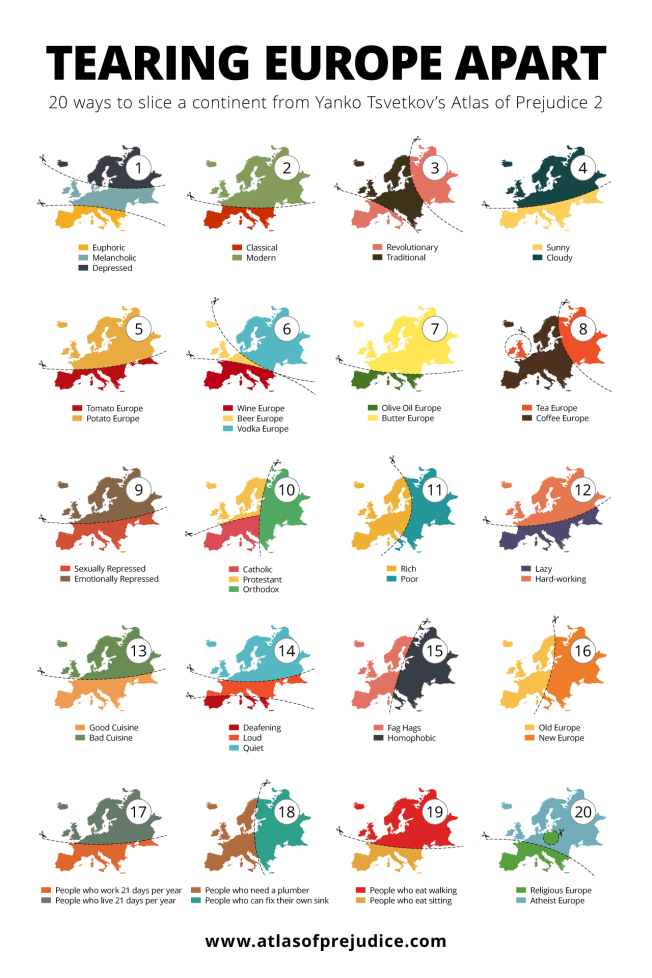
For a relatively tiny continent, Europe has an abundance of divisions.  Ethnicity, religion, weather, and even food have divided Europe along common fault lines throughout its history.  The chart below, taken from Yanko Tsveltkov’s Atlas of Prejudice 2, is a satirically over-broad depiction of some of the most salient of divisions.  It is meant to be overly simplified to the point of absurdity, poking fun at those who hold such blunt prejudices about large swaths of territory, so please do not take offense.

20 Ways to Slice Europe (From “Atlas of Prejudice 2”, by Yanko Tsvetkov, via http://atlasofprejudice.tumblr.com/)

For many of these maps, however, there is a kernel of truth.  My mother’s ancestors hail from Greece, and my father’s from England, which are two countries which could not be more diametrically opposed within Europe.  Indeed, in the chart below, Greece and England are on different sides in 19 of the…

View original post 192 more words

Răzvan Constantinescu's avatar

Institutul de Gastroenterologie şi Hepatologie din Iaşi a fost ani de-a rândul spitalul cu cei mai buni indicatori de performanţă din România şi a reprezentat mândria medicală a Iaşului. Decizia aberantă a Guvernului Emil Boc de desfiinţare prin „comasare” (HG 85/02.02.2011) a IGH – concomitent cu înfiinţarea unui institut cu profil similar în alt oraş – face ca această unitate sanitară de elită să devină un simbol întru nostalgică şi furioasă amintire a valorilor distruse de incompetenţa proletcultistă cu sprijinul nepăsării noastre. Condiţiile de spitalizare şi tratament, pe care abia acum le apreciem (din păcate retrospectiv) la adevărata lor valoare, performanţele şi indicatorii financiari nu au contat pentru un ministru (Attila Cseke) care anterior se ocupase cu activitatea de comercializare a hranei pentru pisici; un proiect în plină dezvoltare şi care-şi arătase eficienţa încă de la început a fost distrus prin decizia „din pix” a unui om care…

View original post 993 more words

Now this is what I call an interesting development.
A 17 years old high school student, who happens to be a female favorable to gun ownership and opposed to abortion, unseats ‘a two term Republican nearly four times her age’ and becomes ‘the official Republican candidate in November’s general election’

History repeats itself. Really?

Image

The passage of time has divided people in two broad categories. Some, noticing that history seems to be repeating itself, became despondent, at least apparently:  “We learn from history that we do not learn from history”, while others, confronted with the same thing, reached a rather different conclusion: “Those that fail to learn from history, are doomed to repeat it.”

In fact the two are not that far apart: It is “us” that don’t learn much from history and, similarly, it is people from amongst ourselves that ‘are doomed to repeat the lessons of history, precisely because they failed to make much sense of them in the first place’…

So, is there anything that can be understood from all this?

First of all that ‘no, history doesn’t repeat itself’. It’s us who play it again and again, until enough of us make enough sense of what has happened to be able to push the whole circus a little further down the road. And sometimes even that is not enough, a whole chapter becomes forgotten and we have to play it one more time….

Secondly we should never forget that more things can be learned during a single lesson. So even if something seems to be safely tucked away during the passage of time we should never forget it had taken place. Who knows when it will yield a fresh meaning? But we cannot extract that meaning unless we remain aware that that thing had happened…

So, going back to where we started, people actually learn from experience, only not always the proper things and certainly not all the useful things at once… and that’s why ‘history repeats itself’: we really need to learn the distinction between the useful, the annoying and the truly dangerous!

Complet de acord (altfel n-as fi preluat postul, nu?!?) iar singurul lucru care ar necesita o oarecare clarificare este ce mai inseamna ‘stanga’ in zilele noastre…
Daca la inceput, pe vremea cand la Paris se intrunea ‘Adunarea Starilor Generale’, membrii acesteia s-au impartit in doua – cei din stanga interesati in reducerea discrepantelor dintre stari pentru ca ‘asa nu se mai poate’ iar cei din dreapta interesati doar de pastrarea status quo-ului – ambele orientari erau relativ de buna credinta acum situatia e de-a dreptul crunta.
Atat stanga cat si dreapta nu sunt nimic altceva decat niste ‘poze politice’ asumate cu ajutorul unor consilieri si acordate fin in functie de ultimele ‘sondaje de opinie publica’.
Orbiti de marketingul politic actorii din scena publica interpreteaza un fel de vodevil uitand ca treaba lor nu este sa distreze lumea ci sa pastreze polisul in stare de functionare.
De fapt asta voia si Iisus, sa-i ajute pe oameni sa scape de frica si in acest fel sa devina membri functionali ai comunitatii, sa-i scoata din starea de sclavi … ai ‘regelui’, ai ‘templului’.
In sensul asta inteleg eu si ‘da-i cezarului ce-i al cezarului’ (adica impozitul si nimic altceva) iar restul pastreaza-l pentru ‘Dumnezeu’ – adica pentru cel ce ne-a incredintat ‘liberul arbitru’!

Michael Arrington's avatarUncrunched

OkCupid played a major role in the successful effort to bring down Mozilla CEO Brendan Eich.

On March 31 the company showed a message to all visitors using Mozilla’s Firefox browser. The message stated: “Mozilla’s new CEO, Brendan Eich, is an opponent of equal rights for gay couples. We would therefore prefer that our users not use Mozilla software to access OkCupid.”

okcupid-firefox-boycott-hed-2014

As we all know, Eich’s opposition to equal rights for gay couples stemmed from his $1,000 donation to support Proposition 8 in 2008. There are no other allegations that he ever showed any other discrimination against gays or anyone else.

Most people will argue (including me) that OkCupid is permitted to express opinions and take actions like this under its first amendment rights as a corporation.

But what was OKCupid’s motivation? And how does OkCupid’s co-founder Sam Yagan fit into this?

I believe that it was a PR…

View original post 425 more words