Archives for category: Economy

“The world’s 400 richest people lost a combined $70 billion on Monday as equity markets around the globe were hammered on fears about Greece and declines in China fueled by leveraged investors exiting the market.”

So. Just because a smallish country failed to pay a mere 1.6 billion euros and because China finally joined the rest of the globe – both moves being obvious for some time now for all who wanted to see – the 400 richest people lost a total of $70 billion.

Does any of this make any sense?

Why didn’t some of those guys get together and used their absolutely huge resources to do something to avoid their losses – saving the planet as a by product? And what’s the use of them being so ‘resourceful’ if they weren’t able to do this?

Things are even stranger because these guys can act without having to look over their shoulders. Political leaders depend on their constituents, the CEO’s of the big international corporations depend on their boards… the 400 depend on absolutely nobody but their own judgement.

Or maybe this is the real problem? That too many resources are concentrated in too few hands?

‘Too big to fail’?!?

Shouldn’t Warren Buffett and the company step on it about the Giving Pledge while there still is something left to give?

Not to mention the fact that we, the people, should hold our elected governments responsible for their shenanigans,,,

By the way. Taxing our way out of this huge imbalance wouldn’t work. It would just move concentrated decision power from one set of hands into another. The cause of what is going now is that power has become too concentrated for our own good, not who exerts it. Just take a peek back in history. Every imperium has crumbled under its own weight very soon after decision has become centralized. From the Roman Empire to the Soviet Union who tried to run a centrally planned economy. And the same is valid for economic ventures, monopolies end up badly.

PS I’ve just read an article by Hans-Werner Sinn, a Professor of Economics and Public Finance at the University of Munich, and President of the Ifo Institute for Economic Research who serves on the German economy ministry’s Advisory Council.
He analyzes the current developments as a ‘game’ between the Tsipras/Varufakis team – who are supposedly using the good cop/bad cop tactic and the ‘naive’ ECB who doesn’t make up its mind to start acting responsibly towards the profligate Greeks.

Maybe this is exactly the problem. Some of the top decision makers have forgotten that the ordinary people, those who bear the brunt of the decisions taken at the highest levels, are human beings. Not numbers to be interpreted using the ‘game theory’… or masses (herds) to be managed (manipulated) according to the latest ‘political science’ theories…

‘Varufakis’s Great Game’.

Further reading:

How we got here:
“Greek Debt Crisis:
How Goldman Sachs Helped Greece to Mask its True Debt”
“Why Greece is in trouble (again)”

How some of the international financial institutions envision that the economies of the EU new entrants should be run:

“These public institutions, funded by taxpayers and owned by governments, have explicit mandates to increase local development in the countries where they spend their money.”
“Lidl has received almost $1bn in public development funding”

Time and time again history has taught us that systems where decisions are taken in a centralized manner eventually fail. The Soviet Union had a centrally planned economy and even privately owned monopolies end up in failure. United Fruit is only one of the many examples that we have at our disposal.

Going back to Greece we have two sides that have promised so much that they cannot back down without personal damage.
The Greek political establishment has promised eternal bliss for those linked with the state – and used borrowed money to fund their promises. Now, that the entire system needs a thorough reform no one is daring even to speak about this subject. Things there are compounded by the fact that the Greek bona fide entrepreneurs, those that keep the economy going, are used to dodge taxes – a somewhat understandable position, who would pay willingly knowing that the money would be squandered?
The European decision makers, those who have turned a blind eye to the Greek shenanigans and later bailed out the banks who have lavished money into those shenanigans, now have to explain to their constituents how come so much money has been sunk into this mess and why so much of it will never be recouped – Greece cannot ever repay the whole amount and survive as a working economy.

Quite a complicated mess that cannot be solved until all the cards are thrown on the table.

Deutsche Bank is sitting on more than $75 Trillion in derivatives bets — an amount that is twenty times greater than German GDP.
Both the next 3D printer and Deutsche Bank derivatives portfolio were designed by us, the human people.
When are we going to get our act together?

“We research and develop groundbreaking, cost-effective robotic technology with which we can 3D-print beautiful, functional objects in almost any form,” wrote MX3D on the project Web page. “The ultimate test? Printing an intricate, ornate metal bridge for a special location to show what our robots and software, engineers, craftsmen and designers can do.”

And why do we need the pope to remind us that the Earth is the only home we’ve got?


“Scientists weary after years of often vicious opposition by doubters of their climate-change findings see this year as crucial to the planet’s future because of a religious document expected from Pope Francis on Thursday. The rare encyclical, or teaching letter, expected to promote climate action as a moral imperative could do more to slow global warming than international negotiations this year to limit greenhouse gas emissions, scientists say.”

Oh, I forgot. Right now we are still under ‘the spell’, we have somehow convinced ourselves that having money, loads of it, trumps every thing else.

We’ll get over it, sooner or later. Francis Bacon has already warned us, all we need is to remember.

Or, even better, we can ask ourselves:

What is money, instrument or goal?

Efficient Market Hypothesis, eh?
The proponents of this hypothesis posit that all participants to the market are perfectly rational and that they all have enough pertinent information about what is going on as to be able to reach reasonable business decisions.
Now consider this: ‘ten percent of the egg producers being wiped out results in a up to 85% hike in retail prices’.
Quite reasonably, don’t you think?
As for efficiency… maybe for the owners of the surviving ‘egg producers’…

So what’s new…

Not so fast. There is more to it than the classic complaints – that high taxes discourage the working people while government hand-outs, made possible by those taxes, encourage the lazy to stay home.
If taxes are collected evenly – from all those that should pay them – and distributed sparingly – only to those who really need those hand-outs – nobody feels cheated so no disincentive is felt.

There is a more malignant phenomenon at work here. If taxes are really high – as a percentage – then being able to not pay them becomes a huge competitive advantage.

Not paying becomes attractive only after you are due a certain amount of money – you have to hire a tax consultant, pay some fees and commissions, etc. – but once you belong in that league not paying becomes a huge advantage over your competition. For instance over your competitors that are smaller and who won’t gain as much, or anything at all, by doing the same thing as you do.

And this is why the market becomes so polarized, why some of the really big brass do not push, in earnest, towards fiscal discipline and how the middle class gets squeezed out.

For the eco-friendly multi-millionaire. (NanoFlowcell)

OK, this is not a technology blog.
And yet. As an engineer I have a ‘natural knack’ for this kind of things.

Where most people see a really beautiful car I see a huge breakthrough in energy storage.

These guys at NanoFlowcell AG have invented a technology that stores electric energy in two tanks filled with a ‘salty’ solution. The way I see it very soon, as soon as prices will make sense, each of us will have a solar panel mounted on the roof and a device in our basement that will store the electricity produced during the day into those two liquids developed by NanoFlowcell AG so that we’ll be able to light up the house (and refill the car) when we come home in the evening.

Nice job guys!

Extreme fragility, dead ahead.

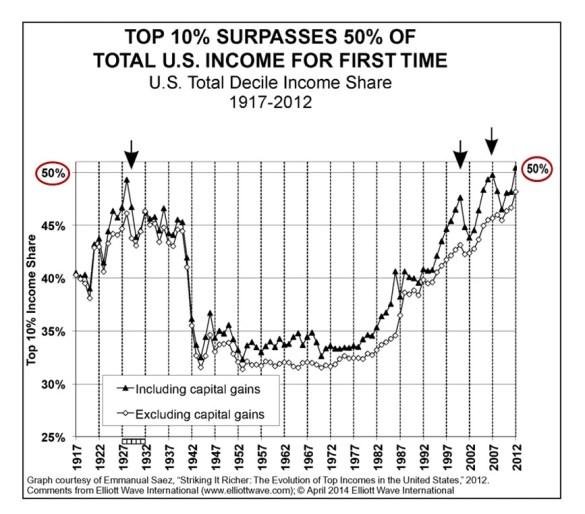
Just prior to the Great Depression an American accountant, Ralph Elliot, had taken Charles Dow’s insight about economic cycles a step forward and came up with the ‘Wave Theory’.
I won’t enter into details here but I have to give you some broad outlines.
Charles Dow: In any market, prices evolve in trends – sustained moves towards the main direction fragmented by ‘reactions’ that run contrary to the trend. According to Dow there are three categories/levels of trends: major, intermediary and minor. The major trends cannot be manipulated and comprises three phases: ‘accumulation/distribution’, ‘public participation’ and ‘panic’. The names are self explanatory but if you want to read some more please click here.
Ralph Elliot: (If a certain asset is traded by a large enough number of traders so that market could be considered ‘free’) Price action is fractal in nature and hence can be broken down and analyzed as such. While Dow identified 3 levels of trending Elliot uses 9 but both ‘agree’ that each action in the direction of the analyzed trend is followed by a reaction contrary to that direction.

Robert Prechter, the brain behind ‘Elliot Wave International’, ” the largest independent financial analysis and market forecasting firm in the world” – the guys from whom I borrowed the picture above – has been using successfully the ‘Elliot Wave theory’ for some 40 years now.
And here comes the really interesting part. Besides building Elliot Wave International as a market analysis company Prechter also founded The Socionomics Institute, a think tank that starts from the assumption that the markets are driven by the prevalent social mood (sentiment) that dominates at any given moment and not all the way around as it is usually believed. Prechter posits that markets go down when/because ‘people are afraid’ and not ‘people start to panic after the market has begun to go down’.
For some people this whole process is a tug of war between greed and fear. It makes a lot of sense but we still lack an explanation about why at some points the bulls are stronger than the bears and at some-other points the situation is completely turned over. Reason was supposed to take care of business at all times, wasn’t it?
Now some of you will tell me that Daniel Kahneman and others have provided ample proof that the market is far from being rational... OK, I agree with that but still, we continue to need an explanation for why the market behaves for so long as if it were reasonable only to break down exactly when everybody was so happy – as it constantly did, from the Tulip Mania in the the XVII-th century Holland to the last financial melt down.

Now please remember two things that I already mentioned.
– One of Charles Dow’s assumptions was that ‘major trends cannot be manipulated while the lesser ones might
– (If a certain asset is traded by a sufficient number of traders so that market could be considered ‘free’). Here I was presumptuous enough to introduce my own experience into the equation. After I was introduced to the Elliot Wave theory I found out that it worked (meaning that I could use it successfully – statistically, of course) for indices or other frequently traded symbols while it is completely useless for illiquid ones.

I started to understand what’s going on only after reading Nassim Taleb’s Antifragile.
The gist of this book is that for a system to remain viable, to conserve it’s chances to survive, it has to keep open as many options as it possibly can.
Does it make any sense to you?
To be alive means being able to make decisions, as freely as possible. If you are forced to make one thing or another then you are not free anymore, right? If you have at least the slightest opportunity to choose among two or more possibilities then it means that you still have a sparkle of life in you! Stephen Hawkins, tied in his wheelchair for so many years, is alive just because he choose not to be overwhelmed by his condition while so many of us are (brain) dead because we indiscriminately follow fads, fashions, habits, you name it. The moment we give up our individual autonomy and enroll into a crowd (read ‘herd’) we might have the impression of becoming safe, or at least safer, but in reality we are already headed for the slaughterhouse.

It is somewhat true though that ‘there is safety in numbers’. And no, I’m not contradicting myself. The bigger the crowd the harder it is for someone to control it (take it to the slaughterhouse, by will or by error) and the greater the chances for an individual to escape an unforeseen  predator. So you need a really big crowd if you want to have a survival situation, a reasonably viable system.

If we look back in history – no magical solution can be found there, only a long list of errors – we’ll see that empires never fail to crash, authoritarian regimes survive for considerable shorter periods than the more democratic ones and that the more powerful a fad was the least it survived. And all these situations fit perfectly Taleb’s theory: the less open options a system has the less able it is to survive. The emperor is but a single man, who inevitable ends up being ‘naked’, no matter how capable it is – and people notice it sooner or later. Also the more an authoritarian a regime the less are the ordinary people inclined to contribute to the welfare of the community.
And something else. When a fad becomes intense enough the people involved become blind to any other alternatives but those prescribed by those convinced that they have a lot to gain by keeping that fad alive. That’s why it is very hard for a social ‘vicious circle’ to be broken until enough people hit the rock bottom. No grown up will voluntarily shout ‘the emperor is naked’ because he thinks he has nothing to gain from this. As strange as it may seem it is rather hard for the regular Joe, who’s afraid of the emperor, to understand that the entire kingdom becomes a laughing stock for the rest of the world if the emperor is known to stroll naked through the public square.

Now please take a second glance at this picture.
Extreme fragility, dead ahead.

What does it suggest?
That there is a certain correlation between income being concentrated in fewer and fewer hands and the probability of a market crash?
But correlation is not causation!
No, it isn’t. Not unless we can find a reasonable story for what may ’cause’ that correlation! Explain it, that is!

By now I’m almost convinced that most of you have already ‘got’ it.
Concentration of revenue means concentration of decision power. As less and less people (proportionally) remain in ‘powerful’ positions they not only command a higher proportion of the aggregated revenue of the entire community but they also control in a greater measure the destiny of that community.

No, I don’t think that ‘they’ are ill intended. ‘They’ live here too. They are not idiots, otherwise they wouldn’t have reached/been able to retain those lofty positions. So no, I don’t think they are willingly leading us to disaster.

The problem is that they are too few! No individual human being is able to make a considerable number of decisions in a short period time. That’s the very reason why we have consultants and so on, right? The problem is that ‘consultants’ only give advice, they cannot/are not allowed to make actual decisions. And the fewer are the people wielding real power the more the rest of us become mere consultants…

And according to Taleb’s theory and to an immense number of historical occurrences the less people are involved in the decision making process the higher are the chances for a catastrophic error to ‘reset’ the entire system.

PS I. Funny for a conclusion like that to be drawn from a picture published by somebody who caters for those ‘working’ hard to get as rich as possible, isn’t it?
On the other side…if these people considered the issue to be important enough to write about it … maybe it’s worth a moment of our precious time.

PS II Never say never!
I don’t think we are necessarily facing another economic melt-down in the immediate future. It might happen, of course. It will happen – sooner or later, of course again, but there is no sure way of telling when.
What I’m trying to suggest here is that there is a very strong possibility that in the near future we’ll witness a considerable change in how we manage the economy and in the way we relate to the concept of ‘money’.

Karl Marx’s version or Max Weber’s?

“the difference between truth as the “unhiddenness of beings” and truth as the “correctness of propositions” (Martin Heidegger)

Only after reading (again) the Essence of Truth I started to grasp the huge mistake made by Marx and his followers.
His declared motives were ‘the emancipation of the oppressed’ and if we are to grasp his work we need to read him in this key.

Only this way I could finally understand why for him ‘capital’ means exclusively ‘trade-able wealth’, money or things easily measurable in monetary units.
Only this way I could finally understand why for him ‘capitalism’ was exclusively about personal profit and hence despicable.

All this had happened because Marx wasn’t really interested in understanding how capitalism works, what it means and how it generated a medium in which creative and hard working people could make better use of the available resources than in previous social settings.
Marx was a man of a mission (it’s not that clear for me if he considered himself a saint that was meant to free the working class, a con-man who swindled a lot of money from Engels under the pretext of helping the poor or both at the same time) and we need to accept that almost all he did write was dedicated to this mission of his, whatever that was.

On the other hand Max Weber was also a man of a mission only his was different from Marx’s.
What he set out to do was to understand the inner workings of capitalism, how it came about and what consequences it might have.

““The most trifling actions that affect a man’s credit are to be regarded. The sound of your hammer at five in the morning, or eight at night, heard by a creditor, makes him easy six months longer; but if he sees you at a billiard table, or hears your voice at a tavern, when you should be at work, he sends for his money the next day; demands it, before he can receive it, in a lump. ‘It shows, besides, that you are mindful of what you owe; it makes you appear a careful as well as an honest man, and that still increases your credit.’ “

This is a brief excerpt from Weber’s “The Protestant Ethic and the Spirit of Capitalism” – retrieved, ironically, from an internet site run by “marxists”, http://www.marxists.org.
Weber is quoting here Benjamin Franklin in an attempt to make us understand what is the true spirit of capitalism.
At the first glance we might say it corresponds closely to what Marx had said about the subject – that it all boils down to money – only after further consideration it becomes apparent that while Marx had stopped there, at ‘money’, Weber and Franklin had seen way deeper than that.

Capitalism is not that much about mere money as it is about credit. Trust that is.

No one would extend credit without trust, no one would enter a contract without mutual trust and so on.

So what would it be? Which version of capitalism would you prefer?
The one in which we would strive to get hold of as much money as possible or the one in which each of us is held responsible by the others for his actions and holds those around him responsible for their actions – this being the only manner in which real trust can be established among us?

Please note that in reality these two sides of capitalism are like the two hands of a working man. For a short time one can get along with only one of them but no sane individual would prefer to live, and work, with only one hand, right?

Then how come our obsession about mere money has come to trump almost everything else?

reason vs comon sense

To an employer, simple economic reason tells him to extract as much work as possible from his employees.
To an employee, the same attitude tells him to ‘resist’, to make himself as ‘scarce’ as possible without giving the employer obvious reasons to fire him.

Add modern technology to all this and here is what you get: employees locking themselves into toilets booths and surfing the internet on their smartphones while employers counteract by installing access control machinery in the ‘rest areas’.
“Not more than 6 (six) minutes a day and a $20 gift card if you don’t go there at all”.

How about a more complex understanding of the whole business?
Can we see economic contracts (work related ones included) as a form of cooperation instead of mindless/ruthless/mutually crippling competition?

Fair sport versus ‘no holds bared fight’?

Or am I too naive?

Maybe.
But who made this possible?
Is there an ‘armed robber’ in every store that compels us to buy one thing or another?

Read this report and find out a very interesting fact.
“Companies that control the world’s food”, 247wallst.com

10 companies are listed there. Nine of them sell things that are marginally useful. For instance even the most health conscious person in the world might, from time to time, indulge in a glass of milk, or a cup of yogurt, accompanied by a couple of Oreos.
The tenth sells carbonated, artificially flavored and acidified sweetened water, while the sweetener is sometimes obtained from corn. Yes, you guessed right, it’s Coca-Cola Company.

And now the interesting part. 8 of the other nine companies have a reasonable profit margin of around 10% (Mars hasn’t disclosed the figure) while Coca Cola has a profitability rate of 18%. Not bad, eh? Specially after considering that they have spent another 6.4% of their turnover on publicity – to remind us of their existence… while the other companies have something to communicate with their ‘audience’ (new products and things like that) Coke hasn’t changed anything of real importance in their line of products since … ?!?

Pepsi, the ‘other’ beverages company in the list, is in line with the majority of the rest when considering the profitability rate, about 10%, and publicity spending – a little less than 4% – while a few of the others try hard to improve their share market by agresivelly advertizing their ‘public image’ instead of letting their ‘considerably better and cheaper product’ become recognized (and demanded) by the happy customer: Kellogg 7.4%, Mars 6.6% but the champion of the advertizing agencies is…Unilever with 10.7%. You thought too that Unilever was more of a chemical company (Omo, Domestos, Rexona, Axe, Vaseline) than anything else? Apparently about half of it’s business is about ‘food’, if you can call it that: Hellmann’s (canned mayonaise), Becel/Flora (hydrogenated vegetable oils known as margarine)… The only really edible thing I found on their list is Ben & Jerry (an otherwise delicious ice cream) (http://www.unilever.com/brands-in-action/index.aspx)

Consumer discretion is in dear need nowadays.

PS Dove, another of the Unilever brands, is the soap I’ll use to wash my hands of this messy business once I’ve had finished this post. In fact I’ve been using it for years now.