
Have you considered ‘being friends with your neighbors to such a degree that you may count on their help’ as being part of an adequate preparation for what ever we may have to confront in the future?
Archives for posts with tag: Long time survival.
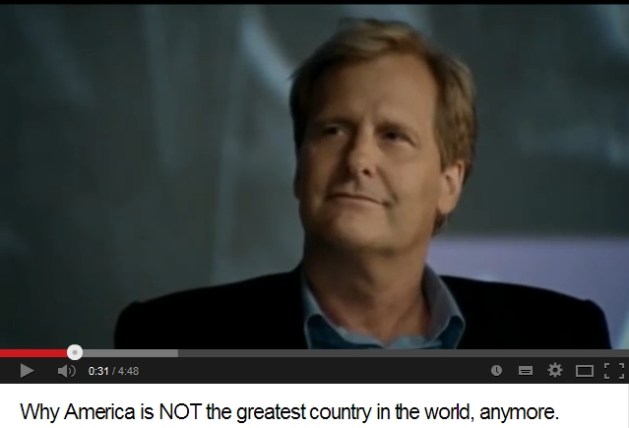
This is the second time I came across with this video.
While some of the arguments presented ‘inside’ are valid I beg to disagree with its conclusion.
Here are some valid arguments for rejecting that conclusion but I’m afraid they don’t get the gist of it.
America is number one, and has been for quite a while, because she is able not only to weather such soul searching controversy as depicted in this video without falling apart as a nation but also to draw a lot of energy from it.
For self centered foreigners and also for disgruntled Americans such bickering might seem a sign of divisiveness and frailty, but in reality this is how America keeps herself on her toes in absence of credible menace from outside. Well, sometimes she was so successful in scaring herself up that she started such hapless wars as the ones against drugs and poverty but this is another topic.
But when push comes to shove she is able to pull herself together. Hitler, the communist leaders of the USSR and bin-Laden are only a few of those who have mistaken lack of unanimity with lack of strength. They are all history now and haven’t arrived there using the recommended venue…
Being able to adapt to whatever comes to cross your path demands being able to think with your own head and original thinkers are renown for sometimes acting boisterously but that doesn’t mean they cannot team up to cross that treacherous mountain!
‘Profit is everything’.
This is the current mantra but is it true?
At first glance yes – what company can survive producing nothing but loses?!? – but then another concept starts jumping before our eyes, the ‘non-profit organizations’.
Ouch!
So let’s take a step back and have a second look.
“Pecunia non olet” – Money has no smell – was how Vespasian, an Roman emperor, replied to his critics who were ‘bewildered’ about how low could an emperor get – to levy taxes on urinals. So if this kind of attitude is OK coming from an emperor who are we, mere mortals, to have a different opinion? The only difference is that today we are a little more prudish and we put it differently: “Money is fungible“!
Really? Try using your grocery money for gambling and see what happens….
“The ends justify the means”. This quote is attributed to Nicollo Machiavelli but it seems that what he really meant, that ‘people will accept a certain course of action when coming from a ‘prince’ ‘ is quite different from what we understand of it today: ‘if you want it badly enough grab it and deal with the consequences latter’.
Same with money, specially now that they don’t smell anymore after Vespasian taught us how to launder them…
‘Survival of the fittest’. Now what on Earth Darwin has to do with being profitable?!? Just bear with me for a little longer.
You see, we are rational human beings. As such we are consummate optimizers: we cannot settle for anything less than the ‘best’. Well…more exactly for anything less than what WE, with our limited knowledge of which we are so proud, consider to be the best …
There is a guy, Ernst Mayr, who opened my eyes about this. As an expression ‘Survival of the fittest’ was not even used by Darwin in any of his works and besides that it doesn’t make any sense from the evolutionary point of view. Being ‘fit’ to one particular environment (not to mention ‘fittest’) means being practically unable to survive in any other environment so your capacity to evolve is severely limited if not altogether absent. In reality evolution, as Mayr aptly puts it, ‘is not about the survival of the fittest but about the demise of the unfit’.
Now lets get back to what profit is about and see if any of this makes any sense in an economic environment. By the way, ‘economy’ comes from ‘oekonomia’, a Greek word meaning making the ends meet in a household.
So what is the ultimate scope of any economic venture? For the entrepreneur to become rich, no matter what?
Or is it about the whole team involved – the so called ‘stakeholders’ – having an as good as possible life as a consequence of their combined efforts ?
OK, both options are at the very extreme so I’ll propose a less ambitious one. How about the real scope of a company being long term survival? This way the shareholders would have a (steady) income and the employees a job.
Yes, for that to happen the company would have to have a certain profit but if the long term goal is ‘survival’ the management and the board will have to take care not to sacrifice the long term prospects of the company for a short term profit boost – just for the sake of the handouts that management currently gets at the end of an ‘exceptional’ year. (Do you still wonder how come every year is ‘exceptional’ nowadays and the bonuses keep flowing, regardless?)
In this circumstances ‘profit’ would no longer be THE exclusive goal of every economic venture. It would still be a very good thing indeed but just an efficiency indicator, one of the indicators that show if a company might be able to survive for the long run.
PS.
And what if the ‘intensity’ with which a certain company exerts itself in the quest for ‘profit’ drives the customers away? And invites some competition, who until then didn’t even considered it, to enter the field? And steal some more of the already disgruntled customers?
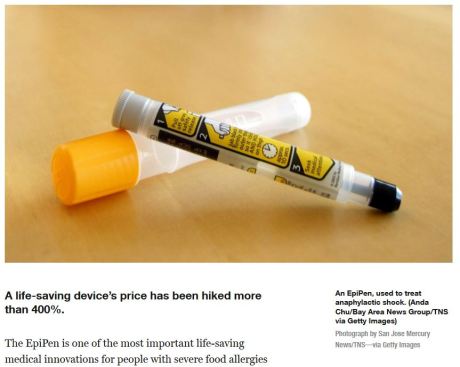
“The EpiPen is one of the most important life-saving medical innovations for people with severe food allergies—which affect as many as 15 million Americans and 1 in 13 children in the United States. But its price has exploded over the last decade despite few upgrades to the product itself. And that’s led to criticism from a consortium of critics which includes consumer advocacy groups and notorious drug price-hiker Martin Shkreli himself.” (Sy Mukherjee, How Mylan Got Away With Its Enormous Price Hike for the EpiPen, Fortune.com)
Nowadays there is a heated debate about how much damage to the nature is acceptable in order for us to have a ‘thriving’ economy.
This way of thinking is very well illustrated by the following picture:
The caption says: “If you really think that economy is more important than nature then try holding your breath while counting your money”.
If we look a little deeper into all this we find out that initially economy – or oikonomia in ancient Greek – was the art of managing the resources needed by a household. Since then these resources came directly from the surrounding nature it ‘naturally follows’ that in those times there was no conflict between economy and nature: people took what ever they needed from where it grew or grazed, threw the garbage wherever around the camps and whenever things became too messy or the pastures/hunting grounds were exhausted people moved a little further, giving the nature an opportunity to heal its otherwise superficial wounds.
Later, as people moved into cities, their relationship with the nature became a little more complicated. If nature had a way of renewing itself periodically all went well. Egypt survives since 5000 years ago mainly because the Nile periodically cleanses and fertilizes the country. If not, and people overuses local resources, the fate of that particular civilization is doomed – the Mayan empire, for example.
A sudden change happened around three hundred years ago: Europeans simultaneously learned advanced agricultural techniques enabling them to feed larger numbers of people, thus freeing a lot of ‘ work force’ that was swiftly employed by the industry, and invented fiat money – paper invested with value by the very entity that ‘printed’ it, the central banks.
‘Economy’ started to thrive only it no longer was about the old struggle for survival; it was gradually transformed into the modern economy: a playing ground where the ruthless fight for more and more money is constantly eating away both natural resources and the moral fiber of those implied in it.
Maybe it is high time for us to understand what is going on and to find a way to reintegrate nature into the economy as a resource that needs to last forever and not as an expendable one.
 nicichiarasa