Archives for posts with tag: Collective identity

A vous de jouer

I shared a video clip on FB a couple of days ago, I’ll post the link at the end of this entry.

It was about a homeless artist in Edmonton, Canada, who taught himself to play the piano and I was wondering where did he find a piano on the streets to do that.

This is how I found out that: “There’s a public piano on the sidewalk in downtown Fargo (North Dakota . It’s in front of an art gallery and is free for anyone to play. (It’s covered during rain and taken indoors for winter, of course.) The plan is to acquire and “sprinkle” more of them around downtown. It’s very popular.”

I was very glad but my happiness was both short-lived and and quickly born again: “The first piano placed on the corner of First Ave. and Broadway in Fargo was vandalized within 10 days. When it comes to public art, our biggest challenge lies in defining the type of behavior our community will tolerate. We must hold each other accountable for our actions. I am working with the local police and with business owners to create ways to reduce the potential for future vandalism.”  
What’s going on there is way bigger than a lonely enthusiast sharing his piano with the passersby. It’s an entire project and the guys aren’t going to give up so easily.

Even more important is that the project is supported by the community: the pianos are donated by the general public and expenses are covered by private sponsors (Kickstarter “helped” a lot) while the big heart behind all this is Susanne Williams.

On this side of the Atlantic, or more specifically in Paris, pianos have found another way to get in touch with the general public. They have somehow convinced the managers of most rail-stations to have one installed near the platforms used by the commuters, as can be seen in the picture that opens my post. Click on it if you want to find out more.

While searching the internet to find out more about ‘street pianos’ I discovered Luke Jerram, the artist who in 2008 had the idea to launch “Play me, I’m yours” : ”

‘The idea for Play Me, I’m Yours came from visiting my local launderette. I saw the same people there each weekend and yet no one talked to one another. I suddenly realised that within a city, there must be hundreds of these invisible communities, regularly spending time with one another in silence. Placing a piano into the space was my solution to this problem, acting as a catalyst for conversation and changing the dynamics of a space.’
Luke Jerram, International artist and creator of ‘Play Me, I’m Yours’

Now I wonder if Luke Jerram and Ryan know about each other.
Ryan playing the piano

Thanks Maria Flieth and Paul Wehage for providing me the initial information for this post.

Me and my limited vision. I consider myself to be a person who is relatively well connected to the world at large yet I could never conceive of somebody not only dreaming about but actually bringing pianos out on the boardwalk for everyone to play.
Maybe it is high time for the rest of us to unleash their dreams.
And to start working on them!

At some point the significant individual involved in a situation will have to make the relevant decision.

And here comes the difference between a human and a horse.

The horse will wait until it becomes thirsty, no matter how ample opportunities to drink would present themselves before him while the human will first make sure that the water is safe to drink and only then decide what to do: drink pre-emptively, fill a flask, take a nap by the spring…

The point I’m trying to make here is that while animals, no matter how ‘sophisticated’, act according to their instincts (or ‘training’) we humans sometimes act instinctively/emotionally and some other times ‘rationally’ – we ‘identify opportunities’ and try to use them to further our goals.

And here lies the watershed…

Our ‘rational’ decisions can be good or bad and there is no real way to tell before hand which is which. Hence the ‘primum non nocere‘ (“first do no harm”) rule used by the professional healers of this world.
The problem with our rationality is that we  never have all the pertinent information at our disposal, enough time to process whatever information we do have nor the wisdom to realize the first two limitations. And this is why we too often proceed as if those two limitations never existed….

Why haven’t we failed miserably until now? (Miserably enough as to never be able to stand up again or to finally learn the lesson?)
Because we relied heavily on ‘tradition’/’religion’. Usually these two are taken together but I prefer to treat them separately. You see, it is true that both of them are nothing but information accumulated in time as a result of the social cooperation that takes place even without us being aware of it but there is a fundamental difference between them.
‘Tradition’ usually has to do with ‘technology’, the way we do things, while ‘religion’ (which comes from the Latin word ‘reliegare’ = ‘connecting to’) is mostly about sharing a common understanding of the world and acting, collectively, according to that ‘Weltaunschauung’.

And here comes the interesting part. Being the member of a certain religious cult/church is nothing but a set of circumstances. Each individual is ultimately/personally responsible for the path he chooses ‘inside’ his religious tradition, for the way he interprets/acts upon the religious teachings he has received during his upbringing.
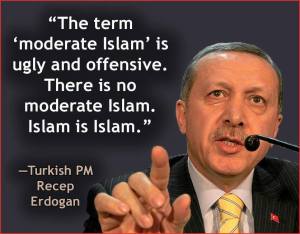
moderate Islam

And this is exactly why I am in full agreement with Erdogan: “There is no moderate Islam. Islam is Islam”.
You see, I grew up in communist Romania and in those times we had a saying that went like this: “it’s not the “ism” but the “ist” who causes the trouble!”.

When placed in a certain situation some people act naturally – they drink if they feel thirsty – or they may decide to use whatever opportunity they identify in order to further their goals.
You can study communism in a library or conspire to impose it on people exactly as you can practice Islam in your community or try to impose it by force to all your neighbors.
It’s neither  ‘communism’s nor ‘Islam’s fault, it’s the communists who cannot understand that communism doesn’t work and the hard-line Islamists who fail to understand  that by acting exactly as the Catholic Inquisitors did during the Dark Ages they’ll eventually drive their flock away from their pulpits.

The real problems arise from the arrogance that blinds those “ists”, individuals so ‘concentrated’ on their self-assumed/assigned goals (no matter if they are well intended, like trying to spread – by force – the wealth around and to – administratively – reduce social inequality, or on the contrary – obsessed with becoming filthy rich at the expense of everybody else and/or accumulating dictatorial power over those around them) that they forget/fail to realize that human rationality is inherently limited. And so they fail to understand that ‘the law of unintended consequences’ will eventually bring them back down to where they belong – with a bang!

There are three sets of social circumstances that these kind of ruthless ‘political actors’ perceive as opportunities: inflamed nationalistic feelings, strong religious beliefs, wide spread social malaise due to economic hardships.

For instance the French Revolution (remember, today is Bastille Day) was fueled by the desperation that ‘doused’, at that time, the French people. They were not only hungry but they also felt abandoned/neglected by their rulers. Marie-Antoinette, the French Queen beheaded during the Revolution, was described as being so callous/ignorant of the real life of her subjects that when informed that her people didn’t have enough bread she interjected: ‘Let them eat cake instead!’
Some historians debate whether this really happened, one of their arguments being that the same words have been attributed to many other historical figures that lived before her but the simple fact that the utterance itself was so widely circulated remains and speaks volumes.
A century later Lenin was able to manipulate the same kind of public sentiment and imposed the Soviet rule over the Russian imploded empire while Ataturk, the leader of the Young Turks, fashioned the freshly minted Turkish nationalism into the glue that held together, until recently, the modern – and secular – Turkish state that succeed the ailing Turkish empire by 1925. It is often forgotten but if we really want to understand Turkey we should always remember that until the late XIX-th century it still was a feudal empire and the social costs of such a short/hasty transformation into a modern nation state were tremendous. Unfortunately in the last decade Erdogan has been working hard, with the unwitting help of the Euro-skeptics who reject Turkey’s efforts to join the EU, to replace secular, and relatively moderate, nationalism with religious zealotry as the backbone of the Turkish republic.
Coming back into Central Europe we have the classic example of how Hitler used nationalistic tensions exacerbated by the economic crises deepened by the unwisely imposed war reparations to implement his demented dream of a Reich that was supposed to last for a thousand years.

The same process is happening again, under our own noses. This time all three ‘components’ are present. The economy of the region is in shambles, arguably because of foreign intervention, nationalistic tensions are rife while religious ones are heated way beyond boiling point.
So why wonder that the al-Baghdadi led Isis uses Islam as a pretext to impose a new dictatorship in a region that has no real need for another one?

“Though al-Baghdadi constantly invokes the early history of Islam, the society he envisions has no precedent in history. It’s much more like the impossible state of utopian harmony that western revolutionaries have projected into the future. Some of the thinkers who developed radical Islamist ideas are known to have been influenced by European anarchism and communism, especially by the idea that society can be reshaped by a merciless revolutionary vanguard using systematic violence. The French Jacobins and Lenin’s Bolsheviks, the Khmer Rouge and the Red Guards all used terror as a way of cleansing humanity of what they regarded as moral corruption.

Isis shares more with this modern revolutionary tradition than any ancient form of Islamic rule. Though they’d hate to hear it, these violent jihadists owe the way they organise themselves and their utopian goals to the modern West. And it’s not just ideas and methods that Isis has taken from the West. Western military intervention gave Isis its chance of power.”

Now it’s up to us. Just as our great fathers used the opportunity presented to them at the end of WWII and helped Germany refashion itself, both economically and socially, by including it in the Marshall Plan instead of making it pay for the rebuilding of the war ravaged Europe we should try to help the peoples in the Middle East find their own respective ways instead of impose on them whatever we might think it would be better for them. And I mean real help, not just let/prod them fight each other to exhaustion.
In fact it would serve our interests also.
The Balkans were considered the powder keg of Europe and indeed the tensions accumulated there helped ignite the WWI. After communism imploded those tensions resurfaced precisely because the previous arrangements were imposed, more or less, from ‘above’. Exactly as the map of the Middle East was drawn by Sykes-Picot.
No, I’m not advocating wholesale dismantling of borders, as it happened in ex-Yugoslavia. If they find a way, by themselves, to preserve the present situation we should encourage and help them to do so. But we should never try to impose something on them just because we consider it would serve our (short term at best) interests.

Lebanon might serve as a good example, both to them and to us.

It won’t be simple, every major power has vested interests there, including Russia, but it can, and should, be done. Specially since the the alternative would be horrible.


Initially politics was an activity. “Was” and not “were” because it was something in which every concerned citizen played an part, a collective effort. Oh, I forgot to tell you that this happened in Ancient Greece during what we now call the ‘first stage of democracy’.

Then, after a little less than two millennia, it became an occupation. People who had successful careers behind them were deemed trustworthy by the rest of the community and elected into government positions. The countries which used this ‘democratic mechanism’ thrived: the US, Britain, France, …to name just a few of them.

Lately politics have become a profession. People study it in Universities and engage in it without any prior experience outside the field. I believe you all know what ‘community organizer‘ means, right?

No, I’m not going to discuss this notion right now. The results can be both good or bad, exactly as it happens with almost all human professions: both Mengele and Albert Schweitzer were MDs…

For now I’ll refrain myself to observing that people have less and less tolerance for digression on the part of the politicians.

“Nicholas Sarkozy arrested over corruption allegations”

Gerhard Schroeder, lionized in his time for cutting down to size the German welfare state is now widely criticized for his involvement with GAZPROM.

Silvio Berlusconi is serving time, disguised as ‘community service’, for tax evasion.

Need I go on?

And this is happening in what we call ‘democratic countries’. In other places former rulers are stabbed to death  or brought to justice in a cage.

In fact we have indeed progressed, as a species. The last time the French got really pissed off by their leaders quite a few people lost their heads…

The most disturbing thing in all this is that the politicians were supposed to be the ones capable/willing of doing ‘the good thing’ AND professional enough as not to exaggerate in anything they do….

Is there anything to be done about all this?

How about upping the ante?

I keep hearing ‘we need a strong leader’ or ‘we need more true leaders’. Are we really sure about that? Leaders would do almost anything to take us where THEY see fit.
How about politicians acting as ‘administrators’?
Right now politics is played, in a lot of places, as a beauty pageant. Would be rulers (leaders) come up-stage to make promises and we choose the ‘best-looking’ charmer. After a while he unfailingly fails so we ‘boo’ him out of office.
Switzerland, for instance, has another way of doing things. They talk a lot more among themselves, many ideas are put forward and then some of them get to become policies and other get dumped.
When have you last heard about a Swiss political leader or about a Swiss political scandal?

rocking the boat

Tesla was a great physicist and a very intelligent man but his wording was rather lousy.

I get the gist of what he wanted to say and I basically agree with him but I don’t think “anti-social behaviour” aptly describes what he had in mind.

The real meaning of ‘anti-social’ is ‘acting against the interests of the group of which the perpetrator is a member”: from stealing to high treason.
What I understand of Tesla’s words are gestures made against ingrained habits which induce social stiffness – social rigidity that inhibits innovation and adaptation.
And in fact all these gestures are pro-social, they are good for the society at large and not at all bad or anti-social.

It is true that today ‘anti-social behaviour’ has been ‘stretched’ to include all actions that disturb ‘social norms, socially sanctioned customs and widely held beliefs’ but this would be true only as long as these ‘habits’ were still useful to the society we are speaking about.

I don’t think Tesla would have condoned theft or any other criminal activity, no matter how anti-social, but he would have applauded, had those things happened during his life, what Copernicus, Giordano Bruno and Darwin had done. Or Martin Luther King.


no piggy back

For some 30 years now the western press is periodically awash with news about the impending doom that is going to engulf China. If not now then soon, very soon.

While I’m not particular fond of the Chinese communists – every political force that enjoys monopolistic control over the space where it resides eventually becomes too rigid and looses ability to cope with the day to day challenges – I must give them what is theirs.

By drawing from the rich experience of the Imperial China the current rulers have learned something. Don’t push it unnecessarily hard, don’t appear to be callous when there is no need for such thing. Not because it would be immoral or anything like that but because it is ‘a mistake’ to do such a thing.

In most countries if something like that would have happened it would have meant that the ordinary people were getting fed with the callousness of the government officials and that generalized riots will follow. Like what happened in Tunisia at the start of the Arab spring.
In  China when ever something like this grabs the attention of the public eye the ‘Party’ springs into action and promptly punishes the perpetrator instead of trying to shield him/cover up for him. This way the ‘Party’ preserves it role in the society and makes sure it remains relevant.

So please put those doom scenarios on hold, at least for as long as things like that will continue to be severely sanctioned by the ubiquitous ‘Party’.

Click here http://www.dailymail.co.uk/news/article-2666147/No-free-rides-Chinese-government-worker-sacked-picture-emerges-riding-employees-flood-avoid-getting-wet.html if you want to read the whole story and thanks Veooz http://www.veooz.com/news/WHHU7ev.html for the picture

“The wiser of the two equally matched opponents will give up first.”
This is a Romanian proverb oftentimes interpreted as a justification/rationalization for cowardly behavior.

It’s anything but!

In a protracted conflict, where none of the opponents has a clear advantage or when the price of wining would be so huge that no one is willing to underwrite it, it is essential that at least one of the interested parties comes up with something new that might defuse the situation. Otherwise the whole thing drags on, people get bitter and calloused and what might have started as a misadventure or as a badly calculated move eventually becomes a festering wound that changes, for the worse, the life of many generations to come.

Think of what happens when two families become embroiled in a ‘vendetta’.
Or about the outcome of the WWI when the people of Germany were punished for the ‘mishaps’ perpetrated by Kaiser Wilhelm.

After WWII the victors have built on previous experience and didn’t fell anymore in the same trap. Instead of inflicting further pain on the already tormented German population they came up with the Marshal Plan. Now, 70 years after the allies landed in Normandy, it would be inconceivable that war might start again between France and Germany. The victors of the Cold War weren’t as wise as their predecessors.

What is happening right now in Ukraine is completely unacceptable. Occupying, in full or in part, the territory of another country, under any pretext, puts the aggressor outside the realm of the civilized world.
But who is the aggressor in this case?

Not so long ago (historically speaking) Louis the XIV-th used to say “L’Etat c’est Moi”. In those times political decisions, including those that had to do with the neighboring states, were made by the rulers while the general population could do nothing but endure their effects. Up to a point of course.
Meanwhile, in a large number of states the political system has evolved considerable. Elections are held periodically so that political leaders and general policies become sanctioned by the electorate. Because of this most of the time there is a certain compact, however fragile and contested, between the political class and the general population.
Unfortunately there still are a number of states where the political situation is ‘ambiguous’ and where the link between the powerful figures of the day and the general public relies more on deceit than on mutual respect and informed consent.
Whenever a country like this is involved in a less than savory encounter on the international scene a very fine line has to be toed when communicating displeasure with its actions. While firm and unambiguous, each message must be very carefully calibrated/formulated lest the general population of the less than democratic country involved will feel besieged. And will naturally coalesce around whoever is in power at that moment. Exactly what that person would wish for and exactly what those who are displeased by the actions perpetrated by that person should try to avoid at any cost.

PS.
In modern terms this whole concept is called re-framing.
And yes, it involves ‘giving up’ in the sense that the ‘wiser’ makes the gambit of renouncing rigidness and maybe even some ‘face’ in exchange for a workable solution.
Any incurred costs are temporary while the benefits tend to stretch far out into the future.
I repeat, just look at what role Germany is currently playing in the European concert.

the right to bear arms

Somehow I don’t think the 2nd Amendment is that much about guns as it is about trust.
That your neighbor can be entrusted with such powerful tools.
That more individuals being powerful enough to defend themselves will bring about safety for all while power becoming concentrated in the hands of the few will eventually lead to tyranny.

Industrial Age

I found this picture on Bob Colgan’s FB page accompanied by the following caption:

THE LONGER You stare at this…….the more you realize how wrong the Industrial Age has been

I don’t want to sound apologetic but isn’t it that the ‘Industrial Age’ is nothing but a set of circumstances that lays at our discretion the technical/social means for us to complain about the shortcomings of the very ‘Industrial Age’ itself?

What if it is US that are responsible for the way WE (mis)use the means at OUR disposal?


Supposedly humans are autonomous and sometimes rational individuals. Overwhelming them with huge quantities of information while restricting the scope of that information – with the declared goal of keeping them focused – will shortly reduce those individuals to the status of highly biased and eventually completely programmed hu(man)-bots.

Whole article appeared in Bizcloud, http://bizcloudnetwork.com/salesforce-wear/

three wishes

So time has come to get down to the serious business…

Better late than never!