Archives for category: The kind of world we live in

‘We already know that, why are you bothering us?’

“labour-power can appear upon the market as a commodity, only if, and so far as, its possessor, the individual whose labour-power it is, offers it for sale, or sells it, as a commodity”

“labour is not a commodity”

OK, reconcile these two declarations… The first belongs to Marx himself while the second is an integral part of the 1944 Philadelphia Declaration made by the International Labor Organization… And if any of you has any doubts about the ILO thinking not being heavily tainted by Marxism please check this out: “the war against want requires to be carried on with unrelenting vigour within each nation, and by continuous and concerted international effort in which the representatives of workers and employers, enjoying equal status with those of governments, join with them in free discussion and democratic decision with a view to the promotion of the common welfare.” Not exactly the Communist Manifesto itself but too close to it for my comfort.

So is it or is it not?

No it isn’t. Not even Marx ever thought it was.

When Marx speaks of labor power as a commodity he only wants to demonstrate the need for the worker to be free in order for the system to function. For him this is the difference between feudalism – when the peasant (the worker of those times) was heavily dependent on the land owner – and capitalism – where the possesor of the labour power is free to sell ‘his commodity’ to the higher bider – is the existence of the free market where commodities – including ‘labour power’, which is traded as if it was a commodity – are exchanged. And the fact that the market is free also determines individual freedom of both the worker and the capitalist, seller and buyer of the labour power.

But this trading of labour power as if it was a commodity doesn’t transform it into a real commodity.

In fact labour is more a form of communication than anything else.
By labouring the worker transforms something into something else, usually in a way that is not so easily reproduced, not even for low skilled jobs. Had it been possible to automate the working process we would have used exclusively robots or morons. Do you really think a robot or a moron could flip burghers at McDonald’s? Are you sure you’d like that to happen?

Confused?
It’s not that complicated. Marx had an insight – that human history is nothing but the story of the individual man enjoing more and more autonomy – and then blew it. He took it upon himself not only to speed up the history of the mankind but also to lead us (even against our will) where he thought that we should finally arrive (communism). Rather arrogant, don’t you thing?
In time that arrogance seems to have mellowed somewhat (or became more conceited?) but it is still very much alive: ‘the war against want requires to be carried…to the promotion of the common welfare’….

What is that ‘the common welfare’? Can something like that ever be determined? Even in a ‘democratic’ way?!?

Had Marx refrained himself at studying the effects of increased individual autonomy on the workings of the human society he would have been considered the undisputed thinker of the second millennium and we’d have been sparred from witnessing (or experiencing) the horrors of communism…  I know, I know, counter-factual history is not acceptable… just saying…

Quite a popular mantra nowadays, don’t you think?

Whenever somebody tosses you a problem without also giving you the tools to fix it and you dare ask for instructions about how to fulfill your new task, you’ll inevitably get this very helpful ‘advice’… And most often it’s your boss who does this, right?

So?

Ever tried Google-ing it?  Wikipedia has, of course, an extensive entry about this notion. Lifehack.org has a decent list of 11 to do-s on this topic, only many of them are things you’d better do in advance…

But what can a man do in a hurry?

First of all stop searching desperately for a solution.
Most of us entertain the idea that the human brain is a well honed tool that only needs to be pointed at the target, fed the pertinent information and, presto, it will provide a solution if pressed/enticed hard enough.
The problem is that something inside that tool (part of our subconscious) has been conditioned during our formative years to stay inside a set of limitations/comfort zone. Don’t do this, don’t touch that, don’t lie…

While staying inside the rules is, usually, a very helpful rule of thumb – specially when it comes to survival situations where you don’t have time to consider the matter – sometimes you really need to do exactly the opposite. Drinking your own piss, for instance.

Whoa! Another quack… I’m out of here!
Hold your horses and keep on reading. Or, even better, click on the highlighted link and find out about how a guy saved himself by simultaneously braking two taboos. Not only the one about drinking your own urine but also the one about ‘not hurting yourself’.

And by reading that article you’ll also understand a lot about the inner workings of the human mind.

So, what do we have there?
A guy wants to convince us that drinking pee is wrong for us. To do this he needs to grab our attention so he brings in Aaron Ralston, a well know character who had his hand pinned down by a fallen boulder, waited awhile to be saved, drunk his own urine during some of that time and, finally, when he got tired of the entire situation, cut himself free, leaving behind his right palm.
Do I still have your attention? My post is about thinking out of the box and I’m trying to illustrate my point by using an article about how bad it is to drink urine, which uses as an attention grabber the story of a guy who did drink his own piss and cut his hand in order to free himself…

A box in a box which lies inside another box… Yep. that’s it, you got it.

The first thing you need to do when having a hard time trying to find a solution is to understand that no matter what you think about your current situation you ARE in a box. In fact not in only one box but deep inside the bowels of a regular Matryoshka.

matryoshka

Feeling desperate? That’s OK. Now that you don’t have anything more to loose than your shackles you’ll have an easier time.

Being ‘inside’ a box is not that bad. The point is that you need to be aware of this fact and to choose yourself which box is the right one for you instead of allowing some ‘strangers’ to box you where ever they want you to be.

So all that is left to be done is to look around, identify the walls of the box you are currently in, the limitations imposed upon you by those walls and how those limitations might prevent you from solving your problem. Finally, look for a way to accede into the wider box. Don’t be afraid nor dream that you’ll ever get out into the open, the walls I’m speaking about are constantly being build by our very own minds.

And this is good. Out there there is no order we can speak of. It’s the Unknown and we are rightfully afraid of it. That’s why we conquer any new ground piece by piece, precisely by building a wall immediately after we have a glimpse of understanding about something.  Usually this process takes place unnoticed by our consciousness. We have a moment of grace, the old wall becomes transparent, we see something behind it and we imediately build another wall a little further. Both to protect the new acquired knowledge and to defend the realm of the familiar from the dark forces of the unknown.

The problem with this process is that most of the time the walls are opaque. Not only the exterior one, most of the interior ones stay opaque for most of us even after they have been breached numerous times. And much of their opaqueness come from nothing else but our own fright.

The Ancient Greeks divided the world in two parts. The Cosmos, which had a certain structure and was governed by rules, and the Chaos, the  frightful rest. The separation between these two places, Cosmos and Chaos, was nothing but one of the walls I keep mentioning and the Greeks never dared look behind it so they didn’t have to face any of the monsters created by their own imagination and set free to roam the Chaos. We, despite our modern belief in science, are no better than they were. Still afraid we wait, wriggling our hands, behind the protection walls we have erected to protect our inquisitive minds from straying into the unknown.

So, next time you feel like taking an exploratory trip into the unknown, start by identifying the walls around you. Both to understand what you have to overcome and to find out where your fall back positions are.

I came across this extremely interesting article about Hitler being a socialist.

After making his point, impeccably, Daniel Hannan – the author – ends up with: “My beef with many (not all) Leftists is a simpler one. By refusing to return the compliment, by assuming a moral superiority, they make political dialogue almost impossible. Using the soubriquet “Right-wing” to mean “something undesirable” is a small but important example.”

To me this article is nothing but another reminder that the the only reasonable alternative to any extremism is the living center, not the dead opposite extremism.

Every time that the functional equilibrium between the content (because of their affluence, carelessness or both) and the strugglers (people who are on a constant quest for new solutions, irrespective of their motivation) has been breached things tended to become rather ugly before coming back towards normalcy.
Just compare how people around the Mediterranean sea used to live during the four centuries straddling AD 1 with what happened during the next millennium, otherwise known as the Dark Ages.
Why? Just because the Roman emperors used ‘panem et circensis’ as their main political concept and the population obliged. Until things went so far that the whole empire failed abysmally…
Same things happened before the French Revolution and before Lenin and Hitler came to power in Russia and Germany, respectively. Nowadays it is currently happening in Russia and the huge gap between the oligarchs and the modern muzhiks is the sole explanation I need for how come Putin has such a stronghold on the Russian people – he is keeping both categories happy by feeding their imagination with dreams about the Greater Russia and their bellies full with the money he gets from selling oil and natural gas.
For people on both sides of the political spectrum to restart a real dialogue all of them need to understand that the other side has legitimate concerns too.
Nowadays most on the left insist on ‘equality’ while most on the right speak of nothing but ‘individual freedom’. And both of them blame the state. The left accuses the government for not doing enough to promote the sacrosanct ‘equality’ while the right blames the state for infringing on the individual’s right to do whatever it wants…  As if equality (of chances) is in anyway different from individual freedom… As if authoritarianism could exist without the guys at the top enjoying a lot  more freedom than those at the bottom of the social ladder… As if functional social order could be maintained without people cooperating among themselves based on mutual respect, said cooperation  having evolved through time and currently reaching the modern form known as “the democratic state”…
I agree with concerned people on the both sides of the divide that the state could, and has indeed in more than one occasions, represent an extremely powerful repression tool in the hands of callous political operators but the answer to this is to make sure that the democratic mechanisms work smoothly, not to thoroughly dismantle the state itself….  Precisely because a skeleton state is a lot more easily highjacked by the ‘political thugs’ than one which has respected and balanced (hence functional) institutions in the right places.
Now please allow me to end my post by extending the invitation made by Daniel Hannan and urge you, all of you, to stop assuming ‘moral superiority’ based exclusively on ideological motives. Ideology is fine but we should never forget that it is nothing but a tool and it is us who do things and are responsible for both our deeds and our fate.
If ideology is diverse enough as to help us see how complex the world really is then we are better off because of it. If, instead, we use our diverse ideologies as filters to shun whatever ‘the others’ are trying to tell us… then it’s curtains for all of us, together at last… but not in the right place.
PS
To read the article – it is brilliant – you can either click on the yellow highlight near the top of my post or here: http://blogs.telegraph.co.uk/news/danielhannan/100260720/whenever-you-mention-fascisms-socialist-roots-left-wingers-become-incandescent-why/.

Momentum and inertia

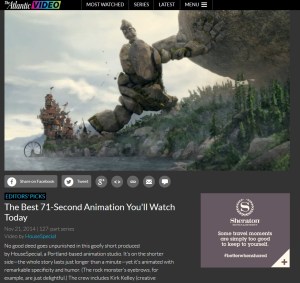
The Atlantic offers us an excellent animated video and captions it ‘no good deed goes unpunished’.
Click on the picture to watch it, brilliant 71 seconds.

The point is that the film is about way more than ‘no good deeds going unpunished’.
It’s about ‘playing with fire’, ‘assuming responsibility even for your unintended mistakes and trying to remedy them’, ‘not acting before understanding what is really going on’ and, maybe the most important of all, ‘should you give in to anger, even if you have nothing to loose, at least apparently?’

the-best-blow-chart-ever-bird-shit

It took me a while.
Long enough to become ashamed of myself…
But I finally got it!

All those individuals are birds! In order to get there they had to fly!

In human terms they were free, nobody forced them to get in those relative positions.
If living in a democracy, those above the basic level had run for those positions and their attempts had been validated by those residing on the lower branches!

So what’s keeping them there?

Do they really enjoy it?
Are they afraid that if they leave, even temporarily, somebody else would take their places?
Have their wings became so stuck with shit that they are no longer able to take off?

Besides that, what kind of leader can find any satisfaction in presiding over such a filthy mess?

modern triad


I’m afraid things are a tad more complicated than that.
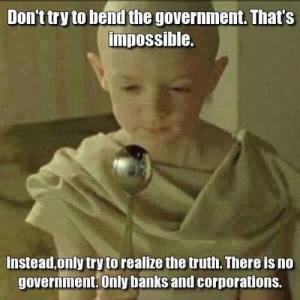
There is us, government and banks/corporations.
None of these three can survive, at the present level of ‘sophistication’, without the other two.
Unfortunately people tend to forget that and to concentrate on their own personae/interests. In hot pursuit of those interests some of these people ‘bend’ the normal interactions between ‘us’, government and banks/corporations.
Those ‘bends’ make life easier for the benders but only on the short run. After ‘power’ becomes too concentrated the system becomes fragile, exactly as Nassim Nicholas Taleb has amply demonstrated and Vilfredo Parreto suggested more than 100 years ago.

A vous de jouer

I shared a video clip on FB a couple of days ago, I’ll post the link at the end of this entry.

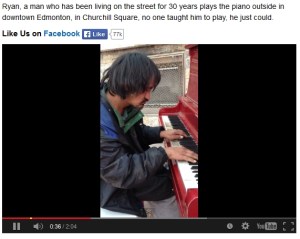
It was about a homeless artist in Edmonton, Canada, who taught himself to play the piano and I was wondering where did he find a piano on the streets to do that.

This is how I found out that: “There’s a public piano on the sidewalk in downtown Fargo (North Dakota . It’s in front of an art gallery and is free for anyone to play. (It’s covered during rain and taken indoors for winter, of course.) The plan is to acquire and “sprinkle” more of them around downtown. It’s very popular.”

I was very glad but my happiness was both short-lived and and quickly born again: “The first piano placed on the corner of First Ave. and Broadway in Fargo was vandalized within 10 days. When it comes to public art, our biggest challenge lies in defining the type of behavior our community will tolerate. We must hold each other accountable for our actions. I am working with the local police and with business owners to create ways to reduce the potential for future vandalism.”  
What’s going on there is way bigger than a lonely enthusiast sharing his piano with the passersby. It’s an entire project and the guys aren’t going to give up so easily.

Even more important is that the project is supported by the community: the pianos are donated by the general public and expenses are covered by private sponsors (Kickstarter “helped” a lot) while the big heart behind all this is Susanne Williams.

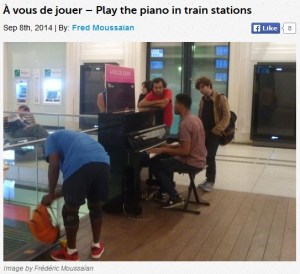
On this side of the Atlantic, or more specifically in Paris, pianos have found another way to get in touch with the general public. They have somehow convinced the managers of most rail-stations to have one installed near the platforms used by the commuters, as can be seen in the picture that opens my post. Click on it if you want to find out more.

While searching the internet to find out more about ‘street pianos’ I discovered Luke Jerram, the artist who in 2008 had the idea to launch “Play me, I’m yours” : ”

‘The idea for Play Me, I’m Yours came from visiting my local launderette. I saw the same people there each weekend and yet no one talked to one another. I suddenly realised that within a city, there must be hundreds of these invisible communities, regularly spending time with one another in silence. Placing a piano into the space was my solution to this problem, acting as a catalyst for conversation and changing the dynamics of a space.’
Luke Jerram, International artist and creator of ‘Play Me, I’m Yours’

Now I wonder if Luke Jerram and Ryan know about each other.
Ryan playing the piano

Thanks Maria Flieth and Paul Wehage for providing me the initial information for this post.

Me and my limited vision. I consider myself to be a person who is relatively well connected to the world at large yet I could never conceive of somebody not only dreaming about but actually bringing pianos out on the boardwalk for everyone to play.
Maybe it is high time for the rest of us to unleash their dreams.
And to start working on them!

Extreme fragility, dead ahead.

Just prior to the Great Depression an American accountant, Ralph Elliot, had taken Charles Dow’s insight about economic cycles a step forward and came up with the ‘Wave Theory’.
I won’t enter into details here but I have to give you some broad outlines.
Charles Dow: In any market, prices evolve in trends – sustained moves towards the main direction fragmented by ‘reactions’ that run contrary to the trend. According to Dow there are three categories/levels of trends: major, intermediary and minor. The major trends cannot be manipulated and comprises three phases: ‘accumulation/distribution’, ‘public participation’ and ‘panic’. The names are self explanatory but if you want to read some more please click here.
Ralph Elliot: (If a certain asset is traded by a large enough number of traders so that market could be considered ‘free’) Price action is fractal in nature and hence can be broken down and analyzed as such. While Dow identified 3 levels of trending Elliot uses 9 but both ‘agree’ that each action in the direction of the analyzed trend is followed by a reaction contrary to that direction.

Robert Prechter, the brain behind ‘Elliot Wave International’, ” the largest independent financial analysis and market forecasting firm in the world” – the guys from whom I borrowed the picture above – has been using successfully the ‘Elliot Wave theory’ for some 40 years now.
And here comes the really interesting part. Besides building Elliot Wave International as a market analysis company Prechter also founded The Socionomics Institute, a think tank that starts from the assumption that the markets are driven by the prevalent social mood (sentiment) that dominates at any given moment and not all the way around as it is usually believed. Prechter posits that markets go down when/because ‘people are afraid’ and not ‘people start to panic after the market has begun to go down’.
For some people this whole process is a tug of war between greed and fear. It makes a lot of sense but we still lack an explanation about why at some points the bulls are stronger than the bears and at some-other points the situation is completely turned over. Reason was supposed to take care of business at all times, wasn’t it?
Now some of you will tell me that Daniel Kahneman and others have provided ample proof that the market is far from being rational... OK, I agree with that but still, we continue to need an explanation for why the market behaves for so long as if it were reasonable only to break down exactly when everybody was so happy – as it constantly did, from the Tulip Mania in the the XVII-th century Holland to the last financial melt down.

Now please remember two things that I already mentioned.
– One of Charles Dow’s assumptions was that ‘major trends cannot be manipulated while the lesser ones might
– (If a certain asset is traded by a sufficient number of traders so that market could be considered ‘free’). Here I was presumptuous enough to introduce my own experience into the equation. After I was introduced to the Elliot Wave theory I found out that it worked (meaning that I could use it successfully – statistically, of course) for indices or other frequently traded symbols while it is completely useless for illiquid ones.

I started to understand what’s going on only after reading Nassim Taleb’s Antifragile.
The gist of this book is that for a system to remain viable, to conserve it’s chances to survive, it has to keep open as many options as it possibly can.
Does it make any sense to you?
To be alive means being able to make decisions, as freely as possible. If you are forced to make one thing or another then you are not free anymore, right? If you have at least the slightest opportunity to choose among two or more possibilities then it means that you still have a sparkle of life in you! Stephen Hawkins, tied in his wheelchair for so many years, is alive just because he choose not to be overwhelmed by his condition while so many of us are (brain) dead because we indiscriminately follow fads, fashions, habits, you name it. The moment we give up our individual autonomy and enroll into a crowd (read ‘herd’) we might have the impression of becoming safe, or at least safer, but in reality we are already headed for the slaughterhouse.

It is somewhat true though that ‘there is safety in numbers’. And no, I’m not contradicting myself. The bigger the crowd the harder it is for someone to control it (take it to the slaughterhouse, by will or by error) and the greater the chances for an individual to escape an unforeseen  predator. So you need a really big crowd if you want to have a survival situation, a reasonably viable system.

If we look back in history – no magical solution can be found there, only a long list of errors – we’ll see that empires never fail to crash, authoritarian regimes survive for considerable shorter periods than the more democratic ones and that the more powerful a fad was the least it survived. And all these situations fit perfectly Taleb’s theory: the less open options a system has the less able it is to survive. The emperor is but a single man, who inevitable ends up being ‘naked’, no matter how capable it is – and people notice it sooner or later. Also the more an authoritarian a regime the less are the ordinary people inclined to contribute to the welfare of the community.
And something else. When a fad becomes intense enough the people involved become blind to any other alternatives but those prescribed by those convinced that they have a lot to gain by keeping that fad alive. That’s why it is very hard for a social ‘vicious circle’ to be broken until enough people hit the rock bottom. No grown up will voluntarily shout ‘the emperor is naked’ because he thinks he has nothing to gain from this. As strange as it may seem it is rather hard for the regular Joe, who’s afraid of the emperor, to understand that the entire kingdom becomes a laughing stock for the rest of the world if the emperor is known to stroll naked through the public square.

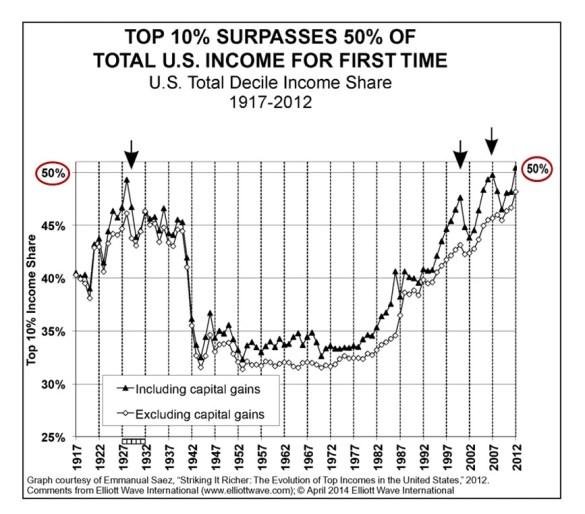
Now please take a second glance at this picture.
Extreme fragility, dead ahead.

What does it suggest?
That there is a certain correlation between income being concentrated in fewer and fewer hands and the probability of a market crash?
But correlation is not causation!
No, it isn’t. Not unless we can find a reasonable story for what may ’cause’ that correlation! Explain it, that is!

By now I’m almost convinced that most of you have already ‘got’ it.
Concentration of revenue means concentration of decision power. As less and less people (proportionally) remain in ‘powerful’ positions they not only command a higher proportion of the aggregated revenue of the entire community but they also control in a greater measure the destiny of that community.

No, I don’t think that ‘they’ are ill intended. ‘They’ live here too. They are not idiots, otherwise they wouldn’t have reached/been able to retain those lofty positions. So no, I don’t think they are willingly leading us to disaster.

The problem is that they are too few! No individual human being is able to make a considerable number of decisions in a short period time. That’s the very reason why we have consultants and so on, right? The problem is that ‘consultants’ only give advice, they cannot/are not allowed to make actual decisions. And the fewer are the people wielding real power the more the rest of us become mere consultants…

And according to Taleb’s theory and to an immense number of historical occurrences the less people are involved in the decision making process the higher are the chances for a catastrophic error to ‘reset’ the entire system.

PS I. Funny for a conclusion like that to be drawn from a picture published by somebody who caters for those ‘working’ hard to get as rich as possible, isn’t it?
On the other side…if these people considered the issue to be important enough to write about it … maybe it’s worth a moment of our precious time.

PS II Never say never!
I don’t think we are necessarily facing another economic melt-down in the immediate future. It might happen, of course. It will happen – sooner or later, of course again, but there is no sure way of telling when.
What I’m trying to suggest here is that there is a very strong possibility that in the near future we’ll witness a considerable change in how we manage the economy and in the way we relate to the concept of ‘money’.

“Kaci Hickox, a nurse whose return to the U.S. after treating Ebola patients in Sierra Leone was sidetracked when she was placed in a mandatory 21-day quarantine Friday, is criticizing the way New Jersey officials have handled her case.

Hickox says she doesn’t have a fever; a preliminary blood test came back negative for Ebola. She reportedly hired a civil rights attorney Sunday to work for her release.

I can understand the notion of ‘quarantine’ even if I have serious doubts about it’s efficiency.
But in an unheated tent and wearing paper scrubs?
I’m afraid this is less about separating people that might be carrying the virus from the rest of the population and more about frightening others from coming in!
Now, I cannot stop wondering, how many otherwise reasonable people will do their ‘best’ (worse?!?) to hide any contact they might have had with this disease?

PS. “Gov. Andrew M. Cuomo Sunday night said people returning from West Africa who have come in contact with Ebola virus patients but are not showing symptoms will be quarantined for 21 days at home instead of in a hospital.

The announcement marked a change in the policy outlined by Cuomo and New Jersey Gov. Chris Christie on Friday that drew criticism from federal and local officials, and medical…”

Altruism is a behaviour that has been ‘naturally’ selected at the ‘social’ level,
Communities that encourage it fare better, as a whole, than communities which condone widespread indifference towards the others.
Please notice that the opposite of altruism is not ego-centrism and not even egoism but complete indifference. An egocentric or egoistic individual is one who is aware of his person and values his individuality. As such he will try to take good care of himself and never dare to behave in a completely callous manner because he fears social rejection, provided his egoism is tamed by reason.
If his egocentricity becomes unmanageable he turns into a socio-path that will be, sooner or later, expelled from the society.
If nothing out of the ordinary (extremely good or extremely bad) comes along, naturally (randomly) occurring ‘altruism’ is encouraged by some, faked by others and on the whole a ‘moderately altruistic’ behaviour becomes the modus vivendi of that particular community. Ties between the members of that group gather more and more force but don’t overwhelm the individual autonomy of the members, on one side because of the ‘fakers’ and on the other because the ‘real’ altruism involves a certain degree of respect towards the others.
If a particular social group, for whatever reasons, stops discouraging extreme egocentricity, like the one Caligula and his heirs ‘practised’ in Ancient Rome, that entire group is doomed. The largely disseminated egocentricity gives birth to indifference about the fate of the group, later to lawlessness and eventually to a state described as ‘anomie’ by a certain Durkheim – a French sociologist who discovered the link between the number of suicides taking place inside a community and the intensity of the forces that coalesce that community.
Durkheim had reached the conclusion that although the actual decision belongs to the individual, each of the members of a community is more or less ‘prone’ to consider ‘doing’ it according to the strength of the bonds that exist inside that community. (Suicide, A study in Sociology). He continued by introducing the concept of Anomie “a condition or state in which there is a breakdown of social norms and guidance for the citizens of a society. Anomie occurs when society has little influence on individuals’ propensity to follow rules and norms, and individuals are, therefore, left without moral guidance. Individuals do not feel attached to the collective society.”

Meaning that there is almost nothing to bind together a society whose members no longer value their own lives, let alone those of their neighbors.

Let’s go back in time to Caligula’s Ancient Rome or to the pre-Revolutionary France. The general atmosphere in both instances could have been very accurately described by ‘apres moi, le deluge‘ (‘a huge amount of water will be needed to cleanse after me’) – a phrase attributed either to Louis XV of France or to his mistress.
Well, we all know what followed. Ancient Rome collapsed under the attacks of the barbarians and the famous Bastille was occupied by the sans-cullotes.