Archives for category: Psychology

Ultimele zile am avut de mers ‘prin cartier’. Fiind soare afara am folosit bicicleta.
Asa ca am fost din nou vanat de maidanezi.
Pe strada Vaselor, la 2 minute de mers pe jos de blocurile de pe calea Mosilor, si in fata bisericii Balaneanu pe de Mihai Bravu.
Oare de ce am asa o presimtire ca se va gasi cineva sa ma intrebe ca de ce umblam cu bicicleta pe trotuar? Pentru ca acolo a trasat Oprescu benzile pentru biciclisti.

Cu ocazia asta mi-am adus aminte si de o plimbare pe care am facut-o sambata trecuta, pe la 4, pe strazile din jurul bisericii Sf. Mina de pe Bd. Coposu. La intersectia dintre Teodor Stefanescu si Calotesti erau vreo cinci care dormeau la soare dupa ce rosesera o punga de oase de vita crude, din alea mari numai bune pentru fiert intr-o ciorba de burta. Cind m-am apropiat – eram singur pe strada la ora aia – sau trezit si au inceput sa hamaie la mine. Pana la urma aveau si ei dreptate, de unde sa stie ca nu aveam de gand sa le fur oasele?
Cat despre ce or fi avut in minte cei care le-au adus oasele…

Si se pare ca orice faci in Bucurestiul asta tot de caini vagabozi dai. M-am apucat sa curat cartofi. Primul lucru pe care il fac in momente din astea dificile este sa iau un ziar, sa il deschid la mijloc si sa il pun pe masa. Normal, nu? De data asta ii venise randul unui Ring pescuit cine stie pe unde. Din stanga paginii din mijloc imi zambea Marina (Almasan) care ‘bombanea’: “Ah, cei mai iubesc pe maidanezi!” Evident ca l-am citit.

“„Nu ştiu cine-i Pamflet şi nici nu mă interesează toţi descreieraţii de teapa matale!”, mi-a retezat scurt individa orice intenţie de dialog constructiv. După care s-a apucat să-mi enumere personaje canine din literatura universală, apoi situaţii în care câinii s-au dovedit a avea mai multă omenie decât oamenii, mi le-a ridicat în slăvi pe Brigitte Bardot şi Cristina Ţopescu. Însă, pe când să treacă la împroşcarea cu noroi a Curţii Constituţionale, s-a apropiat de noi un maidanez flocos, cu mers sigur şi privire înceţoşată. Recunosc, a fost singurul moment în care m-am pierdut. „Ăsta va fi finalul apoteotic al plimbării mele”, am conchis. Dar nu! Maidanezul s-a apropiat nu de mine, ci de Madam, care s-a grăbit să-l gratuleze cu un mieros „Mânca-l-ar mama de frumos!”, întinzând spre el o mână plină de inele. Dulăul a privit-o lung, a lătrat de două ori baritonal, după care şi-a înfipt colţii în mâna durdulie… N-aţi vrea să ştiţi ce-a urmat! Ce recital de invective, urlete, blesteme şi tânguieli, dublate de orăcăielile copilului proaspăt trezit din somn! …
Am şters-o englezeşte din peisaj, încercând să nu mă bucur de necazul interlocutoarei mele. Totuşi mi-au ajuns la urechi, printre lătrături şi plânsete de copil, vorbele victimei: “Lua-v-ar naiba, pe mata şi pe nenorocitu’ ăla de Pamflet, că voi aţi înrăit câinii ăştia, de au ajuns să sară şi pe noi, iubitorii de animale!”…”

Si uite asa s-a mai facut Marina de un cititor fidel.

PS. Ca sa fie clar.
Iubesc animalele iar pe fiul meu l-am adus acasa de la maternitate intr-un apartament de 2 camere unde il astepta un dog german de 70 kg – in ultimele doua zile ii adusesem scutece de la maternitate sa se obisnuiasca cu mirosul copilului asa ca a fost o dragoste la prima vedere, pentru amandoi.
Numai ca este o imensa diferenta intre un caine – orice animal de altfel – crescut intre oameni care il iubesc si cei crescuti in starea lor naturala, in salbaticie. Iar situatia cea mai grea o au cainii ‘vagabonzi’. Ocrotiti de unii, goniti cu pietre de altii devin de-adreptul psihotici. Ar fi simplu sa dam vina pe cei care ii gonesc numai ca orasul e un spatiu destinat oamenilor si nu cainilor salbatici. Asa cum nimeni nu ii invinovateste pe ursii care isi apara puii in mijlocul codrului tot asa nimeni nu poate invinovati un om care isi apara copilul, sau chiar cainele pe care il are in lesa, de un caine vagabond.

Uite, cam asta e diferenta.

IT IS THE SOLDIER

It is the Soldier, not the minister
Who has given us freedom of religion.

It is the Soldier, not the reporter
Who has given us freedom of the press.

It is the Soldier, not the poet
Who has given us freedom of speech.

It is the Soldier, not the campus organizer
Who has given us freedom to protest.

It is the Soldier, not the lawyer
Who has given us the right to a fair trial.

It is the Soldier, not the politician
Who has given us the right to vote.

CHARLES M. PROVINCE, IT IS THE SOLDIER

Mr. Province is a veteran so for him it was simple to see his side of this truth.
The remarkable thing is the attention this poem got from the rest of the society, It is seldom that the ‘regular guy’, the ‘doer’ gets the recognition he deserves.

Yet.

Without priests we wouldn’t have had faith,
Without reporters many truths would have remained hidden,
Without poets our words would have been bland,
Without social activists we would have remained slaves,
Without (some of) the lawyers the law would have become an empty word to be used at the whim of the powerfuls of the day and
Without the real politicians (those few who work for the community) our society would be in a constant state of (cold) war, akin to what’s happening in a baboon troupe.

In fact the only difference between a gang of monkeys and a human community is that the first is based on the week submitting to the most powerful while the latter on the cooperation between the elite and the commoners.

Please note that it is not enough that the individuals in a group to be humans, they need to act their parts! When ever people forget to do that very nasty things come to be, look at what is happening right now in Syria.
And check out this video. The individuals act as our distant ancestors might have done. Yet they are bonobos, apes and not humans, not even primitive humans. Monkeys.

Good monkeys. Monkeys that cooperate and respect each-other.

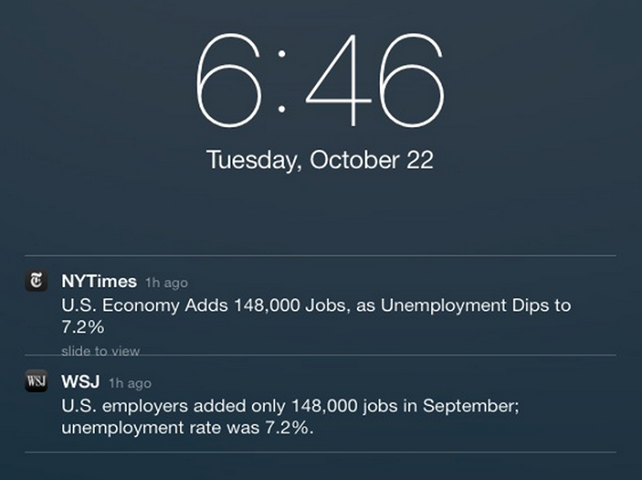
I spotted this picture on The Atlantic’s FB wall:Image

It also had a caption: “A reminder that you should read more than one newspaper—even when you’re using an iPad.”

“So where’s the news?” I asked myself.

Well, the news is that it was a reader who noticed this!
I was expecting, my mistake – I was presumptuous, a self serving sermon about modern era ‘militant journalism’ yet it was a glimmer of hope: people have started to think with their own heads.

And then I read some comments on the FB page. Quite a lot of people were not only taking sides – perfectly acceptable, everybody is entitled to have an opinion – but actually defending or defaming particular newspapers.

My conclusion? It seems there are still too many people who trust “their newspaper” while rejecting all the others. AND that too many journalists/owners continue to misuse this trust.

I started this post with “You can lead a horse to water but…” Some of you might get offended that I compare readers with horses, or, slightly better, with ‘stubborn’ horses who drink only when they feel the need. Some others might remark that horses are less gullible than some people. There is some truth in all these… but I had something else in my mind.

Good horse breeders never take their horses to water when there is no real need and certainly they don’t force anything down the throat of healthy animals. So why is this bullshit going on? I understand differences of opinion but crass manipulation is like purposefully damaging your herd!
Besides that, I know that horses are intelligent animals. OK, nowadays manipulation techniques are indeed very powerful but if a sizable – and growing – portion of the “herd” is able to see through them how come too many still refuse to have a close look at what is going on?

Simultaneously I have the distinct impression that the ‘manipulators’ consider that their habitat is so well protected from the rest of the world that they can do whatever they please, without any fear for the consequences their  acts might have. Are they really that thick, that disconnected from the hard realities of this world or are they delusional?

Well, no horse starts to drink before feeling thirsty!

Yes but we’re not horses! “Readers” and “writers”, we belong to the same species and inhabit the same Earth. Together.

For a funnier side of this subject you might try figuring out what really happened here.

I don’t get this:

“France summoned the U.S. ambassador on Monday to protest allegations in Le Monde newspaper about large-scale spying on French citizens by the U.S. National Security Agency.”

So the French PM found out that the NSA was involved in “large-scale spying on French citizens” by reading Le Monde?

Some twenty-five years ago one of my childhood friends emigrated to America.
I reconnected with him in 1994. He had worked his way up from the ‘floor’ of a auto-parts distribution business to manager of the most important of its warehouses. At that time he was putting on at least 10 hours a day from Monday to Friday and some 5 hours on Saturdays. At some point he felt the need to go back to school – he had very little formal education – and told the owner of the business he wouldn’t be able to contribute so much as he did until then so he was willing to accept a pay cut. The owner replied that he would have to replace him. They departed in good terms, my friend told me he didn’t harbor any bad feelings toward the guy because he was honest and straightforward.
Flash-forward three years. My friend had finished a course for computer engineers and got hired by a really big, privately owned, multinational corporation. He told me he had the impression of working again for a state owned company: people didn’t have the guts to speak up their minds and their main occupation was to cover up their asses under a ton of paper. Procedures took prevalence to common sense. He was the first to tell me that if there is too big a distance between the shareholders/owners and the general management the people at the top of the company start acting as if they own it and this is the reason for which it doesn’t really matter if a huge corporation is privately  or state owned. What it does matter is local culture – if earning undeserved money is shunned by the people then things are OK but if people put money above anything else the big corporation will run into trouble sooner or later. My friend gave up working for others and started a hair-salon with his wife.
Flash-forward to our times.
We have found out about the existence of some (privately owned) corporations which are too big to fail but  which despite (because?) their size and importance have reached some really dire straits and desperately need assistance. We have experienced TARP and QE I and II.
The general public is now split in two:
The Tea Party abhors big Government because it is intrusive and stifles individual initiative.
The Occupy Movement abhors big Business because it is callous and treats the individual exclusively as a consumer/workhorse, effectively disregarding its very humanity, and because it has dumped a huge pile of loses on the humble taxpayer.

And yet Tea Partiers and Occupiers can’t see eye to eye with each-other.

Isn’t this the strangest thing of all?

PS. The existence of a significant shareholder might help a big corporation to overcame the disadvantages of its size. Ford has coped better than GM or Chrysler, BMW (controlled by the Quandt family) than Daimler-Chrysler, etc. Same rationale works for the .com companies where the founders still have a loud enough voice on the board. And maybe the secret of Warren Buffet’s success is that he invests in companies which already have a management focused on the long term survival of the company instead of their own enrichment at all costs (all costs for the company, of course).

WWI. The Americans cross over the Atlantic and ‘save the day’ in Europe.
WWII. The Americans cross over the Atlantic and the Pacific and have a crucial contribution in saving the day in the whole world.

After the WWII the communists  took over Romania, with massive help from the Soviet Russia.
Some people took to the mountains hoping to keep aflame the liberty torch until the, in their view, inevitable war between the US and Russia will eventually end with an American victory and Freedom will come back to Romania.

Sixty years later I find this joke in my mailbox:

“An Australian man was having a coffee and croissants with butter and jam in a café when an American tourist, chewing gum, sat down next to him. The Australian politely ignored the American, who, nevertheless started up a conversation.
The American snapped his gum and said “You Australian folk eat the whole bread?”
The Australian frowned, annoyed with being bothered during his breakfast, and replied “of course”.
The American blew a huge bubble. “We don’t. In the States, we only eat what’s inside. The crusts we collect in a container, recycle them, transform them into croissants and sell them to Australia”.
The American had a smirk on his face.
The Australian listened in silence.
The American persisted “D’ya eat jam with your bread?”
Sighing, the Australian replied “Of course”.
Cracking his gum between his teeth, the American said “We don’t. In the States, we eat fresh fruit for breakfast, then we put all the peels, seed and the leftovers in containers, recycle them, transform them into jam and sell it to Australia.
The Australian then asked “Do you have sex in the States?” The American smiled and said “Why of course we do”. The Australian leaned closer to him and asked “And what do you do with the condoms once you’ve used them?
“We throw them away, of course!”
Now it was the Australians turn to smile. “We don’t. In Australia, we put them in a container, recycle them, melt them down into chewing gum and sell them to the United States. Why do you think it’s called Wrigley’s?”

What happened in these 60 years? I was convinced that Australia is one of the America’s staunchest allies. Shouldn’t Australians have a favorable opinion about the Americans? My personal experience tells me that people you meet in the Main Street, America, don’t act like that and yet a lot of non-Americans, specially those with weak or no direct ties with the US itself, see Americans as being arrogant. Could this be explained by the way the Wall Street Influences the American foreign policy?

Mirel Palada tocmai a publicat un articol foarte bine scris si destul de convingator in favoarea exploatarii gazelor de sist.
Au ramas pe dinafara, din pacate, o parte din motivele pentru care acest proiect este privit cu neincredere.
Da, exista o intensa si aproape evidenta manipulare pe tema asta.  Pe deasupra profesionista. Doar ca, indiferent de cat de tare te stradui, fum fara foc si razmerita fara motiv nu exista.
Si iarasi. Manipularea este intr-adevar profesionista si face uz, extrem de profitabil, de balbaielile de la Rosia Montana precum si de imperfectiunile tehnologice inerente unei, relativ, noi metode de recuperare a hidrocarburilor.
Poate ca rezolvarea situatiei de la Rosia Montana ar fi cel mai convingator argument in favoarea unei investigari oneste in ceea ce priveste oportunitatea exploatarii gazelor de sist in Romania.

A very interesting piece of journalism indeed.
Taken at face value it corrects the actual mistakes made by the author of a video circulating on the internet (I haven’t provided a link here because there is one in the Forbes article).
At a second glance it becomes apparent that the way we understand money/wealth somehow influences our entire Weltanschauung (the way we see the world)
Yes, one can legitimately see public schooling as a ‘wealth transfer’ but only if you look at it from an accountant’s point of view. As an engineer/sociologist I see society as a mechanism/organism: if you feed/grease/power all its limbs/wheels it works a lot better, to the benefit of all parts/people concerned. Same with the fire department, DOD, etc. and including health care. Strange how nobody protests against money spent on the police though…
Ceausescu, Romania’s ‘beloved’ dictator, had a somewhat equivalent policy. He divided the whole workforce in two: the ‘directly productive’ – the workers themselves – and the ‘helpers’ – all the rest. And he said that the workers are the most important because they were the ones who performed the ‘really important’ actions – so they were payed better – while the helpers were considered mere accessories. And this is why the engineers, the scientists, the teachers, the doctors, everybody that didn’t produce something with their own hands were paid less than the all-mighty ‘worker’.
By concentrating too much on ‘money’ we get to make the same kind of mistake. Consecrating ‘classes’ of people – ‘directly productive’ vs ‘helpers’, ‘haves’ vs ‘have-nots’ – is detrimental to the entire society and eventually to all its members.
A perfunctory glance at the entire history is enough to convince us that a uniform society is a dystopia and that a highly divided one is too unstable for it’s own good.
And no, the solution is not more government sanctioned wealth transfer but more opportunities. A really free market coupled with a decent – decent not lavish – safety net works wonders. Look at what happened in Germany and Sweden after they freed the labour market. Bzw, do you know that Germany still doesn’t have a minimum wage? They have just started considering it because the wages have become so low as to depress the internal economic demand – the ‘down side’ of importing many foreign workers who accept very low payments.
Rich/successful people should not pay more/bigger taxes, they should just not use tax havens/loopholes and pay decent wages to their employees.
Poor people should stop whining, make good use of whatever opportunities they can find and stop believing/voting for the ‘wind-bags’.
It’s that simple. There is no magic solution that could be implemented by one side only or by partisan politicking but with a minimum of cooperation things could be brought back on track in almost no time.

Reason, consciousness or morality?
What is it that makes us really different from the other primates?

            I tried to suggest earlier that reason is certainly useful but somewhat over-hyped while “Dubio” might have been what Descartes had in mind when he coined “Dubito ergo cogito, cogito ergo sum”. So what is ‘reason’? Nothing but the ability to compare two or more alternatives. The point is that you have to have those alternatives in the first place AND at least a criterion, a yardstick, to use when trying to choose between those alternatives. And for those of you who love etymology “reason” and “rationality” come from Latin were “ratio” basically means ‘taking into consideration’.

Let’s see now what ‘consciousness’ is about. Experts seem to have a hard time trying to decide one way or another. You have here a 14 pages long dissertation about ‘how to’ and ‘how to not’ define it. I’ll look someplace else for help. There is an evolutionary biologist turned philosopher who says that we are not only conscious (every living thing is) but “self-conscious”! His name is Humberto Maturana Romesin. In a nut shell his arguments are that anything that has a membrane separating an inside from the outside and is able (to a certain degree, of course) to choose what passes through that membrane and what not is ‘conscious’, in the sense that it is somehow able to determine what is good and what it is bad for itself and act accordingly. Humans, says Maturana, are not only conscious but self-conscious: they not only do the choosing but also ‘watch’ themselves doing it. ‘Self awareness’ in plain English.

OK. So we have self awareness to supervise the ability to choose. Why keep on looking for anything else?

Well… you remember the ‘criterion, the yardstick to use when trying to choose between the available alternatives’, don’t you? Where do you get this criterion from? OK, self-awareness might help here in the sense that ‘preservation of self’ might provide a quite valid one. ‘Does it serve my interests? Is it helpful for my survival? Then it must be good!’

In fact this is exactly what Nietzsche said when he justified his Uebermensch’s actions: “What is good? All that heightens the feeling of power, the will to power, power itself. What is bad? All that is born of weakness. What is happiness? The feeling that power is growing, that resistance is overcome.” And where did this attitude drive Nietzsche himself, and some of his followers – Hitler among others? To disaster?
Are you troubled by this line of reasoning? Do you feel that the relentless pursuit of your own interest is legit? Do you believe in Darwin’s ‘survival of the fittest’? You’re not alone!

Unfortunately you’re not right, either. According to Ernst Mayr, What Evolution Is, Darwin never said/wrote such thing: it would have been contrary to the very idea of evolutionism. “Fit”, in this context, means “adapted” – not strong, trained, etc. and being perfectly adapted to your medium actually means you are not able to survive to the slightest modification. For those of you who have some trouble accepting this consider the notion of ‘just in time’ management: carrying additional stocks, anything more than what is necessary right now but enables you to adapt to a malfunctioning in the supply system, is considered unacceptable costs. Same thing with ‘being fit’, the fitter you are – the more adapted to a certain medium and only to that medium – means you make a more efficient use of the resources at your disposal BUT that your ability to cope with an eventual change in the medium you are living with is proportionally lower. Consider the giraffe: it has a competitive advantage over other herbivores because of it size and ability to forage on trees but if the trees become higher or disappear altogether it will be the first to die of hunger.

Rephrasing Mayr, evolution is not about the survival of the fittest but about the demise of the unable to adapt. And what has this to do with our problem? With the relentless pursuit of one’s own interests, NO MATER WHAT? The real problem is right there, at the end of the previous sentence. Following one’s interests is a very legitimate business, as long as the actions of that individual do not endanger the community of which that individual is a member.

One of the most important contributions Mayr made to evolutionism is the notion of ‘Biological Species Concept’. Bluntly put, this is about the species being the object of evolution and not the individuals. When it comes to individual HUMAN beings this is rather hard to accept given their huge adaptability but we should keep in mind that Mayr was speaking about biology while individuals evolve ‘culturally’ and ‘socially’: they adapt, themselves, their communities and even sometimes the medium they live in, by cooperatively using information gathered in time, by themselves and by their ancestors. It is rather easy to understand and accept the fact that a newborn has absolutely no chance of survival without some grownups taking care of him but the fact of the matter is that nobody, absolutely nobody – no matter how strong, wise or both – can survive, let apart evolve, alone. Just think about what Robinson Crusoe had to endure and he was stranded along with some technological artifacts AND with a considerable selection of the information accumulated by the humankind until the time of his misfortune.

This whole thing is getting rather long so I’ll try to wrap it up. My hunch is that it is morality – our ability to get along with each other – that really makes the difference between us and the rest of the primates. Without morality we would never had been able to cooperate, we would be forever embroiled in a constant struggle akin to what is going on in a chimpanzee or baboon troupe. Even more, morality not only creates conditions for cooperation but also sets the rules for competition – without which social adaptability and hence evolution and survival would be impossible.

Please comeback for updates on this, I’m not completely satisfied with it but I have to leave it for now – I have to take care of my material side, dinner has to be cooked.

Who would have thought of something like this?

Yet someone already had and also had it approved, by the medical authorities for starters.

Actually it’s something like the chips implanted at the back of the neck of our pet dogs and cats.

In a very short while we’ll have one implanted ourselves, instead of passports/ID cards/drivers licenses. Only we’ll have it screwed tight someplace, so that it will be considered difficult to remove. And very soon afterwards some ‘surgeons’ will become so adept at ‘hacking’ that they’ll be able not only to provide you with a new identity but also to screw it inside your body, in place of the old one.

As Pink Floyd once said, “Welcome to the Machine“!