Archives for category: Economy

Nowadays there is a heated debate about how much damage to the nature is acceptable in order for us to have a ‘thriving’ economy.

This way of thinking is very well illustrated by the following picture:Image

The caption says: “If you really think that economy is more important than nature then try holding your breath while counting your money”.

If we look a little deeper into all this we find out that initially economy – or oikonomia in ancient Greek – was the art of managing the resources needed by a household. Since then these resources came directly from the surrounding nature it ‘naturally follows’ that in those times there was no conflict between economy and nature: people took what ever they needed from where it grew or grazed, threw the garbage wherever around the camps and whenever things became too messy or the pastures/hunting grounds were exhausted people moved a little further, giving the nature an opportunity to heal its otherwise superficial wounds.
Later, as people moved into cities, their relationship with the nature became a little more complicated. If nature had a way of renewing itself periodically all went well. Egypt survives since 5000 years ago mainly because the Nile periodically cleanses and fertilizes the country. If not, and people overuses local resources, the fate of that particular civilization is doomed – the Mayan empire, for example.

A sudden change happened around three  hundred years ago: Europeans simultaneously learned advanced agricultural techniques enabling them to feed larger numbers of people, thus freeing a lot of ‘ work force’ that was swiftly employed by the industry, and invented fiat money – paper invested with value by the very entity that ‘printed’ it, the central banks.
‘Economy’ started to thrive only it no longer was about the old struggle for survival; it was gradually transformed into the modern economy: a playing ground where the ruthless fight for more and more money is constantly eating away both natural resources and the moral fiber of those implied in it.

Maybe it is high time for us to understand what is going on and to find a way to reintegrate nature into the economy as a resource that needs to last forever and not as an expendable one.
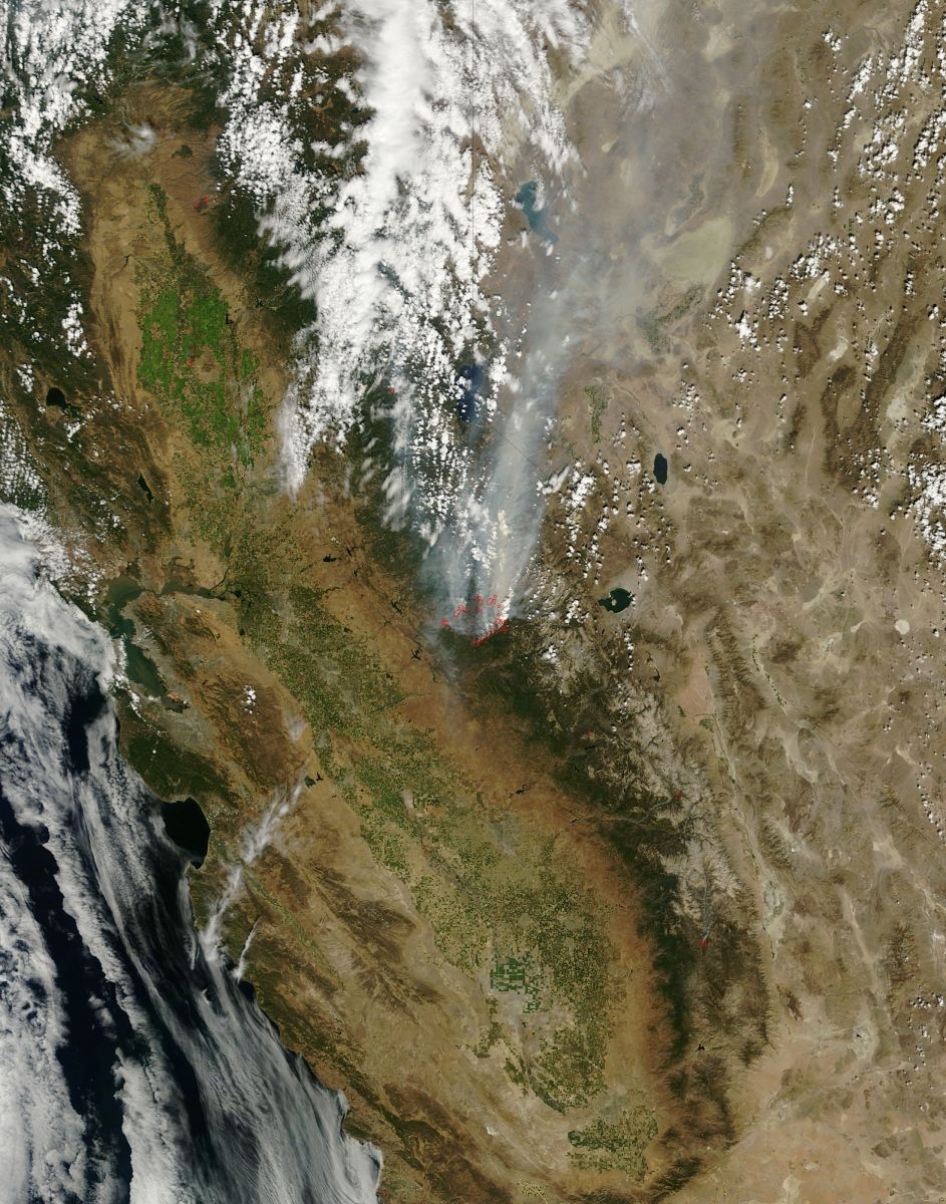
Image

This is a NASA satellite picture of the forest fire currently raging in California.
How did things became so bad: “An average of 5 million acres burns every year in the United States, causing millions of dollars in damage­.”?

It all started more 100 years ago: “The 1910 fire—fanned by hurricane-force winds called Palousers and known variously as the Big Burn or the Big Blowup—scorched 3 million acres of Idaho and Montana, killed 78 firefighters and nine civilians, turned entire towns to cinder, and darkened sunsets all the way to New York City….   The Big Burn ….  “was one of the main drivers, if not the main driver, of the Forest Service getting deadly serious about fighting fire.” The horrific maelstrom produced a public outcry to suppress future forest fires at all costs.”

Only recently people started to understand what really happened: “Fifty years of aggressive fire suppression by the U.S. government has hindered fire’s natural and beneficial processes; many areas have become choked with brush, and other kinds of trees are competing with the large species that formerly dominated the forest. The U.S. Forest Service tried to solve the problem by allowing timber companies to log more of our National Forests. However, the logging companies take only the high-value timber — the largest trees whose thick bark naturally resists the small periodic fires that sweep through forests, leaving behind saplings and massive piles of sticks and debris called “slash.” The forest floor dries out more quickly and temperatures can get much hotter, turning slash piles and debris-strewn clearings to fire-friendly tinder.”

What should we do?
About the fires? I don’t know, I’ll leave this to the specialists. The problem is that I recently saw the picture above on the FB.  My  comment was:
“You wish…
‘Too big to fail’ is a human concept, not a natural occurrence.
Watch what happened to the dino’s  and last time I checked elephants and whales weren’t doing that well either.
And while we didn’t have anything to do with the fate of the dinosaurs it was us who hunted the elephants, the whales, the dodo birds and so on…
The Earth is not at all too big to fail but rather it should be too important for us to meddle with!”

Another issue: The so called Global Warming.
– Everybody agrees that carbon dioxide is indeed a ‘hot house gas’ and that we produce huge, and growing, amounts of it.
– England has seen a resurgence of commercial wineries.
– French, Spanish and other grapes have so  much sugar that wines reach now an alcoholic concentration of 14-14.5% on a regular basis.
And the list can go on.
Yet we not only choose to ignore the deluge of carbon dioxide (chlorofluorocarbons, another class of hot house gases were only recently banned) we unleashed onto the Earth’s atmosphere but also try to deny what’s going on around us: ” “Global Warning Has Stopped”? How to Fool People Using “Cherry-Picked” Climate Data”.

Now what am I driving at? That we should go back in time and live in caves like our fore fathers?

Certainly NOT!
Actually for the time being I’m not that worried about the global warming – the heat spell that transformed the the southern Greenland into the pastures where  Erik the Red fed his sheep had been probably more intense, the same places are not (yet at least) green again.
Moreover the contribution of the carbon dioxide to all this is debatable and debated. (The chlorofluorocarbons were banned because they destroy the ozone layer, that’s another human contribution to the well being of the planet.)

BUT WHY RISK IT?

We strongly need another economic ‘seed’ – like wool clothing and then steel were for England and like the automobiles and airplanes were for the US.
So why not transform this potentially dangerous situation into a win-win situation and turn the global economy around by building a carbon dioxide free future?

“…the general concept of the efficient markets hypothesis is that financial markets are “informationally efficient…” ”

Stretching this concept we may conclude that the market is efficient (the prices reflect the ‘real’ value of the traded assets) because every economic agent acts rationally and that all the pertinent information is always available for everybody. This last sentence might sound far-fetched indeed but: “The third form, known as the strong form (or strong-form efficiency), states that asset prices adjust almost instantaneously not only to new public information but also to new private information.” (ibidem)

So, theoretically, we have perfectly rational economic agents and free flowing information.

In this case (no emotions involved, no shenanigans, brains in perfect working order) why on Earth do we still need the market?

One trained professional (OK, a board, a panel, something: the workload is too big for one individual) would be enough to settle prices based on available information and to adjust them as new information come in, right?

Are you flabbergasted? Well, you should! This is exactly how communists used to run the economies of the ‘popular democracies’ where they had risen to power. (It seems that in the 20 years since the fall of the European communism the concept of ‘popular democracy’ has evolved but nobody notices that this is a huge pleonasm – any real democracy is indeed ‘popular’. The communists used the concept to suggest that only the communist democracy – an oxymoron – was a true democracy; all other forms of democracies being deemed incomplete.

OK, so what’s the point of all this?
Well, some people advocate total deregulation of the economy/market.
As contemporary events have shown us economic trends in a mis-regulated environment give birth to ‘too big to fail’ entities. I’m afraid that a completely deregulated one will produce, in time, nothing but even bigger conglomerates.

So what should we do? Tighten the existing regulation?
NO!!!
We should adopt a much simpler set of rules based on on a staunch philosophy: maintaining the real freedom of the market instead of allowing the ‘significant’ agents to bend the rules in their favor.

Regulation should just state what is unacceptable and not give recommendations, directives, indications, etc.

It should be a must and not at all an oxymoron.
Morals were a time sanctioned method of getting along with the others which was based on religious precepts.
In time people understood the benefits of cooperation versus thuggery and thus the need for the religious backup disappeared. Ethics were born.
Nowadays some try to convince us that life is a zero sum game (it isn’t) and that ‘ethics are for the faint hearted’.
Not true. This conviction arises from falsely understanding the Darwin’s natural selection as the ‘survival of the fittest’!
Ernst Myer demonstrates clearly that this is absolutely wrong: ‘what is “the fittest” ?’ ‘You can be ‘fittest’ only by taking into account one or more parameters but those parameters might never describe completely a situation. Moreover ‘situations’ have a knack for changing so becoming the ‘fittest’ is a useless performance. In NNT’s terms is a (futile) attempt at robustness. Mayr says that in reality natural selection is about the demise of the unable to adapt. (Ernst Mayr, What Evolution Is).
Now is anybody naive enough to believe that one can adapt to new circumstances solely by oneself, without any outside help? And what help can one expect while finding oneself alone in a corner after a long enough spell of behaving unethically?


PS Thanks Vince Pomal for the very interesting question!

Somehow I disagree with the notion of ‘over-education’… warped-education maybe?
My take is that nowadays the formal education system errs in two directions: induces false hopes coupled with an ineffective attitude: “Carefully toe the line and everything will come out fine.”
In a way this is true, only for two different groups of people: those who toe the line are not the same as those for whom everything comes out fine.
And this also valid for what is happening in the advertising business.

Aflindu-ma la Cluj am pus, nevinovat, intrebarea de baraj:
‘- Oare cum a fost reales Boc primar la Cluj dupa ce o tara intreaga l-a dat deoparte ca pe o masea stricata?
– Pentru ca atunci cind a fost primar au mers bine lucrurile in Cluj?
– Pai atunci Tariceanu ar fi trebuit sa castige detasat alegerile din 2008. Romania n-a dus-o niciodata mai bine decit intre 2004 si 2008.
– Da, dar asta nu s-a datorat lui Tariceanu. Asa au fost vremurile, toate tarile din Europa au dus-o bine din punct de vedere economic in perioada aia.
– Si Boc cind a fost primar? Nu tot intre 2004 si 2008?’

In tough times, abandon your employees! 

I had an earlier post about ‘shareholder value maximization’  were I argued that this notion has to be treated with the utmost of care.
Here is a reminder of how close to the hell ‘profit before all else’ can take us:

Safety warning as budget airlines such as Ryanair cut fuel levels for flights.

‘Have a nice flight’ towards the ‘jet set’ status.

One of my obsessions is that if the decision making processes become too centralized then the whole system is already struggling inside some very dire straits.
Here is a rather unusual example.

Tampering with a car’s brakes and speed by hacking its computers: A new how-to

Now why on Earth would the remotely accessible (hack-able) devices of a car be hooked up to some essential components like the braking system or the steering column?
Simple. This way it is easier/cheaper to program/debug/service the entire system. The operator needs to ‘enter’ only once – otherwise he  would have to hook up at least two times, one for the essential systems and a second for the rest.
And since the automakers are in the business of making money, not safe cars – just like the farmers – every $ counts….

Friedman’s idea that the CEO’s job is to take care of the shareholders’ interests, including the monetary ones, is a platitude.
It’s the exclusive focus on the monetary aspects and its short term-ism that constitute the malignancy of this venue.

http://www.forbes.com/sites/stevedenning/2013/06/26/the-origin-of-the-worlds-dumbest-idea-milton-friedman/