
How many apples had fallen?
Before one of us noticed?
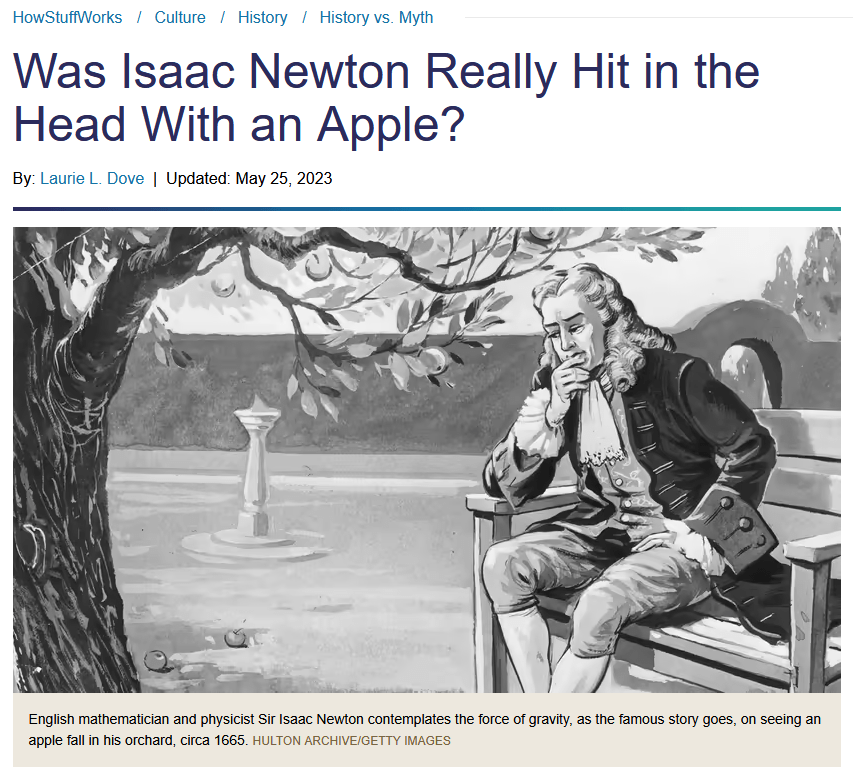
I really don’t care whether the story is true or not.
All I’m interested in is ‘why it took us so long’?
After all, things had fallen towards the center of the Earth since always. Eratosthenes had already calculated the circumference of the obviously round Earth back in 240 BC. And “By the 1st century AD, the spherical model was widely accepted, and Ptolemy developed maps based on a globe with systems of longitude and latitude.” According to the currently famous internet, obviously …
The way I see it, the world was not ready for it. Before Newton.
We didn’t have the ‘language’ in which to spell this new reality. And nobody really cared about the matter. Really invested into the matter, as opposed to interested about the subject…
But things change.
1492 Christopher Columbus discovered America. Trying to go to India but steering into the ‘wrong’ direction. Inaugurating the era of sailing into the unknown.
1524 The posthumous publication of Johannes Werner’s method of determining longitude and latitude by measuring the angular distance between the moon and other astronomical objects. The method was not usable at the time because the necessary data, ‘tables of ephemerides’ had not yet been published.
1543 Nicolaus Copernicus. a priest, published his famous book about how the planets circled the Earth.
1600 Giordano Bruno was burned at the stake for defending and promoting Copernicus’ ideas. The world was still not ready.
1595 – 1627 Johannes Keppler published a series of works detailing Copernicus’s heliocentric model of the Universe and elaborating mathematical tools for the job. Including a set of Ephemerides, in 1617. His work was met with mixed reactions, the opposition being mitigated by the fact that Keppler, a very religious person, never crossed any of the significant figures he came in contact with.
1687 Isaac Newton published his Principia Mathematica. Integrating and formalizing the work of many, Newton’s synthesis filled the ‘need to know’ of those concerned. While his theory was met with some philosophical opposition – Huygens and Leibniz, among others, on the practical side no one had raised any objections. Until Einstein, but that is another subject.
What happened?
People had been already sailing for some 2000 years.
But until then, it used to be a ‘craft’. Something passed on from father to son and kept, more or less, into the family.
The ‘Sea People’…
Vasco da Gama, the first European to reach India by sailing around the Cape of Good Hope, 1498, was the last of the ‘craftsmen’ who ‘discovered’ places. By sailing there using ‘the good old, time sanctioned, manner’.
Christopher Columbus, by sailing the other way around, was the first to transform this craft into an industry.
He also started the process which transformed the whole world.
Sailing and trading on an industrial scale demands a different kind of people. And transform those who embark unto the adventure.
Ancient Athens, heavily involved in sailing and trading, had invented democracy. The city continues to exist while we consider democracy to have been invented by the Ancient Greeks.
Ancient Sparta, Athens’ fiercest domestic competitor, a quintessentially agricultural society, was run as a dictatorship. Only ruins survived. And a myth…
Isaac Newton, and his readers, were able to understand gravity because they needed that knowledge.
Which was but a step in the road they were opening. For themselves and for those who followed.
Basically, what they did was to spin a new story, read ‘narrative’ out of information which was already floating around.
Are we capable of following in their steps?
For ‘only God knows what reason’ this very morning I was reminded by ‘the FB algorithms’ about a comment I made some 7 years ago.
“Democracies fend off challenges when participants value the preservation of the system—its norms and ideals and values—over short-term political gain.”
https://nonprofitquarterly.org/understanding-death-democracy-not-really-trump/
 nicichiarasa
“The conference will be held in the Bavarian city later this week and the report by researchers Tobias Bunde and Sophie Eisentraut argues that countries unwilling or unable to adapt to a more coercive global environment risk being run over in an international system increasingly shaped by power rather than consensus.”
https://www.cbc.ca/news/politics/munich-security-trump-carney-9.7077801
LikeLike