
I have already convinced myself that language is inherent to life.
That each living organism remains in an animate state for only as long as a flow of information continues to coordinate the processes which make life possible. And since information needs to have the same meaning at both ends of a ‘conversation’, each coordination effort depends on information being conveyed using a language.
Successful coordination depends on information being conveyed in such a manner as to make sense, the same sense, for all those involved in conversation!
A perfunctory look at a world-wide map is enough to determine that there are three ‘dead-ends’.
Places not that hard to go to but almost impossible to return from. Specially for our distant ancestors. Hunter-gatherers who lived off the land. Some of whom moved over whenever the population became too numerous for the place they inhabited at any given moment. If the new place was good enough, they thrived. Then, at some point, some of them went even further.
If not…if the new place wasn’t that good … the best they could do was to survive. Going back was no option. The old place was already full when they left.
The Namibian dessert in South Africa, the Southern tip of South America and Australia. OK, now that I remembered, I must add the Easter Island to the roster. Make it three and a tiny bit.
‘Living at the end of the trail’ means little to almost no interaction with your neighbors. Until the pestering Europeans started to ‘discover’ the world… but that’s another subject.
While people living in the ‘middle of the action’ – the Ancient Egyptians make a very good example – meant having plenty of ‘intercourse’ with the neighbors.
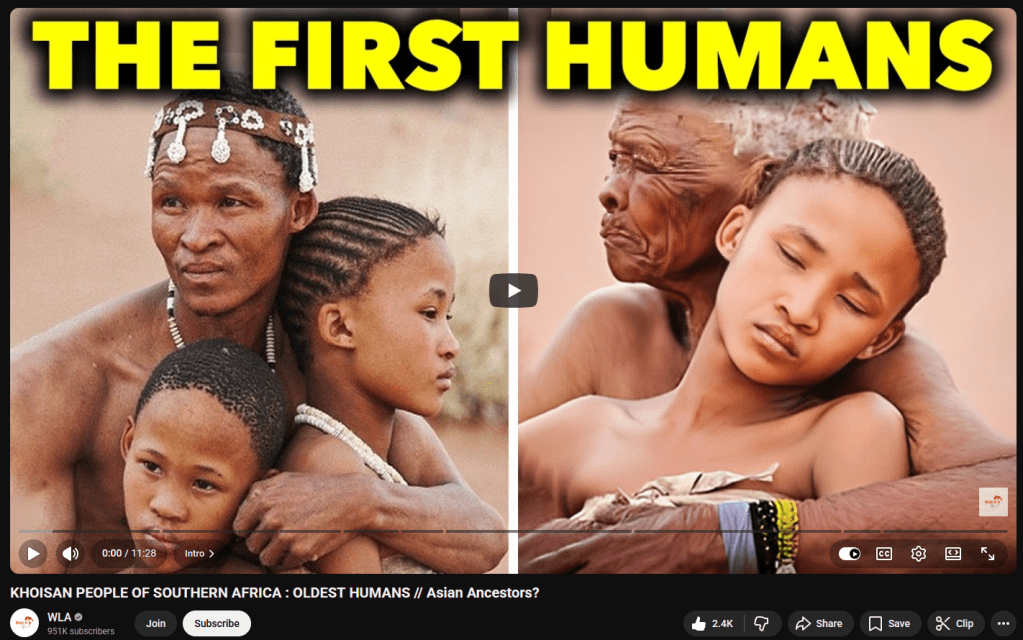
The Khoisan family of languages use a huge number of phonemes but in a rather rigid manner.
The Australian Aboriginal Languages use 15 to 25 consonants and a system of 3 vowels ‘phonetically stretched’ to make 6 to 8 vowel sounds.
The Chonan languages, spoken until recently in Patagonia, use 23 consonants and three to five vowels.
These are facts. Which can be checked online.
What can we make of them?
Other than building an interpretation? An attempt to make some sense out of them? Knowing very well that any interpretation will remain just that? A simple, impossible to prove, interpretation…
The Khoisan didn’t have to travel much. To get there.
If the cradle of modern mankind was somewhere in Ethiopia, it was a short walk in the park – well, in the savanna – from there to the Kalahari dessert. And, since we’re talking about the early days of humankind, probably the Khoisan were the first modern humans to take that walk. Meaning that they didn’t meet anybody during the journey.
Let me remind you that 70 000 years ago – read all about it over the internet – Homo sapiens almost disappeared. Population bottleneck due to a super-volcano event. 1000 to 10 000 of them survived, somewhere in Africa, and then moved about and reached almost every corner of the round Earth.
Going back to the Khoisan, what can we infer from the fact that they:
– use so many phonemes, some of which are clicks
– live in the same area since the start of human history?
Also to be taken into consideration:
Some languages belonging to the Bantu family (Zulu, Xhosa, Ndebele and others) have borrowed some of the clicks used by the Khoisan. After the Bantu have arrived in the general area, came in contact with the Khoisan and drove them even further into the dessert. Some 1800 years ago.
So why would a ‘sophisticated’ civilization borrow sounds from hunter-gatherers living, literally, in the stone age? Taking into account that the Bantu used agriculture to provide for themselves and were savvy enough to transform iron ore into everyday tools…
Pidgin.
English, Dutch and Portuguese colonists needed to get in contact with the locals. To ‘coordinate’ with them.
To learn from them about the specifics of the place where they tried to make a living.
Hence ‘pidgin’. Various pidgins, depending on the circumstances.
Now, what if the English, Dutch and Portuguese colonists could not go back? Reconnect to their original bases?
For how long do you think they would have been able to preserve their original language?
Keep in mind that the Bantu colonists did not use writing to preserve knowledge. Or their original language…
So, where are we now?
A preliminary conclusion, not talking about a geographical position…
The Khoisan, after the shortest migration ever, continue to use a huge number of phonemes but in a rather rigid manner.
The Australian Aboriginals and the Patagonian natives, after migrating to the other side of the world, literally, make do with less than half the phonemes used by the Khoisan. Leading a more or less similar way of life. Subsisting, for so long, in a such meager environment as to transform survival in a form of art.
The more ‘sophisticated’ travelers who arrived later – in comparatively small numbers, at first – have integrated at least some of the native language into theirs. Needing to get in touch with the reality present in that place, to coordinate their efforts with that reality, the newcomers had to get in touch, to coordinate, with the locals. In order for that coordination to happen, a new language was developed. Out of what? Out of what the two people had at their disposal. The two already present languages..
In this context, we need to remember the fact that the natives were very curious about the travelers. At the beginning, at least…
 nicichiarasa