Archives for posts with tag: economy

Nowadays there is a heated debate about how much damage to the nature is acceptable in order for us to have a ‘thriving’ economy.

This way of thinking is very well illustrated by the following picture:Image

The caption says: “If you really think that economy is more important than nature then try holding your breath while counting your money”.

If we look a little deeper into all this we find out that initially economy – or oikonomia in ancient Greek – was the art of managing the resources needed by a household. Since then these resources came directly from the surrounding nature it ‘naturally follows’ that in those times there was no conflict between economy and nature: people took what ever they needed from where it grew or grazed, threw the garbage wherever around the camps and whenever things became too messy or the pastures/hunting grounds were exhausted people moved a little further, giving the nature an opportunity to heal its otherwise superficial wounds.
Later, as people moved into cities, their relationship with the nature became a little more complicated. If nature had a way of renewing itself periodically all went well. Egypt survives since 5000 years ago mainly because the Nile periodically cleanses and fertilizes the country. If not, and people overuses local resources, the fate of that particular civilization is doomed – the Mayan empire, for example.

A sudden change happened around three  hundred years ago: Europeans simultaneously learned advanced agricultural techniques enabling them to feed larger numbers of people, thus freeing a lot of ‘ work force’ that was swiftly employed by the industry, and invented fiat money – paper invested with value by the very entity that ‘printed’ it, the central banks.
‘Economy’ started to thrive only it no longer was about the old struggle for survival; it was gradually transformed into the modern economy: a playing ground where the ruthless fight for more and more money is constantly eating away both natural resources and the moral fiber of those implied in it.

Maybe it is high time for us to understand what is going on and to find a way to reintegrate nature into the economy as a resource that needs to last forever and not as an expendable one.
“…the general concept of the efficient markets hypothesis is that financial markets are “informationally efficient…” ”

Stretching this concept we may conclude that the market is efficient (the prices reflect the ‘real’ value of the traded assets) because every economic agent acts rationally and that all the pertinent information is always available for everybody. This last sentence might sound far-fetched indeed but: “The third form, known as the strong form (or strong-form efficiency), states that asset prices adjust almost instantaneously not only to new public information but also to new private information.” (ibidem)

So, theoretically, we have perfectly rational economic agents and free flowing information.

In this case (no emotions involved, no shenanigans, brains in perfect working order) why on Earth do we still need the market?

One trained professional (OK, a board, a panel, something: the workload is too big for one individual) would be enough to settle prices based on available information and to adjust them as new information come in, right?

Are you flabbergasted? Well, you should! This is exactly how communists used to run the economies of the ‘popular democracies’ where they had risen to power. (It seems that in the 20 years since the fall of the European communism the concept of ‘popular democracy’ has evolved but nobody notices that this is a huge pleonasm – any real democracy is indeed ‘popular’. The communists used the concept to suggest that only the communist democracy – an oxymoron – was a true democracy; all other forms of democracies being deemed incomplete.

OK, so what’s the point of all this?
Well, some people advocate total deregulation of the economy/market.
As contemporary events have shown us economic trends in a mis-regulated environment give birth to ‘too big to fail’ entities. I’m afraid that a completely deregulated one will produce, in time, nothing but even bigger conglomerates.

So what should we do? Tighten the existing regulation?
NO!!!
We should adopt a much simpler set of rules based on on a staunch philosophy: maintaining the real freedom of the market instead of allowing the ‘significant’ agents to bend the rules in their favor.

Regulation should just state what is unacceptable and not give recommendations, directives, indications, etc.

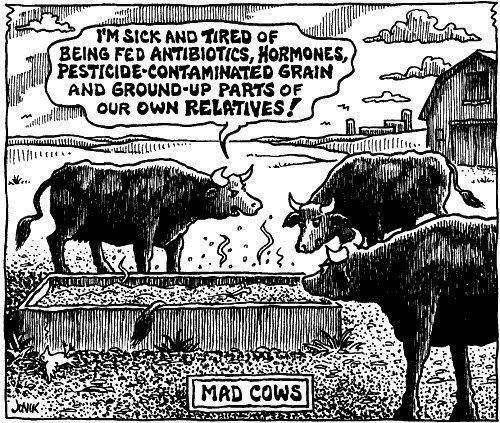
mad cow.jpg

The current mantra is ‘consumer driven economy’.
I think this is a blatant lie. Currently the economy is not ‘consumer driven’ but ‘driven by marketeers’. The consumers do nothing but set the limits… (or more precisely the limits are set by the consumers’ ability to borrow against their future).
Some nights ago, while listening to Zhang Xin about the Chinese economy becoming more consumer oriented (http://www.bbc.co.uk/iplayer/episode/b0371br6/HARDtalk_Zhang_Xin_Chief_Executive_Soho_China/) I started to see the stages we passed in order to get here:

– Hunter-gatherers for most of our pre-history. Minimal material progress: Chipped stone tools, bow and arrows, fire, some weaving.
– Agriculturalists. Second longest period. Increased productivity freed some people to do something else but toil for food. Most important features of modern life appeared now: lifespan improved dramatically, at least for those not having to work endlessly under the sun, water and waste management in the cities, commerce, manufacture, thinking for the sake of thinking. Still, people tended to mind a natural order: first things first and thrills later.
– Industrialists. The advent of the machine tool. Apparently things were going even better. People started to become less ‘poor’.
– Economists. Mass production, economy of scale. The poor were still improving their lot but the rift between the have’s and the have-not’s was already widening.
– Marketers. Rational, profit seeking agents. The economy is no longer a human activity that provides goods for the consumer to choose from but a ‘killing field’ were everybody tries to get rich and the weakling be damned. People are faking the very food they serve to their fellow humans just because they need additional money to buy more trinkets. Planned obsolescence. Redundancies. Corporations try to control everything, including drinking water. http://www.forbes.com/sites/nadiaarumugam/2012/10/19/nestle-sued-again-for-falsely-representing-bottled-tap-water-as-naturally-spring-sourced/

Surely we must be doing something wrong.
I’m all in for science, reason and everything else. The problem is what are we going to do with all these!?!

No Hope for a Consumer-Driven Economic Recovery


http://online.wsj.com/article/SB10001424127887323740804578601472261953366.html?fb_action_ids=10151510769946641%2C10151508961426641&fb_action_types=og.recommends&fb_source=other_multiline&action_object_map=%7B%2210151510769946641%22%3A137344176473019%2C%2210151508961426641%22%3A1392368000981860%7D&action_type_map=%7B%2210151510769946641%22%3A%22og.recommends%22%2C%2210151508961426641%22%3A%22og.recommends%22%7D&action_ref_map