Archives for category: Economy

Some twenty-five years ago one of my childhood friends emigrated to America.
I reconnected with him in 1994. He had worked his way up from the ‘floor’ of a auto-parts distribution business to manager of the most important of its warehouses. At that time he was putting on at least 10 hours a day from Monday to Friday and some 5 hours on Saturdays. At some point he felt the need to go back to school – he had very little formal education – and told the owner of the business he wouldn’t be able to contribute so much as he did until then so he was willing to accept a pay cut. The owner replied that he would have to replace him. They departed in good terms, my friend told me he didn’t harbor any bad feelings toward the guy because he was honest and straightforward.
Flash-forward three years. My friend had finished a course for computer engineers and got hired by a really big, privately owned, multinational corporation. He told me he had the impression of working again for a state owned company: people didn’t have the guts to speak up their minds and their main occupation was to cover up their asses under a ton of paper. Procedures took prevalence to common sense. He was the first to tell me that if there is too big a distance between the shareholders/owners and the general management the people at the top of the company start acting as if they own it and this is the reason for which it doesn’t really matter if a huge corporation is privately  or state owned. What it does matter is local culture – if earning undeserved money is shunned by the people then things are OK but if people put money above anything else the big corporation will run into trouble sooner or later. My friend gave up working for others and started a hair-salon with his wife.
Flash-forward to our times.
We have found out about the existence of some (privately owned) corporations which are too big to fail but  which despite (because?) their size and importance have reached some really dire straits and desperately need assistance. We have experienced TARP and QE I and II.
The general public is now split in two:
The Tea Party abhors big Government because it is intrusive and stifles individual initiative.
The Occupy Movement abhors big Business because it is callous and treats the individual exclusively as a consumer/workhorse, effectively disregarding its very humanity, and because it has dumped a huge pile of loses on the humble taxpayer.

And yet Tea Partiers and Occupiers can’t see eye to eye with each-other.

Isn’t this the strangest thing of all?

PS. The existence of a significant shareholder might help a big corporation to overcame the disadvantages of its size. Ford has coped better than GM or Chrysler, BMW (controlled by the Quandt family) than Daimler-Chrysler, etc. Same rationale works for the .com companies where the founders still have a loud enough voice on the board. And maybe the secret of Warren Buffet’s success is that he invests in companies which already have a management focused on the long term survival of the company instead of their own enrichment at all costs (all costs for the company, of course).

Mirel Palada tocmai a publicat un articol foarte bine scris si destul de convingator in favoarea exploatarii gazelor de sist.
Au ramas pe dinafara, din pacate, o parte din motivele pentru care acest proiect este privit cu neincredere.
Da, exista o intensa si aproape evidenta manipulare pe tema asta.  Pe deasupra profesionista. Doar ca, indiferent de cat de tare te stradui, fum fara foc si razmerita fara motiv nu exista.
Si iarasi. Manipularea este intr-adevar profesionista si face uz, extrem de profitabil, de balbaielile de la Rosia Montana precum si de imperfectiunile tehnologice inerente unei, relativ, noi metode de recuperare a hidrocarburilor.
Poate ca rezolvarea situatiei de la Rosia Montana ar fi cel mai convingator argument in favoarea unei investigari oneste in ceea ce priveste oportunitatea exploatarii gazelor de sist in Romania.

For me this article, if the allegations are true, proves a lot on things.

Boeing ‘selling used parts as new to the Pentagon’ means not only that the the lust for money is strong as ever but that it has reached a new dimension: it seems that consequences don’t matter anymore.
After all it is one thing for Lockheed to bribe  some foreign officials – who might had abused their positions – to buy something of an otherwise excellent quality and quite a different one to overburden the defense budget of your own country, to say the least – assuming that the used parts were of the same quality and reliability as the news ones would have been.

American companies – supposedly operating in the freest and most transparent market in the world – perpetrating such practices cast a dark shadow on the future of the whole planet. In the light of these happenings one can only wonder about what is going on in the more ‘opaque’ areas of the Earth….

Legislation without social consent is akin to window-dressing. After the Lockheed scandal the whole world supposedly ‘tightened the spigots of corruption’. So what? Nowadays people question some of the President of the US ‘s actions while on the international arena Siemens, for example, has attracted the lime-lights.

The notion that corruption is something that has to do exclusively with the public employees is half backed. While I may accept the idea that maybe the Japanese officials involved in the Lockheed scandal asked for kick-backs themselves – a practice revived nowadays in some ex-communist countries – I am convinced that nobody from the Pentagon is guilty of anything more than, at most, having too much trust in Boeing. In fewer words it becomes clearer that in quite a lot of instances the active corruption comes from the private sector, specially so in countries were it has the upper hand – precisely the civilized democracies that the most parts of the Earth try to emulate. Maybe these people should exercise more discretion about what attitudes to adopt and what to have second thoughts about – the most important of the latter being the indiscriminate lust for money that has been the first western ‘obsession’ to have been globalized.

I need to end this in a more optimist key. Traian Basescu, the current Romanian President – who is not above suspicion himselfputs it very clearly: “‘Corruption rests with two sides. I do not want to change responsibility, but it must be shared and assumed. A corrupt civil servant cannot be corrupt if they do not have a partner to put money into their hands, a ministry cannot pay by 50 percent more if there is not a consultant to sustain what the constructor says: ‘Yes, we’ll raise the bill’.” and “‘I believe we must, first and foremost, leave hypocrisy behind. The state alone cannot be corrupt, it has a partner, if there is corruption. The state alone cannot be non-performing, it has a partner. Let us together assume what we have to do. The easiest thing for the private sector to do is to criticise the state and the easiest thing for the state to do is to show indifference to the problems facing the business environment.”
Now even if the translation is not very good the message is indeed clear. Swim or sink together. Either we all understand that we cannot go on this path much further – every step in the wrong direction will provoke additional pain on the return trip –  or we’ll have to face really dire straits at the end of it.

But the direction we chose depends on nobody but US.

Yesterday I picked up this book from the British Council in Bucharest.
Actually it is not so much about flying itself but more about how we individual human beings allow ourselves to be transformed into ‘consumers’ so we could be better ‘fleeced’.
Read it.

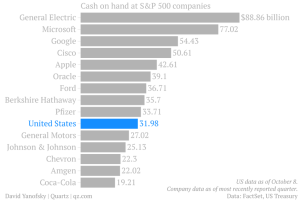
So much cash laying around…

yanofsky_cash-on-hand_chartbuilder
Some twenty years ago the general mantra was ‘use borrowed money so you’ll improve the return on your own capital’. After that businesses leveraged too much and some of them crashed. Now the survivors sit on piles of cash while start-ups have a hard time finding working capital.

And then we call ourselves rational beings… sheesh

More than 60 years ago Isaac Asimov published a series of novels which somehow quelled our fears about robots:
because they were going to obey the “Three laws of robotics” robots would not represent any danger to humans:

1. A robot may not injure a human being or, through inaction, allow a human being to come to harm.
2. A robot must obey orders given it by human beings except where such orders would conflict with the First Law.
3. A robot must protect its own existence as long as such protection does not conflict with the First or Second Law.

Lets see what’s going on now:

– We use robotic drones to kill other human beings
-Robotic computer applications scour our communications for key-words  in order to supervise what we do in the virtual world – not only the NSA, purportedly for a good cause, the Chinese and the Iranians are doing the same thing in order to quell dissidence.
– Besides taking over the hard, dangerous or plain repetitive jobs robots are starting to displace specialist jobs.

Now you’re going to tell me robots have nothing to say about this so they are innocent. Right, it is us humans who use robots, not the other way around – for now, anyway.
The real problem resides in the fact that no matter how brilliantly programmed no robot will ever be able to innovate anything. This way by displacing specialists from their reasonably well payed jobs to low paying ones two nasty things beggin to happen:
– The aggregate demand in the economy decreases and
– The ability of the society to innovate also decreases. The individual specialist doesn’t disappear overnight but a disgruntled person doesn’t care about ‘thinking’ nor has any real opportunity to do so – he has been insulated from his domain of expertise and he cannot continue to innovate: he no longer has any contact with the realities he was familiar with and specialized in.

Mind you, I’m not speaking here about the Newton’s or Edison’s of this world, they’ll continue to exist and create. This is about the run of the mill ‘small scale’ innovator praised by every ‘human resources’ book that deals with ‘improving the innovative process in your organization.’

“Currency should be backed by assets (not necessarily by gold) and not by debt as it is now”
Interesting information ‘inside’ but what I find really troublesome is how come this information comes to us via Moscow?
Why haven’t I heard about this from an American source?

‘Profit is everything’.
This is the current mantra but is it true?

At first glance yes – what company can survive producing nothing but loses?!? – but then another concept starts jumping before our eyes, the ‘non-profit organizations’.
Ouch!

So let’s take a step back and have a second look.

“Pecunia non olet” – Money has no smell – was how Vespasian, an Roman emperor, replied to his critics who were ‘bewildered’ about how low could an emperor get – to levy taxes on urinals. So if this kind of attitude is OK coming from an emperor who are we, mere mortals, to have a different opinion? The only difference is that today we are a little more prudish and we put it differently: “Money is fungible“!
Really? Try using your grocery money for gambling and  see what happens….

“The ends justify the means”. This quote is attributed to Nicollo Machiavelli but it seems that what he really meant, that ‘people will accept a certain course of action when coming from a ‘prince’ ‘ is quite different from what we understand of it today: ‘if you want it badly enough grab it and deal with the consequences latter’.
Same with money, specially now that they don’t smell anymore after Vespasian taught us how to launder them…

‘Survival of the fittest’. Now what on Earth Darwin has to do with being profitable?!? Just bear with me for a little longer.
You see, we are rational human beings. As such we are consummate optimizers: we cannot settle for anything less than the ‘best’. Well…more exactly for anything less than what WE, with our limited knowledge of which we are so proud, consider to be the best …

There is a guy, Ernst Mayr, who opened my eyes about this. As an expression ‘Survival of the fittest’ was not even used by Darwin in any of his works and besides that it doesn’t make any sense from the evolutionary point of view. Being ‘fit’ to one particular environment (not to mention ‘fittest’) means being practically unable to survive in any other environment so your capacity to evolve is severely limited if not altogether absent. In reality evolution, as Mayr aptly puts it, ‘is not about the survival of the fittest but about the demise of the unfit’.

Now lets get back to what profit is about and see if any of this makes any sense in an economic environment. By the way, ‘economy’ comes from ‘oekonomia’, a Greek word meaning making the ends meet in a household.
So what is the ultimate scope of any economic venture? For the entrepreneur to become rich, no matter what?
Or is it about the whole team involved – the so called ‘stakeholders’ –  having an as good as possible life as a consequence of their combined efforts ?
OK, both options are at the very extreme so I’ll propose a less ambitious one. How about the real scope of a company being long term survival? This way the shareholders would have a (steady) income and the employees a job.
Yes, for that to happen the company would have to have a certain profit but if the long term goal is ‘survival’ the management and the board will have to take care not to sacrifice the long term prospects of the company for a short term profit boost – just for the sake of the handouts that management currently gets at the end of an ‘exceptional’ year. (Do you still wonder how come every year is ‘exceptional’ nowadays and the bonuses keep flowing, regardless?)

In this circumstances ‘profit’ would no longer be THE exclusive goal of every economic venture. It would still be a very good thing indeed but just an efficiency indicator, one of the indicators that show if a company might be able to survive for the long run.

PS.

And what if the ‘intensity’ with which a certain company exerts itself in the quest for ‘profit’ drives the customers away? And invites some competition, who until then didn’t even considered it, to enter the field? And steal some more of the already disgruntled customers?

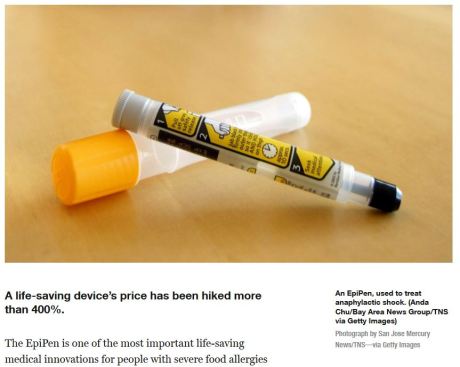
400% hike

“The EpiPen is one of the most important life-saving medical innovations for people with severe food allergies—which affect as many as 15 million Americans and 1 in 13 children in the United States. But its price has exploded over the last decade despite few upgrades to the product itself. And that’s led to criticism from a consortium of critics which includes consumer advocacy groups and notorious drug price-hiker Martin Shkreli himself.” (, How Mylan Got Away With Its Enormous Price Hike for the EpiPen, Fortune.com)

This is something I wrote a couple of years ago, when I started to understand that the financial market had gone wildly astray. I’ve been tinkering at it since and I’m still not happy with it but I need to post it as a stepping stone for what I’m going to publish next.

Money appeared, at first, as a trade facilitator: instead of changing five measures of grain for one of oil people started to use as an intermediary step of the process whatever the local civilization called “money”. From shells to beads to holed pebbles or whatever else.
Then some people wanted to delay consumption, stock up for “black days”, or wanted to trade further apart. That was when they “invented” gold.
It was not only generally accepted, relatively easy to divide without sizable loses but also practically indestructible. This was fine from the monetary point of view but also created the illusion that gold (and later money) was the supreme value per-se. Everybody ‘forgot’ that things have ‘value’ only as long as people have a use for them. The simple fact that there is no such thing as ‘value’ but that which we – buyer and seller, attach to each object when it passes through our hands.
Do you remember the alchemists trying to transform everything into gold? What if they succeeded? Probably we would have roofed our houses with some very cheap and everlasting gold shingles.
Since it was indestructible it created another illusion: that its role/value will last forever. And so, for some two thousand years, until let’s say 1100 AD, gold, as money, played its roles as trade facilitator and hoarding device.
Until then resources available to the society had been allocated at the discretion (whim?) of the local ruler (the “strongest” guy around). Who later used to pretend he had a divine blessing to decide the fate of the commoners. For example the feudal system consecrated that the king ruled who had the use of what piece of land or of whatever other natural resource.

An old habit had resurfaced at the same time. Civilizations restarted to trade goods and ideas between them.  (Christian and Islamic around the Mediterranean Sea, for example). The advent of new transportation technologies created new opportunities for travel and trading. This was when a quantity of gold (money) became itself a resource, albeit not a natural one.
You could use it to start a trading cycle yourself. Or you could “rent” it to somebody else, for a fee. The interest. That way, somebody else – the ‘renter’ of capital, could do the actual buying, transporting/transforming and reselling.
Money, and interest, took on a new role. The amount of interest asked was specific to each occurrence – if I trust you are a capable (of doing whatever you are trying to do) person then I’m going to ask a smaller interest from you. In the end a lender gets paid for assessing risk – at the end of the day some deals get sour, some get through, and if the risks were correctly measured – and the corresponding interests asked – the investor/lender ends up with some profit. Meanwhile the same lender does another thing: he is distributing resources among the competing entrepreneurs and so the ones that are more creditworthy can start their businesses a little easier.
This way resources  are no longer allocated at the whim of a single person – the feudal lord – but by the business  acumen and experience  of  a  multitude of  operators, the “free market” – theoretically  a more natural, and thus  more efficient,  process.

As a consequence money was no longer a mere trade facilitator and a humble hoarding device but also a resources allocating tool. In a way, money (and interest) started to measure not only value but also trust, which became by itself a kind of resource.
Remember this is roughly the same time when “paper/fiat money” started to appear, at first having a gold equivalent and dispensing with it later. And ‘paper’ money have value (and are accepted as tender) only as long as people have reasons to trust the country that printed it.
But this whole line of reckoning presumes that the “efficient market hypothesis” is true – this would translate into the assumption that the risks are measured rationally and, as a consequence, that the resources are appropriated reasonably. Not entirely true, is it? Elliot’s Wave Principle says it’s not, Nicholas Nassim Taleb says it’s not, George Soros (The New Paradigm for Financial Markets – The Credit Crisis of 2008 and What it Means) concurs and so on.
A symptom of this lack of reason is the financial effervescence that is, only now, starting to ebb out. People “foregot” that money is a second class resource (only as long as people think it is and that it has any value) and started to treat it as a first class/real one. As a consequence inflation is perceived as inherently bad and not as a normal mechanism for economic adjustment and, more importantly, people now want to obtain “money”, and lots of it, directly from “money”.
No transformation whatsoever. The cycle “money traded for resources transformed into merchandise and traded back into money” has been replaced by money conned from one hand to another. Currently, quite a lot of people are convinced they can retire with no (little) public pensions and that they’ll be able to live of the revenue (and not the capital itself) received from investing whatever small fortune they have saved (delayed consumption), or inherited.
This means that these people have to enter the “resources (trust) allocating” game, the ‘financial market. Since most of them don’t have the necessary skills they rely on others: bank or fund managers or even the CEO-s of the companies whose stock they have bought. And all these managers, under pressure, have started to (mis)use a lot of instruments, originally designed as insurance/hedging, in order to make money out of thin air (speculation).
That’s how the derivative markets became bigger than the spot market. Making an analogy we can consider speculators as some kind of carnivores whose very important role is to keep the herds in top condition by culling the misfits. The benefit of the ‘landlord’, the one who from time to time hunts himself (buys or sells stock), is that the herds (companies) are OK, don’t get degenerated and don’t overgraze. But no sane landlord, not until now at least, would consider lions’ meat (or whatever else might be obtained from them) as a desirable food but only hunts (gets involved with paper issued by highly speculative investment funds) them for sport or when they threaten the well being of the herds. So why am I not surprised by the last moves in the world of investment banking? Or even banking in general?
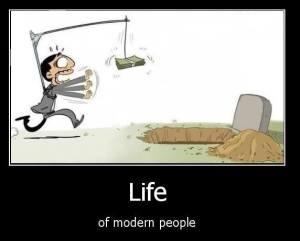
follow the money

2021 edit.

Some people still have a hard time understanding how Trump had come to be.

I was speaking above about those money managers hard pressed to produce yield.
Some of them had fulfilled their task by exporting ‘real’ jobs to places where the work force was cheaper. And/or by replacing people with robots.
This development has deepened the divide between the haves and the have nots.
Those who had happened to have some invested capital at the start of the process only got richer.
Those who didn’t had found that getting richer was way harder than for their parents. Education had become way more expensive while the good paying jobs were no longer available.

Trump had promised to bring back those jobs. And to ‘ease’ the tax ‘burden’.
By doing this he was able to endear himself to people competing for the same thing. Money. Mere money….
To those people convinced that having money is enough.
That mere possession of money can get you there. No matter where that ‘there’ might be…

To put it briefly, Trump – and his followers, ignore the fact that money is, by definition, a convention.
A convention which is based on trust. On mutual trust between the members of the society.

On the trust that when push will come to shove, each of us will do what is expected of them.
What the community, as a whole, will need them to do.

You see, what Trump – and his followers, seem to ignore is the fact that no individual – no matter how rich/powerful/skilful/bright, can survive, sustainably, on their own. And even less ‘against the grain’.
What many of Trump’s detractors ignore is the corespondent fact. That no community will survive sustainably if it is reduced to a herd. That only a community composed of autonomous – also known as ‘free’, individuals have a fighting changes at being flexible enough to survive indefinitely.

The problem being that people chasing money as the ultimate goal are not free.
Are not free to pursue alternative goals. To explore.
They are so mesmerized that are behaving like moths lured to a flame.

2022 edit

It just downed on me that until recently money have been used by the powerful to maintain their power.
Kings minted coins to pay their armies and to feed their people.
Governments printed money to pay for whatever was needed so that the society kept going.

Nowadays those in power use their positions to hoard money.
Accept bribes. Use their connections to arrange deals. To promote legislation. For a ‘fee’, of course!

2024 edit

Adams Smith’s capitalism was about getting things done.
The baker/butcher/brewer toiled, for a fee, towards ‘feeding’ people.
Today’s capitalism is about making money. Being of service, getting things done, has become a cost. Something you have to ‘pay’ in order to get what you want. Money! Hence less and less service is being offered for more and more money. Efficiency, remember?

The Economy’s Greatest Illness Rana Faroohar

Mornings are a very special time for me and my wife.
I drive her to work and those 15 minutes are a very good opportunity for us to empty our souls to each other.
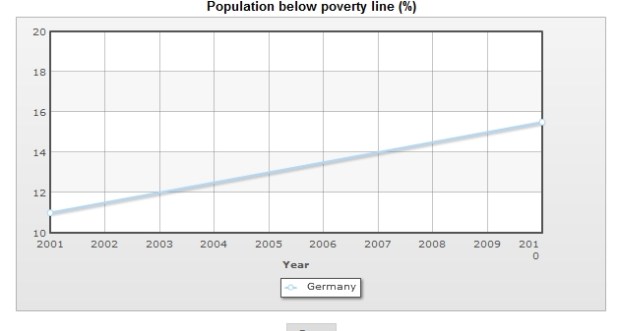
“I’m sad and disorientated” she said to me today. Yesterday she had found in her mail a newspaper article, in Romanian, about the 12 million Germans, 15% of the population, that are living at or under the poverty line and she had forwarded it to me. “Yeah, I know, who would have thought of this?”
“Well, I pity those people, of course, but I’m more concerned about what will happen here, in Romania!”
“?!?”
“You see, until I had read that article I nurtured the notion that if we clean up our act and start working really hard we may narrow, in time, the gap that separates us from the rest of Europe. But now, after finding out that even Germany is going southward… I don’t know anymore… I even started to wonder what kind of world is our son going to live in?!?”

Image

I looked into this a little deeper and I became even more worried: “Life in Europe’s “squeezed middle” ”  Please notice that this ‘news’ is already two and a half  years old!

She is right, my wife. Where are we going to?